Dell: The New Cloud "Brake" Didn't Hit Orders — But Did It Hit Valuations?
 11/25 2026
 363
Dell Technologies (DELL.N) released its fiscal 2027 third-quarter earnings report after the U.S. market close on November 25 Beijing time (quarter ended October 2026):
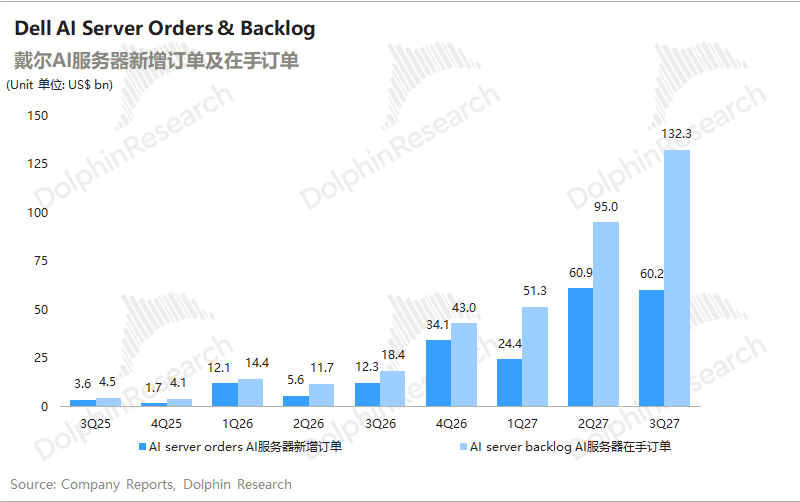
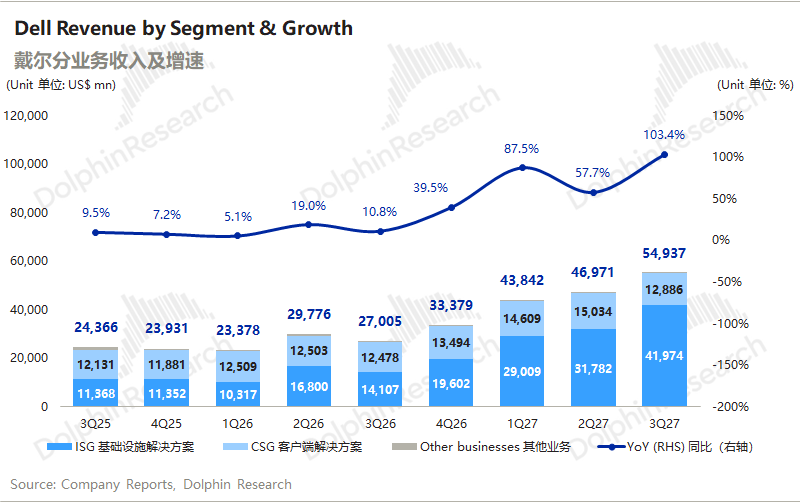
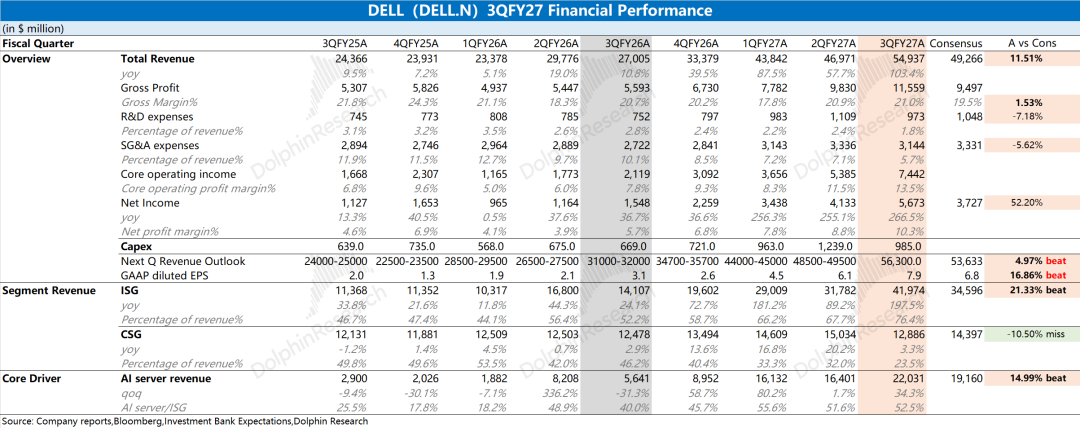
1. AI revenue: Dell's AI server revenue came in at approximately $22 billion this quarter, up $5.6 billion quarter-over-quarter and ahead of the $19.2 billion market consensus.
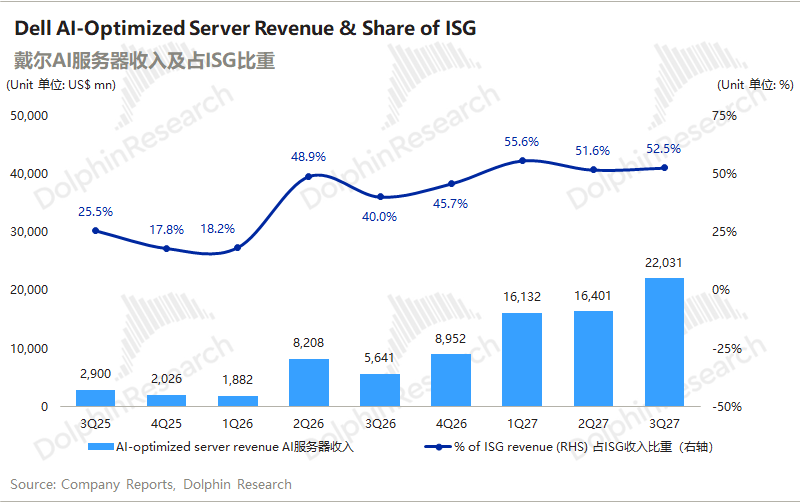
The company booked $60.2 billion in new AI orders this quarter (versus $60.9 billion last quarter), and its AI backlog reached $132.3 billion by quarter's end, up $37.3 billion quarter-over-quarter. Management guided AI server revenue to approximately $23.5 billion next quarter, slightly above the $23.2 billion consensus.
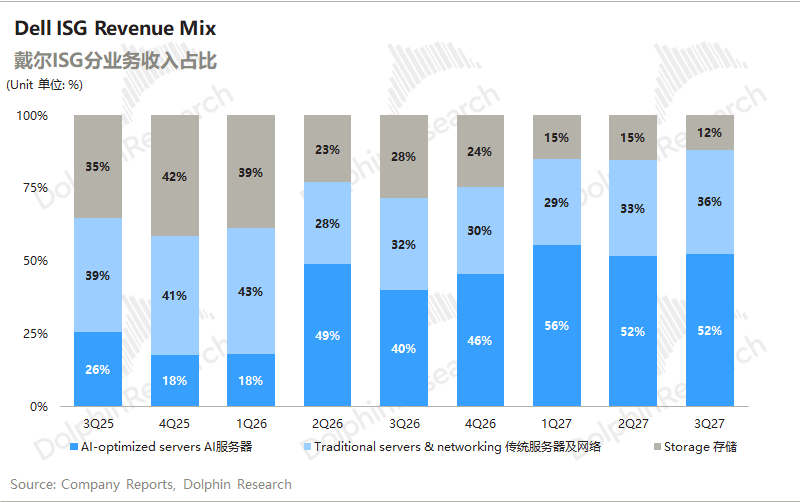
Breaking it down, AI servers rose to 40% of total revenue this quarter. New orders topped $60 billion for a second consecutive quarter, with a book-to-bill ratio of roughly 2.7x.
2. Company guidance: Management expects next quarter (Q4 FY2027) revenue of $56.25 billion (±$500 million), above the $53.5 billion consensus. Next-quarter non-GAAP EPS is guided to $8.40 (±$0.10), above the $7.48 consensus. FY2027 AI server revenue guidance was raised to $78 billion from $74 billion.
A closer look at the guidance: Q4 ISG revenue is expected to grow roughly 120% year-over-year, with AI server revenue rising quarter-over-quarter to approximately $23.5 billion; traditional server revenue is expected to grow about 137% year-over-year (down roughly 7–8% quarter-over-quarter, as wafers reallocated from PCs to servers in the second half arrived in October and were recognized early in Q3); storage is expected to grow low double digits year-over-year (the storage sub-segment within ISG accounts for roughly 7–8% of total revenue and consists mainly of enterprise external storage systems); and CSG revenue is expected to be roughly flat year-over-year.
For FY28, management did not provide quantitative guidance but struck a qualitatively positive tone: AI server demand is still accelerating, PC shipments remain weak, and the extent to which demand exceeds supply in calendar 2027 will be greater than in 2026.
3. Operating metrics: Revenue this quarter was $54.9 billion, ahead of the $49.3 billion consensus. Revenue grew $8 billion quarter-over-quarter, driven mainly by ISG (AI servers plus traditional servers), while CSG declined $2.2 billion quarter-over-quarter.
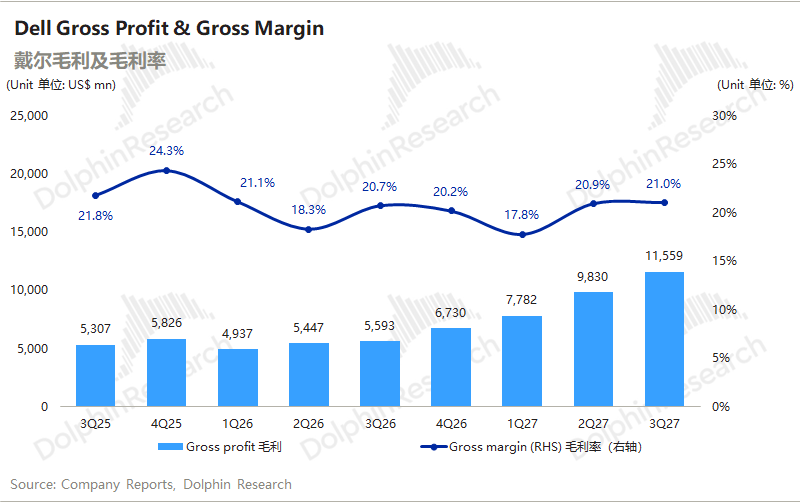
GAAP gross margin this quarter was 21.0%, roughly flat quarter-over-quarter and above the 19.5% consensus. Management attributed the improvement to economies of scale, a better North American sales mix, and a higher share of Dell IP storage. The North American mix benefit is expected to normalize in Q4, with operating margin guided to approximately 12.3% — well below Q3's 14.2%.
4. ISG business (Infrastructure Solutions Group), which includes traditional servers, AI servers, and storage-related products:
ISG revenue this quarter was $42 billion, up $10.2 billion quarter-over-quarter and ahead of the $34.8 billion consensus. The sequential increase was driven mainly by AI servers (+$5.6 billion) and traditional servers (+$4.5 billion), with storage roughly flat quarter-over-quarter (+2%).
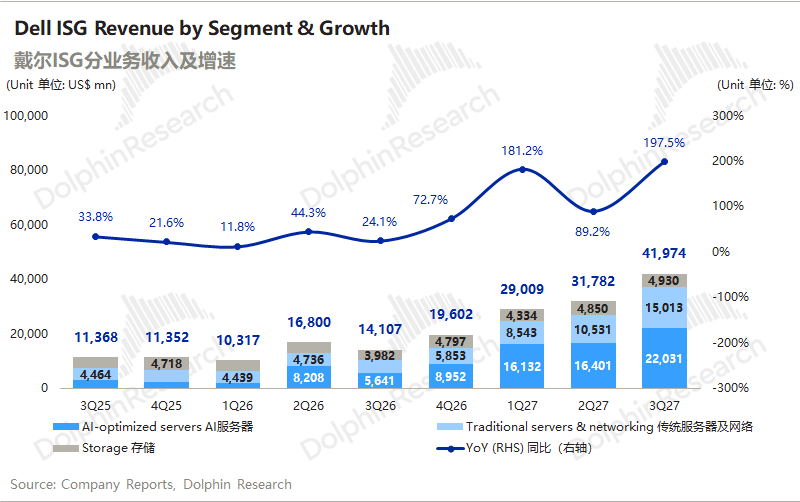
Traditional servers were the biggest surprise this quarter: revenue of $15 billion, far above the $11 billion consensus. The strength was driven mainly by (1) data center modernization and replacement of aging equipment; (2) CPU server demand from inference and agent workloads; and (3) replacement tied to cybersecurity and resilience requirements.
On the volume-price front, server shipments are declining — especially entry-level servers under $3,000, which have essentially disappeared — but core count, DRAM, and NAND capacity per server have risen significantly.
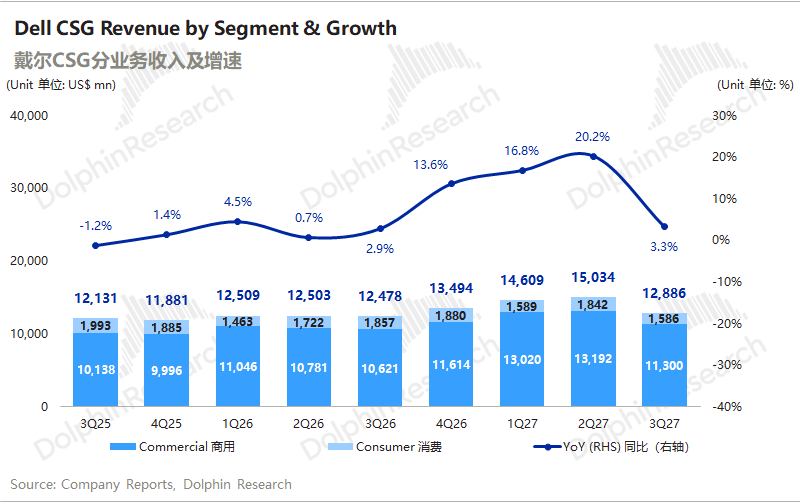
5. CSG business (Client Solutions Group): revenue this quarter was $12.9 billion, up 3% year-over-year but below the $14.4 billion consensus, with growth driven mainly by price increases while shipments remained under pressure.
Within CSG, commercial customer revenue was $11.3 billion this quarter, up 6% year-over-year; consumer revenue was $1.6 billion, down 15% year-over-year.
Dolphin Research's overall take: Orders haven't fallen, and 8x PE has already priced in peak earnings
Dell's results this quarter beat expectations overall, but the beat came mainly from traditional servers. That growth was driven by higher per-unit configurations rather than shipments, and some revenue was pulled forward.
What really reassured the market was that, even as financing for neocloud vendors tightened, AI orders did not fall off — the "AI plus traditional server replacement" dual-engine thesis still holds. Combined with the full-year guidance raise and a new buyback authorization, this earnings report goes some way toward easing concerns stemming from the earlier Nvidia incident and the spillover of new cloud risks.
What bears watching is that AI revenue clearly decelerates in next quarter's guidance, and the pace of converting orders into revenue has slowed again. The company still has not disclosed the proportion of neocloud in orders and backlog, and whether backlog can be converted into revenue on schedule will depend on the delivery pace in the coming quarters.
Beyond this earnings report, the market is also focused on the following aspects of the company:
1) AI servers: Nvidia and new cloud
Dell's current backlog is a mix of Grace Blackwell and Vera Rubin, with new orders mostly Rubin. AMD's MI455X/Helios racks will also ship from Dell, HPE, Lenovo, and Supermicro starting in Q4.
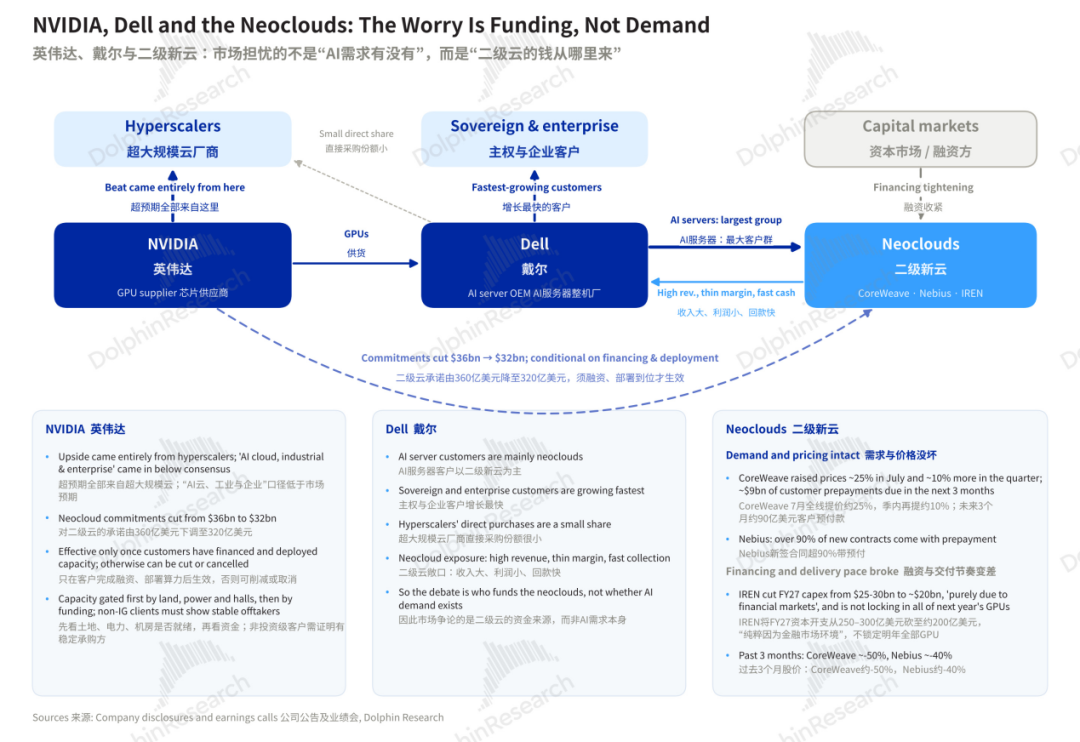
Dell's AI server customers are mainly tier-2 neoclouds, with sovereign and enterprise customers growing fastest, and direct purchases by hyperscalers accounting for a very small share. As such, recent market concerns about Dell are less about "whether AI demand exists" and more about "where the new cloud money will come from."
Management addressed concerns about new cloud on several fronts:
(1) Credit review: every AI order is reviewed with the risk team involved, assessing the customer's financial capacity and the underlying end-user contracts;
(2) New cloud customers: the company remains "highly selective" about new cloud partners and the end customers behind them;
(3) DFS financing (Dell Financial Services, the financing arm): provided only to a small number of customers, all short-term, and used as bridge financing between order placement and cluster go-live. Financing receivables rose only about $500 million quarter-over-quarter this quarter, while AI server shipments reached $22 billion (up $5.6 billion quarter-over-quarter);
(4) Rubin: new orders are mainly Vera Rubin, and the company has already locked in Rubin pricing with customers based on expected delivery timing when customer data centers and power are ready.
2) CSG business (PC)
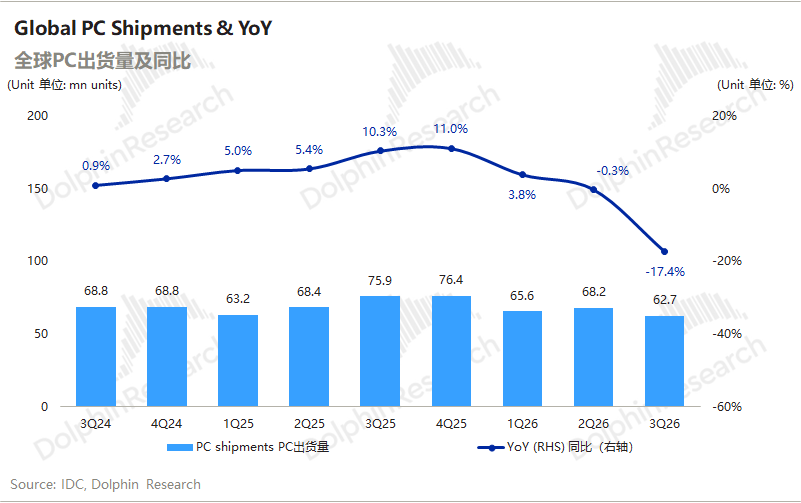
Affected by storage price increases, the overall PC market has deteriorated noticeably. Global PC shipments in Q3 2026 were approximately 62.7 million units, down approximately 17% year-over-year. Dell shipped approximately 7.6 million units, down 25% year-over-year.
Management also acknowledged that PC shipments are weakening: the industry is adapting to a higher price band, and some budget-constrained customers are prioritizing limited budgets toward servers and storage while delaying PC replacements. The company reallocated some wafer supply originally allocated to PCs toward servers in the second half and expects PC shipments to remain weak next year.
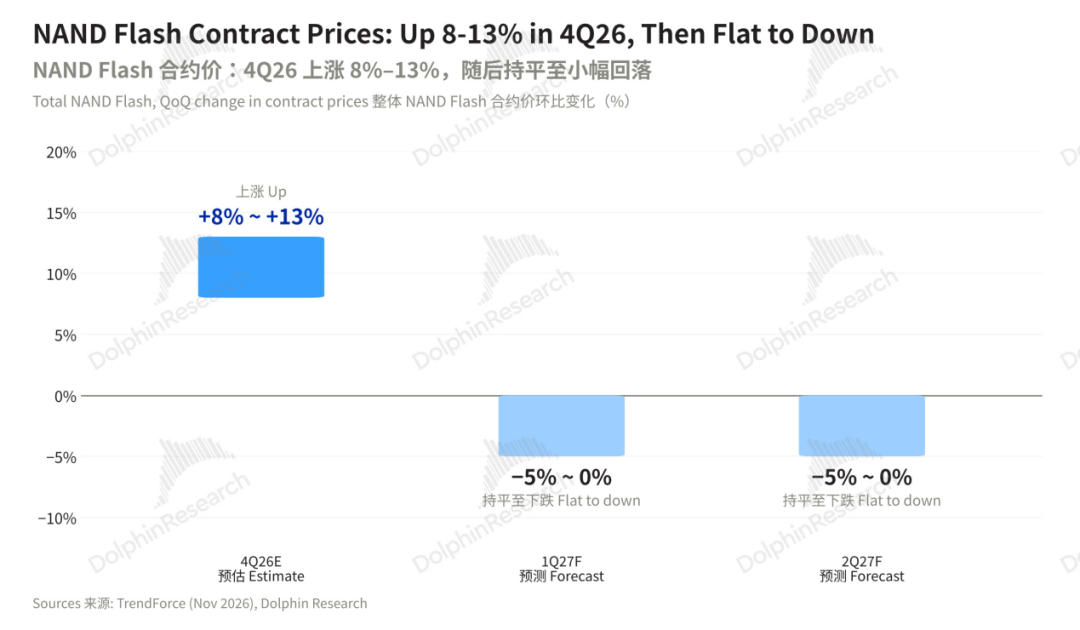
Recently, market expectations for storage prices have shifted significantly. TrendForce believes that due to some CSP vendors sharply cutting orders and slowing consumer demand, overall NAND Flash contract prices will turn downward starting in Q1 2027, with the decline potentially widening quarter by quarter.
The earlier-than-expected decline in storage prices cuts both ways for Dell: on one hand, it helps restore consumer demand such as PCs; on the other, it also reflects the risk of delayed AI construction or capital expenditure "order cuts."
Management's view on server storage prices: from the supply side, there are no signs that enterprise NAND and DRAM for servers will decline in price; this tight situation will clearly continue into 2027, with price increases smaller than in 2026. Server customers are not waiting due to price increases; those delaying purchases are mainly PC customers.
Dell's current valuation corresponds to a relatively low level of after-tax core operating profit for FY2028 (i.e., calendar 2027) (assuming revenue grows 50% over two years, gross margin of 18.5%, tax rate of 18%), near the lower end of the company's historical valuation range.
Dell's decline in this AI correction has been significantly larger than that of other AI supply chain companies: the stock price has retraced more than half from its peak, while market expectations for FY28 EPS have not been cut. Last quarter's backlog was Dell's "amulet," but this time the market is worried that new cloud orders in the backlog will turn into delays or bad debt, directly factoring financing risk into the valuation.
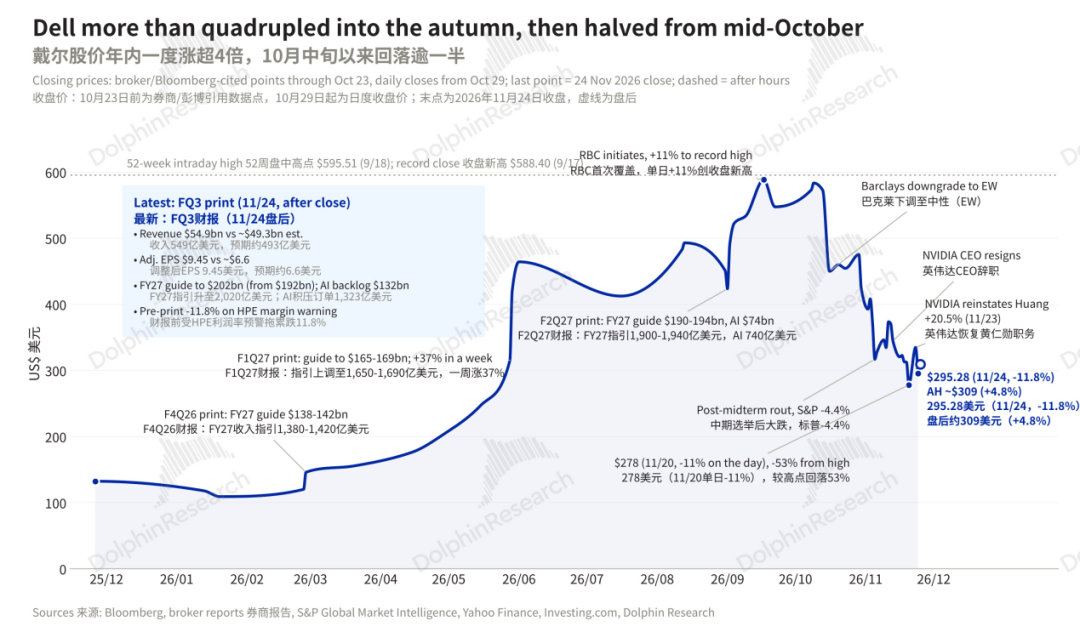
Regarding Dell's earnings, the market is mainly focused on two aspects: (1) the quality of orders and backlog — against the backdrop of tighter new cloud financing and Nvidia scaling back its backstop, whether new orders have slowed noticeably and whether there have been cancellations or delays in pickup; and (2) whether Q4 and FY28 guidance can stabilize earnings expectations, and whether management gives a direction for FY28 for the first time.
Overall, Dell addressed both issues the market is most focused on in this earnings report:
(1) Orders and backlog: new AI orders were $60.2 billion, backlog rose to $132.3 billion, and management said no customers have rescheduled, with tighter new cloud financing not yet transmitting to Dell's orders and balance sheet;
(2) Guidance: full-year revenue guidance was raised by $10 billion to $202 billion, and EPS raised to $29.68. It should be noted that Q3 gross margin included temporary factors such as a high North American sales mix, implying an expected decline in Q4. As for FY28, the company still has not provided clear guidance.
Compared with many themes built on growth narratives, Dell has solid performance and order support, and the current valuation is already pricing in the combination of "peak earnings + new cloud credit event."
Even though the company's valuation has already been significantly compressed, if new cloud subsequently "hits the brake" and new orders fall sharply, the company's valuation will be difficult to lift again, and future stock price performance will need to rely more on earnings delivery and shareholder returns.
From the perspective of shareholder returns, management has set two targets: "return at least 80% of adjusted free cash flow to shareholders" and "convert no less than 100% of net income into adjusted free cash flow." Based on this, the scale of shareholder returns (dividends plus buybacks) in FY28 would be quite considerable.
From a risk-avoidance perspective, some market views already regard calendar 2027 as the peak, and Dell's nearly 10% shareholder return rate is actually not attractive enough (compared with Nvidia's 6.5% and storage vendors' around 10%).
Even though backlog is still rising, considering the potential risks of new cloud, if Dell could offer a 12% shareholder return rate, it might be more attractive.
- END -
// Reprint authorization
This article is an original article by Dolphin Research. Please obtain authorization before reprinting.
// Disclaimer and General Disclosure Notice
This report is intended for general comprehensive data purposes only, aimed at providing general reading and data reference for users of Dolphin Research and its affiliates. It does not take into account the specific investment objectives, investment product preferences, risk tolerance, financial situation, or particular needs of any person who receives this report. Investors must consult independent professional advisors before making any investment decisions based on this report. Any person who makes investment decisions by using or referencing the content or information mentioned in this report shall bear the risks themselves. Dolphin Research shall not be liable for any direct or indirect liability or loss that may arise from the use of the data contained in this report. The information and data contained in this report are based on publicly available materials and are for reference purposes only. Dolphin Research strives for but does not guarantee the reliability, accuracy, and completeness of the relevant information and data.
Under no circumstances shall the information mentioned or the views expressed in this report be construed or regarded, in any jurisdiction, as an offer to sell securities or an invitation to buy or sell securities, nor shall they constitute advice, solicitation, or recommendation with respect to the relevant securities or related financial instruments. The information, tools, and materials contained in this report are not intended or designed for distribution to citizens or residents of any jurisdiction where the distribution, publication, provision, or use of such information, tools, and materials would contravene applicable laws or regulations, or would subject Dolphin Research and/or its subsidiaries or affiliates to any registration or licensing requirements in that jurisdiction.
This report reflects solely the personal views, opinions, and analytical methods of the relevant authors and does not represent the position of Dolphin Research and/or its affiliates.
This report is produced by Dolphin Research, and the copyright is solely owned by Dolphin Research. Without the prior written consent of Dolphin Research, no institution or individual may (i) produce, copy, reproduce, reprint, forward, or otherwise create any form of copies or reproductions in any manner, and/or (ii) directly or indirectly redistribute or transfer the same to any other unauthorized persons. Dolphin Research reserves all related rights.
-
Why Are Listed Companies' Financial Reports Starting to Take Douyin E-commerce's Business Logic Seriously?
-
AI Steps on the Gas: A 167-Year-Old Cold Case Finally Hears an Echo
-
![]()
Short Dramas: Big Tech's Q3 Earnings Scapegoat or Lifeline?
-
![]()
Coating Material Selection: Four Critical Gates — Contrast, Absorption, Stress, and Process Window
-
![]()
Maishi Optoelectronics Completes IPO Coaching Acceptance Inspection, Securing 2 Billion Yuan in Financing This Year
-
Second Financing Round of the Year! Chengfeng Technology Secures Tens of Millions of Yuan in B+ Round
-
![]()
Why Can't Hongguo Swallow Bilibili?
-
![]()
The Day After Jensen Huang's Return: The Fed Pours Cold Water on the Rally