Data Analysis, Information Research, and Content Creation Emerge as the Most Commonly Assigned Tasks for Office Agent Users — Part I of the "China Office Agent Market User Research Report 2026"
 11/25 2026
 537
Analysys recently released the "China Office Agent Market User Research Report 2026," which conducted an in-depth study of office agent users. The research found that office agent users are scattered across industries but concentrated in functional roles, and that their distribution correlates directly with the degree of digitization in their daily tasks.
In the report, "office agents" are defined as agent products that leverage artificial intelligence as their core capability to provide task automation, workflow orchestration, and information processing services to users in office settings. The survey was distributed via online questionnaires to users who had used office agent products within the past three months, with an effective sample size of N=1,200. The survey period was October 2026. Respondents were predominantly desktop users and included both active users and low-frequency trial users. Key findings from Analysys are as follows:
I. Industry Distribution of Users: Digital-Native Industries Lead, Physical Industries Follow
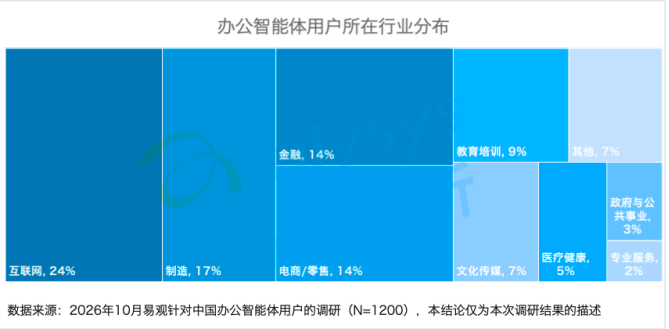 Figure 1: Industry Distribution of Office Agent Users
In terms of overall distribution, users in internet and software services account for 24%—the largest share of any industry—followed by manufacturing at 17%, finance at 14%, and e-commerce/retail at 14%. Together, these four industries account for 68% of users. Their office outputs are primarily digital deliverables—reports, proposals, spreadsheets, and presentation materials that can be generated directly and fed straight into circulation. The way agents deliver tasks aligns closely with existing workflows in these industries, creating favorable conditions for adoption.
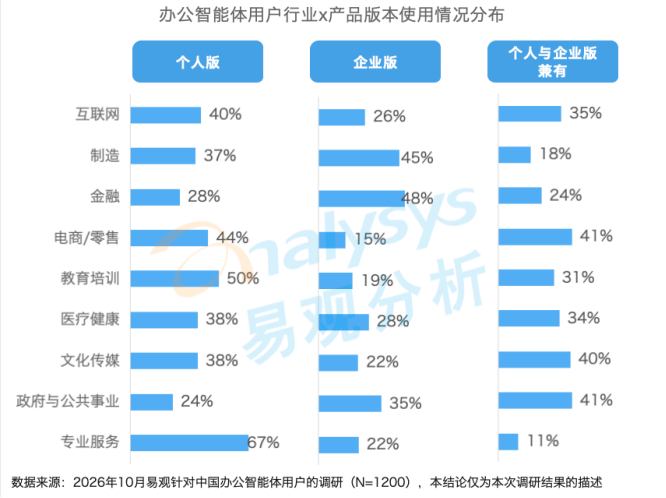
Figure 2: Distribution of Product Edition Usage Among Office Agent Users
In terms of edition usage, users who choose the enterprise edition and those who use both personal and enterprise editions together account for nearly 60% combined. By industry, enterprise edition usage rates are higher among users in finance, manufacturing, government affairs, and similar fields. Office processes in these sectors are highly standardized, with clear rules for workflows and collaborative tasks. The permission management, data isolation, and operation auditing offered by the enterprise edition have become essential configurations.
Mainstream office agent vendors are currently accelerating the rollout of enterprise and industry edition products in key sectors, entering organizational applications through industry knowledge bases, industry data, and enterprise-level security capabilities. This also reflects the capability direction that leading products generally emphasize—cross-industry general capabilities combined with localized deployment.
II. Positions and Tasks: Deliverables That Can Be Verified Upon Receipt Are Adopted First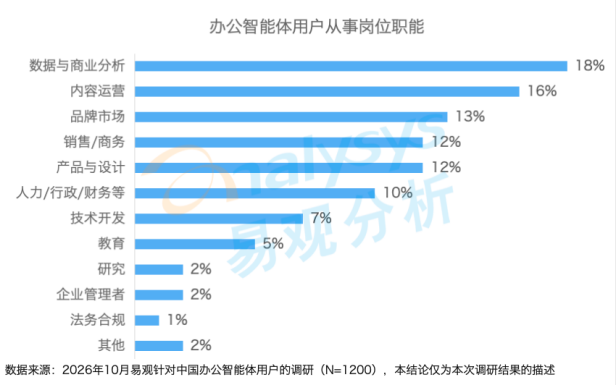
Figure 3: Position Distribution of Office Agent Users
In terms of job functions, white-collar groups have a large base and share similar task formats, providing the foundation for continued expansion of the office agent user base. Compared with survey results from the first half of the year, the proportion of white-collar groups in the user structure increased further in this survey. Users in data and business analysis, content operations, and brand marketing positions rank highest. What these roles share is that their daily output consists mainly of deliverables such as reports, proposals, spreadsheets, and presentation materials—tasks with clear boundaries and verifiable results that are well suited for delegation to agents. The focus of future product development should be on deepening understanding of the business context of these positions and improving the consistency and stability of delivery quality. 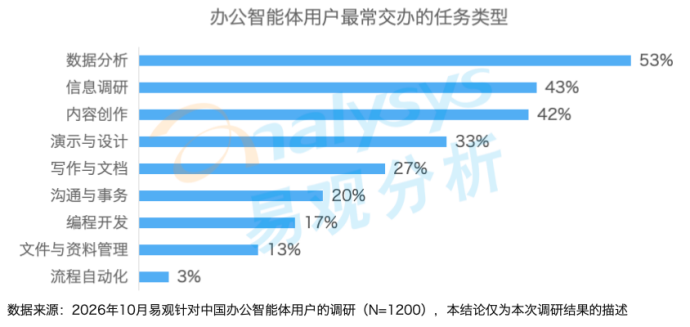
Figure 3: Types of Tasks Assigned to Office Agents
Task assignment is concentrated in analysis and research scenarios where results can be verified: tasks with strong objectivity, such as data analysis and information research, rank highest in adoption. Users can judge whether the data is accurate and whether the conclusions hold, and users' trust in agents is first established through such tasks.
As models improve their understanding of requirement intent and the stability of execution chains, the scope of lightweight development they can handle will continue to expand, and the capability boundary of office agents will move toward application building and process integration. More users have begun assigning multiple workstreams to agents simultaneously, placing higher demands on products' concurrent execution capabilities and requiring progress to remain visible. Parallel use improves task throughput per unit time, and the delivery success rate and stability of each task directly affect users' trust in agents, becoming the foundation for continued use.
Since 2026, mainstream products in the market have generally been strengthening long-task hosting, background execution, and task progress panels. These supply-side investments and users' habits of parallel scheduling reinforce each other, and changes in usage patterns are in turn shaping product forms. Capabilities in task back-end links such as task queue management, resource scheduling, and exception handling are becoming part of the user-perceived experience.
III. Programming Capabilities Spill Over to Non-Developer Groups
Among users who choose to assign "programming development" tasks, those without a professional development background account for 75% in total—ordinary office users make up 46%, users with a technical foundation whose work is not primarily programming account for 29%, and professional developers account for 25%.
This shows that agents have further lowered the coding capability threshold for ordinary users. For certain lightweight development tasks—such as webpage building and product demonstrations—even users without programming ability can delegate them to agents by describing requirements. Programming tasks have thus become a capability that can be directly assigned, and the composition of their user groups has consequently changed.
Combined with the earlier finding that "task scenarios have expanded from the professional programming field to general office fields such as documents, research, and creation," this change has occurred in two directions: general office users have begun using agents for lightweight development, while programming agent vendors have generally made parallel layouts toward general office product lines.
IV. Office Agent Products Have Moved from Personal Efficiency Tools into Enterprise Office Processes
Survey data shows that, in terms of edition usage distribution, users who choose the enterprise edition and those who use both personal and enterprise editions together account for nearly 60% combined. By industry, enterprise edition product usage rates are relatively high in finance at 48%, manufacturing at 45%, and government and public utilities at 35%. The common condition in these fields is that "office processes are highly standardized, with clear rules for workflows and collaborative tasks." The permission management, data isolation, and operation auditing offered by the enterprise edition have become essential configurations.
Mainstream office agent vendors are currently accelerating the rollout of enterprise and industry edition products in key sectors, entering organizational applications through industry knowledge bases, industry data, and enterprise-level security capabilities. This also reflects the capability direction that leading products generally emphasize—cross-industry general capabilities combined with localized deployment. This phenomenon corresponds to the conclusion that "demand for organization-level applications has begun to emerge centrally"—personal use solves single-point efficiency, while organization-level applications solve processes and collaboration. The adoption of enterprise edition products across multiple industries shows that organizational uptake has begun.
V. Usage Patterns: Desktop-Led, Multitasking in Parallel, Users Retain Control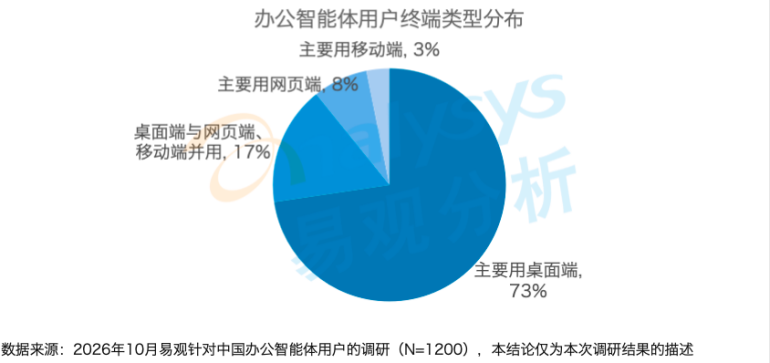
Figure 4: Distribution of User Terminal Types for Office Agents
In terms of terminals, survey data shows that users who primarily use the desktop account for 72.7%, those who use desktop together with web and mobile account for 17%, those who primarily use the web account for 8%, and those who primarily use mobile account for 3%. Analysys believes this structure differs from general conversational AI products because of the nature of the tasks: office agents handle tasks that require reading local files, cross-software collaboration, long continuous execution, and delivery in the form of complete documents and reports. These processes rely more on the operating permissions and runtime environment of the PC; web and mobile ends mainly handle lightweight tasks, progress checking, and approval processing.
In terms of working mode, survey data shows that users who initiate multiple tasks in parallel account for 40%, and those who complete most tasks in one concentrated session account for 36%—together exceeding three quarters. More users have begun assigning multiple workstreams to agents simultaneously, placing higher demands on products' concurrent execution capabilities and requiring progress to remain visible.
Analysys believes that parallel use improves task throughput per unit time, and the delivery success rate and stability of each task directly affect users' trust in agents. Since 2026, mainstream products in the market have generally been strengthening long-task hosting, background execution, and task progress panels. Capabilities in task back-end links such as task queue management, resource scheduling, and exception handling are becoming part of the user-perceived experience.
In terms of interaction, survey data shows that the vast majority of users primarily open the product, assign tasks through conversation, and follow up on results, with more than half of users relying on this form for most interactions. Remote control, scheduled tasks, and cloud hosting have all entered use. Users tend to delegate controllable links while retaining judgment links in their own hands. Analysys attributes this to the fact that "user trust is still in the accumulation stage."
VI. Open Ecosystem: Knowledge Base Ranks First and Determines Delivery Fit
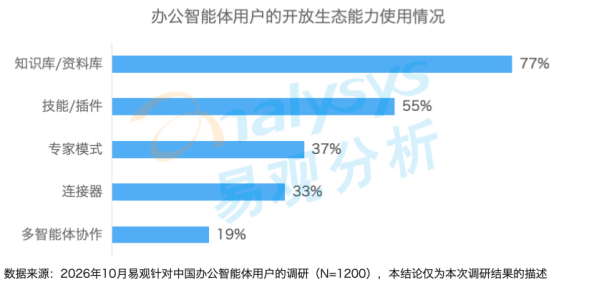
Figure 5: Users' Views on Openness
Data shows that among open ecosystem capabilities, knowledge base/data repository ranks first at 77%, followed by skills/plugins at 55%, expert mode at 37%, connectors at 33%, and multi-agent collaboration at 19%. Analysys believes that agents call upon knowledge assets within the authorized scope. Once their own materials are connected, tasks can be executed within a complete business context. Project background, user preferences, and expression habits naturally accumulate during collaboration, and the fit between deliverables and position requirements improves accordingly. For enterprises, the connected documents and process specifications constitute reusable and inheritable knowledge assets.
At the same time, more than half of users use skills and plugins in tasks. Expert mode provides preset professional roles for specific scenarios. Connectors link external applications such as cloud drives, office software, and databases into the task execution chain. Multi-agent collaboration is oriented toward multi-role division of labor for complex tasks and is still in an early stage of use. Building skills and plugin marketplaces, integrating enterprise systems, and developing multi-agent orchestration strategies are key directions for vendors' capability building, and ecosystem capabilities will also become an important consideration for users when choosing mainstream products. In addition, Analysys found in its analysis of model usage strategies that users who switch modes according to task type and complexity account for 29%, those who mainly use balanced and fast modes account for 27% and 17% respectively, and users who actively choose models account for more than 85% in total. Multi-model scheduling strategies directly affect vendors' cost structures. Optimizing computing power allocation while ensuring delivery quality will become an important factor for users in evaluating office agent platforms in the future.
VII. User Profile of Office Agents
Six sets of data jointly outline a clear user profile:
(1) White-collar positions whose main output is digital deliverables adopt them first, assigning verifiable analysis, research, and creation tasks as complete items;
(2) As delivery stabilizes, tasks move from single items to parallel processing and from personal efficiency tools to enterprise office processes;
(3) The higher the requirement for delivery fit, the greater the weight of ecosystem capabilities such as knowledge bases, connectors, and multi-model scheduling.
Analysys believes that as the user base expands along task boundaries, demand for organization-level applications has begun to emerge centrally—expansion does not rely on generalization of the population, but advances cell by cell along task boundaries.
For the complete data and conclusions of the office agent user research, please refer to Analysys's "China Office Agent Market User Research Report 2026."
Research Notes
Analysys's industry analysis is based primarily on industry-level macro data, quarterly end-user survey data, historical vendor data, and quarterly vendor business monitoring information. It draws on Analysys's proprietary industry analysis models and integrates market research, industry research, and vendor research methods. The analysis is intended to reflect current market conditions, trends, inflection points, and patterns, as well as the development status of vendors.
Analysys believes that data obtained through these industry research methods fall within the acceptable margin of error recognized by the industry and can accurately reflect industry trends and patterns of change.
Research findings derived from professional research methods are intended for decision-making reference only. For actual vendor data, please refer to the financial reports published by the vendors.
Copyright Statement
All third-party data and other information cited by Analysys in this article are sourced from public channels, and Analysys assumes no responsibility for them. Under no circumstances should this article be used as the sole reference or as any form of basis. The copyright of this article belongs to the publisher. Without authorization from Analysys, it is strictly prohibited to reprint, cite, or otherwise use any content published by Analysys. Where any media outlet, website, or individual uses such content after authorization, they shall quote the original text and indicate the source, and analytical views shall be subject to the content officially released by Analysys. Any form of deletion, addition, splicing, reinterpretation, or distortion is not permitted. Analysys assumes no responsibility for any disputes arising from improper use and reserves the right to pursue liability against the parties responsible.
-
Why Are Listed Companies' Financial Reports Starting to Take Douyin E-commerce's Business Logic Seriously?
-
AI Steps on the Gas: A 167-Year-Old Cold Case Finally Hears an Echo
-
![]()
Short Dramas: Big Tech's Q3 Earnings Scapegoat or Lifeline?
-
![]()
Coating Material Selection: Four Critical Gates — Contrast, Absorption, Stress, and Process Window
-
![]()
Maishi Optoelectronics Completes IPO Coaching Acceptance Inspection, Securing 2 Billion Yuan in Financing This Year
-
Second Financing Round of the Year! Chengfeng Technology Secures Tens of Millions of Yuan in B+ Round
-
![]()
Why Can't Hongguo Swallow Bilibili?
-
![]()
The Day After Jensen Huang's Return: The Fed Pours Cold Water on the Rally