Google and Alibaba: Testing the Convergence Theory of Large Models
 11/26 2026
 345
November has arrived, and Google has hardly been sitting still.
Gemini 4 Carbon shot to the top of the large-model leaderboards, and in its earnings report, Google Cloud revenue surged 103% year over year.
Alibaba soon followed with its own results: Alibaba Cloud's external revenue climbed 64%, marking a six-year high.
Starry Sky's thesis of "far ahead" is steadily being vindicated—pure-play AI model companies will either go bankrupt or be acquired. Model capabilities are converging, and the real money in AI is being made by cloud computing companies.
1
Google's Earnings Report
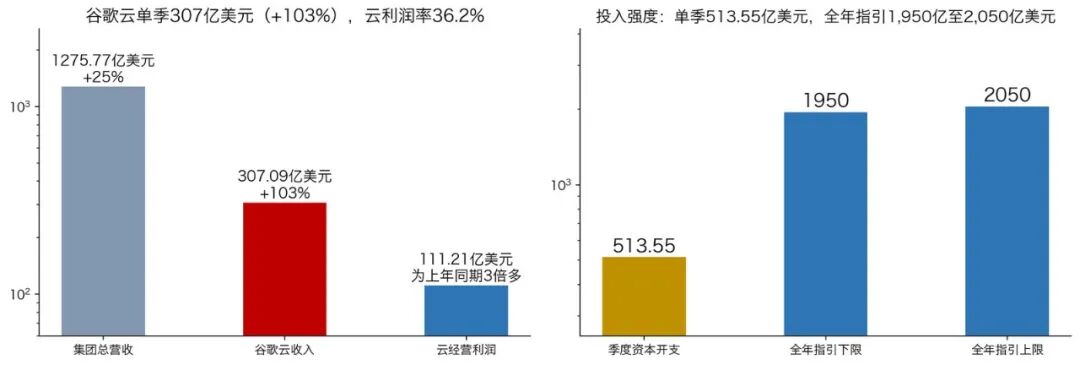
In the third quarter of 2026, Alphabet, Google's parent company, reported total revenue of $127.577 billion, up 25% year over year, with annualized revenue topping $500 billion. The most striking piece of the puzzle is Google Cloud: quarterly revenue of $30.709 billion, up 103% year over year, and operating profit of $11.121 billion—more than triple the same period last year—for an operating margin of 36.2%.

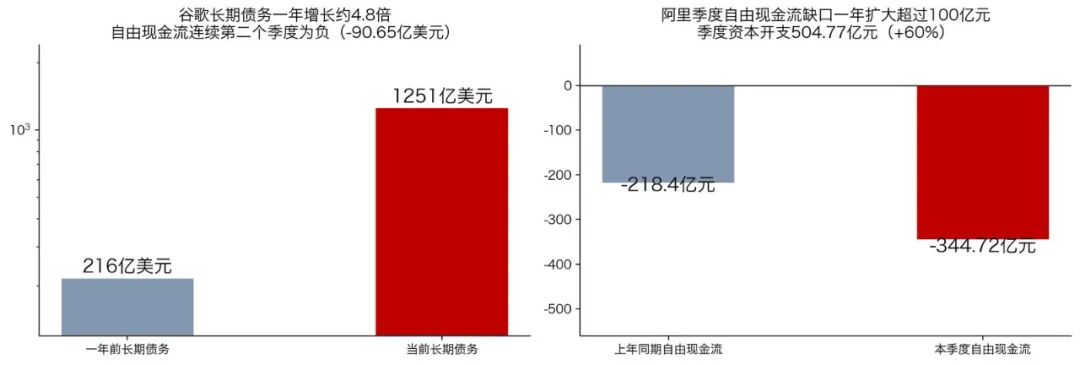
Behind the cloud's expansion lies the sheer intensity of investment. Third-quarter capital expenditure came to $51.355 billion, with full-year 2026 guidance of $195 billion to $205 billion; management explicitly said 2027 will see another significant increase, with market expectations exceeding $300 billion. Free cash flow was negative for the second consecutive quarter, with a net outflow of $9.065 billion in Q3; long-term debt jumped from $21.6 billion a year earlier to $125.1 billion—roughly a 5.8-fold increase. One of the world's most valuable companies has begun borrowing heavily for AI.
Data source: ifind
The models' own scorecard is equally impressive. Gemini 4 Carbon, released on October 28, ranked first on the Artificial Analysis Intelligence Index with 59 points, surpassing Anthropic's Claude Opus 5.5 and OpenAI's GPT-6 Astra; Argon, released two weeks earlier, saw developer platform usage ramp up 3.5 times faster than Gemini 3 in its first week. The proprietary model API processes nearly 32 billion tokens per minute, up 40% from the previous quarter and four times that of a year ago. Gemini app users surpassed 1 billion, making it the fastest-growing product in the company's history.
But Starry Sky cares about only one question: how much money have large models actually made for Google?
The earnings report offers no standalone answer. What is visible is that external sales of TPU systems have become a major contributor to cloud revenue, with a cloud backlog of $561 billion and future purchase commitments of $924 billion.
The value of large models flows back through the cloud, through search, and through subscriptions. Google's own framing is that AI investment has driven the fastest search query growth in five years.
Ironically, this is the first time in nearly four years that Google's revenue and profit both fell short of expectations. On the first trading day after the earnings release, the stock plunged 12.64%—the largest single-day drop since its IPO in 2004—wiping out about $500 billion in market value.
What the market lacks confidence in is not the cloud business, but the runaway intensity of investment.
Google spent over $200 billion on training chips and models, then packaged computing power, tokens, and software and sold them to enterprises, achieving cloud revenue growth of 103% and a margin of 36.2%.
2
Convergence Is Becoming the Default State of Large Models
Starry Sky believes that whether closed-source or open-source, large models are converging. The evidence is not in slogans, but in three verifiable numbers.
First, the margin of lead at the top. Carbon's 59 points can take first place, but the scores have not opened up a generational gap; the top three on the evaluation leaderboard are crowded within single-digit differences, and each company's flagship takes turns leading in a tight race. A model that was half a step ahead 12 months ago may be half a step behind 12 months later.
Second, the impact of convergence on profit distribution is structural. When model capabilities cannot create a gap, customers pay only for whether computing power is sufficient, whether prices are cheap, and whether the ecosystem is convenient. The suppliers of these three things all happen to be cloud computing companies.
Third, the narrowing gap between open-source and closed-source is the other half of the evidence for the convergence judgment: the score differences between open-source flagships and closed-source flagships on multiple benchmarks have narrowed to within the margin of error, and some specialized capabilities have even overtaken them.
When freely available open-source models can complete 80% of tasks, enterprise customers' willingness to pay several times the price for the remaining 20% capability improvement will inevitably decline. The price war is only the surface; the transfer of pricing power is the substance.
3
Alibaba's Financial Report: The Same Playbook
If Google is the originator of this playbook, Alibaba is the most thorough benchmarker executing it in the Chinese market. Almost every key number in Alibaba's financial report replicates Google's path.
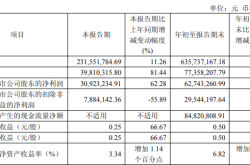
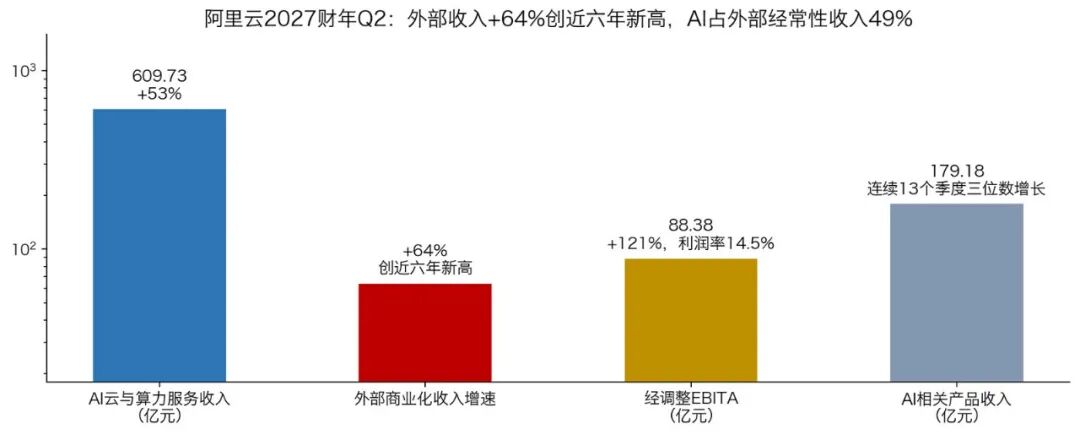
In the second quarter of Alibaba's fiscal year 2027, group revenue was 271.519 billion yuan, up 10% year over year. AI cloud and computing power services revenue was 60.973 billion yuan, up 53% year over year; external commercialization revenue grew 64% year over year, hitting a six-year high; adjusted EBITA was 8.838 billion yuan, up 121% year over year, with the margin rising to 14.5%.
Data source: ifind
What best illustrates the issue is the revenue structure. AI-related product quarterly revenue was 17.918 billion yuan, marking the 13th consecutive quarter of triple-digit growth and accounting for 49% of external customer recurring revenue; management expects it to exceed 50% within a year. Google Cloud's margin is 36.2%, while Alibaba Cloud's is 14.5%. The gap is not small, but the direction is the same—both are on an upward trajectory.
Alibaba also provided a profitability timetable, with the most aggressive investment phase concentrated in 2027 and the first half of 2028, targeting positive group free cash flow in the second half of 2028, while maintaining the goal of $100 billion in external cloud revenue and a margin exceeding 20% by 2030.
In terms of proprietary chips, Alibaba also has a product benchmarked against Google's TPU. T-Head's Zhenwu V900, released in September, is planned for mass production in the first quarter of 2027, with performance about three times that of the previous generation M890.
Wu Yongming confirmed that Qwen has already trained the next-generation model on T-Head's domestic chips, and Bailian has provided inference services based on domestic chips. After 2027, the vast majority of new AI chip supply will come primarily from T-Head, which has already submitted a confidential listing application to regulators. Proprietary chips, self-built cloud infrastructure, self-trained models, and self-developed applications—the Chinese implementation of this full-stack closed loop is exactly this chain.
The cost is equally enormous. Quarterly capital expenditure was 50.477 billion yuan, up 60% year over year; free cash flow net outflow was 34.472 billion yuan, continuing to widen from 21.840 billion yuan in the same period last year. This quarter, the AI lab and applications segment revenue was 4.435 billion yuan, up 51% year over year, but adjusted EBITA loss was 10.503 billion yuan, narrowing by about 24% quarter over quarter.
Data source: ifind
4
The Path for Pure-Play Model Companies, and DeepSeek's Exception
For pure-play large model companies like OpenAI and Anthropic, there are only two paths forward: bankruptcy or acquisition.
Pure model companies have a structural gap in their business model: the revenue side relies on token subscriptions, while the cost side is dominated by computing power leasing. After model convergence, token prices decline with competition, while computing power procurement faces sellers like Amazon, Microsoft, Google, and Oracle, leaving them naturally weak in bargaining power. Between the decline on one side and the rise on the other, gross margin space is squeezed from both directions.
They can certainly raise funds to stay alive—OpenAI and Anthropic's fundraising capabilities are already industry legends—but when capital patience is measured in years and the profitability inflection point is pushed back year after year, fundraising itself becomes a chronic bleeding of control dilution. Being acquired by cloud vendors is instead the most dignified way to monetize model capabilities. Anthropic took money from Amazon and Google, OpenAI is deeply bound to Microsoft, and the shape of this path has long been previewed in their capital structures.
DeepSeek is the exception, and the source of the exception is precisely its shareholder structure.
High-Flyer Quant is a quantitative fund that started with proprietary capital, does not rely on external financing, has no exit pressure, and has no IPO bet agreements.
DeepSeek can therefore treat model research and development as a long-term experiment without a financial deadline, making money as it comes, with frontier capabilities taking priority. It may become a truly pure frontier technology company: no ads, no chasing commercialization, no selling itself, funded by the parent entity's investment profits. The scarcity of this path is not in technology, but in shareholders.

The large-model war is shifting battlefields.
When there is no generational gap in performance, what is compared is not whose model is smarter, but whose cloud can deliver tokens to customers more cheaply. On this battlefield, Chinese companies are standing at the same starting line as Silicon Valley leaders for the first time.
-END- Disclaimer: This article is an analytical study based on the public company attributes of listed companies and the information publicly disclosed by listed companies in accordance with their legal obligations (including but not limited to temporary announcements, periodic reports, and official interactive platforms) as the core basis; Poetry and Starry Sky strives for fairness in the content and views contained in the article, but does not guarantee their accuracy, completeness, timeliness, etc.; the information or opinions expressed in this article do not constitute any investment advice, and Poetry and Starry Sky assumes no responsibility for any actions taken due to the use of this article.
Copyright Notice: The content of this article is original by Poetry and Starry Sky and may not be reproduced without authorization.
-
![]()
Million Satellites Approved: SpaceX to Move Data Centers into Space
-
![]()
Q1 Orders Top Ten Million! How Did Metalens Secure Over 100 Million Yuan in Financing?
-
![]()
Zhongrun Optics: New Facility Enters Capacity Ramp-Up Phase in First Half of 2026
-
![]()
AI Helps Citizens Mass-Produce FOIA Requests as Startups Mine Public Data, Straining Transparency Systems
-
Used Car Sales Stall as Small Dealers Begin to Band Together
-
![]()
Why Have Japanese Coffins and Robot Clothing Become Caoxian's Business?
-
Three Ministries Issue Landmark Document: The "Policy Floor" for Optical Communications Has Arrived
-
5. FSD V15 Major Upgrade: Deconstructing the Engineering Core UVE Behind Reality View