Why Have Japanese Coffins and Robot Clothing Become Caoxian's Business?
 11/26 2026
 518
Produced by: #MarketValueFinance
Selling 13 billion yuan of hanfu a year — what else can Caoxian's factories take on?
While domestic cities are racing to stake claims in high-precision, cutting-edge tracks such as semiconductors and AI computing power, Caoxian in southwestern Shandong has captured half of the national hanfu market by running sewing machines.
In 2025, Caoxian's hanfu sales reached 13 billion yuan, with 2,822 hanfu enterprises, 15,627 online stores, and nearly 100,000 practitioners, linking together a complete chain from original design to cutting and pattern-making, embroidery and printing, and then to online marketing.
But hanfu is only the tip of the iceberg of Caoxian's industrial capabilities.
Downstream, Caoxian used its woodworking foundation to capture 90% of Japan's coffin market share; toward the new, the same wood-processing capability was transferred to pet home furnishings, driving the county's pet economy output value to exceed 3.2 billion yuan in 2025; forward-looking, even the "cyber hanfu" for humanoid robots ships from here.
Yet these seemingly unrelated Caoxian categories, spanning a huge range, share at their foundation the same reusable flexible manufacturing capability and a grassroots industrial ecosystem rooted in villages and towns.
PART 01 From Studio Costumes to a 13-Billion Emotion Business 01
The starting point of Caoxian hanfu was not hanfu.
The seeds of its apparel industry were sown as early as thirty years ago. In the 1980s and 1990s, villagers in Daji Town and Ancaolou Town began making studio outfits and opera performance costumes, and secured a foothold in national niche markets by carrying goods on shoulder poles for sales.
After e-commerce rose, the performance costume industry exploded. At its peak, Caoxian performance costumes held 70% of the national market share, making it a veritable "No. 1 County for Performance Costumes in China."
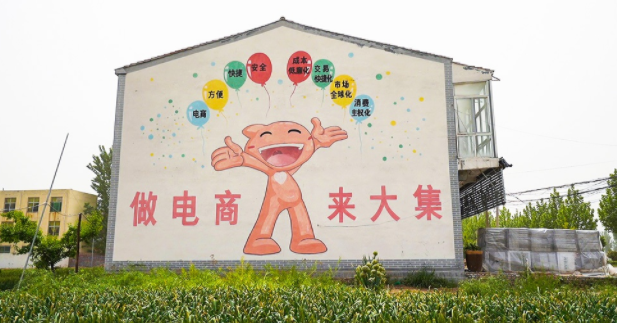
Image source: Sina Galleries
The turning point came in 2020. Offline performance activities were suspended on a large scale, performance costume orders plummeted, and a large number of village and town workshops faced production stoppages.
But precisely at this time, guochao consumption rose, and hanfu moved from a niche circle to the mass market. Caoxian manufacturers with mature cutting, embroidery, and pattern-making processes completed the track switch with almost zero threshold.
Sewing experience from performance costumes could be directly reused, and the rapid-response supply chain serving photo studios could, with slight adjustments, adapt to hanfu's needs for many styles and rapid iteration.
By 2025, Caoxian's hanfu sales reached 13 billion yuan. For every two hanfu sold domestically, one is produced here. From upstream fabrics and embroidery, to midstream design, pattern-making, and sewing, to downstream e-commerce operations and logistics after-sales, the entire chain can be assembled within a 5-kilometer radius in Caoxian.
But most people only see the production scale of Caoxian hanfu and overlook that its true core competitiveness is an "emotion supply chain" system precisely adapted to mass consumption.
When young people buy hanfu, they are essentially paying for identity recognition, social currency, and scenario-based emotional value. Scenic-area photos require a sense of ritual, holiday outfits pursue atmosphere, and circle exchanges rely on a sense of belonging. These diverse needs together form the underlying driving force of hanfu consumption.
And the "small-batch rapid response" capability that Caoxian honed in the performance costume era can precisely translate these scattered circle emotions into mass-produced goods quickly.
When a horse-face skirt explodes on social platforms, local manufacturers can complete the entire process of pattern-making, production, and listing within a week, precisely catching every wave of emotional consumption.
From piece-priced studio costumes to a tens-of-billions hanfu market carrying cultural emotions, Caoxian spent more than a decade completing the leap of its front-end commercial form.
PART 02 The Spillover of Flexible Manufacturing Behind "Everything Can Be Worn" 02
If hanfu is the calling card Caoxian hands to the outside world, the real trump card behind the card is the flexible manufacturing capability to "wrap any object in a layer of cloth, a layer of wood, a layer of leather."
Among them, the crossover with the strongest contrast comes from the invisible pillar of wood products.
Caoxian is known as the "Hometown of Paulownia in China," with more than 8,000 forest product processing enterprises and more than 45,000 individual processing households, and products covering 12 major categories and more than 30,000 varieties.
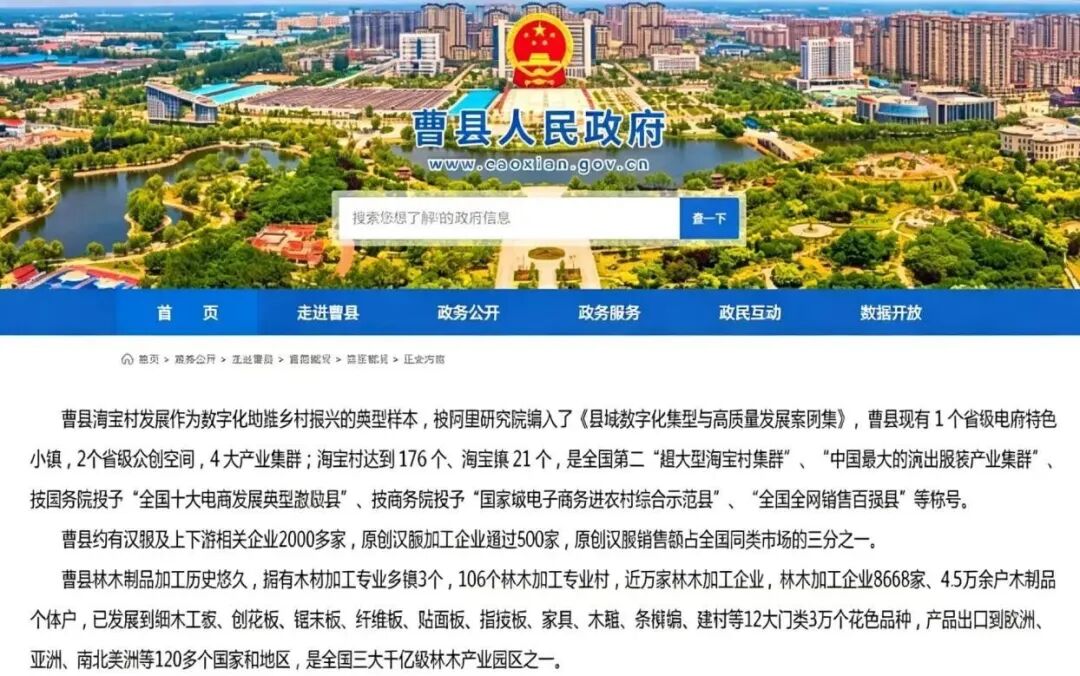
Image source: Caoxian government website
Paulownia is lightweight and not easily deformed, exactly meeting the needs of Japanese coffins. Relying on woodcarving skills and cost control, Caoxian coffins occupy 90% of the Japanese market, and Yunlong Woodcarving alone sells 200,000 to 300,000 coffins annually.
But this is only the old story.
The new story is that the same wood product industry chain is turning toward the pet home furnishings track.
Relying on the existing wood-processing foundation, Caoxian enterprises have modified production lines and developed more than 500 products such as cat trees, solid wood pet houses, and wooden food bowls, exported to more than 20 countries and regions including Europe, America, and Southeast Asia.
In the Mengchong Industrial Park in Pulianji Town, 125 enterprises are clustered together, and more than 90% have transformed from traditional wood product enterprises. In 2025, this drove the county's pet economy output value to exceed 3.2 billion yuan.
And the capability spillover on Caoxian's fabric side is even more imaginative.
The high-precision cutting, complex fabric handling, and small-batch customization capabilities honed by the hanfu industry are extending to "non-human apparel."
In April 2026, the country's first "Intelligent (Humanoid) Robot Apparel Industry Base" was officially unveiled in Caoxian. Local hanfu leader Chenfei Apparel and others were among the first to enter, customizing functional outer coverings for humanoid robots and robot dogs.
This sounds like a gimmick, but the underlying logic is extremely solid: humanoid robot joint structures are special, and outer covering materials have stringent requirements such as special-shaped cutting, wear resistance and heat dissipation, and lightweight customization, which exactly match the complex pattern handling and small-batch rapid response capabilities accumulated by the hanfu industry.
By August of that year, Caoxian had received more than 2,000 robot apparel orders, with clients including Unitree Robotics and several other leading robot companies.
In addition, beyond robot apparel, Caoxian is also reusing the same manufacturing system in niche tracks such as pet Chinese-style costumes, BJD doll clothes, and ethnic performance costumes.
In essence, what Caoxian outputs is no longer a certain type of product, but a county-level manufacturing operating system of "small-batch rapid response + extreme cost control + village- and town-level cluster collaboration."
PART 03 The "Root Power" of the Grassroots Cluster, the Industrial Confidence of Having No Giants 03
Unlike many cities that drive industries by attracting tens-of-billions-level giants, Caoxian's industrial chain has no hundred-billion-level listed company and no nationally renowned consumer brand.
But it is precisely this "grassroots cluster" structure that gives Caoxian's industry extremely strong resilience and self-iteration capability.
Caoxian's industrial landscape presents a typical pyramid structure: leading enterprises focus on brand R&D and large-scale orders, medium-sized manufacturers deepen niche categories, and a massive number of individual businesses take on scattered orders and front-end sales.
The biggest advantage of this structure is strong risk resistance. The fall of a single enterprise will not shake the entire industry, and when market trends change, a massive number of small and medium-sized merchants can quickly change direction.
This flexible capability has been particularly evident in recent years.
As the growth rate of the hanfu market slows, Caoxian manufacturers have quickly extended production capacity to new tracks such as doll clothes, pet Chinese-style costumes, and humanoid robot apparel, using mature sewing processes and supply chain capabilities to quickly enter niche markets. This cluster advantage of "a small ship turns easily" is difficult for giant-led industrial models to possess.
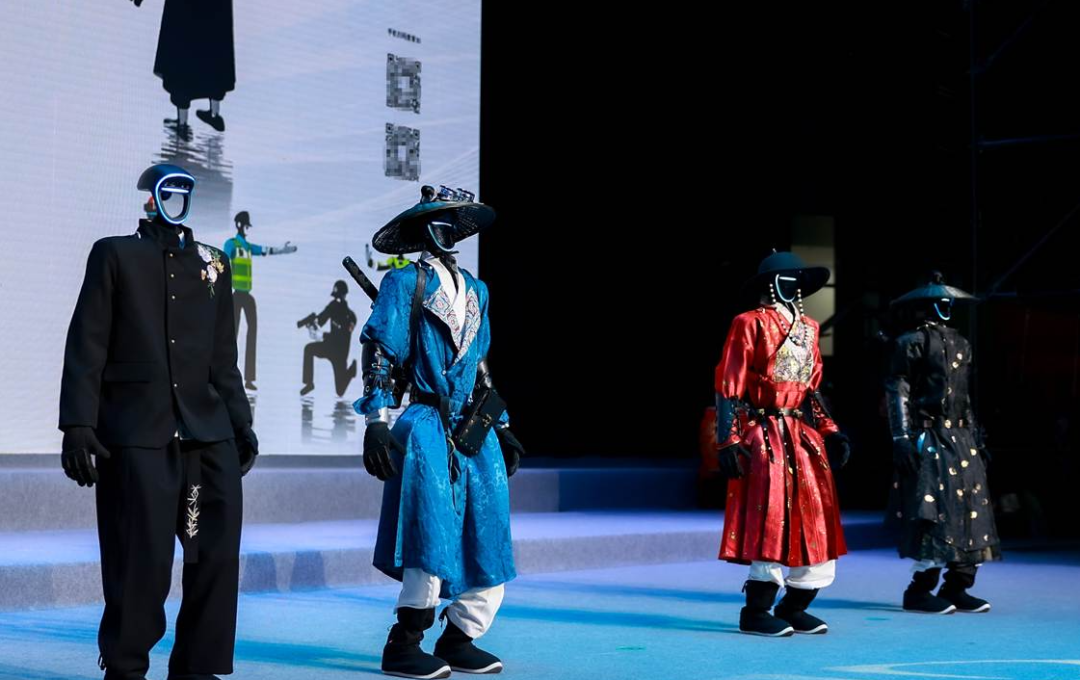
Image source: Caoxian government website
And the more core confidence comes from endogenous talent momentum. Caoxian's industry was not built up by imported talent, but supported by a cumulative wave of more than 50,000 people returning home to start businesses.
"Running around outside is not as good as going home to run a Taobao store." Villagers who once worked away from home returned with capital, technology, and market experience, starting from mom-and-pop stores and gradually growing bigger; local vocational colleges also set up majors related to hanfu design and e-commerce operations in response, supplying localized talent to the industry.
More noteworthy is that Caoxian's industry has never stayed in its comfort zone.
Cross-border e-commerce has become a new growth pole. More than 500 enterprises in the county are registered on platforms such as Alibaba International Station and Amazon, and hanfu and wood products are exported to many countries and regions.
Caoxian's counterattack has never been any internet-famous miracle, but an industrial evolution based on local endowments.
From domestic e-commerce to overseas expansion, from hanfu to pan-guofeng apparel and pet supplies, Caoxian's industrial chain has been continuously iterating and extending outward.
After shedding the traffic label, it is not hard to find that this reusable manufacturing capability, honed by a grassroots cluster without policy favoritism or location advantages, is the most valuable sample it leaves to China's county economy.
#Caoxian #What Is Caoxian's Hanfu Sales Volume#
END
Disclaimer
MarketValue Finance hereby declares that all information and content we provide are objectively compiled and analyzed based on publicly available materials, but we cannot guarantee the absolute accuracy, completeness, and timeliness of such information. Any views, analyses, and conclusions contained in this article are solely the independent opinions of MarketValue Finance based on a specific point in time and do not represent any investment advice or strategy; financial markets involve risks, and investors should bear full responsibility for any decisions made accordingly. If you have any questions about the content of this publication or find any omissions, please contact us directly through our official backend channels, and we will verify and handle them as soon as possible.
-
![]()
Million Satellites Approved: SpaceX to Move Data Centers into Space
-
![]()
Q1 Orders Top Ten Million! How Did Metalens Secure Over 100 Million Yuan in Financing?
-
![]()
Zhongrun Optics: New Facility Enters Capacity Ramp-Up Phase in First Half of 2026
-
![]()
AI Helps Citizens Mass-Produce FOIA Requests as Startups Mine Public Data, Straining Transparency Systems
-
Used Car Sales Stall as Small Dealers Begin to Band Together
-
![]()
Why Have Japanese Coffins and Robot Clothing Become Caoxian's Business?
-
Three Ministries Issue Landmark Document: The "Policy Floor" for Optical Communications Has Arrived
-
5. FSD V15 Major Upgrade: Deconstructing the Engineering Core UVE Behind Reality View