From Chat Assistants to Proactive Agents: ByteDance and Tencent Take Opposite Sides Again
 11/26 2026
 471


Are the two tech giants off to the races? Image source: Internet (please contact us for removal if this infringes any rights). Partially AI-generated.
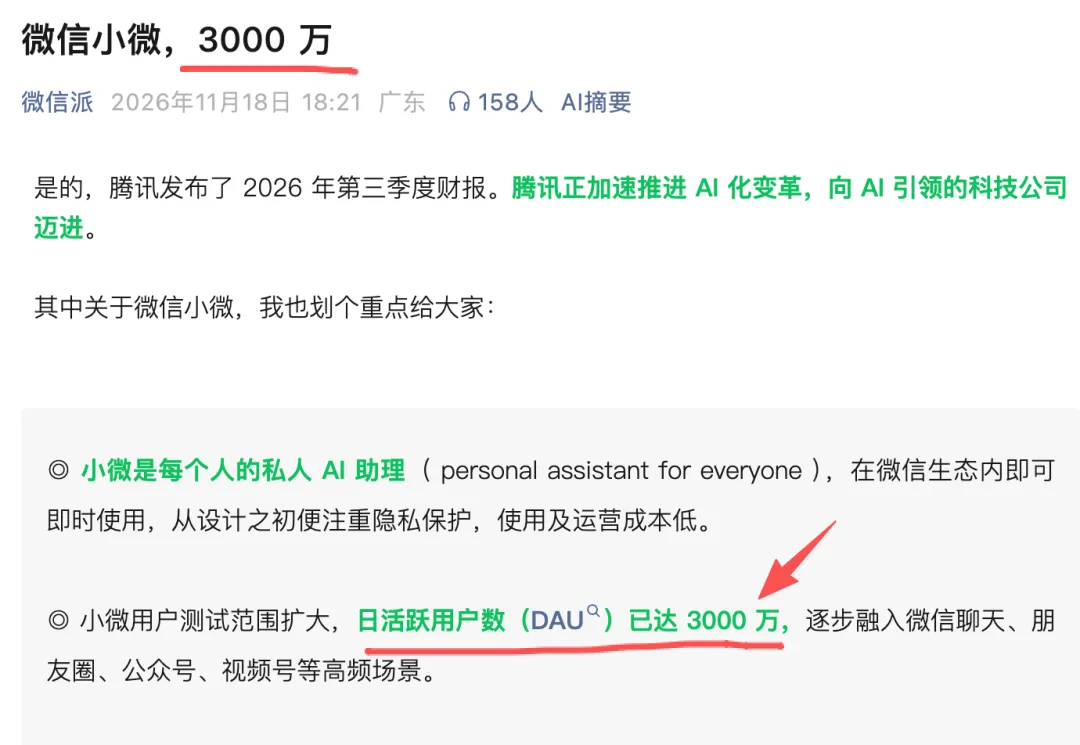
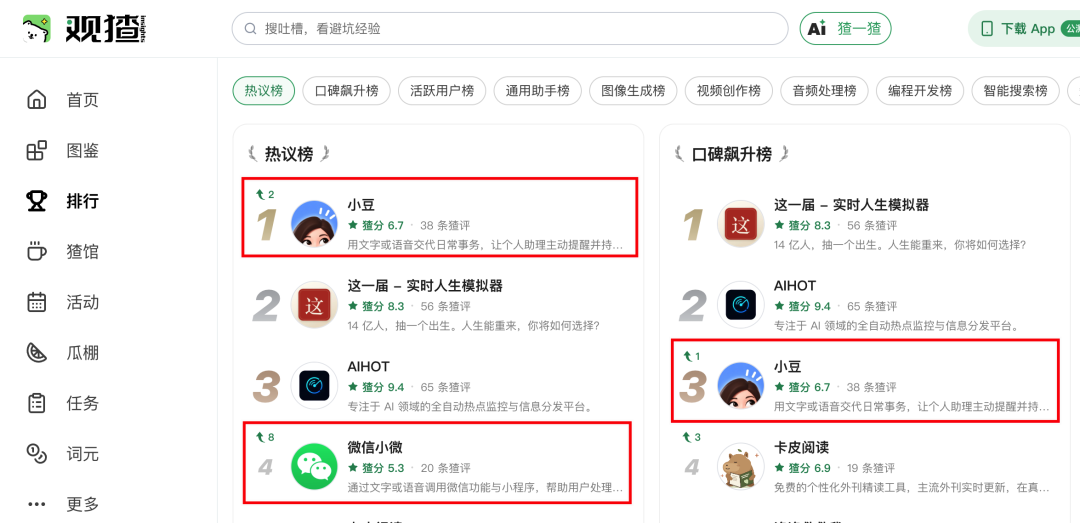
Recently, ByteDance's Doubao launched an invitation-only public beta of its personal AI assistant "Xiaodou"—and in doing so, unexpectedly thrust Tencent WeChat's previously beta-tested native AI assistant "Xiaowei" into the spotlight.
Some media outlets are already comparing the two, but as things stand, they have not yet truly reached the stage of direct competition.
They are better understood as representatives of two different paths in the development of personal agents in China.
One is the standalone, proactive agent that ByteDance is experimenting with: AI no longer merely waits for users to ask questions, but remembers their habits, follows up on tasks over time, and even proactively calls on different applications to get things done.
The other is the ecosystem-embedded agent that Tencent is exploring: AI rooted in WeChat, offering help within existing social relationships and service systems, and solving problems by calling on WeChat's native functions and mini programs.
The former envisions AI as an independent personal service hub; the latter envisions AI as a new interaction gateway within the WeChat ecosystem.
Both look like AI assistants, but the product philosophies behind them are not the same.
And this divergence is precisely what deserves serious discussion.


One wants to break out; the other wants to stay within the ecosystem
Let's start with Xiaowei.
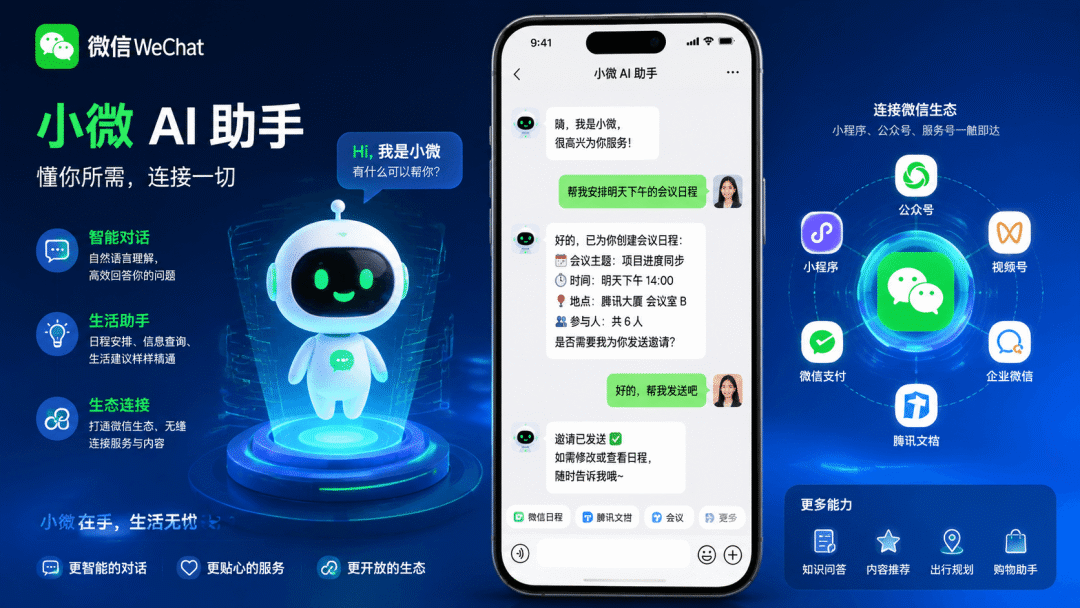
The defining feature of WeChat Xiaowei is that it did not choose to become a standalone AI application—it is embedded directly in WeChat.
Users can communicate with it via text or voice, ask it to adjust WeChat settings, send messages, call mini programs, and even complete services such as hospital registration and buying coffee.
The core of this design is to make the fullest possible use of the product foundation WeChat has already built.
WeChat already has a vast user relationship network, a mini program service system, and payment capabilities. Users do not need to download another application or rebuild their usage habits.
AI only needs to become a new gateway connecting these services.
This actually continues WeChat's consistent product philosophy: minimize disruption to the original user experience and let new capabilities integrate naturally into the existing ecosystem.
But this design also has inherent boundaries. WeChat is first and foremost a social product, not a personal operating system with unlimited permissions.
Users' chat relationships, payment information, work communications, and private lives are all concentrated in it.
Once AI obtains too many autonomous permissions, it may alter the originally stable trust relationship between users and WeChat.
Therefore, Xiaowei is better suited to starting from clear user instructions and completing tasks within the scope of WeChat's existing functions and services.
Its advantage lies in its gateway, scenarios, and service resources; its constraint lies in ecosystem boundaries and permission governance.
Now let's look at Xiaodou. ByteDance chose another path.
Xiaodou was launched as a standalone app and is being released through an invitation-only public beta.
It is not content to be a chat assistant waiting for users to ask questions; it aims to become a personal assistant that can continuously understand user needs and follow up on long-term tasks.
For example, a user tells Xiaodou that a document needs to be sent before 4 p.m.
It can not only record the task, but also continuously follow up in the background, remind the user at the specified time, and even help send it after obtaining the corresponding authorization.
As another example, if a user previously opened a bag of cat food, Xiaodou can estimate the remaining amount based on daily consumption and ask at an appropriate time whether restocking is needed. After the user confirms, it then completes the order.
The shift behind this is that AI begins to move from one-off question answering to continuous task management.
Xiaodou also attempts to connect third-party applications such as Calendar, Douyin, Feishu, and Amap, so that AI can establish connections between different services.
But it should be noted that this does not mean Xiaodou has already obtained the ability to operate third-party applications arbitrarily.
Actual execution is still limited by the degree of application interface openness, user authorization, and specific scenarios.
The advantage of a standalone app is that interaction and permission systems can be redesigned around personal needs, without having to fully accommodate an existing super app.
The problem is also obvious: users need to install an additional application, grant authorizations, and gradually build trust in it.
Therefore, neither product is absolutely superior or inferior to the other.
The logic of Xiaowei is to let AI adapt to the ecosystem, while the logic of Xiaodou is to let the ecosystem serve AI.
One starts from existing relationships; the other starts from personal tasks.

Each is calculating a different equation
Behind the product form lie the strategic considerations of the two tech giants.
For Tencent, WeChat Xiaowei is first and foremost an ecosystem efficiency tool.
WeChat already has a huge user base, covering social interaction, payment, content, life services, and commercial transactions.
Tencent does not need to create another new super gateway; it only needs to make it more convenient for users to access existing services through natural language.
In the past, users had to search for mini programs, find services, and complete operations themselves.
In the future, if Xiaowei can understand user needs and then automatically call up suitable mini programs, the efficiency of service connections within the WeChat ecosystem may improve.
This means that AI does not necessarily have to become an independently charged product; it can also become an efficiency multiplier for the existing business system.
Users spend more time on WeChat, service calls become more convenient, the mini program ecosystem gains more opportunities—and ultimately the platform that benefits is still WeChat.
From a business perspective, this is a relatively clear equation.
But Tencent also needs to consider another thing: it cannot let AI easily disrupt WeChat's original product order.
WeChat is not only a traffic gateway, but also the infrastructure for user relationships and commercial transactions.
If AI begins to autonomously decide whom to send messages to, what services to call, and what transactions to conduct, it means that it is changing the original way services are distributed.
For Tencent, AI is both an ecosystem increment and potentially a variable in ecosystem order.
ByteDance's calculation is somewhat different.
Doubao already has a fairly mature AI product foundation, but ordinary AI assistants mainly solve the problems of information acquisition and content generation.
A user asks a question, and AI gives an answer; a user proposes a need, and AI generates a piece of text.
But truly high-frequency, long-term personal service needs often go beyond this.
Users hope that AI remembers their work habits, knows when reminders are needed, can follow up on unfinished matters, and even help them handle some repetitive life and work tasks.
This requires Doubao to upgrade from an AI interaction product to a personal service platform—and Xiaodou is undertaking exactly such exploration.
It establishes a more complete personal task management and execution system through a standalone app, while attempting to connect different applications.
From this perspective, what ByteDance hopes to compete for is not just the AI chat gateway, but the right to organize users' daily affairs.
If users begin to get used to handing tasks to Xiaodou instead of opening different apps one by one themselves, then AI will have the opportunity to become a new service distribution gateway.
Of course, this path also means higher product costs.
Long-term memory, background tasks, cross-application calls, and continuous follow-up all require support from models, computing power, interfaces, and stable execution mechanisms.
Whether Xiaodou can form independent paid value also needs market testing.
Tencent wants AI to improve the efficiency of the WeChat ecosystem, while ByteDance wants AI to become a personal service hub that can break away from a single ecosystem.
The former has a ready-made service network; the latter attempts to reorganize the service network.

The more proactive AI becomes, the more users need to hand over
If the first two issues still belong to competition at the product and business levels, then what is truly worth being vigilant about is the trust issue behind personal agents.
In the past, when we used AI, we mainly handed problems to it.
Even if the answer was wrong, most of the time it was only a deviation in information judgment.
But when AI begins to proactively handle affairs, the problem changes.
It may send messages for you, arrange schedules, purchase goods, contact merchants, and even continuously execute a certain task when you have not opened the app.
At this point, an AI error is no longer just a wrong answer—it may directly produce real-world consequences.
This is also why there is a difficult-to-ignore dividing line between personal agents and traditional chatbots.
The stronger AI's autonomy, the higher the requirements for personal data, system permissions, and user trust.
Let's look at personal data first.
A truly useful personal assistant needs to know users' work arrangements, lifestyle habits, consumption preferences, and long-term goals.
If it does not even know when the user has a meeting or when a document needs to be sent, it will be difficult to truly provide proactive services.
But the problem is that this information is often also the most private content.
WeChat in particular not only records communication between users and friends, but also carries a large amount of work communication, family contact, and business dealings.
If AI needs to continuously understand this information in order to provide better services, then how much access permission should it obtain?
Should users authorize by default?
After authorization, how long will the data be stored?
Can users withdraw at any time?
These questions cannot simply be reduced to product experience.
From currently public information, Xiaowei emphasizes providing services within WeChat's native ecosystem, but it cannot be directly inferred from this that it has obtained permission to continuously read all chat records.
Tencent's permission boundaries in this regard still need to be based on official actual disclosures.
Now let's look at Xiaodou.
The product logic of a standalone agent determines that it needs more personal context.
It needs to understand users' preferences, remember previously assigned tasks, and establish connections between different applications.
This means users may need to authorize calendars, contacts, SMS, and other third-party services.
The fuller the authorization, the more things the agent can theoretically complete.
But at the same time, users also need to bear greater trust costs, especially for proactive execution.
For example, AI judges that the user's cat food is about to run out and proactively proposes restocking. This is a convenient thing.
But if it misjudges the inventory, or does not correctly understand the user's purchasing preferences, should it place an order directly?
As another example, a user asks AI to help send a document.
If AI misunderstands the file version, or sends the document to the wrong person, who should bear the responsibility?
These problems are not distant.
When AI changes from an adviser to an executor, the product must redefine authorization, confirmation, and responsibility mechanisms.
At the current stage of development, what personal agents truly need to establish is not to let users grant as many permissions as possible at once, but a layered trust system.
Which things can be completed automatically, which things must be confirmed twice, which data can only be temporarily called, and which operations must leave records—all of these should have clear boundaries.
For example, setting reminders and organizing public information can allow AI to handle autonomously.
Behaviors involving money transactions, sending private information, and transmitting important documents should retain a user confirmation step.
At the same time, users also need to know why AI executes a certain task, what services it called, and how to pause and revoke.
This is not only a technical issue, but also a product governance issue.
More importantly, user authorization cannot be simply understood as users bearing all risks.
If AI executes incorrectly, the platform should bear corresponding product responsibility, rather than using a lengthy authorization agreement to transfer all uncertainty to users.
From this perspective, Tencent's restraint and ByteDance's proactiveness are more than just two technical paths—they embody two fundamentally different approaches to trust.
Xiaowei can more easily build trust from the WeChat environment users are already familiar with, but its capabilities are also more constrained by the ecosystem.
Xiaodou seeks to deliver value through greater memory and proactive services, but it must bear higher privacy governance and authorization costs.
What users truly need is not an AI that knows all their secrets, but one that—even if it knows many things—will not make decisions on their behalf without permission.
This may well be the key to whether Personal Agents can survive for the long term.

Does the average person really need a proactive Agent?
Let's return to actual usage scenarios.
For ordinary users, Xiaowei and Xiaodou address two different types of problems.
If a user's daily life is heavily dependent on WeChat—with main needs being finding information, invoking mini-programs, sending messages, and using life services—then Xiaowei already offers fairly clear value.
It does not require users to change their existing habits, nor does it require maintaining a separate set of application relationships.
For the vast majority of light AI users, this low threshold may matter more than complex Agent capabilities.
Xiaodou is better suited to people with a large number of repetitive tasks, long-term plans, and cross-application needs.
Think of professionals who need to continuously follow up on meetings, organize materials, and manage schedules, or freelancers who often need to handle affairs across multiple platforms.
If these tasks can be reliably handed over to AI, users may indeed save a great deal of time.
But there is a realistic problem here: not everything that can be handed over to AI is worth handing over to AI.
If a user only checks the weather every day, writes a few paragraphs, and summarizes a document, an ordinary AI assistant is already sufficient.
To use a proactive Agent, users instead need extra authorization, task setup, and checking of execution results—which may not truly improve efficiency.
Moreover, Xiaodou is currently still in an invitation-only public beta, and usage eligibility, the scope of third-party application access, and actual execution results all have certain limitations.
The upper limit of the capabilities it demonstrates does not mean that all users can reliably obtain the same experience.
For self-media creators, these two products also have different value.
Xiaowei's advantage lies in the WeChat ecosystem.
Creators can use it to more conveniently invoke services inside WeChat, handle some communication affairs, and explore new interactions between natural language and mini-programs.
But for now it cannot replace a creator's complete content production and operations system.
Xiaodou's imaginative space leans more toward workflows.
If in the future it can reliably connect to more creation tools, it has the opportunity to become a creator's personal affairs management assistant.
But note that content creation itself is not simple task execution.
Topic judgment, business analysis, viewpoint formation, and content expression still require the creator's own thinking.
AI can help organize materials and follow up on processes, but that does not mean it can replace the creator's judgment of content quality.
Therefore, for ordinary users and creators alike, what should be focused on at this stage is not how many amazing demonstration features an Agent has, but whether it can reliably complete those repetitive, trivial, yet genuinely time-consuming tasks.
If, before completing a task, users need to repeatedly check, re-authorize, and correct errors, then so-called proactive service may simply transfer the original operating cost into supervision cost.
This is also what Xiaodou needs to prove next.
It needs to prove that it can not only proactively initiate tasks, but also reliably complete them.
And what Xiaowei needs to prove is how much real incremental value AI can bring to the ecosystem without damaging the original WeChat experience.

The emergence of Xiaodou and Xiaowei has created a fork worth observing in the development of Personal Agents in China.
ByteDance chose to let AI step out of existing applications and try to become an independent personal service hub.
Tencent chose to keep AI inside WeChat and complete service connections through the existing ecosystem.
Both routes have opportunities and both face constraints.
Independent Agents need to solve permissions, trust, execution stability, and willingness to pay; ecosystem-embedded Agents need to solve the balance among capability boundaries, ecosystem coordination, and product experience.
So it is obviously too early to judge who will win now.
Even in the future, there may not necessarily be only one form.
After all, users do not care which company the AI belongs to, nor do they care whether it uses an independent App or an embedded entry point.
What users really care about is: whether they can do fewer repetitive things, whether they can confidently hand over tasks, and whether they still have enough control when AI makes mistakes.
This is the question that Personal Agents ultimately need to answer.
-
![]()
Million Satellites Approved: SpaceX to Move Data Centers into Space
-
![]()
Q1 Orders Top Ten Million! How Did Metalens Secure Over 100 Million Yuan in Financing?
-
![]()
Zhongrun Optics: New Facility Enters Capacity Ramp-Up Phase in First Half of 2026
-
![]()
AI Helps Citizens Mass-Produce FOIA Requests as Startups Mine Public Data, Straining Transparency Systems
-
Used Car Sales Stall as Small Dealers Begin to Band Together
-
![]()
Why Have Japanese Coffins and Robot Clothing Become Caoxian's Business?
-
Three Ministries Issue Landmark Document: The "Policy Floor" for Optical Communications Has Arrived
-
5. FSD V15 Major Upgrade: Deconstructing the Engineering Core UVE Behind Reality View