Foldable Smartphone Showdown: A Prelude to the 'Tech Spring Festival Gala'
 09/13 2026
 475
475
Author | Xiaoman
Disclaimer | The featured image is sourced from the internet. This original article by Jingzhe Research Institute may not be reproduced without prior application and approval.
In the early hours of September 10, Beijing time, Apple's newly appointed CEO, John Ternus, made his debut at a product launch event, unveiling Apple's first foldable smartphone, the iPhone Duo. To forge stronger connections with Chinese consumers and create buzz before the launch, Ternus opened a Weibo account on the evening of September 1, his first day as CEO, and posted "Hello, 你好" in both Chinese and English.
Following the product launch, the topic "Apple's foldable iPhone Duo" quickly soared to the top of trending charts, amassing over 47.19 million views. Meanwhile, Huawei and Xiaomi, which had preemptively released new foldable smartphones, also dominated the trending lists, with topics such as "Huawei foldable," "Xiaomi foldable," "Huawei, Xiaomi, and Apple duel in the premium smartphone market," and "Foldable smartphone three-way showdown" trending on Weibo.
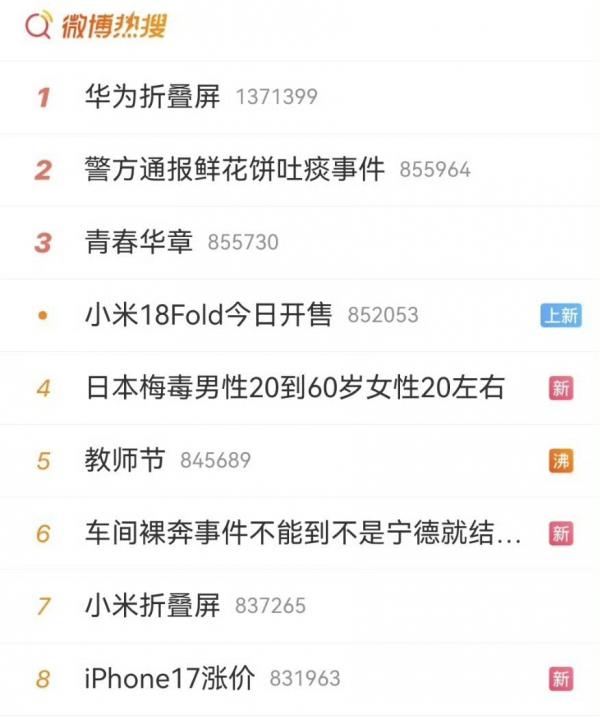
*Screenshot of Weibo trending topics
A closer look at the trending charts in the 72 hours leading up to this "Tech Spring Festival Gala" reveals that the topic of foldable smartphones had already been ignited by Huawei and Xiaomi. After a prolonged period of stagnation in the smartphone market, this "grand showdown of foldable smartphones" has brought back a "familiar flavor."
"Strangling" Apple's Foldable Ambitions
As early as 2019, rumors circulated that Apple was developing a foldable smartphone. Prior to the official unveiling of the iPhone Duo, domestic smartphone manufacturers like Huawei and Xiaomi had already taken the lead in launching foldable models. However, in recent years, foldable smartphones have not yet become a transformative market segment, remaining a niche but high-growth sector.
Data released by IDC shows that in 2023, foldable smartphone shipments in the Chinese market reached approximately 7 million units, a year-on-year increase of 114.5%. In 2024, shipments reached about 9.17 million units, up 30.8% year-on-year. By 2025, shipments are expected to expand further to around 10.01 million units, though growth will slow to 9.2%.
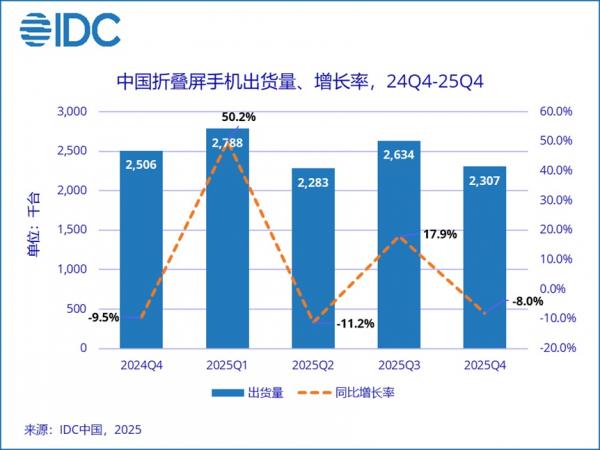
*Source: IDC China
It's worth noting that despite the slowdown in growth, foldable smartphones remain one of the few emerging markets that have sustained growth in recent years. With the overall smartphone market weakening, especially as traditional bar phones offer diminishing incentives for consumers to upgrade in terms of imaging, fast charging, and display, the industry needs a "new concept" that can simultaneously support technological innovation, brand premium, and user imagination. Foldable smartphones have emerged as one of the optimal solutions in the current limited market environment.
As a bellwether in the smartphone market, Apple's clear entry into the foldable segment has stirred up the market. Counterpoint predicts that global foldable smartphone shipments will grow by 21% in 2026, with Apple expected to capture 25% of the market share in its first year. In the domestic market, IDC data from the first quarter of this year shows that Huawei dominates with about 60% market share, while Xiaomi holds just 4%.
With Apple entering the foldable market, Huawei faces the challenge of defending its existing market share to prevent excessive erosion due to Apple's entry. Meanwhile, Xiaomi has an opportunity to break through amid the new competition between Apple and Huawei. The simultaneous launch events by Huawei and Xiaomi are no coincidence but a strategic move to seize the narrative on foldable smartphones and win the marketing battle.
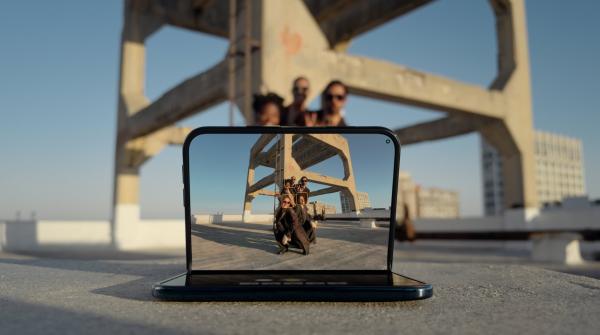
*Source: Apple official website
In fact, well before Apple's launch event, Huawei and Xiaomi had already set their sights on Apple.
During Huawei's September 7 launch event, Yu Chengdong, while introducing the "wide bar" Pura X View, publicly invited Apple users to "consider Huawei as a backup phone—you might end up switching to it full-time." Meanwhile, on September 3, during a live broadcast at IFA (Berlin International Consumer Electronics Show), Lu Weibing mentioned, "I hear Apple is also releasing a mid-sized foldable. You can compare it and find that Xiaomi's 18 Fold offers exceptional value."
Yu and Lu's proactive "provocations" of Apple are essentially consistent with the logic behind their simultaneous launch events—both aim to stand out in the spotlight before Apple's foldable flagship debut. However, when Huawei and Xiaomi both target the same opponent, a showdown becomes inevitable.
One Goal, Two Strategies
Both Huawei and Xiaomi aim to "hijack" user attention away from Apple, but they employ different strategies: Huawei focuses on creating scarcity, while Xiaomi excels at generating buzz through events.
On August 31, Huawei opened pre-orders for its Mate XT 2 Ultra Master Edition ahead of its product launch, revealing only limited information such as storage, privacy screen, and color options, with the rest disclosed through leaks. Despite requiring a 1,000 yuan deposit, pre-order slots sold out within half an hour, creating inherent scarcity for the Mate XT 2. On September 2, Huawei announced that Andy Lau would continue as the brand ambassador for the Ultra Master Edition, leveraging celebrity endorsement to attract public attention and reinforce the brand's premium narrative.
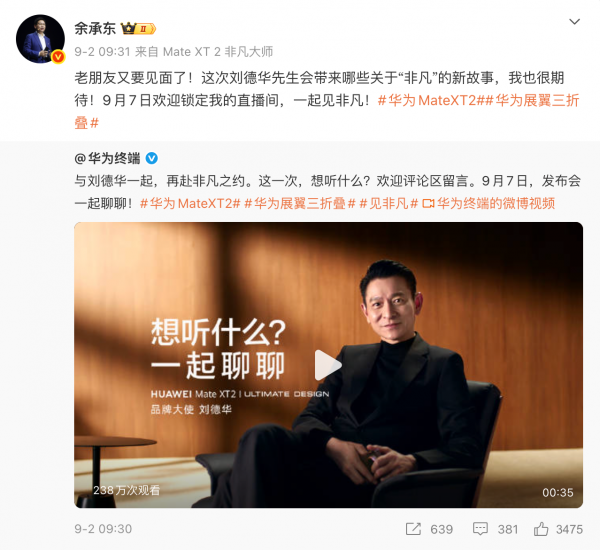
*Source: Screenshot of Yu Chengdong's Weibo post
Additionally, since the release of the first tri-fold smartphone in 2024, the Mate XT series has been closely associated with the label "digital Moutai." Against the backdrop of collective price hikes by smartphone manufacturers, the Mate XT 2's unannounced final price, combined with the instant sellout of pre-order slots, reignited discussions about "digital Moutai" on platforms like Weibo.
As a result, the scarcity of the Mate XT 2 was fully amplified before the launch. Whether consumers planning to upgrade, scalpers looking to profit, or curious onlookers, everyone likely tuned in on launch day to see the final price of the Mate XT 2.
On the other hand, Xiaomi began its campaign with Lei Jun, a natural attention-grabber, posting a video of the real Xiaomi 18 Fold on his personal Weibo account at 2 PM on September 2, mentioning the keyword "mid-sized foldable." Five minutes later, Lu Weibing followed up with a long post defining the "mid-sized foldable" as the "most significant form factor leap" in Xiaomi's foldable history, highlighting the product's features of a "lightweight compact flagship + stunning large screen." While a single video and post may not fully convince users to adopt the Xiaomi 18 Fold, the concept of "mid-sized foldable" successfully entered user consciousness.
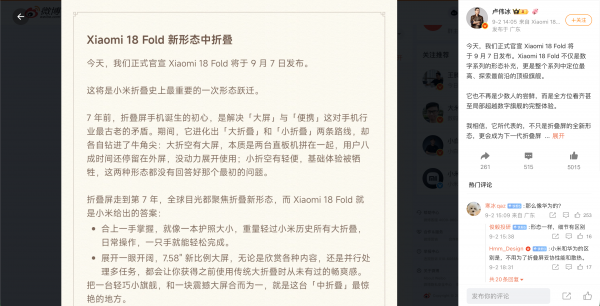
*Source: Screenshot of Lu Weibing's Weibo post
Jingzhe Research Institute also noted that Xiaomi's marketing efforts for the 18 Fold were not confined to the September 7 launch event. From September 4 to 8, during IFA in Germany, Xiaomi live-streamed its "four major announcements" covering smartphones, chips, robots, and cars. While Xiaomi's official live-stream content became material for user-generated creations, the "global debut of the Xiaomi 18 Fold" was organically spread by media and industry influencers. Some influencers specifically "camped" in live-streams for details on the Xiaomi 18 Fold's specifications, while tech media reported live from IFA, sharing firsthand information.
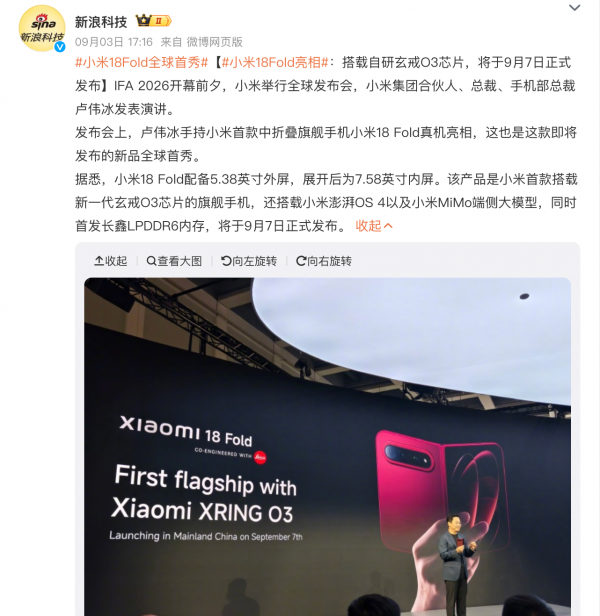
*Source: Screenshot of Sina Tech's Weibo post
On the day of Xiaomi's launch event, Lei Jun shared behind-the-scenes stories about the team's 80,000+ drop tests and the 1,500+ engineering units damaged (worth tens of millions of yuan) in the "foldable phone graveyard," which trended on Weibo and sparked widespread discussion.
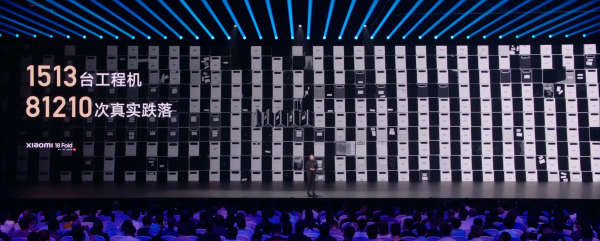
*Source: Screenshot of Xiaomi's launch event live-stream
Overall, Huawei cultivated a sense of exclusivity and identity for its user base, locking in high-net-worth customers. Xiaomi, on the other hand, guided user attention and participation in online discussions through buzzworthy topics and storytelling. While their strategies differed, both successfully tied the term "foldable" to their brands in the final window before Apple's launch.
A clear sign of Huawei and Xiaomi's success in "hijacking" user attention is that even after Apple's September 10 launch event, the names Huawei Mate XT 2 and Xiaomi 18 Fold frequently appeared in discussions about the iPhone Duo. Huawei and Xiaomi served as reference points for foldable smartphones, with any related topic inviting comparisons.
The Real Competition Lies Beyond Launch Events
On the surface, Huawei and Xiaomi's simultaneous flagship launches felt like a "head-to-head showdown." However, their competition had already extended beyond launch events, starting with their use of social media to maintain user engagement before and during the launches.
For example, after Yu Chengdong announced the September 7 launch date on August 25, he released a tri-fold real device video on August 30, mentioned the "Flex Shield Privacy Screen" feature on September 1, and announced Andy Lau's continued role as brand ambassador on September 2, releasing nearly one product update per day.
During this period, on August 31, Yu Chengdong responded directly to netizens' questions about the "changed form factor" on his personal Weibo, sparking further discussion about the new device's design. On the same day, pre-orders for the Mate XT 2 Ultra Master Edition opened, reigniting "digital Moutai" discussions. Materials such as second-hand platform listings with markup and users visiting stores to pre-order the Mate XT 2 began circulating widely on media platforms like Weibo.
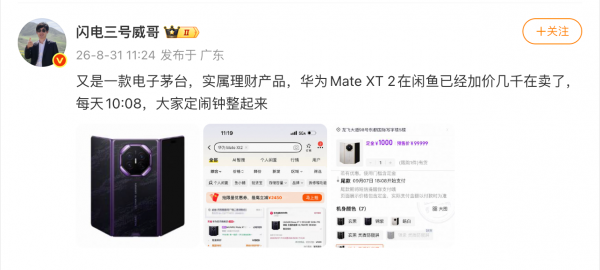
*Source: Screenshot of "Lightning No. 3 Weige's" Weibo post
Even on launch day, topics like "Huawei launch event" and "Kirin 9050pro" trended, with Yu Chengdong shouting "Super" three times in English and Andy Lau performing on stage, providing excellent material for user-generated creations. After the event, Yu Chengdong's Weibo recap officially concluded Huawei's product launch.
Additionally, Huawei's official Bilibili account posted a preheat video (teaser video) titled "Pioneer of Tri-Fold, A New Generation, Unprecedented" on August 30, which garnered over 350,000 views. Huawei's Xiaohongshu Blue V account simultaneously opened a live-stream. While live-streaming on Weixin Channels, Huawei also collaborated with over 50 media outlets, including Sina News, for simultaneous broadcasts. The launch event was also live-streamed on five major overseas platforms, including X and YouTube—a scale not seen since the return of the Huawei Mate 60.
Xiaomi, meanwhile, deployed its entire executive team to generate buzz and public discussion.
Before the release of the Xiaomi 18 Fold real device video, the Weibo device suffixes for Lei Jun, Lu Weibing, and other Xiaomi executives were uniformly changed to "Xiaomi 18 Fold" on August 24. The significance lay not in the feature itself but in the fact that this station-only visible detail was reported and spread by tech media as a news clue, allowing Xiaomi's new device to generate "new product teaser" buzz at nearly zero cost.
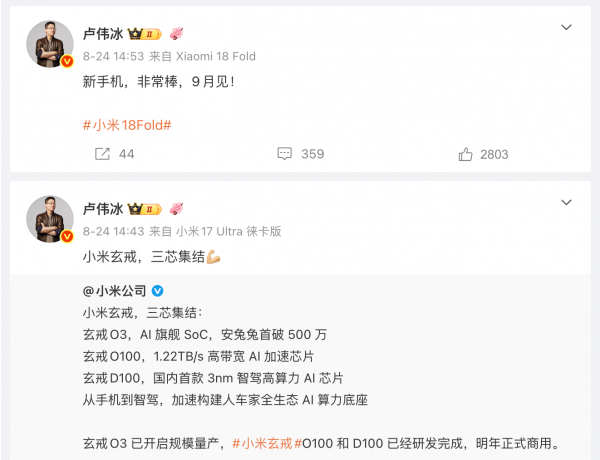
*Change in Lu Weibing's Weibo "tail"
The main event on September 7 was the launch, but Lei Jun deliberately solicited questions from netizens two hours before the event and personally replied to comments like "6999 is impossible" and "memory is too expensive," using these "leaks" to attract user attention and build anticipation for the live-stream. Lei's comments directly spawned topics such as "Lei Jun says Xiaomi 18 Fold starting price unlikely to be 6999" and "memory is too expensive," spreading the suspense about the new product's pricing without official press releases.
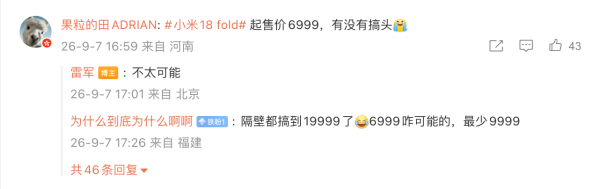
*Source: Screenshot of Lei Jun's Weibo comments
Notably, the morning after the launch, Xu Fei, Xiaomi Group's Vice President and CMO, posted on Weibo that the "Xiaomi 18 Fold mid-sized foldable is selling like crazy," along with a photo from Wang Xiaoyan, Xiaomi Group's Senior Vice President and President of China Region, showing "Xiaomi 18 Fold flagship sales in the premium segment explode, up 310% year-on-year compared to the previous large foldable model" at a China Region core customer meeting. Just hours later, Lei Jun announced that the Xiaomi 18 Fold would officially go on sale on the 10th.
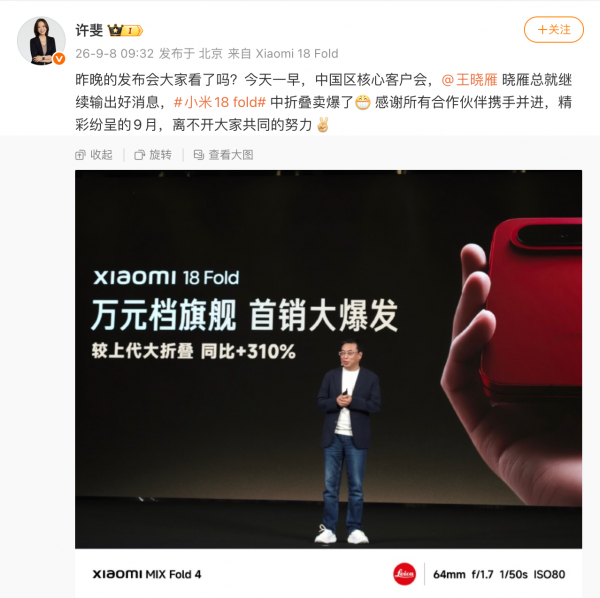
*Source: Screenshot of Xu Fei's Weibo post
Xiaomi's social media strategy fully leveraged the hierarchical nature of its executive team, with Lei Jun, Lu Weibing, Xu Fei, and Wang Xiaoyan disseminating information across different dimensions. This approach ensured dense communication rhythm and comprehensive coverage—discussing design today, technology tomorrow, and pre-order availability the next day, with new trending topics daily to sustain user attention.
Xiaomi also employed this collaborative and location-tailored communication strategy across other platforms. On Bilibili, Xiaomi live-streamed the product launch concurrently, while renowned tech influencers, including Zhong Wenze and Technology Aesthetics, posted unboxing reviews during the same timeframe. Notably, Zhong Wenze’s review video alone amassed over 1.1 million views. Furthermore, Xiaomi customized the product interface with a horizontal split-screen design, enabling Bilibili users to “watch videos on the left while posting bullet comments on the right.” On Xiaohongshu, the “Xiye Red” color variant of the Xiaomi 18 Fold emerged as the focal point in influencer posts, establishing Xiaohongshu as a pivotal platform for Xiaomi’s grassroots marketing initiatives. Within the WeChat and WeChat Channels ecosystem, the official accounts and video channels of Xiaomi’s major stores nationwide formed an extensive communication matrix, synchronously distributing promotional content.
The high-stakes showdown between Huawei and Xiaomi is essentially a contest for public attention centered on the keyword “foldable screen,” with both brands striving to dominate the discourse through strategic topic management. The distinction lies in their strategies: Huawei opts to control the pace of information dissemination, fostering a sense of exclusivity while stimulating public discussion. Conversely, Xiaomi proactively provides “clues” to the media and netizens, sparking public conversation and fueling heated debates centered around the brand.
Consequently, discussions surrounding questions such as “Are 10,000-yuan phones a waste of money or a good value?” and “Is the mid-fold a genuine innovation or merely a rebranded large-fold?” reflect not only clashes of personal preferences among brand users but also serve as a true litmus test of the marketing effectiveness of smartphone manufacturers.
In the quest for user attention, both Huawei and Xiaomi have achieved their objectives. However, the competition in the foldable smartphone market is far from over.
-
![]()
Mother and Son with a 7-Year Age Gap, Labor Remuneration Soars Over 2 Trillion: Xingyu Shares Faces Information Disclosure 'Mishaps' Amid Layoff Controversy
-
If You're a Disruptor, Let's Ride the Wave of CALB's Business Success Together
-
![]()
Foldable Smartphone Showdown: A Prelude to the 'Tech Spring Festival Gala'
-
![]()
China’s Wealthiest Individual Could Change! DeepSeek Aims for STAR Market IPO—Could Liang Wenfeng’s Net Worth Hit Trillions?
-
![]()
Porsche Sells Bugatti for €7.8 Billion to Cover Pension Obligations
-
Does Changsha Still Inspire Optimism?
-
![]()
Riding Tesla’s Wheel-less Cybercab: An Hour of Comfort, Marred by Perplexing Drop-offs
-
![]()
The iPhone Duo, Arriving 7 Years Late, Aims to 'Dominate' the Market from the Start