Doubao Mobile Phones: Opting for the Path of Maximum Public Discourse
 09/14 2026
 484
484
In the upcoming half-month period, China's mobile phone market will witness a flurry of new releases: vivo is set to unveil its X500 series next week, followed by the debut of the OPPO Find X10 the day after, and the Honor Magic9 launch event at the end of September. Several manufacturers are crowding their new flagship models into a single week, all vying to become consumers' preferred choice for their next smartphone upgrade.
Just as traditional manufacturers are gearing up to persuade consumers with the question, 'Why upgrade your phone this year?', Doubao suddenly steps into the limelight.
The official website of the Doubao mobile assistant has announced its formal launch, with the consumer version of the Nubia NaviX Ultra now available for pre-order. Nubia primarily handles the hardware R&D, design, and manufacturing.
In the official demonstration, an AI button that integrates fingerprint verification and activation functions places Doubao within easy reach for users. It can also access local information, invoke tools, and operate apps within authorized and supported parameters.
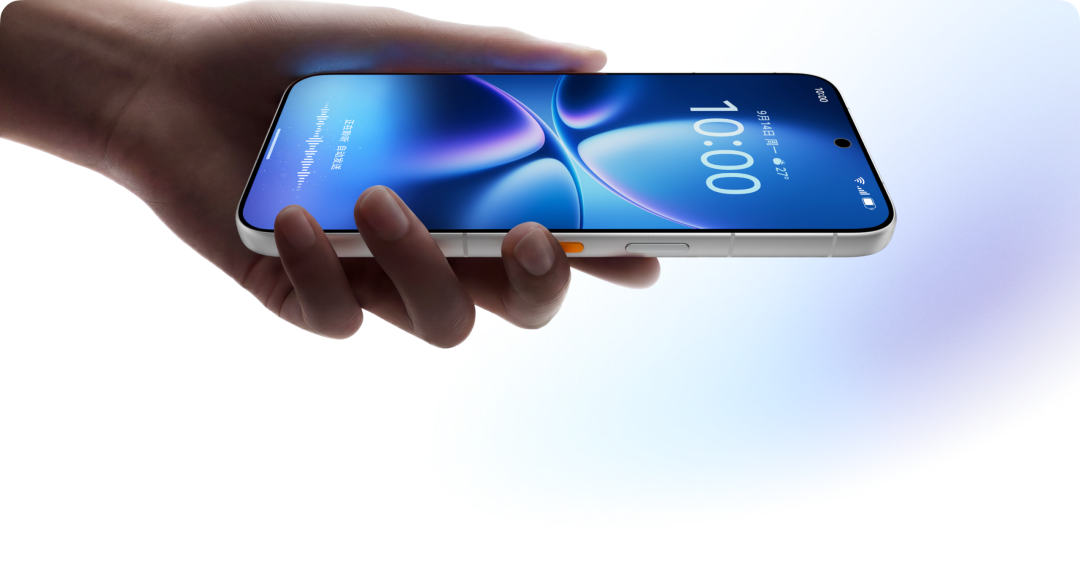
Figure 1: The consumer version of the Doubao mobile assistant on the collaborative NaviX Ultra model.
Doubao has escalated this competition to the OS level. Users desire fewer steps, and the more the assistant can accomplish on their behalf, the more likely it is to become their go-to for daily needs. Application platforms must rethink how services are invoked, and traditional manufacturers must also confront a change: consumers may purchase their phones but build their usage habits around Doubao.
Doubao's approach, which has sparked the 'most public discourse,' lies in simultaneously affecting the interests of multiple parties. Doubao requires mobile phone manufacturers and application platforms to open up capabilities while also intervening in their relationships with users. Moreover, it has initiated this competition at a time when traditional manufacturers are about to release their new flagship models.
The immediate impact is a rush to redefine the evaluation criteria for new flagship models. Consumers are still awaiting each manufacturer's product unveiling, but Doubao has already introduced system-level AI into the comparison. Mobile phone manufacturers, originally preparing to showcase lenses, chips, and new systems, must now also answer: Why is their AI worthy of long-term user adoption?
01 Selling Phones Doesn't Guarantee User Retention
Two reports released by QuestMobile in July and September provide data support for this wave of intensive launches. Mobile phone manufacturers possess a vast device base, but the coverage of their proprietary AI assistants is inconsistent. As external AI begins to compete for deeper system capabilities, these gaps become the starting point for a new round of competition. The QM smartphone report released on September 8th outlines the market realities behind this wave of releases: In June 2026, the total number of active mobile internet devices reached 1.282 billion, with growth continuing to slow, making smartphone replacement the focus of competition. Manufacturers must persuade existing smartphone users to upgrade, relying primarily on AI-driven features.
While better imaging and longer battery life remain reasons to upgrade, AI has emerged as an alternative to the traditional stacking of parameters. However, a disconnect has arisen between manufacturers and demand: Users are not necessarily pursuing new phones because AI-native apps are already appealing enough.
In QM's AI app semi-annual report released in July, a set of data comparisons was provided: In June 2026, the monthly active user base of terminal manufacturer AI apps was 755 million, up 14.0% year-on-year; AI-native apps had 499 million, up 85.4% year-on-year. The former had a larger scale, while the latter grew faster.
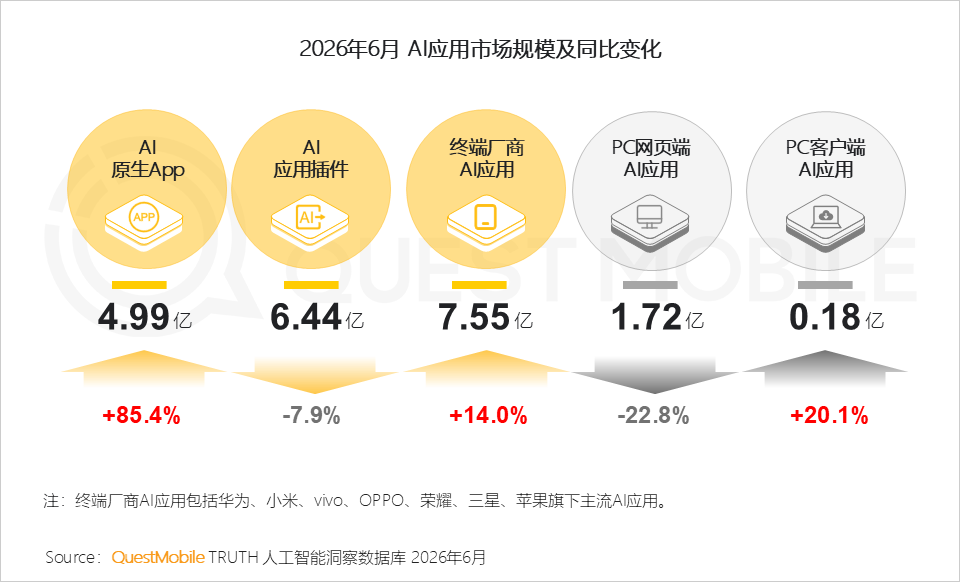
Figure 2: Market size and year-on-year changes in the AI app market. From the July AI app semi-annual report, covering June 2026.
Mobile phone manufacturers' AI tools have achieved broad coverage through devices, while native apps are accumulating users more rapidly. For hardware manufacturers, devices are just the starting point for reaching consumers; to turn this contact into sustained AI usage, they must win back user choice.
An individual might buy a phone for its camera and then continue to use an AI provided by another company in an app for work and life issues. While the mobile phone manufacturer completes a hardware sale, another company is accumulating user relationships day after day.
This will alter the pace at which manufacturers arrange competition. New flagship models are typically upgraded generationally, but AI apps can continue to update between two generations of phones. Before a phone is even replaced, user habits may have already changed. When new features are unveiled at launches, manufacturers must also persuade consumers to change their established habits.
The QM report in September further discusses collaboration between terminal assistants and the application ecosystem, including the A2A mechanism that enables different agents to work together. Competition thus advances to service selection and operational aspects: Whoever first receives user demand has a greater chance of participating in subsequent allocations.
Take arranging travel as an example. In the past, users needed to query information separately, compare options, and then add the results to their calendar. Once an assistant can reliably take over these steps, users have a reason to entrust their next trip to it as well. Apps continue to provide services, but the assistant begins to influence which options users see first and which services are invoked next.
The easiest choice for mobile phone manufacturers is to have AI continue to serve their already successful selling points. If they have a strength in imaging, they let AI assist with shooting and photo editing; if hardware is being upgraded, they incorporate AI features into the next launch. Each investment follows a familiar path to returns, making transformation prone to staying within the original business.
In March 2025, a Harvard Business Review article discussing AI strategy pointed out that companies busy using AI to improve existing businesses can easily overlook opportunities for exploring new business models. The article proposed pursuing two types of transformation simultaneously: improving today's business and building new AI-driven businesses.
For mobile phone manufacturers, this means R&D investment must not only help sell new phones but also support the assistant in continuously meeting user needs after the phone is sold.
Apple has already undergone an AI architecture overhaul. Last year, software engineering head Craig Federighi explained in an interview the delay of the new Siri: The team spent months improving app operations and search, only to find that the first-version architecture fell short of delivery standards and had to shift to a second-version architecture. A solution that could already support demonstrations still needed to be redone for everyday use.
In this round of mobile phone competition, the constraints of old advantages on transformation occur in every resource allocation decision. The more successful the original selling point, the easier it is to gain support for continued investment, and the greater the resistance to rearranging R&D priorities.
Doubao's entry just before the September wave of intensive releases conveniently pushes this contradiction in front of consumers.
Manufacturers are showcasing how much stronger their new phones are compared to the previous generation, with every feature receiving an AI-driven upgrade. However, user demand is converging. Once consumers start choosing phones based on assistants, the selling points that were once the most effective in driving sales will face pressure to decline in importance in purchase decisions.
For manufacturers still relying heavily on imaging and with lagging coverage of their proprietary assistants, this wave of releases also serves as a reminder: While continuing to strengthen old selling points, the time left for them to establish new usage habits is being occupied by external AI.
02 Doubao Steps In Before New Flagships Debut
In the June 2026 data released by QM, Xiao Bu's penetration rate among OPPO brand users was 70.8%, Honor YOYO's was 63.1%, and vivo's Blue Heart Xiao V's was 34.9%. The gaps between Blue Heart Xiao V and the first two were 35.9 and 28.2 percentage points, respectively.
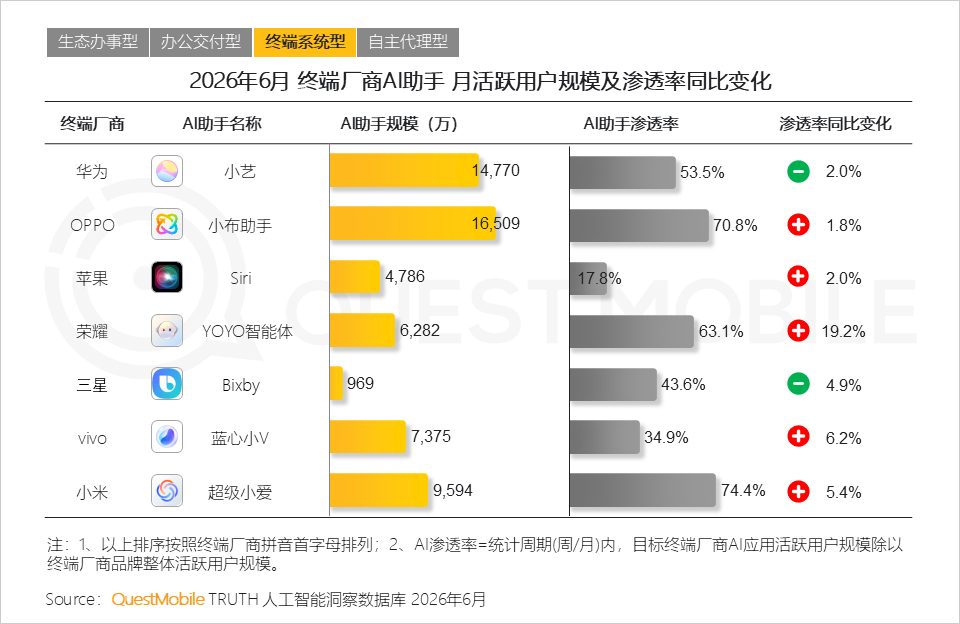
Figure 3: Scale of terminal manufacturer AI assistants and brand-internal penetration rates. Original figure from the July AI app semi-annual report, covering June 2026; the September report continues to use the same period's data. Source: QuestMobile
Penetration rate measures the active coverage of assistants among a brand's users. It directly relates to the starting point for promoting the next generation of AI products: The broader the coverage, the more conditions manufacturers have to promote new capabilities along existing usage relationships; with lower coverage, they must still vie for those who have already bought phones but do not actively use their proprietary assistants.
Xiao Bu and YOYO already have broad coverage bases and can promote more complex tasks to existing users. Blue Heart Xiao V must also address a more fundamental issue: getting more vivo users to adopt its system-level AI. As they prepare to release new flagship models, the assistant user bases among these manufacturers are already diverging.
Doubao's entry into the system coincides with this stage.
The QM semi-annual report shows that the monthly active users of the Doubao app reached 382 million in June 2026. Doubao brings its existing AI user base into the mobile phone system, and the collaborative model aims to transform this user base into a demand for system-level experiences. It can first make consumers recognize its assistant and then influence their choice of phones.
Next, it needs to strive for its existing AI capabilities to do more on mobile phones. Relying solely on a standalone app, the information it can access and the operations it can complete are still limited by system permissions and app openness. Collaboration with terminal manufacturers can provide more direct activation methods and deeper system integration.
The features demonstrated officially already reflect this intention. Users activate Doubao with a button press, and the assistant understands on-screen information within authorized ranges and executes tasks through tool invocation or simulated clicks. The official website also showcases processes for product consultations, parameter comparisons, and generating shopping cards, extending AI participation into the user's product selection process.
Competition thus enters the realm of benefit distribution. Users benefit from fewer page openings and repeated operations. Application platforms are concerned about whether users will still browse, compare, and decide within their interfaces. Once assistants begin participating in recommendations, the original service display and customer acquisition methods will face adjustments.
Mobile phone manufacturers also face concrete trade-offs. Introducing external AI can increase product appeal and shorten the time needed to fill capability gaps; at the same time, the more users rely on this assistant, the more they will evaluate devices around it. Once accounts, memories, and services can continue across devices, manufacturers must confront a tougher question: Do users still need to buy their phones to continue using this AI effectively?
Doubao has thus chosen a product form whose effects are easily visible and whose resistance is hard to avoid. To reduce user operations, it requires device and app cooperation; the deeper it intervenes, the more it must answer questions about access permissions and service selection. The application access policies, user authorization, and operational audit mechanisms set up on the official website are precisely to address these boundaries. 'Operating the phone' is still in Beta, with support limited to the system and ZTE apps, ByteDance-owned apps, and some third-party apps that have integrated.
Placing these conditions back in the context of the current timeline makes the purpose clear. New flagship models have not yet all debuted, and consumers are waiting to compare. Doubao first showcases another way to use mobile phones. The purchase discussions that originally revolved around imaging, chips, and new systems now have the opportunity to include an external assistant. Rather than just testing the waters, it is stirring things up.
This will bring pressure to the mobile phone manufacturers about to debut. In addition to showcasing how their new phones are better than the previous generation, they must also explain why their AI deserves priority use. What Doubao is vying for is precisely this period before consumers form their smartphone replacement judgments.
The more partners open up, the more Doubao can accomplish on behalf of users, and the more reason users have to turn to it first. For the same feature, consumers gain operational convenience, while companies face a redistribution of user relationships and service selection rights. Intensive releases place these divergences within the same round of product comparisons.
03 Device Scale Cannot Hide Assistant Coverage Gaps
When such comparisons fall on OV and Honor, the pressure is not evenly distributed.
Blue Heart Xiao V's penetration rate among vivo brand users is 34.9%, significantly lower than Xiao Bu's 70.8% and YOYO's 63.1%. During the same statistical period, vivo's lag in this indicator was quite prominent: It has sold a large number of phones but has not yet achieved assistant coverage among brand users comparable to its competitors.
According to QM's September report, the active device base of vivo reached 212 million units in June 2026, marking a 9.5% year-on-year increase. The company boasts a substantial and growing device base. However, it has not demonstrated a similar advantage in terms of assistant coverage.
The usage data further highlights this disparity. During the same statistical period, the monthly active users of Blue Heart Xiao V witnessed a 33.2% year-on-year increase. Yet, the per capita monthly usage frequency decreased by 18.3%, and the duration dropped by 45.8%. In contrast, Honor YOYO's monthly active users increased by 47.3%, with per capita frequency and duration rising by 22.1% and 62.6%, respectively. Xiao Bu's per capita frequency experienced a slight dip of 1.6%, while its duration increased by 17.5%. The scale expansion of Blue Heart Xiao V has not been accompanied by a corresponding growth in per capita usage.
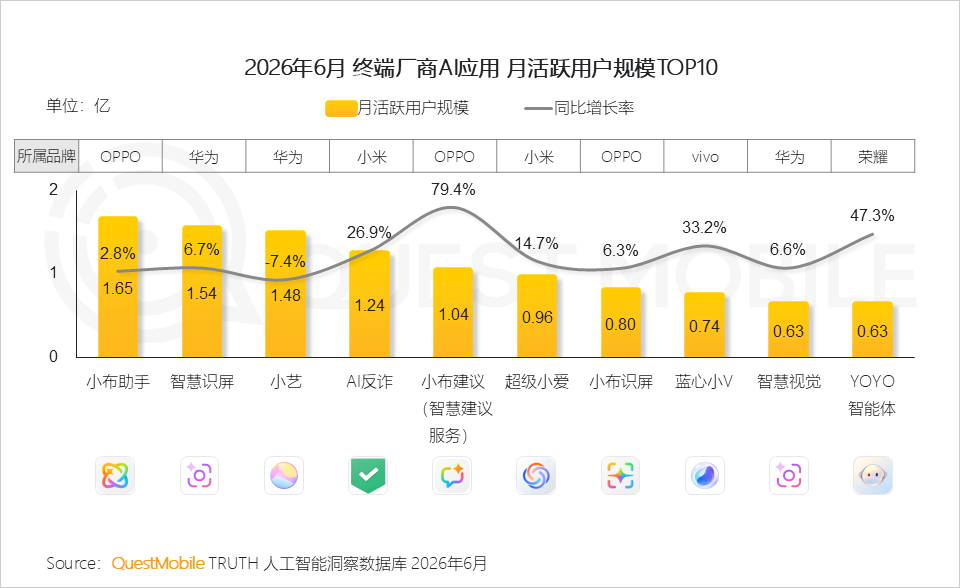
Figure 4: Monthly active user scale and year-on-year growth of AI apps from terminal manufacturers. Data is from the September smartphone report, covering June 2026. Source: QuestMobile
Blue Heart Xiao V had an average of 16.4 uses per month, higher than Xiao Bu's 15.6 and YOYO's 15.0. This indicates that vivo already has users willing to use its assistant. The next challenge is to expand this user base further while reversing the decline in per capita usage.
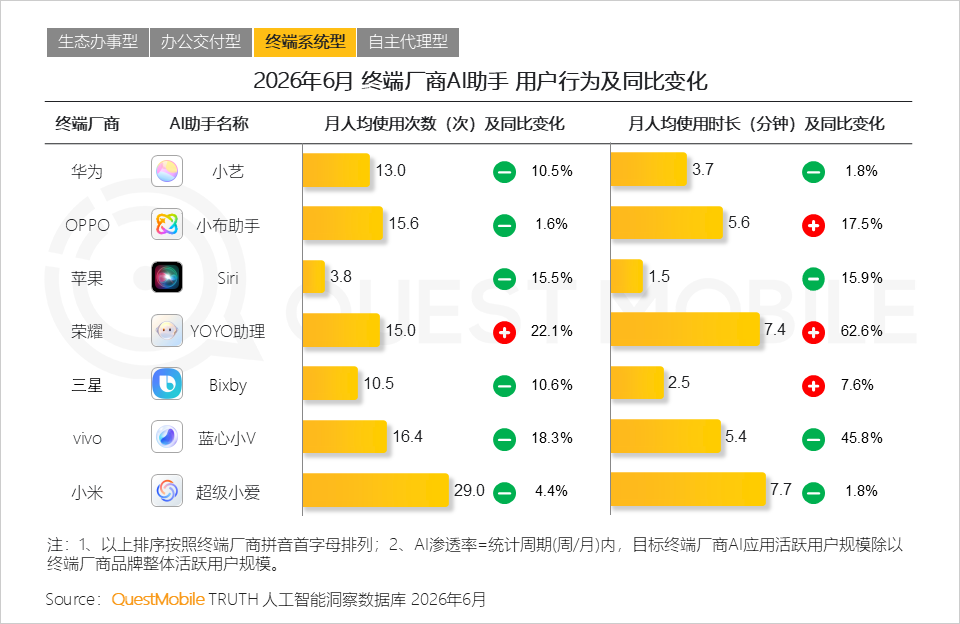
Figure 5: Per capita usage frequency, duration, and year-on-year changes for each brand's assistant. Data is from the July AI app semi-annual report, covering June 2026. Source: QuestMobile
The combination of lower coverage and declining per capita usage places vivo under dual pressure. It must attract more existing smartphone users and provide active users with compelling reasons to continue using its assistant. While new flagship models can generate a wave of trials, it is the daily needs that will determine how many users Blue Heart Xiao V can retain from these trials.
During its September product presentation, vivo continued to emphasize imaging capabilities. On September 7th, it held a creator summit in Yantai, where it upgraded its Blueprint Imaging strategy, previewed the video capabilities of the X500 series, and showcased an AI photography assistant that includes scene recognition, composition suggestions, and natural language photo editing.
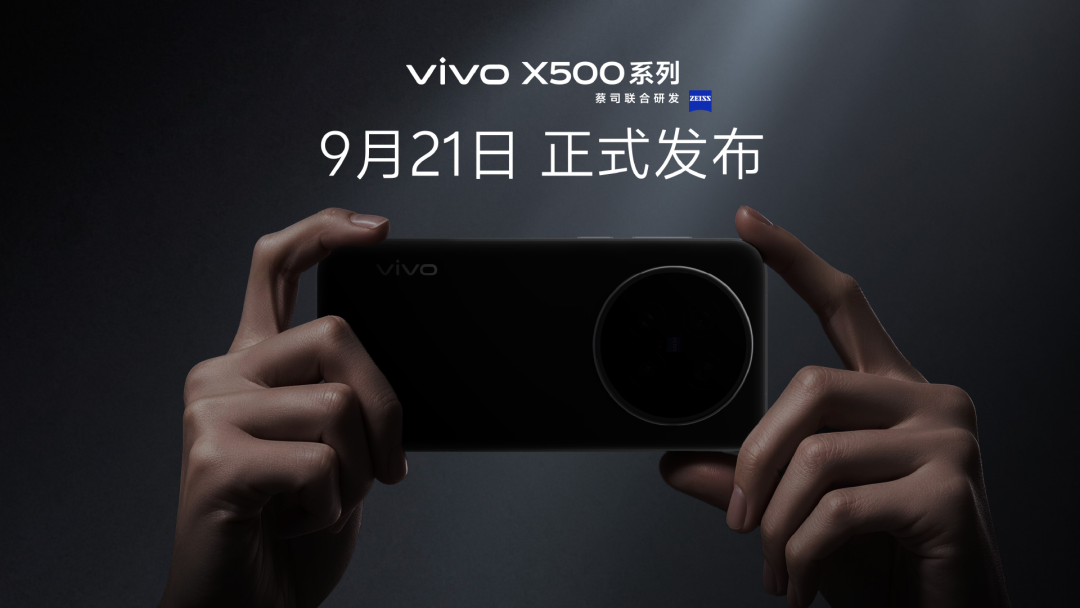
Figure 6: Official teaser for the vivo X500 series. The image is sourced from the press release of the Creator's Gala on September 7th; the new product is scheduled for release on September 21st. Source: vivo official website.
Imaging technology, brand recognition, and the creative ecosystem are long-term assets that vivo has accumulated. Continuing to upgrade shooting capabilities can leverage existing investments and provide easily perceivable reasons for purchasing new flagship devices.
However, this period of intensive releases requires vivo to extend its competition beyond shooting. When users ask AI to remove passersby from photos, it is a specific function call. Entrusting personal information organization and cross-application tasks to an assistant, however, builds a longer-lasting usage relationship. Doubao aims for the latter, while Blue Heart Xiao V's coverage within the vivo brand remains significantly lower than that of its competitors.
Using AI to further enhance imaging is the most familiar investment direction for vivo. Enabling assistants to integrate into users' daily lives, however, requires it to rearrange its R&D and product evaluation priorities. Whether coverage can expand and whether users can continue to use the assistant must occupy a more prominent position in resource allocation. Otherwise, each new flagship generation may add selling points, but the relationship between the assistant and users will remain weak.
vivo has already introduced 'Xiao V Memory,' which supports content saving, retrieval, and synchronization of collected content from some third-party applications. These capabilities directly enter users' daily information management and represent a significant opportunity for Blue Heart Xiao V to establish a sustained usage relationship.
OPPO and Honor can promote new capabilities across their broader existing coverage, while vivo must simultaneously catch up on penetration gaps. The new flagship in September provides an opportunity for concentrated promotion, but Doubao's entry makes this period even more urgent: consumers already have a comparable external option.
This is why low penetration is even more alarming at this point. A large number of users have chosen vivo hardware but have not yet established an active connection with Blue Heart Xiao V, giving external assistants the chance to first capture their daily needs. As useful information, preferences, and task records accumulate in another AI, the next device upgrade is more likely to revolve around 'how to continue using it effectively.' What vivo needs to strive for is the time before this usage relationship forms.
From the perspective of the September release window, Doubao has accelerated the challenges faced by traditional manufacturers. While others are still vying for a single purchase of new flagships, it has already begun competing for daily needs after the phone is sold. Once this demand flows steadily to external assistants, device manufacturers' influence over users will be squeezed.
In the fourth quarter of 2026, this competition will face practical tests: after the new system and cooperative models are launched, can the assistant expand coverage, retain users who have tried it, and reliably complete complex tasks? By 2027, the more noteworthy aspect will be how these usage habits influence device upgrade decisions and whether consumers will adjust their phone brand choices based on their experience with their preferred assistant.
The new flagship on September 21st represents an opportunity for vivo to concentrate on promoting its AI capabilities. On one hand, it must encourage existing users to adopt Blue Heart Xiao V more widely, re-establishing user mindshare and shifting perception from imaging strengths to AI capabilities. On the other hand, it must retain users with high-frequency practical functions beyond photography.
Now that the smartphone market is nearing saturation, the key to firmly grasping users lies in the daily experience with AI assistants.
-
![]()
Rescuing Neta Auto: Even Taiyi Zhenren Steps In, and Associated Company’s Value Soars by 2.5 Billion Yuan
-
Why Does 'Taiyi Shenglian' Step In to Save Neta?
-
![]()
Registered Capital Sees Slight Reduction to 110.7291 Million Yuan! Yongxin Optics Finalizes Industrial and Commercial Registration Amendments
-
![]()
Renaming Marks the Start: Conant Optics’ Smart Glasses Business Gets a Full-Throttle Boost
-
Amazon’s Shift to Passkey Compels Home Furnishing Brands to Overhaul Backend Access Controls
-
![]()
Doubao Mobile Phones: Opting for the Path of Maximum Public Discourse
-
![]()
OpenAI Hits Pause on the AI Race: The Hype Around Large Models Cools Down, and Enterprise AI Enters the Era of Results-Based Adoption
-
![]()
Li Feifei's Atlas Opens the Door to a New World for Embodied AI