After 7 Years of Anticipation, Apple's Foldable Phone is Finally Here! Starting at $15,999, Samsung Quickly Responds with a "Copycat" Launch...
 09/10 2026
 369
369
Serena Chen, DeepBlue Technology, Reporting from San Francisco
The iPhone 18 Pro is here, the foldable phone is here, dual battery life is here, and the Apple Watch ready for emergencies is here... and so is the new leader.
Apple's "Surprise and Shine" event kicked off at Apple Park on time last night (10 a.m. U.S. time on September 9, 1 a.m. Beijing time on September 10) and wrapped up after an hour and forty minutes. Seven new products were unveiled at once: the iPhone 18 Pro series, the first foldable iPhone Duo, Apple Watch Series 12, Apple Watch Ultra 4, AirPods 5, along with system updates for iOS 27 and watchOS 27. 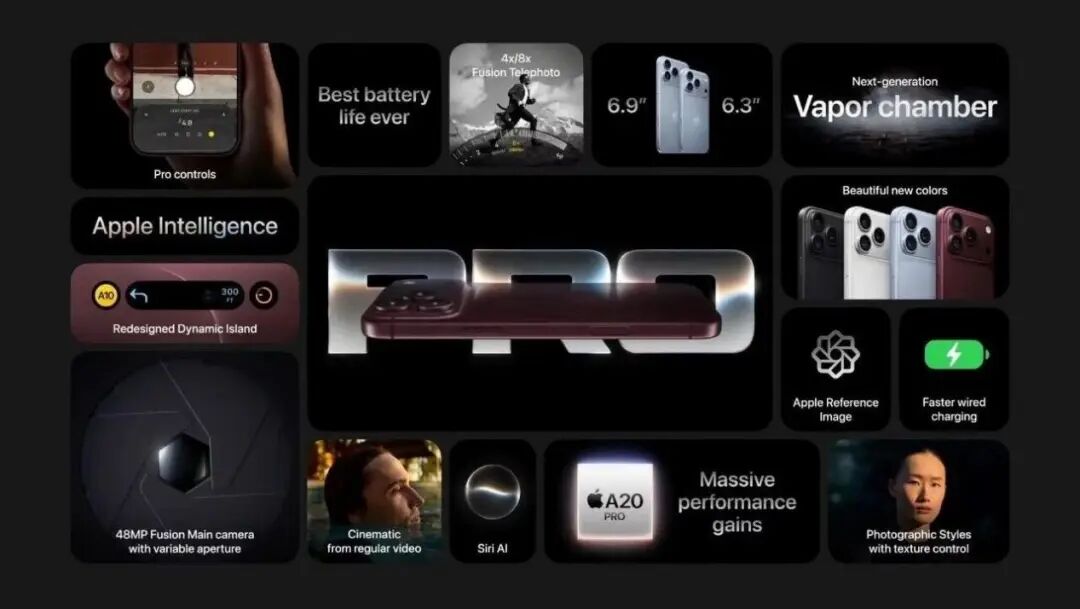
Let's cut to the chase: The foldable Apple Duo is indeed coming, but you won't get it even if you order now—it ships a full month later than the other new products. One has to admit, Apple still knows how to play the hunger marketing game.
Tim Cook didn't appear on stage himself; this marked the first solo flight for new CEO John Ternus after Cook stepped down as CEO.
Excited netizens continued the tradition of staying up all night to queue, with our dedicated price reporter on the scene 
Let's break it down one by one.
Cook Steps Back, 51-Year-Old "Tech Geek" Ternus Makes His Debut
Everyone was eager to see the new boss's debut: The biggest highlight of this event actually lay beyond the products.
Apple's executive shakeup was officially announced in April and took effect on September 1—Cook stepped down as CEO to become Executive Chairman, primarily responsible for "engaging with global policymakers"; his successor is former Senior Vice President of Hardware Engineering John Ternus, 51, a Penn Engineering graduate who joined Apple right after graduation in 2001 and has worked there for 25 years, leading key hardware projects like AirPods, Apple Watch, and Vision Pro in recent years.
Cook places great importance on this successor, fully expecting him to excel.
In the handover letter, Cook was full of praise, saying, "He has the mind of an engineer and the soul of an innovator"; Ternus didn't hold back either, stating, "I feel incredibly honored to take on this role at a truly great company... there's no other team in the world I'd rather build the future with."
So this event could be seen as Ternus's "first final exam." From the on-stage presentation, he continued his consistent engineer style, diving deep into chips and sensors without much of Cook's emotional branding.
iPhone 18 Pro: Price Hike or Not, It Finally Offers Something Practical
The iPhone 18 Pro / Pro Max follows the familiar formula: a 2nm A20 Pro chip with 40% faster GPU than the previous generation; the 48MP main camera upgrades to a physical variable aperture, supporting manual adjustments for aperture, shutter speed, and white balance—photography enthusiasts now have something to work with. Battery life is touted as Apple's "longest ever," with the Pro Max offering up to 45 hours of video playback and 50% charge in just 15 minutes. Two new colors are added: Glacier Blue and Burgundy Red.
One notable feature that's not exactly about "performance":
Can't tell real photos from AI-generated ones? Apple steps in.
A technology called "Apple Reference Image" provides signed authentication for sensor data to prove photos haven't been tampered with by AI. Given the current flood of AI-generated images, this move is quite "timely"—marking Apple's first direct response in imaging to the question of "how to prove a photo is real, not generated."
Price: Pro starts at $1,199, Pro Max at $1,299, with pre-orders on September 12 and availability on September 18—neither a surprise nor a shock.
The Foldable Phone is Finally Here: Starting at $1,999, But You'll Have to Wait Another Month
This was the true star of tonight—Apple's first-ever foldable phone, the iPhone Duo (previously rumored as "iPhone Ultra," but the name changed). After seven years of rumors, it's finally reality. 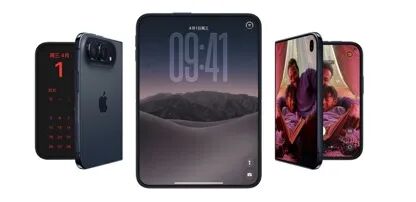
The specs aren't complicated: When closed, it's a regular palm-sized slab; when unfolded, it becomes a 7.6-inch large screen (with a 5.4-inch outer screen), featuring a titanium body and IP68 water and dust resistance. Two "unexpected moves" stand out:
First, Face ID is gone, replaced by side-button-integrated Touch ID. This marks Apple's flagship models' first biometric regression in a decade—not due to technical limitations, but because Face ID sensors couldn't fit in the foldable form factor, leading Apple to compromise.
Second, the price is lower than rumors suggested. Foreign media previously predicted a starting price between $2,000 and $3,000, but the official announcement is $1,999 (256GB), with the top 2TB version at $3,199—slightly more "friendly" than expected, though still more than double the price of an iPhone 18 Pro Max for most people. It shares the same chip platform as the iPhone 18 Pro, features dual 48MP rear cameras, supports Apple Pencil, and comes in Star White and Midnight Black.
Tech media AppleInsider's review was spot-on: "Feature-rich, full of trade-offs, yet surprisingly affordable." This sentence basically sums up all the contradictions of this device.
But here's the key point: You can't pre-order it on September 12. Pre-orders for the iPhone Duo begin on October 16, with availability on October 23—a full five weeks later than the iPhone 18 Pro. The first batch covers over 70 countries and regions, including the U.S. and China, with a second batch on October 30 covering 28 more countries. In other words, Apple has intentionally created a more than one-month gap between "announcement" and "availability"—a rare move in Apple's product launch history, suggesting the inaugural model's production ramp-up still needs more time.
Let's see what netizens have to say: 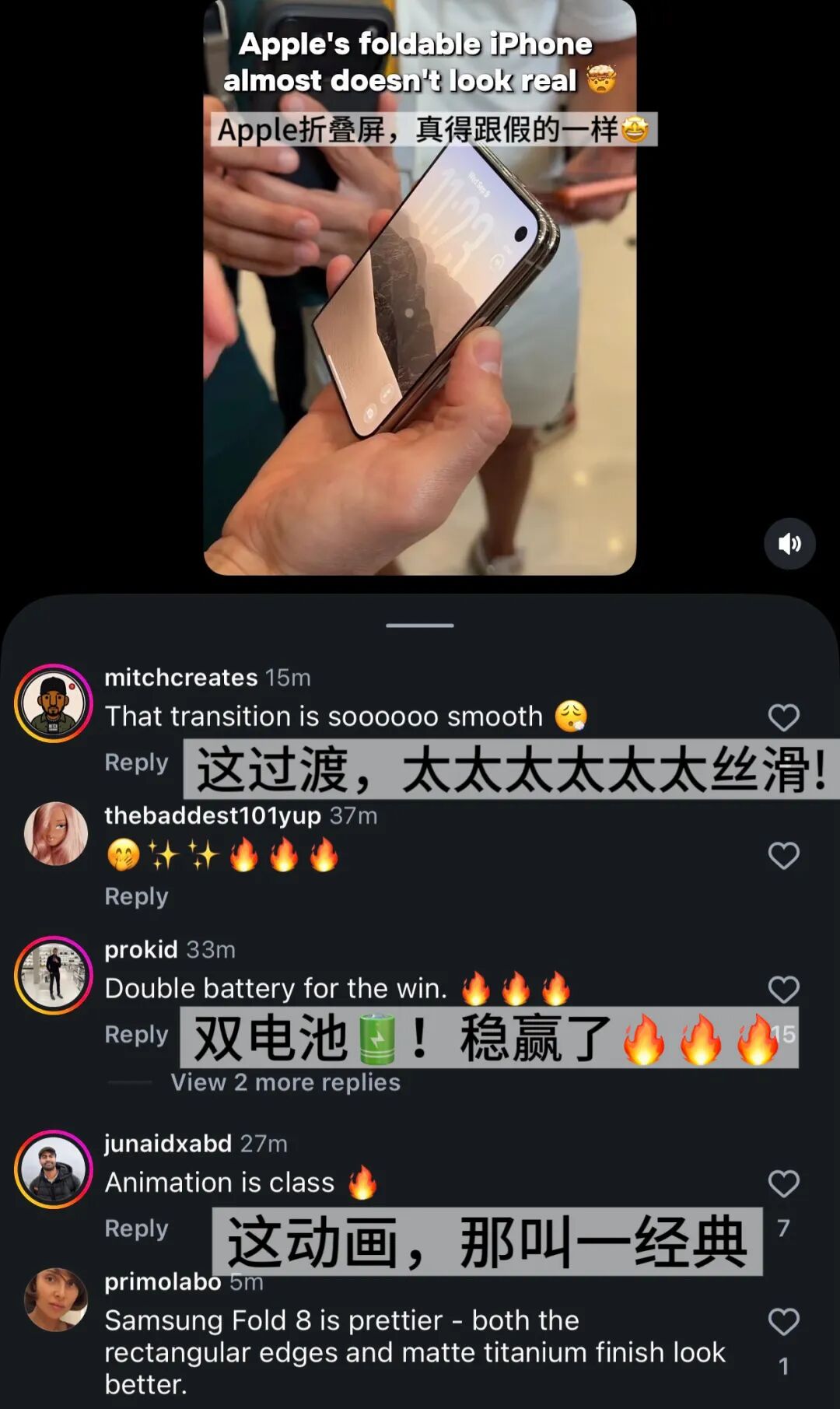
While many netizens expressed excitement, some unexpected voices emerged, like this "spy" sent by Samsung next door. Interestingly, this company really made its presence felt at Apple's home turf.
Coinciding with this off-stage episode: A few hours before the event started, Samsung released a 35-second ad on YouTube, highlighting the Galaxy Z Fold 8 as the "world's lightest foldable" (weighing 201 grams); Hee-Cheul Moon, Samsung's head of mechanical R&D, publicly stated the same day that "the core user value of foldable products lies in weight."
This statement, while not naming names, clearly targeted Apple—media previously estimated the iPhone Duo's weight between 230 and 241 grams, close to the iPhone 17 Pro Max and nearly 20% heavier than Samsung's model (this weight hasn't been officially confirmed by Apple yet, for reference only).
One has to admit, both companies know how to play the game. Clashing on launch day, Samsung's "intercept marketing" was even more entertaining than the specs themselves.
Apple Watch Duo: Health Monitoring Takes Center Stage
The Apple Watch Series 12 and Ultra 4 also received updates, with no surprises in their main focus—health monitoring.
Seeing that intense emergency scene at the event, we almost thought the Apple Watch could act as a paramedic. 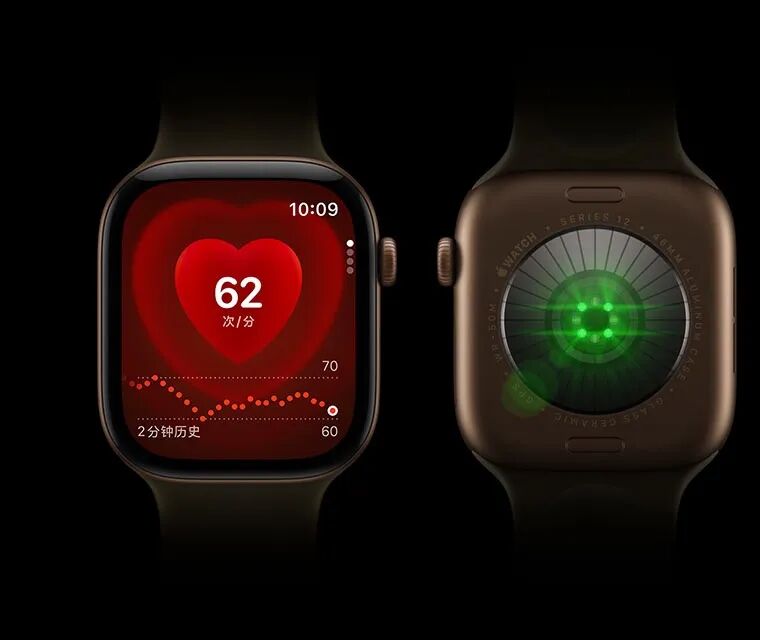
The Series 12 starts at $399 (42mm aluminum case), featuring the new S11 chip—Apple calls it the "first true hardware upgrade in three generations";
Heart rate variability (HRV) monitoring frequency increases to once every 5 minutes, 24 times denser than the previous generation;
Outdoor exercise battery life improves by 25% to 10 hours, with 15 minutes of fast charging providing 12 hours of use;
The ceramic case, discontinued for six years, makes a return in Pearl White and Midnight Blue;
The screen switches to Ceramic Shield 2, claimed to be 60% stronger.
The Ultra 4 starts at $799, with battery life extending to 50 hours, 84 hours in low-power mode, and 45 hours of continuous GPS tracking—enough for a 100-mile ultramarathon; 15 minutes of fast charging adds 18 hours of battery life. Apple has firmly positioned the Ultra series—not as a "more expensive Apple Watch," but as an "Apple Watch for serious outdoor enthusiasts."
Both watchOS 27 updates arrive on September 14, shipping alongside the iPhone 18 Pro on September 18.
AirPods 5: Nothing Special, But It Has Everything It Needs
The AirPods 5 improve noise cancellation by 50% compared to the previous generation, offering 5 hours of listening with ANC on. The standard version costs $129, with the wireless charging case version at $149, shipping on September 18. This was the "least surprising" product at the event, and Apple didn't spend much time discussing it.
By the Way: Siri AI is Coming, European Users Will Have to Wait
On the software front, iOS 27 rolls out on September 14, with the highly anticipated Siri AI launching the same day in English beta, followed by French, Japanese, Korean, Portuguese, and Spanish versions in October. One notable point: Siri AI won't debut in the EU initially—given the regulatory environment, this isn't Apple's first delay in Europe.
In a Nutshell
This event didn't end with a "one more thing" surprise or Cook's emotional sign-off. Ternus delivered his first report as Apple CEO with an engineer-focused presentation: chips iterated as expected, imaging added a new "anti-AI forgery" feature, the foldable phone finally arrived but clearly faces production shortages, and prices are friendlier than rumors suggested but still not cheap.
The biggest suspense of the event wasn't whether the foldable phone would launch, but the five-week gap between "announcement" and "availability"—more telling than any spec: Apple's first foldable phone might not be as "ready" as the company wants to appear.
Ultimately, the new boss kept a lower profile than the products, aligning with public expectations: Don't overshadow the products; let technology speak for itself.
He looks sharp, embodying the tech elite image continue ed since Jobs and Cook: lacking Jobs' romantic edge and Cook's polished charm, he presents a calm, efficient new face for Apple. 
-
![]()
The Loss Conundrum and the High-End Wager: Xiang Xingchu Declares, 'JAC Embarks on Its Third Trailblazing Journey'
-
![]()
'Problematic Stock' Plummets for a Decade, Then Suddenly Surges to Limit Up for Two Straight Days! Is the Auto Sector Making a Resurgence?
-
Value and Cost: Validations from Anthropic and Zhipu
-
![]()
Eliminating Set-Top Boxes: A Panacea for the TV Industry’s Woes?
-
Who Defines 'AGI' Defines the Future
-
![]()
What Unfolded Following Tesla's Substantial Price Reduction?
-
![]()
4-Minute Surge: 10,000 Orders Secured for Xiaomi Pengcheng, Sparking Hot Search Trend. Lei Jun: Extended-Range Vehicles Hold Immense Promise
-
The Future Trajectory of AI Large Models