Development of the Satellite IoT Industry from the Perspective of the Competitive Landscape Matrix
 09/29 2026
 477
477
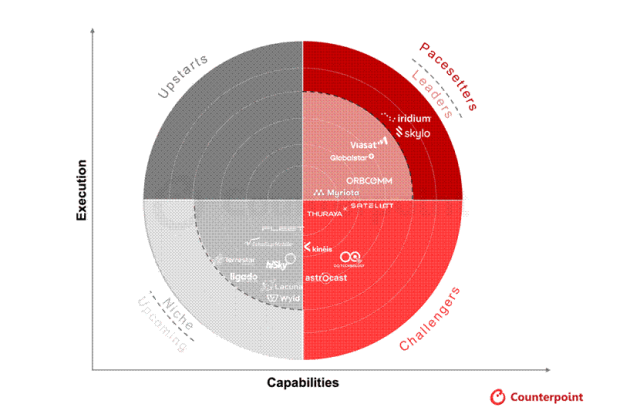
Recently, market research firm Counterpoint Research released its annual Satellite IoT Connectivity CORE Evaluation Matrix. Based on data from the first half of 2026, the matrix systematically evaluates 18 overseas satellite IoT players across two dimensions: Capabilities and Execution. Players are categorized into four quadrants: the Leader quadrant includes a subset called Pacesetters, while the Challengers and Niche quadrants also encompass multiple enterprises.
Counterpoint analysts note that with the maturation of 3GPP NTN standards and hybrid satellite-terrestrial connectivity architectures, satellite communications are accelerating integration into the cellular ecosystem. Mobile operators, virtual operators, chip and module manufacturers, terminal vendors, and IoT platforms are all entering the fray, shifting the competitive focus from network availability to scalable delivery of connectivity value. China has launched commercial trials for satellite IoT, making it crucial to deeply understand and benchmark against overseas satellite IoT players.
Overseas Satellite IoT Competitive Landscape
1. Pacesetters: Iridium and Skylo Lead the Way
In the matrix, Iridium and Skylo are jointly recognized as Pacesetters within the Leader quadrant, but they represent vastly different development paths. Iridium follows a dedicated network deepening strategy, leveraging a mature in-orbit constellation, a large existing IoT user base, and an extensive partner ecosystem while continuously investing in hybrid connectivity and standardization. Its strength lies in network reliability, validated over two decades, with a deep pay customer base in high-end markets such as global logistics tracking, maritime, and aviation.
Skylo, on the other hand, pursues a standard ecosystem reconstruction path. Instead of building an independent constellation, it deeply integrates with mobile operators, chip vendors, and terminal ecosystems to promote standardized satellite connectivity based on 3GPP NTN, enabling seamless access to satellite networks for ordinary cellular modules and terminals.
2. Leaders: Incumbents Navigate Transition
Viasat (post-Inmarsat merger), Globalstar, ORBCOMM, and Myriota form the Leader camp. Viasat gains an edge with its portfolio spanning both high and low Earth orbits; ORBCOMM and Globalstar expand through mature industrial IoT and tracking services; Australia's Myriota excels in ultra-low-power direct connectivity and is extending its capabilities to hybrid architectures. Common traits among this group include existing assets and cash flow, but they face transformational pressures amid standardization waves.
3. Challengers: Divergent Technical Approaches
Sateliot and OQ Technology focus on tightly coupled solutions with the cellular ecosystem around 3GPP NB-IoT NTN; Thuraya advances 3GPP-compatible NTN through collaboration with Skylo; while Kinéis and Astrocast adhere to proprietary non-3GPP technologies. It is predictable that among players with similar technical capabilities, future differentiation will primarily hinge on the scale of commercial execution, market reach, and application breadth.
4. Niche Players: Regional and Scenario-Based Deepening
Fleet, EchoStar Mobile, Ligado, Lacuna, Wyld, and others target niche markets, surviving through regional presence and tailored solutions for specific scenarios. The matrix evaluation suggests that during the early market stage, niche players still have a window to break through upward by leveraging their professional capabilities.
Common Trends in Satellite IoT Development
The Counterpoint matrix reveals several common trends in the satellite IoT sector, including:
First, standardization has emerged as a critical "reshuffling" variable. After the introduction of the NTN standard framework in 3GPP Release 17/18, satellite connectivity can leverage the scale effects of the terrestrial cellular supply chain, leading to rapid cost reductions in terminal modules. This is a key reason for the rise of asset-light players like Skylo and Sateliot.
Second, hybrid connectivity has become the default architecture. Satellites are no longer alternatives to terrestrial networks but rather components of a cellular-satellite multi-link intelligent switching system. This requires players to possess hybrid connectivity management capabilities at the core network fusion, unified billing, and device management levels.
Third, the importance of commercial execution is increasingly prominent, jointly determining enterprise competitiveness alongside network capabilities. Counterpoint explicitly states that secure, compliant, and reliable connectivity is becoming a baseline requirement rather than a differentiator, with success hinging on device integration depth, ecosystem interoperability, and scaled deployment.
China's Progress in Satellite IoT from an Overseas Perspective
From a policy standpoint, China has fully rolled out initiatives from top-level planning to commercial trials. Since 2024, satellite internet has been incorporated into strategic industrial layouts. In August 2025, the Ministry of Industry and Information Technology (MIIT) issued the "Guidelines on Optimizing Business Access to Promote the Development of the Satellite Communications Industry," explicitly proposing to organize commercial trials for satellite IoT and support eligible enterprises in leveraging low-Earth-orbit satellite IoT constellations to provide wide-area IoT connectivity services for sky, ocean, and remote regions. In November 2025, MIIT issued the "Notice on Organizing Commercial Trials for Satellite IoT Services," officially launching commercial trials open to industry users in sectors such as industry, transportation, energy, agriculture, and emergency response. In September 2026, the "15th Five-Year Plan for the Development of the Information and Communications Industry" further committed to promoting the commercialization of satellite internet and satellite IoT, with approvals for a new round of commercial trials for China's low-Earth-orbit satellite IoT Synchronized landing .
In terms of constellations and network infrastructure, China is advancing multiple constellations simultaneously. At the constellation level, China has formed a multi-tiered satellite IoT supply landscape. The China Starnet GW constellation, as the national mainstay, is accelerating network deployment, while Shanghai-based Yanxi's Qianfan constellation has over 200 satellites in orbit. Geely Constellation by Time and Space Dao Yu has completed its first phase of 64 satellites, and Guodian Gaoke operates 41 satellites in orbit, both focusing on IoT data services. Additionally, high-throughput satellites, Tiantong-1, and Beidou short messaging form a collaborative high-low orbit resource pool.
From a standardization deployment perspective, all three major Chinese operators have deeply engaged with 3GPP NTN, and domestic 3GPP ecosystem vendors are vigorously promoting the landing of NTN-standardized products.
Compared to the Counterpoint matrix, China's satellite IoT sector exhibits distinct advantages, including strong policy support, rapid constellation construction, manufacturing cost reduction capabilities, and a unique environment for satellite-terrestrial integration facilitated by China's massive terrestrial cellular networks. However, gaps remain, such as the lack of scaled revenue for satellite IoT operators and insufficient accumulation of international commercial brands, global service networks, and multinational enterprise clients.
Looking ahead, standardized NTN and proprietary networks may coexist long-term, but the incremental market will likely favor standardized solutions. Meanwhile, competition is shifting from constellations to the integration of constellations, operations, and terminals. Furthermore, the Skylo model demonstrates that asset-light integrators can mobilize the entire cellular ecosystem, suggesting the potential emergence of similar ecosystem integrators in China.
For domestic enterprises, adhering to the 3GPP NTN standard path is essential to avoid technological silos and directly leverage global cellular supply chain achievements. Focusing on key sectors and implementing commercialization strategies that achieve breakthroughs in critical scenarios—such as prioritizing replicable models in connected vehicles, low-altitude economy, marine fisheries, and emergency management—will nurture leading enterprises deeply rooted in China yet globally oriented during this pivotal window for global satellite IoT development.
-
![]()
Seres Struggles to Escape Huawei's 'Influence'
-
The AI 'Golden Rice Bowl' of FDE Amid Massive Layoffs
-
![]()
NIO and Geely Cross-Hold Shares: Pioneering a New Auto Industry Joint Venture Focused on Battery Swapping
-
![]()
From 1.3 Trillion to 300 Billion: The Vanishing Trillions in Market Value—Is the Zhipu AI Boom Over?
-
![]()
What Supports Chinese Cinema in the Absence of Blockbusters During the National Day Holiday? | 2026 Chinese Film Report and Overseas Trends
-
US$8.2 Billion: Silicon Valley's Top-Tier 'Girls Help Girls'
-
![]()
Are DOE and Metasurfaces Truly Distinct Entities?
-
![]()
Manus Founder Xiao Hong: Manus Preceded the Advent of Codex and Claude Collaboration