Qualcomm Pays Huawei, Yet Chip Sales Remain Restricted
 10/08 2026
 566
566
On October 5, Huawei and Qualcomm unveiled a patent cross-licensing agreement, sparking initial speculation that Qualcomm chips would soon return to Huawei's supply chain. 
However, this assumption is incorrect. Qualcomm's move primarily involves paying patent fees, with no alteration to the existing chip export controls. Thus, Huawei continues to be without Qualcomm chips. Over the past 25 years, the dynamics between the two companies have shifted dramatically, with offensive and defensive positions interchanging seven times. 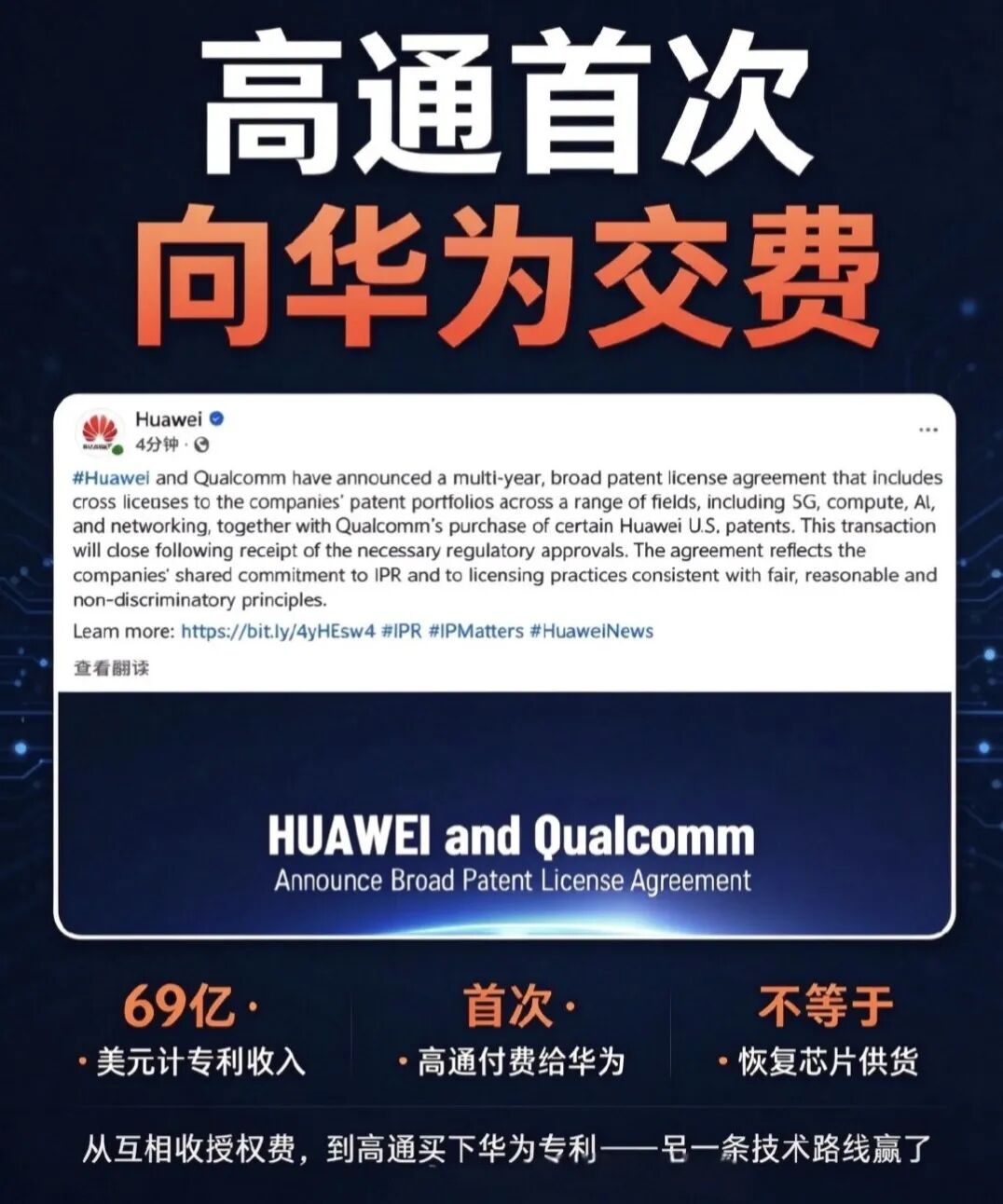
For the first time in 25 years, Qualcomm has assumed the role of a 'net payer.' In 2001, Huawei began paying Qualcomm for patent licensing, a position it maintained for over two decades. In 2017, a dispute arose over royalty rates, leading to a settlement in 2020, wherein Huawei made a lump-sum payment of $1.8 billion in overdue fees.
The previous agreement was set to expire at the end of 2024, and renewal negotiations faced obstacles. The turning point occurred this year—in August, Huawei secured a Wi-Fi patent agreement with HP, followed by the finalization of the Qualcomm deal on October 5. Qualcomm is now utilizing over 680 Huawei patents, representing a mere 0.23% of Huawei's extensive portfolio of nearly 300,000 patents.
Yet, this 0.23% encompasses some of the most advanced technologies in computing and networking, including near-package optical interconnects and related patents that support logical folding chip technology. According to the China Academy of Information and Communications Technology, Huawei leads globally with a 14.59% share of 5G standard-essential patents, while Qualcomm trails closely with 10.04%.
Controversy surrounds the deal, particularly regarding whether the Federal Trade Commission (FTC) will approve it. With a value exceeding $133.9 million, the agreement triggers a review under the U.S. Hart-Scott-Rodino Antitrust Improvements Act.
The situation presents a political conundrum: Huawei remains on the Entity List, yet Qualcomm is investing in Huawei's patents. This paradox underscores the complex interplay between technology and politics.
Adding to the intrigue, neither Qualcomm's nor Huawei's official announcements explicitly mentioned 'logical folding.' Bloomberg initially reported on the logical folding authorization, but neither company's official statements have confirmed it. This raises questions about how Qualcomm plans to address its AI chip deficiencies if Huawei has not licensed logical folding technology. 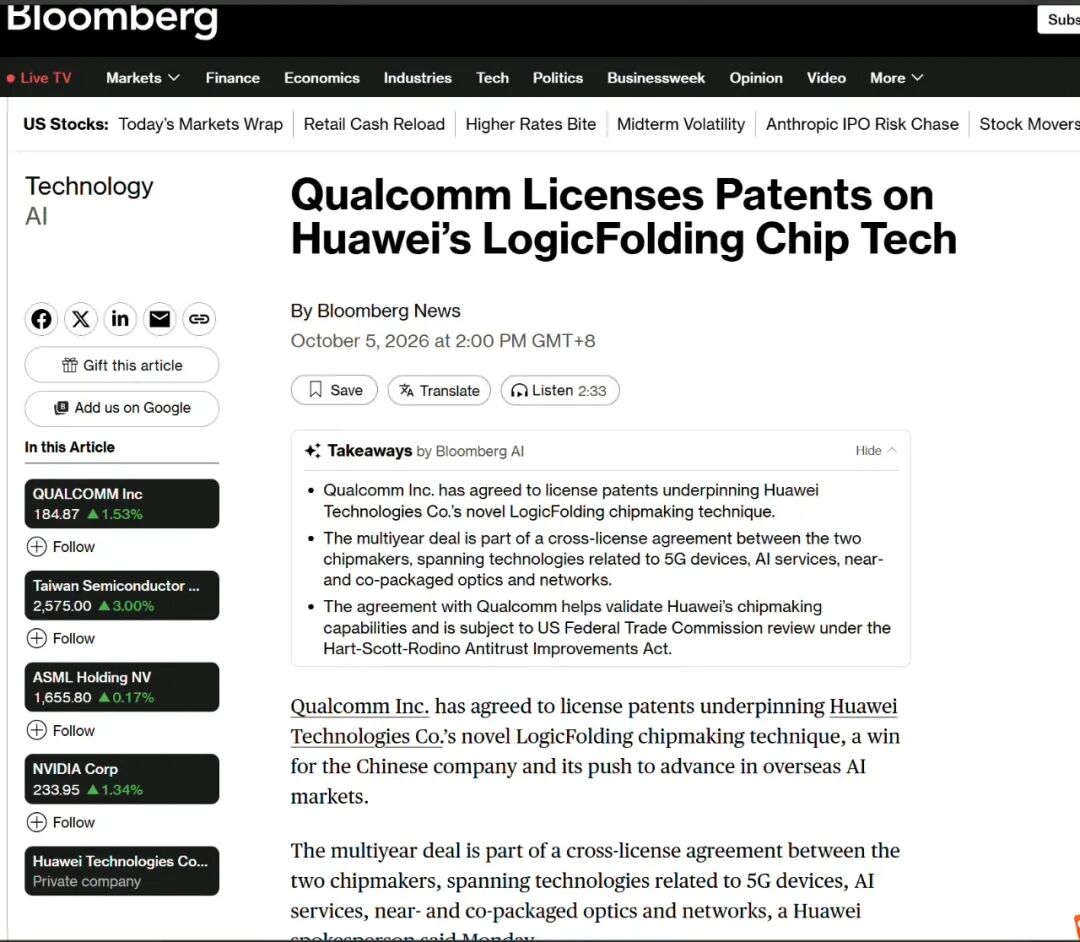
Observation reveals that the true beneficiary may not be Huawei or Qualcomm alone. The core value of logical folding lies in its potential to enhance performance without relying on EUV lithography. If this approach proves viable and gains widespread adoption, it could reshape the global semiconductor competition landscape, challenging TSMC's dominance in advanced processes. Qualcomm's patent acquisition is not merely a financial transaction but a strategic move to secure a foothold in the AI era. However, the effectiveness of this strategy hinges on Washington's regulatory stance.
What are your thoughts on whether the FTC will approve this deal? Share your opinions in the comments section.
#HuaweiQualcommPatentAgreement #LogicalFolding #FTCReview #MaoQiyingAICircle
-
![]()
Will Chinese Cars Secure 20% of the European Market This Year?
-
![]()
Qualcomm Pays Huawei, Yet Chip Sales Remain Restricted
-
![]()
The Android Moment of Embodied AI Lies in the Cost of Switching Bodies
-
![]()
After Testing ChatGPT dot, I Understand Why Big Companies Must Develop Personal Agents
-
![]()
SAIC Surpasses BYD! Automakers' 2026 Yearly Goals Prove to Be a Daunting Task
-
![]()
Leapmotor Surges Ahead! Li Auto and HiMo Harmony Intelligent Travel See Declines, September’s New Energy Vehicle Market a Blend of Triumph and Challenge
-
![]()
SERES and Huawei Make a Dramatic Shift! AITO Launches Ultimate Evolution Strategy
-
![]()
Changan Automobile Takes Action: What Lies Ahead for Deepal and Avatr?