Trading Suspended! GAC Group Launches Significant Restructuring
 09/15 2026
 576
576
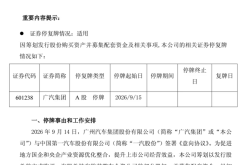
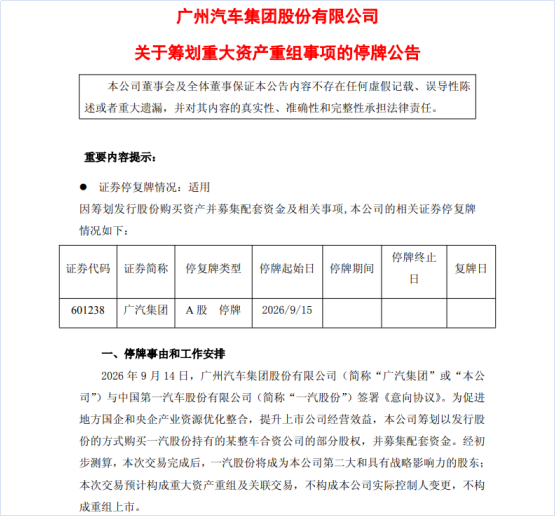
On the evening of September 14, GAC Group released a trading suspension notice, officially putting an end to the long-standing rumors circulating in the market regarding asset restructuring between GAC and FAW.
According to the notice, GAC Group has entered into a Letter of Intent with FAW Group to plan the acquisition of a portion of the equity in a joint-venture automotive company held by FAW Group through share issuance, along with raising corresponding funds. Preliminary calculations indicate that upon completion of the transaction, FAW Group will emerge as the second-largest and strategically influential shareholder of GAC Group.
Trading of GAC Group's A-shares has been suspended since September 14 and is anticipated to resume within no more than 10 trading days. The notice underscored that this transaction is expected to constitute a major asset restructuring and related-party transaction, but it does not entail a change in the actual controller or constitute a restructuring listing.
The notice disclosed that due to the restructuring target involving an overseas-listed company, the name has not yet been revealed. However, market speculation predominantly points to FAW Toyota. Currently, Toyota has established joint ventures with both GAC and FAW. If it is ultimately confirmed that this restructuring involves equity in FAW Toyota, it would signify that Toyota's long-standing "dual-channel, dual-system" structure in China is evolving towards a more streamlined direction.
Sources indicate that North and South Toyota are planning to establish a unified sales company, with Toyota holding a 50% stake and FAW and GAC each holding 25%.
GAC's transaction is not about "who acquires whom" but rather an "equity-for-equity swap." Without utilizing any cash, GAC will acquire equity in the joint-venture company held by FAW through the issuance of new shares, while FAW will become a strategic shareholder of GAC through asset contribution.
For GAC, which is currently under profit pressure, this arrangement circumvents further strain on its cash flow. In the first half of 2026, GAC's consolidated revenue surpassed 46.5 billion yuan, marking a 9.13% year-on-year increase. However, its net profit attributable to shareholders was approximately -4.467 billion yuan. Despite improved sales, the situation remains challenging, with cumulative sales of 1.0126 million units from January to August, representing only a 0.21% year-on-year increase, including 368,200 new energy vehicles, up 63.06% year-on-year. At a stage where continuous investment in the independent new energy sector is still necessary, completing asset integration through equity rather than cash is a pragmatic choice.
For FAW, securitizing a portion of its joint-venture assets not only activates existing assets but also establishes a capital link in the southern market. Delving deeper, FAW boasts strong foundations in Hongqi, Jiefang, northern channels, key accounts, and manufacturing systems. However, it has been relatively slow in large-scale new energy and intelligent operations targeting the mass market. In contrast, GAC is closer to the consumer end in terms of Aion, Trumpchi, Hyper, batteries, intelligent driving, the South China Supply Chain, and overseas expansion. There is ample room for further cooperation between the two parties in areas such as intelligent electric R&D platforms, joint procurement cost reduction, north-south channel integration, and even overseas collaboration.
From a policy standpoint, this restructuring aligns with the trajectory of central and local state-owned enterprise integration. Just a few days prior to the announcement, the "15th Five-Year Plan for the Development of the Intelligent Connected New Energy Vehicle Industry" issued by nine departments, including the Ministry of Industry and Information Technology, explicitly proposed "intensifying efforts for lawful mergers, acquisitions, and cross-regional integration among automotive enterprises." FAW is a central enterprise, while GAC is a municipal state-owned enterprise under Guangzhou. Their capital cooperation exemplifies the practice of advancing resource integration through market-oriented means within a policy framework.
From the integration attempts between Dongfeng and Changan to the impending partnership between GAC and FAW, the consolidation of state-owned assets in China's automotive industry is accelerating towards implementation. GAC's equity-for-equity restructuring may not immediately transform the companies' profitability, but it opens a noteworthy window—when capital links between central and local automotive enterprises are truly established, resource barriers can be gradually dismantled. The complementary technological, production capacity, and market advantages of both parties can achieve deep integration, addressing long-standing industry issues such as redundant R&D, homogeneous competition, and resource fragmentation, and fostering synergies at this critical juncture of electrification and intelligent transformation.
-
The 'Three-tier Deconstruction' of the Restructuring Intentions Between FAW and GAC
-
![]()
"Living Room on Wheels": Pie or Trap?
-
![]()
Zhipu Secures Nearly US$5 Billion in Funding
-
![]()
FAW and GAC Integration: Will China's North and South Toyota Further Merge, and Will Dongfeng Continue Its Consolidation Efforts? | MINGJINGpro
-
![]()
Goldman Sachs Sets Its Sights on a City: Ulanqab!
-
![]()
The City in Goldman Sachs’s Spotlight: Ulanqab!
-
How Should Gas Stations Adapt Amid Declining Fuel-Powered Vehicle Sales?
-
![]()
Should GAC Shareholders Be Concerned: FAW Opts Not to Invest Cash but Lightens Its Joint Venture Load to Become Second-Largest Shareholder!