Has the Modular Architecture of Autonomous Driving Disappeared After the Emergence of End-to-End Systems?
 09/20 2026
 479
479
From modular to end-to-end, the way autonomous driving understands the world has been completely transformed.
While modular systems are logically clear, they struggle in complex urban driving scenarios.
End-to-end systems often emerge to address the issues inherent in modular architectures. But after the rise of end-to-end systems, has the modular architecture truly disappeared?
01 Is Single-Stage End-to-End Still the Only Answer?
The development of Tesla's FSD has become a significant factor driving the end-to-end approach.
Starting with FSD V12, Tesla significantly reduced traditional rule-based code, allowing neural networks to handle more driving decision-making tasks. This is widely regarded as a key marker of single-stage end-to-end systems.
A single-stage end-to-end system begins with sensor inputs and uses a large neural network to directly generate driving actions, bypassing traditional independent modules like perception, prediction, and planning.
By 2026, end-to-end technology itself is evolving.
While Tesla's FSD V14 retains the basic end-to-end framework, it introduces chain-of-thought reasoning during decision-making. Before outputting steering angles, it first generates a natural language reasoning chain.
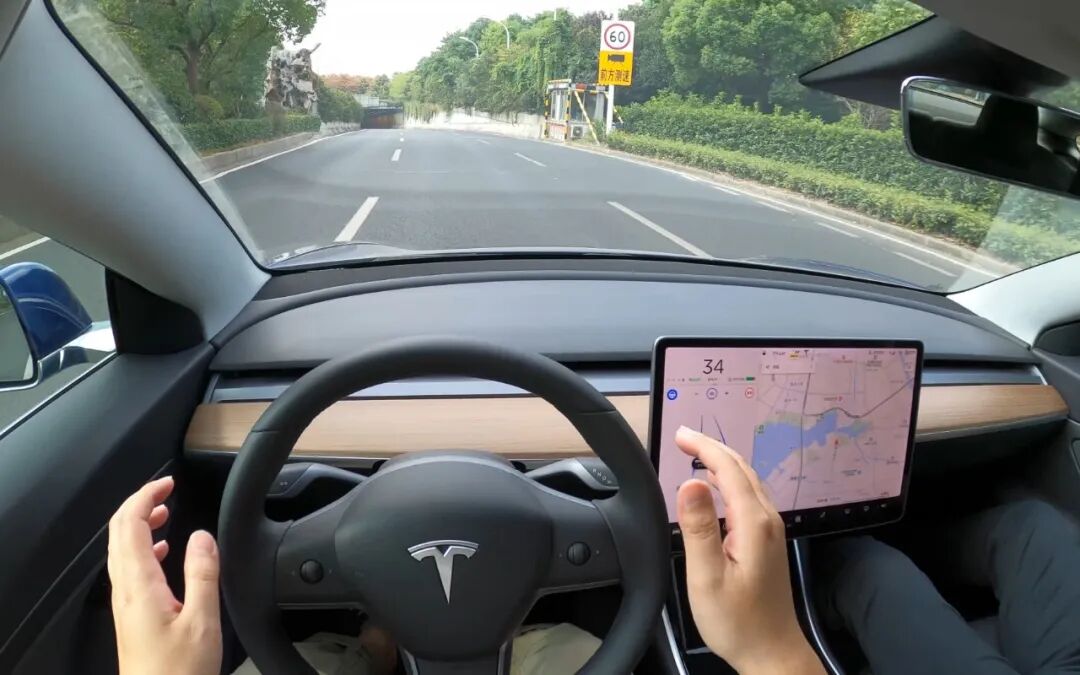
Image Source: Internet
This change by Tesla is driven by the fact that while pure end-to-end models perform well in complex scenarios, engineers find it difficult to trace their decision-making basis.
Introducing chain-of-thought reasoning leaves a readable trail of reasoning before outputting actions, at least giving developers a chance to understand why the model drives the way it does.
Along this path, the industry has begun to more systematically explore how to equip end-to-end models with deeper scene understanding capabilities.
The VLA approach inserts a language model between visual inputs and action outputs, leveraging the language model's ability to grasp semantics and logic to help the system understand the nature of the scene it is processing.
For example, a car parked diagonally at an intersection may appear as just an obstacle from a purely visual perspective. However, after language-based reasoning, the system can determine whether the car is waiting to turn left or has stalled, with completely different driving strategies for each scenario.
However, the two conversions in VLA—from vision to language and from language to action—introduce additional computational overhead and response latency. Balancing reasoning depth and response speed remains an issue to be addressed.
The world model takes a different approach. Instead of language-based reasoning, it allows the system to internally simulate possible events over the next few seconds before executing actions.
For instance, if a bicycle is wobbling by the roadside ahead, the world model would simulate several possible trajectories and then choose the safest response. This simulation capability resembles how human drivers anticipate risks in their minds.
Xpeng's X-Mind technical framework is an attempt in this direction, enhancing the system's predictive capabilities in dynamic environments through an embedded predictive world model.
Both VLA and world models have made substantive progress by 2026, and the industry has gained a clearer understanding of the relationship between these two approaches.
At CVPR 2026, Xpeng explicitly stated that VLA and world models are not competitive but rather form two pillars of a physical world foundation model.
They address different levels of problems.
VLA is responsible for semantic-level scene understanding, while the world model handles spatiotemporal-level simulations of dynamic processes. Together, they enable the system to have both scene judgment and risk anticipation capabilities.
From these industry attempts, it is evident that while end-to-end systems have taught autonomous driving how to drive, systems still need to develop deeper cognitive abilities about the physical world to cope with its complexity and uncertainty.
End-to-end systems address driving skill challenges, while VLA and world models enable the system to truly understand the world it is driving in.
02 Have Traditional Modules Really Disappeared?
After all this groundwork, we can now discuss today's main topic.
Since end-to-end models can directly output driving actions, are traditional modules like perception, prediction, and planning still necessary? Has the modular architecture disappeared?
To answer this, we must first clarify what we mean by the disappearance of modular architecture.
If we refer to the strictly process-divided software stack of perception, prediction, planning, and control, then modular architecture is indeed fading.
By 2026, China's automotive industry is transitioning from modular to end-to-end architectures. WeRide's WRD 3.0 uses a single AI large model to integrate perception, prediction, planning, and control; Bosch's single-stage end-to-end solution has also achieved mass production in China.
Mainstream intelligent driving solutions have shifted from classical perception-decision-control modular approaches to end-to-end neural networks.
However, if we refer to the engineering mindset of breaking down the autonomous driving system into independently developable and verifiable components, then it has not disappeared but rather survives in a new form within the new architecture.
Let's first examine what changes have actually occurred in the industry.
At CVPR 2026, Wayve divided autonomous driving approaches into three generations. AV1.0 is the classical modular stack, with perception, prediction, planning, and control each handling their own tasks; AV1.5 adds a layer of rule checkers around the end-to-end model; AV2.0 lets the end-to-end model handle the main intelligence from perception to control.
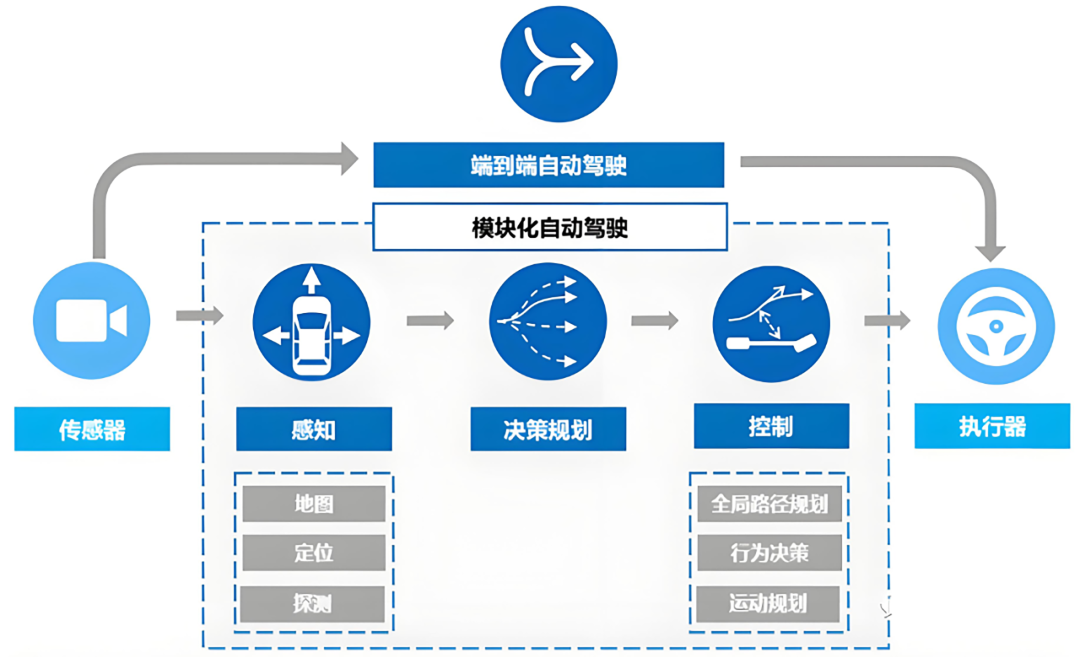
Image Source: Internet
Wayve emphasized that what truly matters is not the presence or absence of rules but the change in the responsible entity for safety assurance.
Traditional systems rely on rules written by engineers for safety, while AV2.0's approach is to let the model learn to judge risks.
However, even within the AV2.0 framework, the modular mindset still exists, with module boundaries shifting from external functional divisions to internal component divisions within the model.
TIER IV's approach also illustrates the same point. In July 2025, the company released an end-to-end AI architecture supporting Level 4+, marking a key step from traditional modular perception-planning-control pipelines to a data-driven neural network holistic decision-making framework.
However, TIER IV did not completely abandon modularity but instead advanced both modular AI architectures and holistic end-to-end architectures in parallel. The modular AI architecture introduces deep learning models into sub-modules like perception, prediction, planning, and control, retaining interpretability and safety isolation advantages; the holistic E2E architecture directly maps sensor inputs to vehicle control outputs through neural networks. These two approaches advance in parallel rather than being mutually exclusive.
From these companies' choices, a common point emerges: the industry is not making a single choice between end-to-end and modular approaches.
End-to-end models address driving behavior challenges—how to make the car drive more human-like and require fewer takeovers in complex scenarios.
However, a complete autonomous driving system also needs to address other issues: how to trace the cause when the model makes a mistake? How to safely degrade when sensors fail? How can regulatory authorities verify the system's safety?
End-to-end models alone cannot answer these questions. This is why many mass-production intelligent driving solutions universally retain a layer of engineering-based safety fallback.
The large-scale rollout of L2 autonomous driving is possible because humans remain behind the wheel as a safety fallback; for L3 and L4 to scale with pure end-to-end systems, breakthroughs in interpretability, safety verification, and other areas are still needed.
03 Final Thoughts
So, by 2026, have traditional modules truly disappeared?
In the opinion of Zhijia's cutting-edge researchers, what has disappeared are the rigid, artificial rule-based perception-prediction-planning-control pipelines. Single-stage end-to-end systems are replacing these independent modules with unified neural networks.
However, the mindset of breaking down complex systems into independently verifiable and debuggable components has not disappeared but merely exists in a new form.
It may take the form of observable component divisions within the end-to-end model, a rule layer outside the model for safety verification, or a dual-track strategy like TIER IV's, combining modular AI and holistic E2E approaches.
Thus, by 2026, what has disappeared are rigid architectures, not modularity itself.
#AutonomousDriving #EndtoEndAutonomousDriving #ModularArchitectureInAutonomousDriving
-
![]()
Silicon Valley Sparks the AI Office War
-
![]()
Weekly Stock Review | Trump’s Concern Over AI Rivalry: The Auto Industry’s ‘Biggest Competitor’
-
![]()
FAW and GAC's Strategic Move: More Than Corporate Collaboration, a Pioneering Case of National Industrial Anti-Involution
-
![]()
Can the Long-Wheelbase Mercedes-Benz GLE SUV Tread in the Footsteps of the BMW X5?
-
![]()
From Netizens' Perspective, the XPENG G9L Still Seems Pricey
-
![]()
10 Questions I Care Most About Regarding Doubao Mobile Phone II
-
![]()
Quality Performance of China’s New Energy Vehicle Tri-Electric Systems in 2026: Experience-Centric Issues Take Center Stage, Range Remains Top Challenge
-
![]()
AIDrive’s Cooperation Model Undergoes Change: Is Xiaomi Pengcheng the Unexpected Winner?