China's Intelligent Driving Ventures Abroad Face Rivals: Europe and US's Momenta 'Wayve'
 09/20 2026
 522
522
Now, in London, Europe, when you open Uber, you have the first opportunity to be assigned to a self-driving taxi with no one at the wheel. The car is a Ford Mustang Mach-E, with a row of cameras and radars mounted on the roof, and WAYVE printed below the A-pillar.
Keep in mind that in early September, Tesla rolled out the Cybercab without a steering wheel in Austin; six weeks ago, China's Momenta obtained Germany's KBA national L4 testing permit, becoming the first Chinese company to do so.
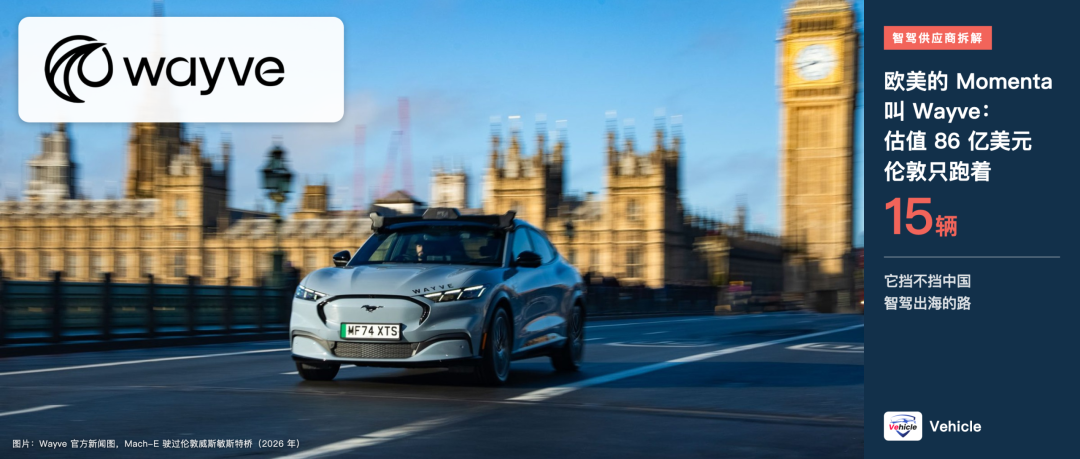
In Europe, which has been swept by Chinese automobiles, there is already its own AI autonomous driving company, Wayve. So, who does Wayve most resemble? Not Waymo, not Tesla, but Momenta.
Neither builds cars or operates their own fleets; both started by selling driving software to automakers and then moved towards Robotaxi using the same model. Both have received funding from Uber and investments from Mercedes-Benz, with German offices located in the Stuttgart metropolitan area—one in Leonberg and the other in Böblingen, just twenty kilometers apart. The market's valuation of the two companies is almost identical: Wayve's valuation reached $8.6 billion after its February funding round, while Momenta's market capitalization exceeded 70 billion Hong Kong dollars (approximately $8.9 billion) after its Hong Kong stock market listing in July.
The difference lies in what's written on the back of the checks. As of mid-September:
Mass Production Deployment: Wayve has 0; its first mass-produced vehicle will be Nissan's FY2027 Elgrand. Momenta has 26 automakers, 105 models, with a cumulative total of over 1 million vehicles.
Revenue: Wayve has not disclosed; Momenta reported 1.602 billion yuan in the first half of the year, with a gross profit margin of 73.2% and an adjusted net loss of only 14 million yuan.
Robotaxi: Wayve has 15 vehicles in London with safety operators; Momenta is testing or operating in 3 countries and 6 cities, with a target of hundreds by the end of the year.
Employees: Wayve has approximately 1,200 employees, doubling in a year; Momenta has not disclosed.
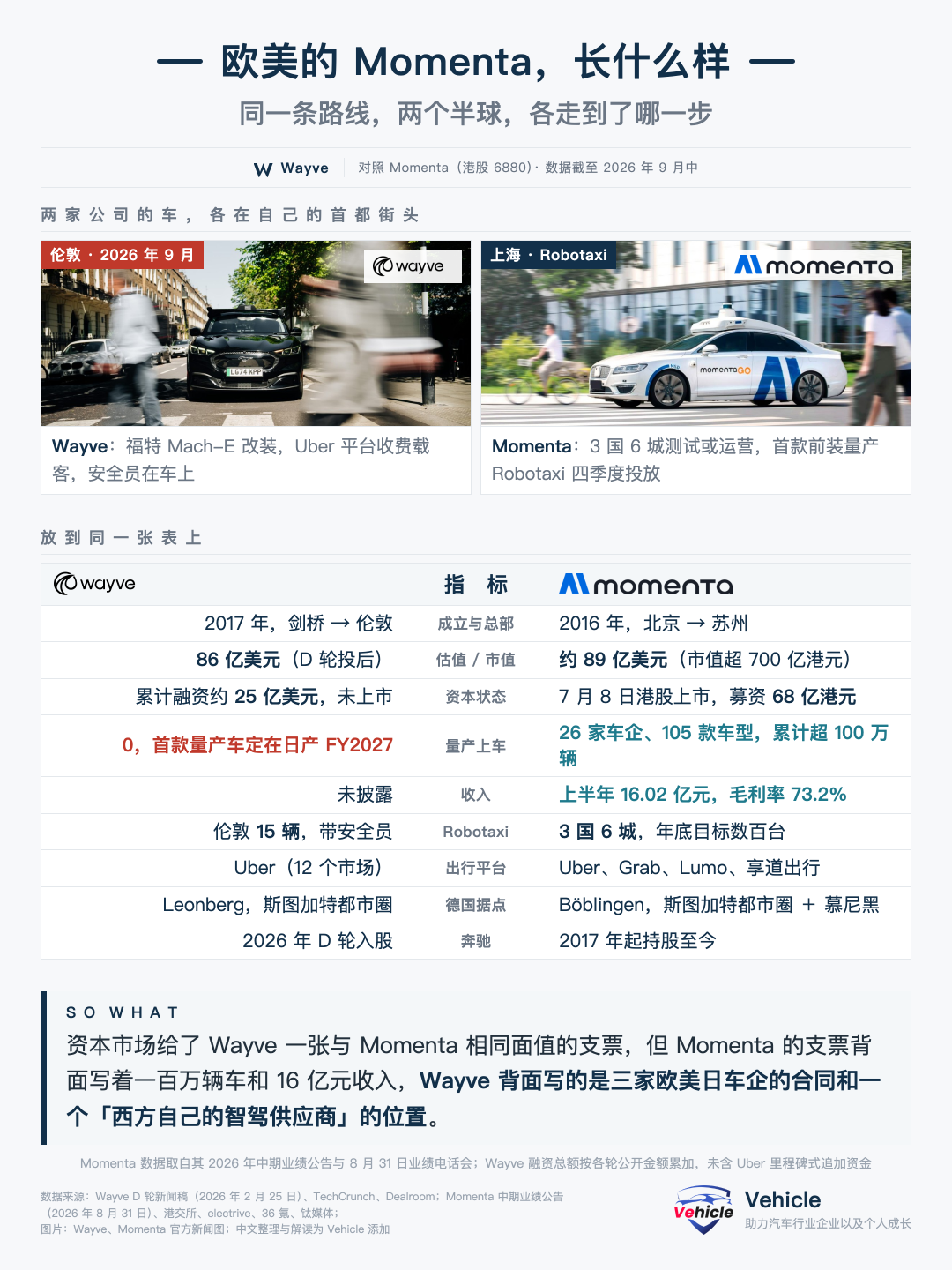
The same route, two hemispheres; Momenta's data is from its 2026 interim results announcement.
How can a company with no revenue and no mass-produced vehicles command the same price as a company that is nearly breaking even and has installed its technology in a million vehicles?
Today's article by Vehicle aims to dissect this question: What are Wayve's people, money, products, and collaboration methods? Where is it headed next, and what does it mean for China's intelligent driving solutions that are flocking to Europe?
Who's at the Helm of Wayve
Wayve was founded in Cambridge in 2017 by two machine learning Ph.D. students, Amar Shah and Alex Kendall. Shah served as CEO, and Kendall as CTO. Shah left in 2020, and Kendall has been CEO since then. In his early thirties, he received the Royal Academy of Engineering Silver Medal and an OBE in 2025 and is the kind of entrepreneur the UK government likes to mention in speeches.
At the technical research level, the team consists of Cambridge alumni. Chief Scientist Jamie Shotton, a Cambridge Ph.D., joined from Microsoft Research in 2021, where his team developed Kinect's skeletal recognition and HoloLens 2's hand-eye tracking. AI Vice President Vijay Badrinarayanan, the first author of SegNet (Kendall is the second author), joined from Magic Leap in 2020, where he was responsible for deep learning. New Research Director Alexander Toshev, who joined this year, previously led research teams at Apple and Google and is now building a robotic intelligence team in Sunnyvale, extending beyond automotive applications.
At the industry level, the team is composed of a different set of individuals. President Erez Dagan, who worked at Mobileye for twenty years, rising to Executive Vice President of Product and Strategy, joined in 2024 to handle business with automakers. Vice President of Product and Delivery Simone Fabris also came from Mobileye, previously at ZF. In February, two vice presidents joined: Girish Venkataramani manages the AI platform, and Brandon Basso oversees simulation, data, evaluation, and verification. On September 16, former Waymo CFO Elisa de Martel took office. She managed finances at Waymo from 2022 to January this year, overseeing a $5.6 billion Series C round, after eleven years in manufacturing finance at Apple. Former CFO Max Warburton transitioned to an advisory role.
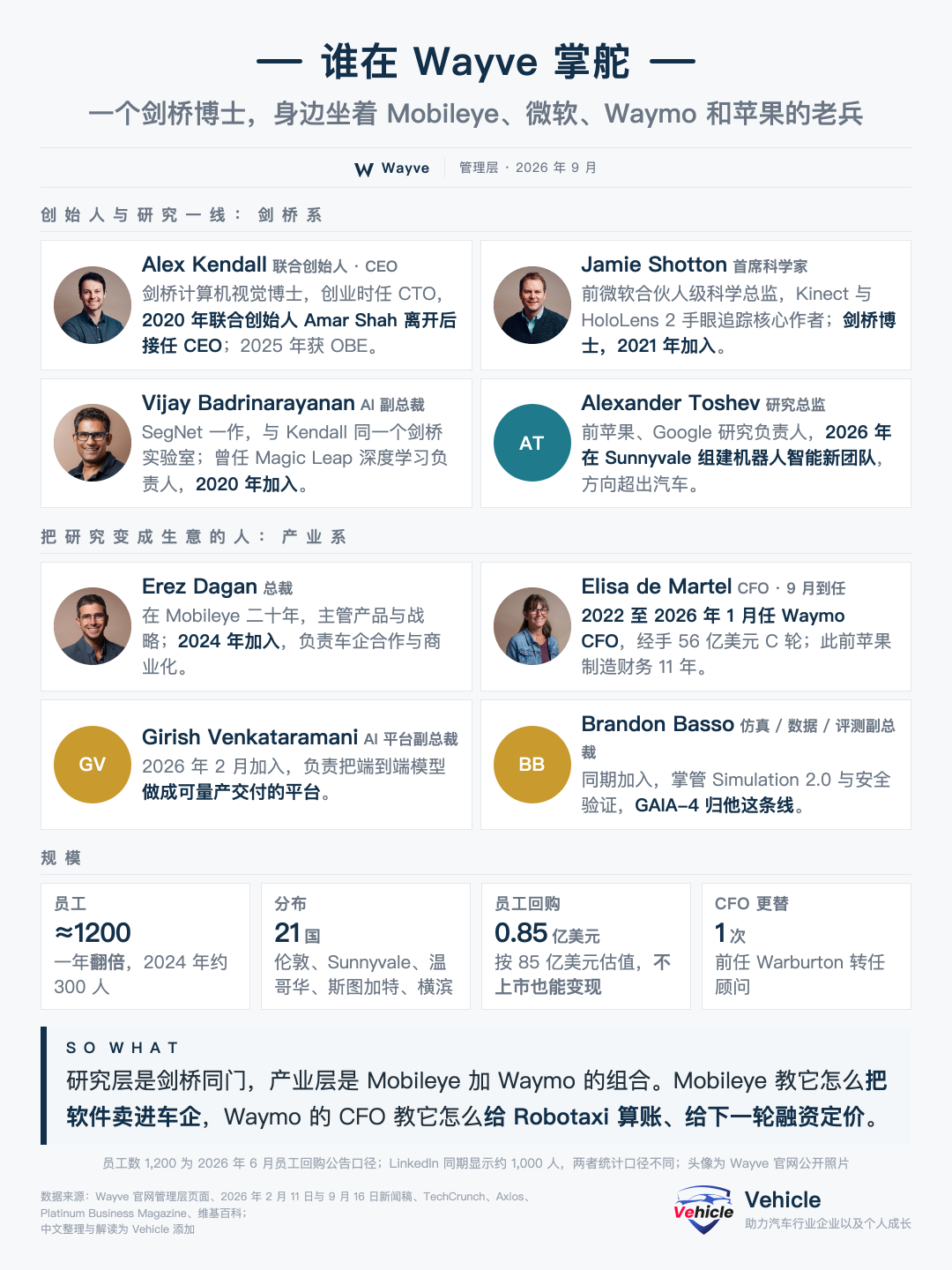
Research team: Cambridge alumni; Industry team: Mobileye plus Waymo; Headshots are publicly available photos from Wayve's official website.
Reading through this list reveals how the company plans to do business: Mobileye's veterans know how to sell software to automakers, collect fees per vehicle, and navigate the three-year development cycle for new models. Waymo's CFO understands how many trips a Robotaxi needs to make per day to be profitable and how to price the next funding round. The research team is responsible for developing the model, while these two groups turn it into contracts.
In terms of scale, Wayve had about 300 employees in 2024 and now has around 1,200 across 21 countries, with main offices in London, Sunnyvale, Vancouver, Stuttgart, and Yokohama. In June, the company conducted an $85 million employee share buyback at an $8.5 billion valuation, allowing early employees to cash out without waiting for an IPO. This is a standard practice for Silicon Valley unicorns but relatively rare among European automotive software companies.
Where Does the Money Come From, and Why?
Wayve has raised five rounds of funding. In 2019, it raised $20 million in Series A, led by Eclipse, with just over a dozen employees. In January 2022, it raised $200 million in Series B, with Microsoft participating for the first time. In May 2024, it raised $1.05 billion in Series C, led by SoftBank, with NVIDIA and Microsoft following—the largest round for a European AI company at the time. In August 2024, Uber made a strategic investment of an undisclosed amount, securing a commitment to place Wayve's vehicles on its network. In February 2026, it raised $1.2 billion in Series D, led by Eclipse, Balderton, and SoftBank Vision Fund 2, with a post-money valuation of $8.6 billion; Uber committed up to an additional $300 million, unlocked based on Robotaxi deployment progress. The total publicly disclosed funding amounts to approximately $2.5 billion.
The list of Series D investors is more noteworthy than the amount. There are three types of investors with three different motives.
Financial investors seek returns. In addition to the three lead investors, new participants include the Ontario Teachers' Pension Plan, Baillie Gifford, Schroders, and the British Business Bank, the latter with a UK government background.
Tech giants seek ecosystem control: Microsoft's Azure provides Wayve's training computing power, NVIDIA's DRIVE Thor is its in-vehicle chip, and Uber is its transportation capacity.
Automakers represent the third category and the biggest change in this round: Mercedes-Benz, Nissan, and Stellantis directly invested for the first time. Nissan's investment coincided with a mass production contract, and Stellantis signed a technology agreement within three months of investing.
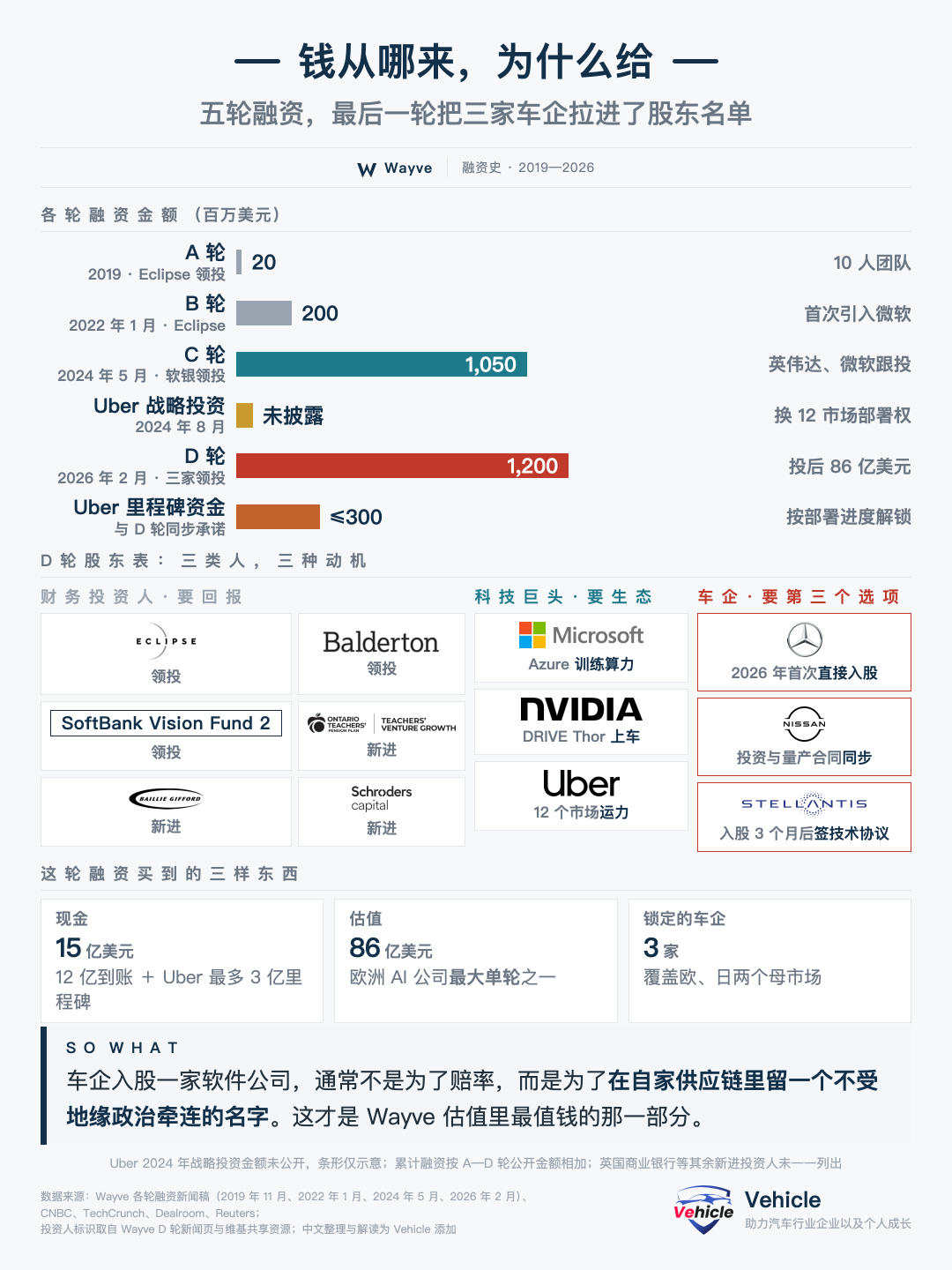
Five rounds of funding, with the last round bringing three automakers into the investor list.
When automakers invest in a software supplier, they usually look not at the odds but at securing a name in their supply chain that is not entangled in geopolitics. This is the most valuable part of Wayve's valuation and where it differs most from Momenta.
What Does It Sell?
Wayve calls its approach AV2.0 (for an explanation of what 2.0 means, see our previous article 'The Battle for Autonomous Driving's Future: A Comprehensive Look at the Underlying Logic and Architectural Evolution of 'End-to-End' Autonomous Driving'). It contrasts with Waymo's generation, which relies on lidar, high-definition maps, and handwritten rules (AV1.0). The core is an end-to-end model that outputs driving decisions directly from sensors, without high-definition maps or handwritten rules. Tesla is also pursuing this path, but the difference lies in the sales approach: Tesla's software is only installed in its own vehicles, which account for about 1% of global production; Wayve aims to sell to the remaining 99%.
To be installable in other companies' vehicles, Wayve deliberately avoids making choices in three areas. It does not picky (tiao ti, meaning 'be picky about') sensors: the Mach-E in London uses cameras plus radar, without lidar; Nissan's next-generation ProPILOT and Tokyo's LEAF Robotaxi both add lidar, using the same model. It does not picky chips: NVIDIA Orin, Thor, and Qualcomm 8650 can all run its software, and the company does not develop its own chips. It does not picky levels: the same model scales from L2+ hands-off to L4 driverless, unlocking features step by step according to regulations and automaker needs, without requiring automakers to switch suppliers.
Supporting this approach is the GAIA series of world models (shared in our previous article 'CVPR 2026: Wayve's Latest Insights: Autonomous Driving as the First Testing Ground for One Billion Robots').
GAIA-1 in June 2023 was the first generative world model in driving, with about 9 billion parameters.
GAIA-2 in March 2025 achieved multi-view controllable generation (similar to Li Feifei's Altas; for details, see 'A Detailed Explanation of Li Feifei's World Model Atlas: How It Influences Autonomous Driving, Humanoid Robots, and Other Physical AI Industries'), using synthetic data to supplement real data.
GAIA-3 in December 2025 expanded to 15 billion parameters, 10 times the data, and 9 countries, shifting focus from generation to evaluation.
GAIA-4 on August 3 this year reintegrated the AI Driver into the simulation loop: record a real-world driving scenario and let the model make decisions within it. If it brakes, the scene (hua mian, meaning 'video frame') slows down; if it turns, the next frame changes accordingly, while surrounding vehicles and pedestrians follow their actual trajectories. Every moment a safety operator previously took over can be revisited to ask, 'What would it have done if not taken over?' The same model can also generate radar points in parallel, which Wayve claims is a first for driving simulators.
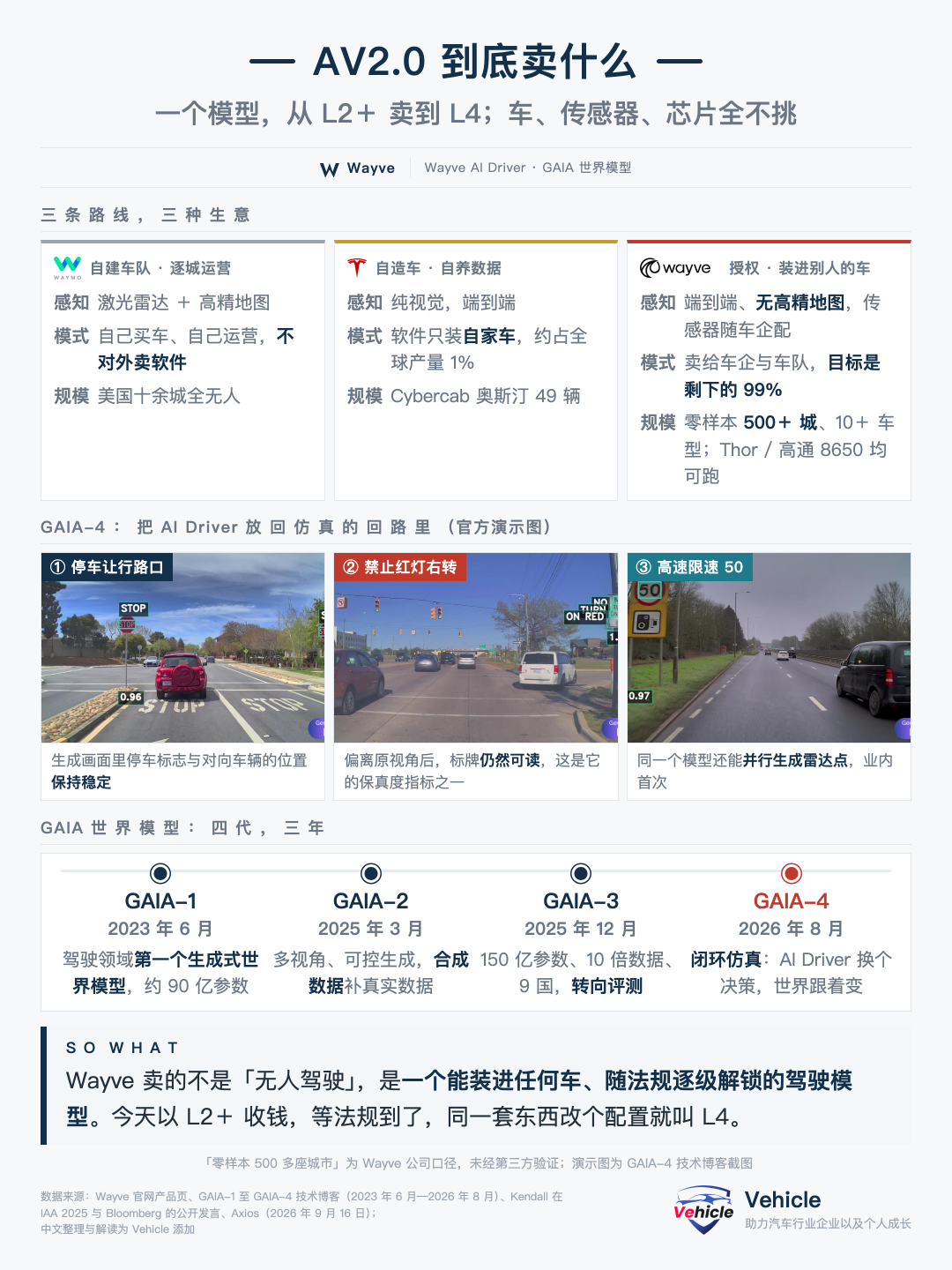
Three routes, three business models; GAIA-4 demonstration image from Wayve's technical blog.
The numbers Kendall uses to convince automakers are three:
The model has driven zero-shot in over 500 cities and more than 10 vehicle models, operating for a full day in Tokyo during a typhoon without takeovers.
It does not bind to specific chips.
And as he told Bloomberg, 'It achieves the same safety level as Tesla using only a fraction of the data and computing power.'
None of these claims have third-party verification. But they form the entire narrative Wayve uses when quoting prices to automakers: You don't need to change vehicles, chips, or wait for regulations—buy an L2+ first and update configurations when regulations allow.
What Did London's Debut Really Prove?
First, the numbers. Fifteen Mach-E vehicles, all licensed under TfL's private hire scheme; no geofencing, available throughout London except airports; priced the same as regular UberX, without tip prompts, randomly matched, and users can reject the vehicle before it arrives. Bloomberg's 40-minute test ride saw the safety operator take over twice—once when briefly blocking the oncoming lane while merging into congested traffic, and once when changing lanes to bypass several stopped vehicles. BBC's test ride saw one takeover when a truck (huo che, meaning 'truck') door appeared to be opening; Wayve later said the AI could have handled it.
Fleet maintenance is handled by UK fleet operator Otto Car, with a base near King's Cross headquarters.
Next, the regulatory path. The UK has actually opened two doors. One is the old one: private hire licenses, with the same legal status as regular Uber vehicles, requiring a driver in the seat responsible for the entire journey, but allowing immediate operation—licenses obtained in August, vehicles on the road in September. The other is the new one: the APS Automated Passenger Transport permit, effective May 15 this year, under Part 5 of the Autonomous Vehicles Act, requiring three stages: VCA vehicle listing plus special permission, DVSA approval, and TfL consent. No company in London has completed the first stage yet, and TfL's guidance has not been issued. Wayve and Uber chose the old door; Waymo is still testing, aiming to launch driverless from the start, using the new door.
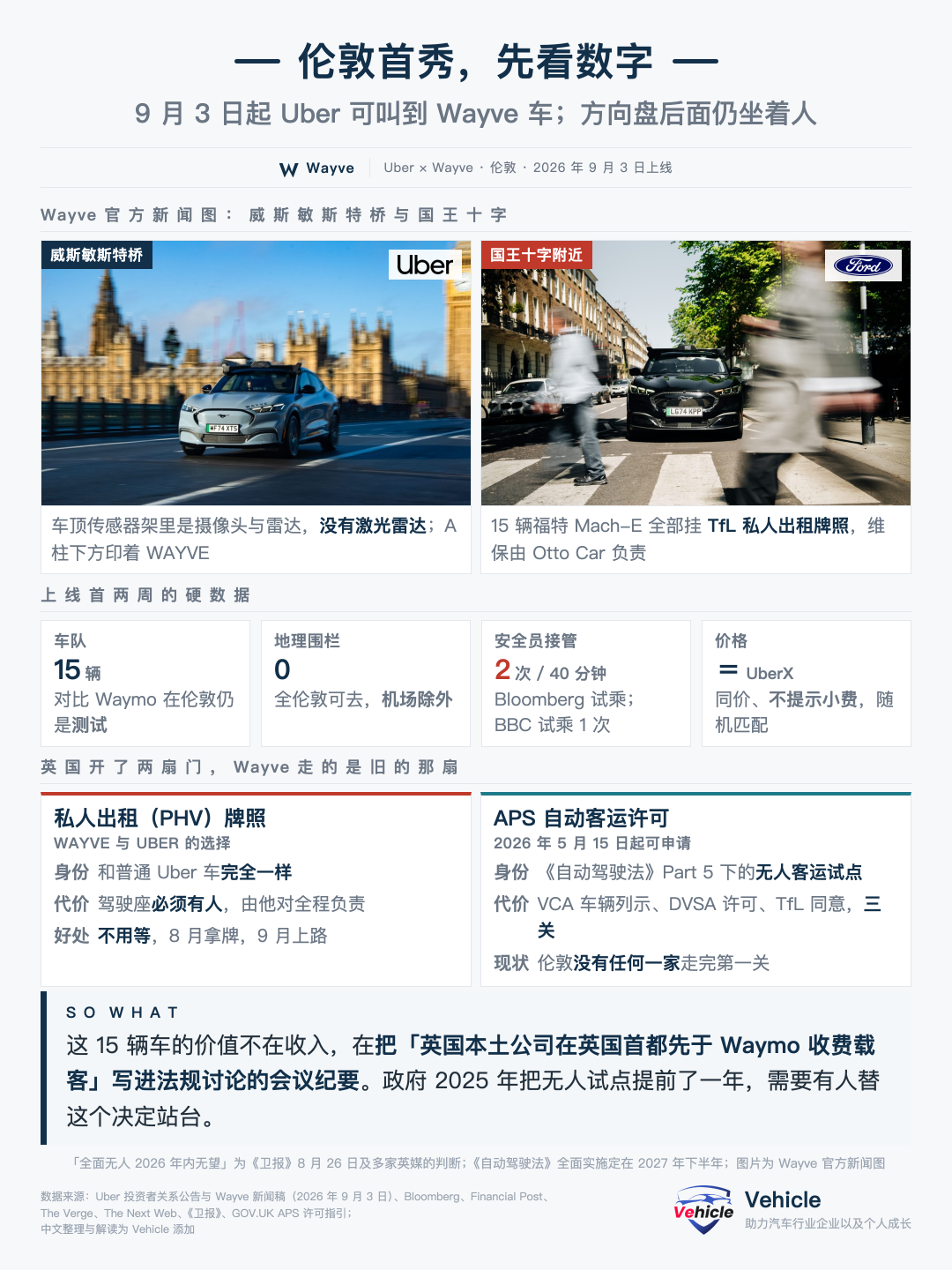
The UK has opened two doors, and Wayve has chosen the older one; the image is an official press photo from Wayve
So these 15 vehicles are not a testament to technology. Given London's traffic conditions, with two interventions every 40 minutes, this is roughly on par with the early performance of Tesla's Model Y Robotaxi in Austin—hardly leading. What it does prove is something else: UK Transport Secretary Heidi Alexander's decision to advance the driverless pilot by a year to 2025 required a British company to launch fare-based passenger services in the UK capital ahead of Waymo, ensuring the decision would hold up under parliamentary scrutiny. On the announcement day, both the Transport Secretary and Business Secretary issued statements repeatedly emphasizing "British-built." Wayve secured political capital, Uber claimed "first in London," but nothing changed in terms of regulations.
Kendall declined to provide a timeline for removing safety drivers, only stating, "we're pushing as fast as we can." Uber's $300 million milestone funding is tied precisely to this milestone.
Who Pays, Who Builds, Who Operates
Laying out the publicly announced contracts reveals Wayve's business model clearly.
Nissan is the most straightforward partner. For passenger vehicles, the next-gen ProPILOT will integrate Wayve's model with Nissan's proprietary perception and LiDAR systems—11 cameras, 5 radars, 1 LiDAR. The Ariya prototype demonstrated in downtown Tokyo in September 2025, with mass production slated for FY2027 in Japan starting with the Elgrand model. For Robotaxi, built on the LEAF platform with dual NVIDIA Thor chips and full redundancy design, a tripartite MoU with Uber was signed on March 12, with Tokyo pilots planned by year-end pending regulatory approval.
Stellantis signed on May 21 to integrate Wayve into STLA AutoDrive for urban and highway L2++ hands-off driving, launching first in North America in 2028.
Mercedes-Benz only has Kendall's Reuters interview quote about "passenger vehicle and Robotaxi applications," with no details disclosed; its existing MB.DRIVE ASSIST PRO was co-developed with NVIDIA, while the China-spec CLA uses Momenta.
Uber provides fleet capacity and order management: Wayve vehicles will launch in 12 markets, with Uber owning and operating the fleets—handling purchasing, maintenance, dispatch, and customer service.
NVIDIA supplies in-vehicle chips, Microsoft provides cloud computing power; both are Series C and D investors.
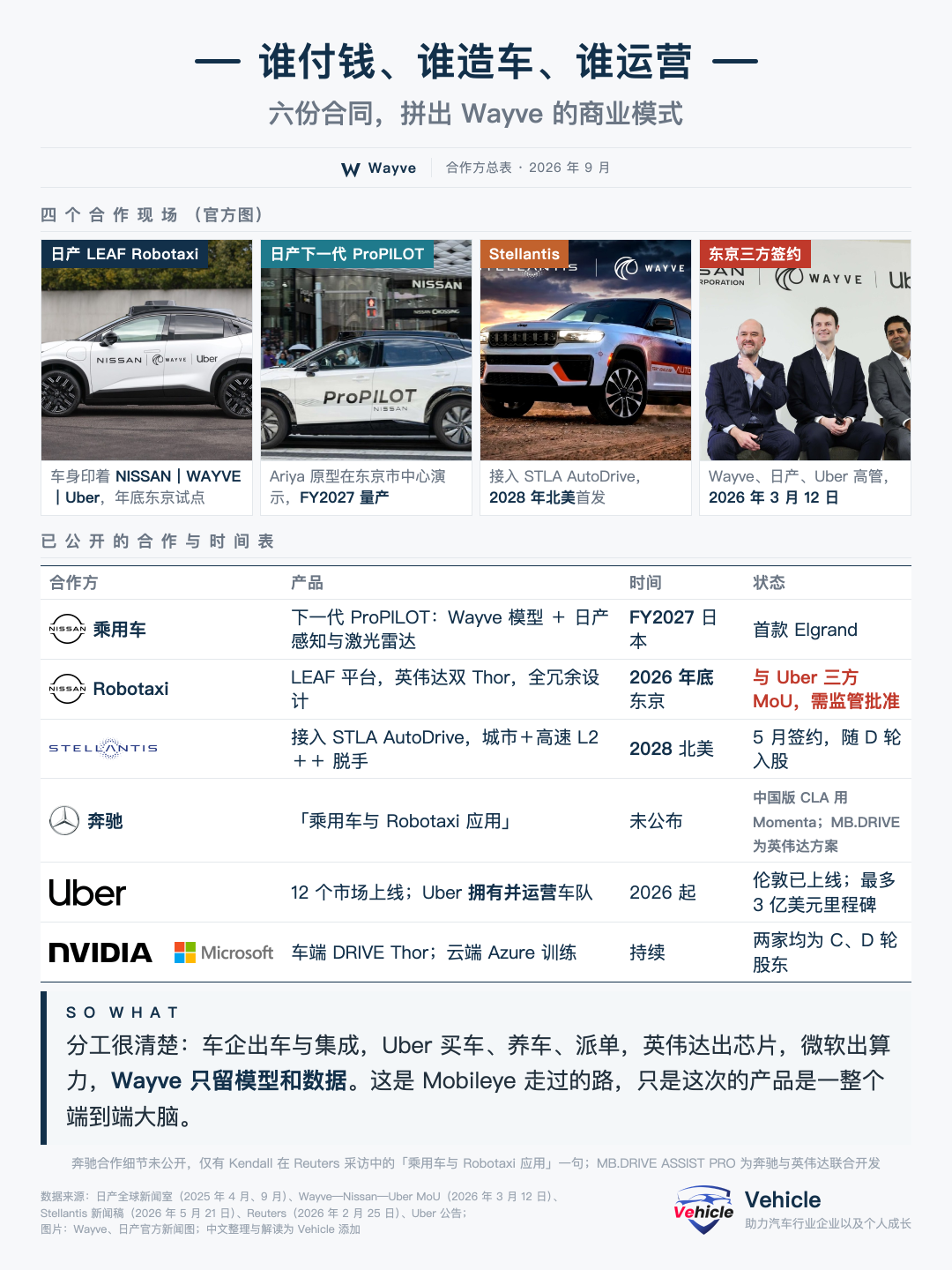
Six contracts piece together Wayve's business model; image from Wayve and Nissan official press photos
The division of labor is clear: automakers handle vehicle production and integration, Uber manages fleets and operations, NVIDIA supplies chips, Microsoft provides computing power, while Wayve retains only models and data. Offloading all heavy assets follows Mobileye's playbook—Erez Dagan and Simone Fabris came from that path. The difference is that Mobileye sold a chip plus perception suite, while Wayve aims to sell a complete end-to-end brain. Automakers sign on for three reasons: a single model scales from L2+ to L4 with one-time R&D investment; no vendor lock-in for chips, sensors, or HD maps; and the boardroom-friendly fact that it's neither Tesla nor Chinese.
Two Timelines, Same Year
Juxtaposing 2026 milestones reveals opposite sequencing between the two companies.
Wayve's timeline: February 25 - $1.2 billion Series D funding; March 12 - Tokyo MoU with Nissan and Uber; May 21 - Stellantis technical agreement; August 3 - GAIA-4 launch; September 3 - London service launch, with former Waymo CFO joining by September 16. Fare collection precedes regulatory approval.
Momenta's timeline: July 8 - HKEX listing raising HK$6.8 billion (~20% allocated to Robotaxi); July 29 - KBA full Germany L4 urban road testing approval; August 31 - first half-year report showing RMB1.602 billion revenue (+75.9% YoY), adjusted net loss of RMB14.097 million, and cash reserves exceeding RMB15 billion; Q4 plan to deploy first factory-fitted Robotaxi with R7 world model; year-end plans to launch operations in Abu Dhabi with Mercedes and Lumo, while Munich project with Uber awaits commercial operation date. Regulatory approval precedes operations.
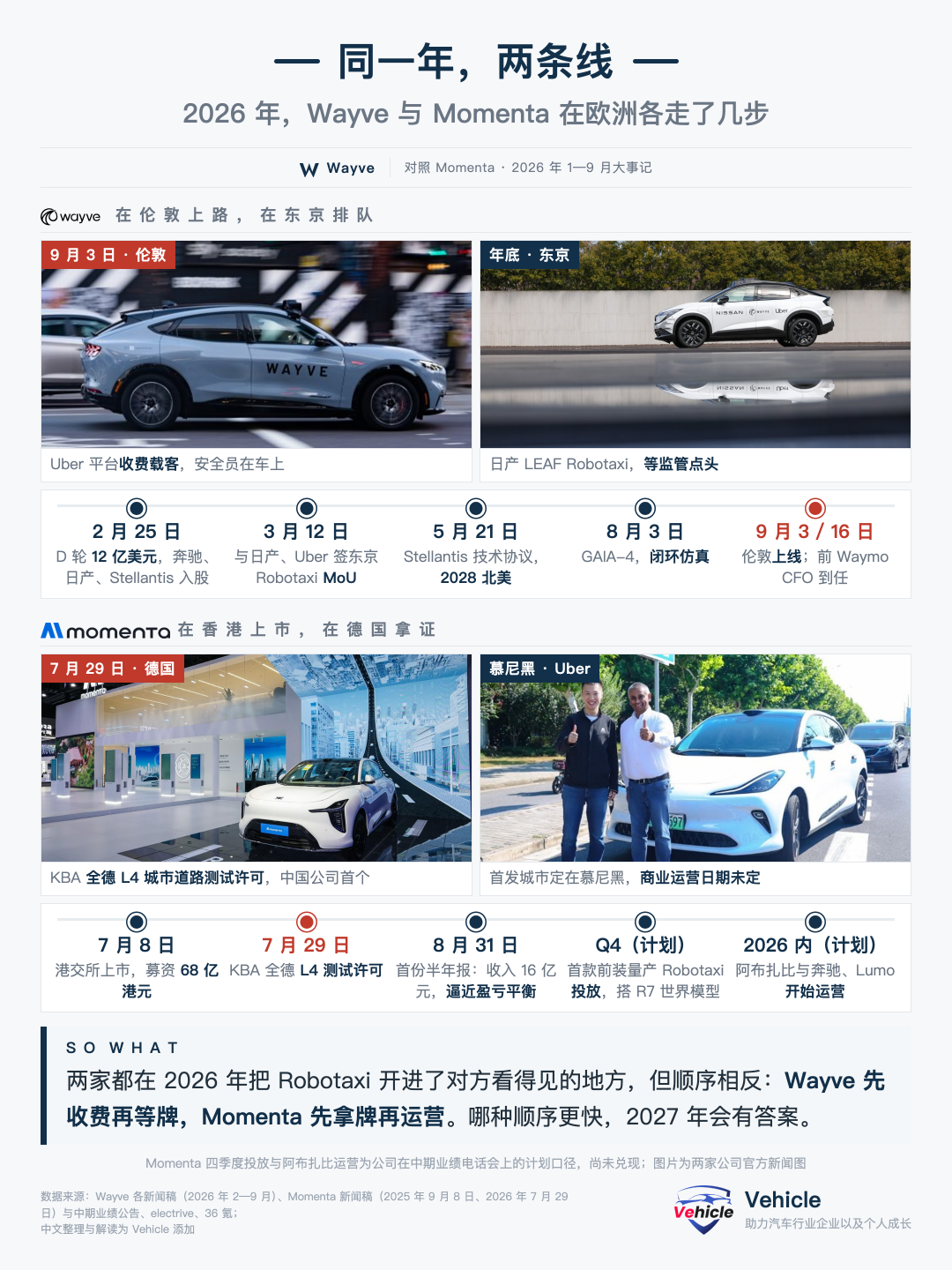
Wayve collects fares before approval, Momenta secures approval before operations; image from company official press photos
Momenta presented a longer roadmap: testing licenses in 10+ global cities with hundreds of vehicles by end-2026; expansion to 30+ cities in 2027; large-scale operations in 2028. Wayve hasn't provided such a timeline but has given automaker production dates: Nissan FY2027, Stellantis 2028. Both still operate Robotaxi with safety drivers—2027 will reveal who removes them first.
Implications for China's ADAS Global Expansion
First, observe an established fact. Mercedes uses Momenta for China's CLA long-wheelbase version but NVIDIA's MB.DRIVE (with Wayve investment) elsewhere; Nissan uses Momenta for Dongfeng Nissan N7 in China but Wayve for next-gen ProPILOT in Japan; Uber uses Momenta in Munich but Wayve in London and Tokyo. The same automaker/platform adopts different "brains" for Chinese vs overseas markets—a pattern I call "One Vehicle, Two Brains," which exists despite no vendor endorsing the term.
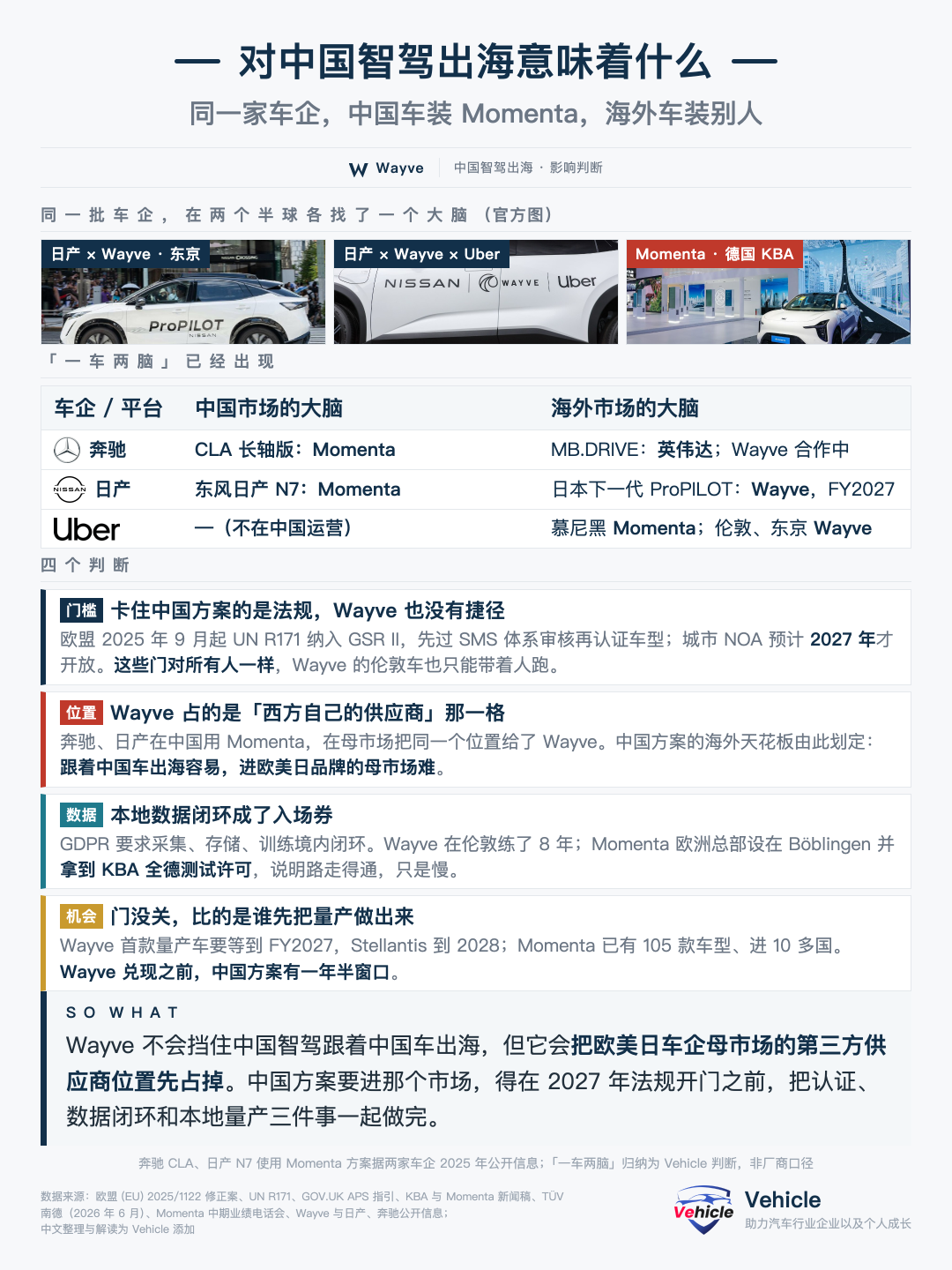
Same automakers select different "brains" in each hemisphere; "One Vehicle, Two Brains" is the author's Summarize
Building on this fact, I offer four judgments:
First, Chinese solutions remain constrained by regulations, with no shortcuts for Wayve. The EU incorporated UN R171 (DCAS) into GSR II in August 2025, requiring L2 systems in new models to obtain R171 certification after passing SMS safety management system audits—a process that took Chery six months via TV Süd's SMS review in June 2025. Urban NOA in Europe likely won't open further until 2027, per Momenta's half-year report. UK driverless passenger services face three regulatory hurdles, with no company passing the first stage in London yet. These barriers apply equally to Wayve—its London vehicles still operate with human supervisors.
Second, Wayve occupies the "Western indigenous supplier" niche. To European, American, and Japanese automakers' boards, it represents a third option beyond Tesla and Chinese firms. Mercedes and Nissan use Momenta in China but Wayve in their home markets—not through technical comparison but procurement strategy. This sets a ceiling for Chinese solutions overseas: following Chinese vehicles abroad is easy (Momenta has entered 10+ markets including Norway, UK, UAE, Singapore, and Australia), but penetrating Western brands' home markets remains difficult—no Chinese supplier has publicly secured such projects yet.
Third, local data closed loop (closed loops) have become mandatory. GDPR requires full domestic lifecycle management for data collection, transmission, storage, training, and destruction—a 15-year automotive data lifecycle makes this far more challenging than in China. Wayve's eight years of London training and Stuttgart test center give it inherent local advantages. Momenta established its European HQ in Böblingen with Munich offices, taking nearly a decade to secure KBA's nationwide testing approval—proving the path's viability but slowness. Knowing Technology's Munich R&D center, with 200,000km of overseas driving data, follows the same strategy.
Fourth, the door remains open—competition hinges on who achieves mass production first. Wayve's first production model arrives in FY2027, Stellantis in 2028; Momenta already has 105 models in 10+ countries with real revenue and margins. Before Wayve delivers, Chinese solutions have ~18 months to transform "following Chinese vehicles abroad" into direct OEM contracts. Momenta's half-year report states it's "advancing local market mass production projects with multiple international automakers"—the true test will be when this becomes a specific model name.
So how formidable is this Chinese ADAS globalization rival? Watch three signals:
1. When Wayve removes safety drivers, who clears London's APS first stage, and the pace of Uber's $300M milestone unlock.
2. Whether Nissan's FY2027 Elgrand mass production or Momenta's Munich commercial operations launch first—the former represents Wayve's first scalable revenue, the latter China's first European operational license.
3. By 2027's European urban NOA opening, which company holds R171 urban functionality certification for production models—no Chinese supplier has publicly obtained this yet.
Wayve won't block Chinese ADAS from following Chinese vehicles abroad, but it will preemptively occupy the third-party supplier position in Western automakers' home markets. Chinese solutions must complete certification, data closed loop , and local mass production before 2027 regulatory openings to enter those markets.
Epilogue
Wayve's current valuation represents a vote of confidence from three automakers, explicitly stating "we need an option that's neither Tesla nor Chinese." Whether this pays off depends on how Nissan's FY2027 Elgrand owners perceive the gap between Wayve's system and Momenta's installation in the N7. Until then, calling Wayve "Europe's Momenta" flatters it; only after reaching one million vehicles will the comparison merit reversal.
*Unauthorized reproduction or excerpting strictly prohibited*
-
![]()
Silicon Valley Sparks the AI Office War
-
![]()
Weekly Stock Review | Trump’s Concern Over AI Rivalry: The Auto Industry’s ‘Biggest Competitor’
-
![]()
FAW and GAC's Strategic Move: More Than Corporate Collaboration, a Pioneering Case of National Industrial Anti-Involution
-
![]()
Can the Long-Wheelbase Mercedes-Benz GLE SUV Tread in the Footsteps of the BMW X5?
-
![]()
From Netizens' Perspective, the XPENG G9L Still Seems Pricey
-
![]()
10 Questions I Care Most About Regarding Doubao Mobile Phone II
-
![]()
Quality Performance of China’s New Energy Vehicle Tri-Electric Systems in 2026: Experience-Centric Issues Take Center Stage, Range Remains Top Challenge
-
![]()
AIDrive’s Cooperation Model Undergoes Change: Is Xiaomi Pengcheng the Unexpected Winner?