Are the Jobs of 16.74 Million Automotive Professionals Still Safe? Will They Remain So?
 09/20 2026
 393
393
Huasheng's Insight
"While individual effort is crucial, one must ultimately heed the march of progress."
Over the past two years, misleading viewpoints have been widespread. Last year, it was claimed that the major shift towards new energy intelligence would create fresh opportunities. This year, it is argued that the automotive industry's pivot to robotics will lead to a surge in job openings, with media reports consistently touting "millions" of job vacancies.
But what is the actual situation? In Germany, France, the United States, and Japan, automotive companies are implementing significant layoffs, often attributing them to AI—"To tackle the challenges posed by artificial intelligence, cost reductions and efficiency improvements have been achieved through AI."
This discussion has been less prevalent domestically until recently, when a report from the China Association for Automotive Personnel revealed that industry-wide employment has decreased by 26.3% over the past three years.
It's not a shortage of people; it's a reduction in numbers.
Last year, as a special assessment expert for the Talent Committee, I evaluated the "Impact of AI on the Talent Competency Framework," considering it a future issue. Now, it seems the future has arrived sooner than expected.
Are the jobs of 16.74 million automotive professionals still secure?
01. It's Not a Shortage of People; It's a Replacement
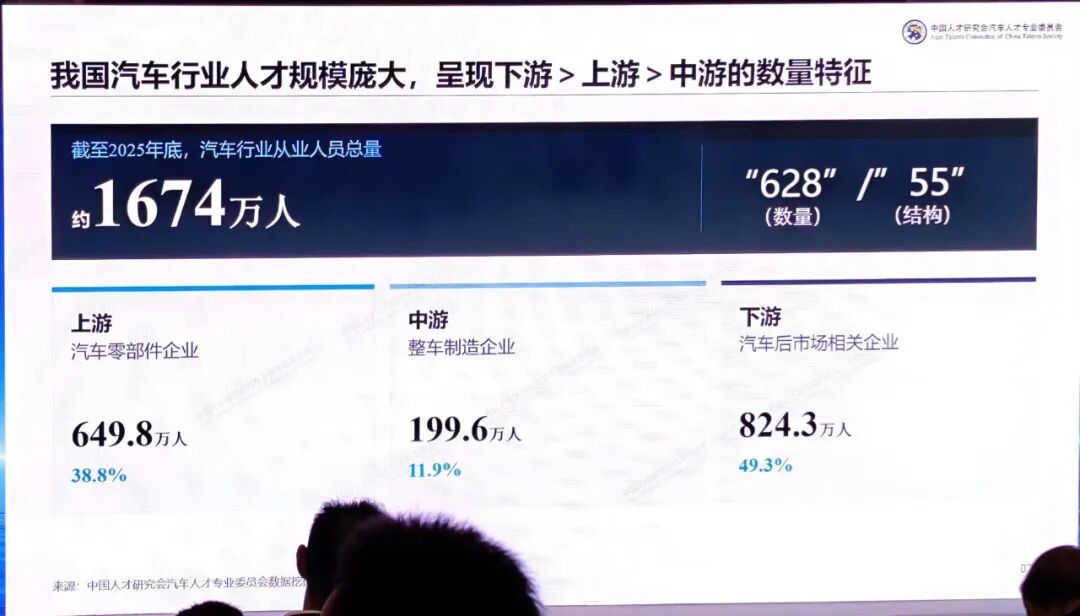
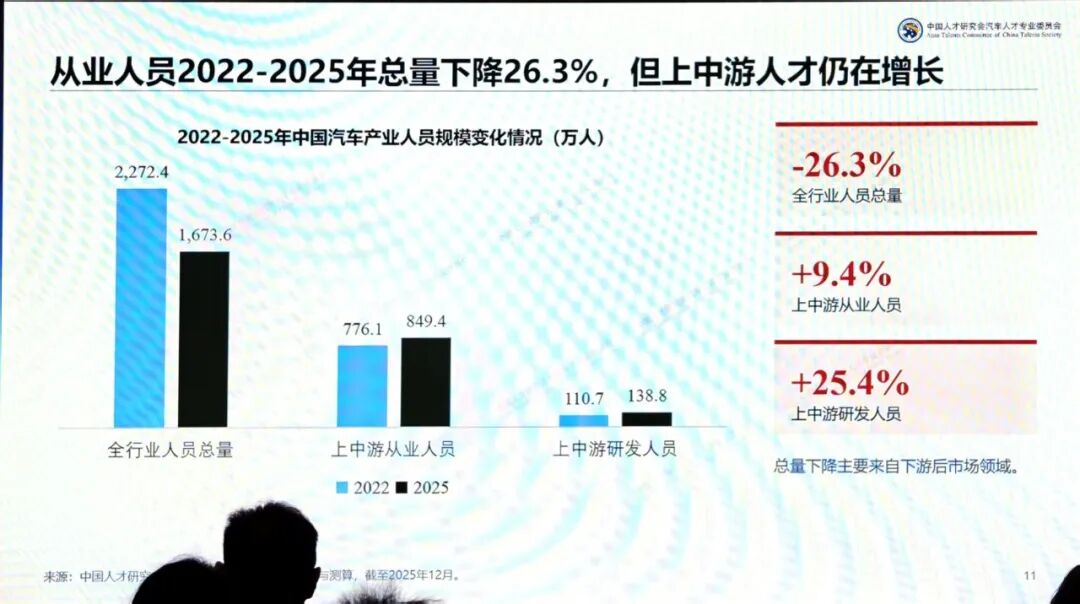
As of the end of 2025, China's automotive industry employs approximately 16.74 million people, with 6.5 million in upstream components, 2 million in midstream vehicle manufacturing, and 8 million in downstream aftermarket services.
A comparison in the report by Li Zhele, Secretary-General of the Talent Committee, reveals that from 2022 to 2025, industry-wide employment decreased by 26.3%. However, upstream and midstream sectors saw increases, particularly in R&D personnel, while downstream sectors experienced the most significant declines.
It's not that the industry doesn't need people; it doesn't need the same kinds of people as before.
The aftermarket sector, employing over 8 million people, with nearly 70% in maintenance, repair, and beautification services, is the hardest hit by contraction. The frequency of maintenance for new energy vehicles is low, with closed three-electric systems and OTA remote upgrades, leading to the disappearance of traditional maintenance tasks. (Despite this, the media still claims a "million-person" talent shortage daily.)
Upstream sectors, such as new energy components and intelligent connected vehicle components, are hiring. The fluctuation represents a cross-sectoral workforce movement involving millions of people.
02. In the Next Five Years, 1.78 Million Jobs Will Be Impacted
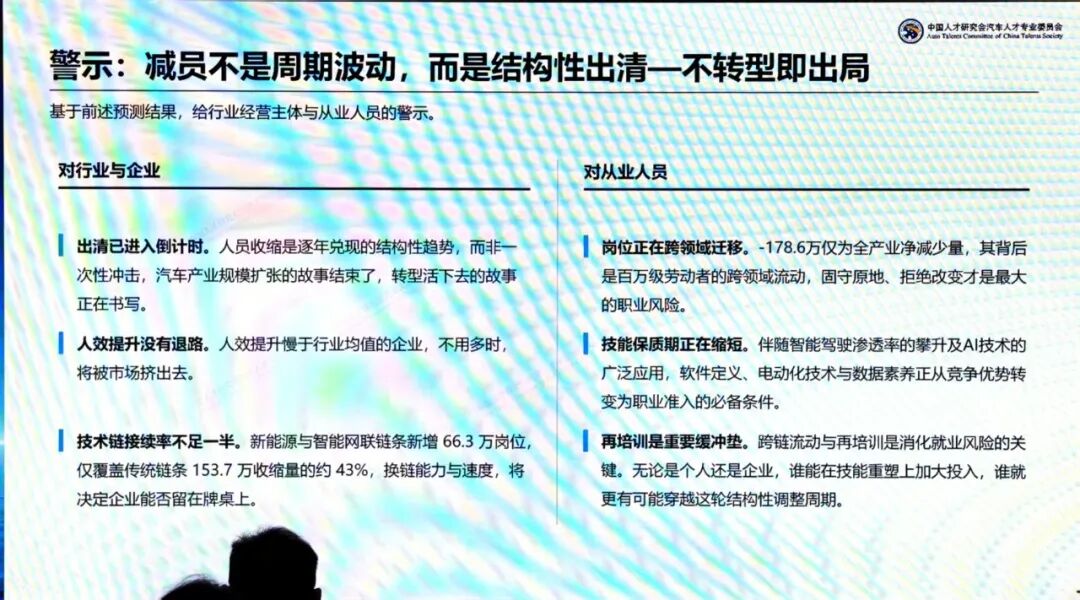
The Automotive Talent Committee team used four indicators to model predictions, forecasting approximately 39.88 million vehicle sales by 2030, with a 75.2% penetration rate for new energy vehicles and exports reaching 11.8 million. Under this scenario, the industry is expected to see a net reduction of 1.78 million jobs over the next five years, a 10.7% decrease in employment.
Note that this is a "net reduction." Behind it lies a larger-scale job transition: the traditional internal combustion engine vehicle supply chain will release about 1.53 million positions, while new energy and intelligent connected vehicles will add approximately 660,000, with a success rate of less than half.
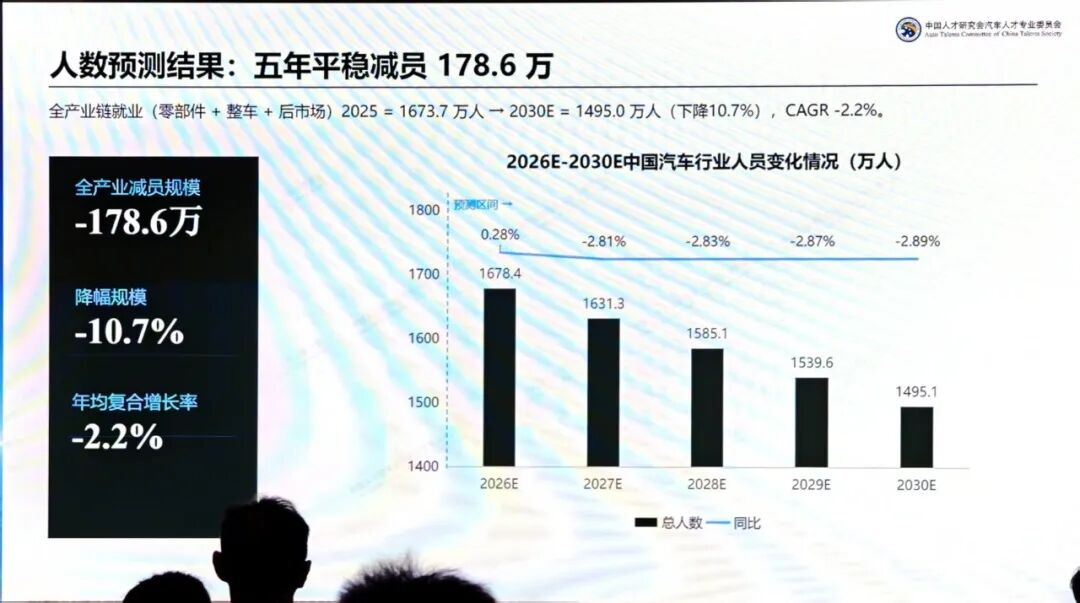
Why are jobs being added in some areas while reduced in others? Three reasons: skill mismatches—those with old skills cannot fill new positions; workforce imbalances—new additions are far fewer than those disappearing; productivity improvements—output is increasing while the workforce needed is decreasing.
Li Zhele said, "Refusing to change and staying in place is the greatest career risk." Over the past two decades, the industry has been expanding, and many have never experienced contraction. Now, contraction has arrived, and it's not cyclical but structural.
The story of scale expansion has ended; the story of transformation and survival is what matters now.
03. Profits Are Razor-Thin, Unable to Sustain Such a Large Workforce
From January to May this year, 542 new vehicle models were launched in the Chinese automotive market, averaging 3.6 per day. New vehicle launches are more frequent than meals.
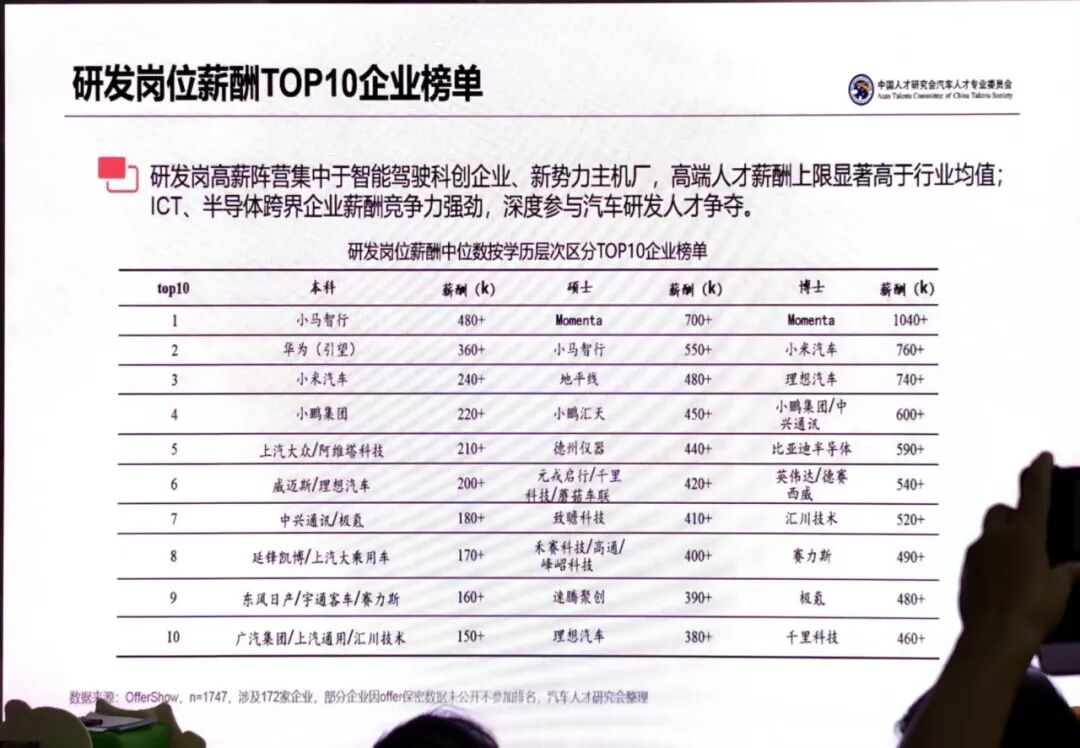
Fu Yuwu, the former chairman of the Automotive Talent Committee, also pointed out this issue: "Intense internal competition, highly homogeneous products, low overall efficiency, and unreasonable talent supply and resource allocation for the new era."
Ministries such as the Ministry of Industry and Information Technology and the National Development and Reform Commission have taken intensive actions: combating intense internal competition, setting minimum product pricing, expanding distribution, and ensuring compliant overseas expansion. The fact that so many ministries need to provide continuous guidance indicates that the industry's problems are complex.
Behind the talent contraction lies razor-thin profitability.
Yang Hong, Chairman of Hangsheng Group, calculated: From January to July this year, domestic automotive retail sales fell by 13% year-on-year, the largest decline among all commodity categories; total industry profits fell by 20%, with the profit margin dropping to around 3.6%.
This is still an industry-wide average that includes high-profit sectors like batteries and chips.
Yang Hong's assessment is direct: "Disorderly intense internal competition has led to severe overcapacity. Except for battery and chip companies, many small and medium-sized component suppliers face survival crises and difficult times."
What's even more noteworthy is the vicious cycle between intense internal competition and talent. Yang Hong stated, "The roots of industry intense internal competition lie not only in market competition itself but also in hiring logic and talent evaluation, with deviations in talent competition models."
Companies poach mature teams with high salaries rather than cultivating talent internally; they compete for the same core talent, driving up salary bubbles; hiring focuses on short-term output, fostering a short-term profit-seeking mindset among employees. Intense internal competition distorts hiring practices, which in turn exacerbate intense internal competition.
04. The Hat in the Revolving Restaurant
I had a unique experience in Shenzhen.
The hotel I stayed in was a cross-century old building with a revolving restaurant on the top floor. While dining, I casually placed my hat and bag on the windowsill, thinking they were right in front of me. After 25 minutes, when I finished my oysters and looked up, they were gone.
It took a few seconds to realize: the restaurant was rotating. It wasn't that someone had taken my things; the entire environment was moving, and my seat had rotated away, leaving my belongings in their original position.
I had to go around the entire circle to find them again. Fortunately, they were highly recognizable and had moved to an unobstructed spot.
Writing this, I can't help but sigh and think that the automotive industry is no different. Many people assume their jobs will always be there and that their skills are their own, thinking that as long as they don't move, they won't lose them. But the entire industry is rotating, undergoing structural changes. By the time you notice, your original position has already rotated away.
In this structural shakeout, the cruelest aspect beyond layoffs is skill devaluation. Li Zhele said, "The shelf life of skills is shrinking." What you spend ten years mastering may become worthless by next year.
The Automotive Committee suggests "retraining" as a buffer.
But Huasheng feels that this is more of a comfort. How likely is it for a 40-year-old traditional internal combustion engine vehicle engineer to transition into intelligent driving? What can a maintenance technician with ten years of experience at a 4S shop do when faced with the closed architecture of three-electric systems?
These questions have no standard answers.
Huasheng has been following the automotive industry for eleven years, witnessing its heyday and its most anxious times.
Around 2015, an average of 1,193 companies were established in the industry each year. After 2023, that number rose to 1,997 per year. More players are rushing in. But when the tide recedes, we'll see who is swimming naked.
None of the 16.74 million automotive professionals want to be the ones eliminated. But structural shakeouts won't stop just because you don't want them to. They will ruthlessly filter: who can transform, who can learn, and who can find a new position.
Like the hat in the revolving restaurant, you have to go around to find it. The prerequisite is that you must first realize the restaurant is rotating, wake up early enough, and hope it's still there.
Written by | Li Xiyin · Huasheng
-
![]()
ZTE’s New Doubao Phone: Playing It Safe in the AI Race
-
ZTE’s New Doubao Phone: A More Cautious Approach
-
![]()
Samsung, Spurred by Apple, Steps Up Its Game, with LY Technology Reaping the Greatest Benefits
-
Blue Heart Xiaov Set to Introduce Paid Pro Version, Revealing vivo’s Large Model Strategy
-
Three-Way Struggle for Market Share: BYD, Chery, and Geely Challenge Great Wall, Posing Immediate Risks to Wei Jianjun
-
![]()
The Reason Behind Valve's Headset Price Surge of 2400 Yuan: The End of an Era of Selling at a Loss
-
![]()
Decoding the '4S' Architecture | Report on Enterprise-Level AI Services in China
-
![]()
Li Auto Aims to Sell Three Technologies, First Buyers Unlikely to Be Major Automakers