Li Auto Aims to Sell Three Technologies, First Buyers Unlikely to Be Major Automakers
 09/20 2026
 394
394
Media reports suggest Li Auto is gradually opening up the supply of its Mach M100, SiC module, and extended-range system. With RMB 87.5 billion in cash reserves, the motivation is to find an outlet for R&D and production capacity that exceeds its own sales scale. The SiC business is closest to becoming a standalone venture, while the Mach chip is furthest from commercialization. Will other automakers be willing to purchase components from a competitor?
Produced by Zhineng Technology
With RMB 87.5 billion in cash reserves, Li Auto has begun selling its technologies externally.
According to 36Kr, the Mach M100 chip, SiC power module, and extended-range system are advancing toward external supply. Independent company entities have been established for the chip and SiC businesses, with plans to introduce external capital for certain operations.
In the first half of 2026, Li Auto's revenue declined by 13.4% year-on-year, with its gross margin dropping to 9.5% from 20.3% in the same period last year, and a net loss of approximately RMB 4 billion. Operating cash flow turned positive in the second quarter, but only by about RMB 15 million, while free cash flow remained negative at RMB 1.3 billion. Quarterly R&D investment approached RMB 3 billion during the same period.
With RMB 87.5 billion in cash, Li Auto is far from a survival crisis. The capacity invested in chips, semiconductors, and powertrain systems over the past few years now requires an outlet beyond internal consumption.
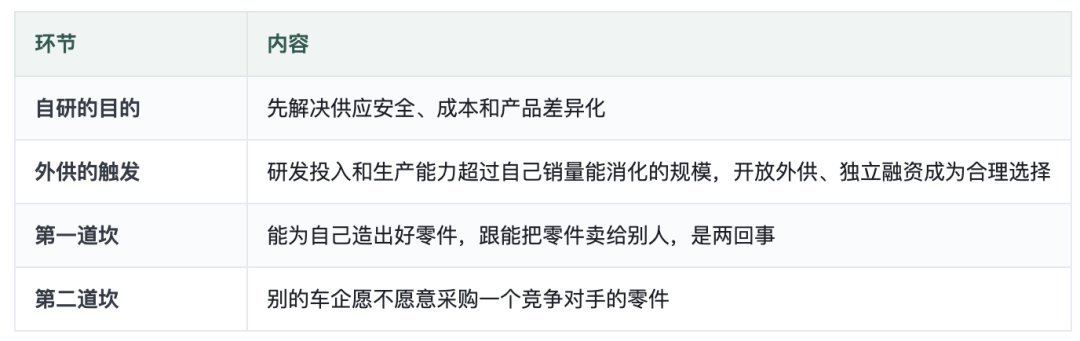
When an automaker develops core components in-house, it first addresses supply security, cost, and product differentiation.
When R&D investment and production capacity exceed what its own sales can absorb, external supply becomes a natural choice to improve asset utilization.
Of course, Li Auto faces the same challenge as BYD: being able to build great components for itself is one thing, but selling them to others is another.
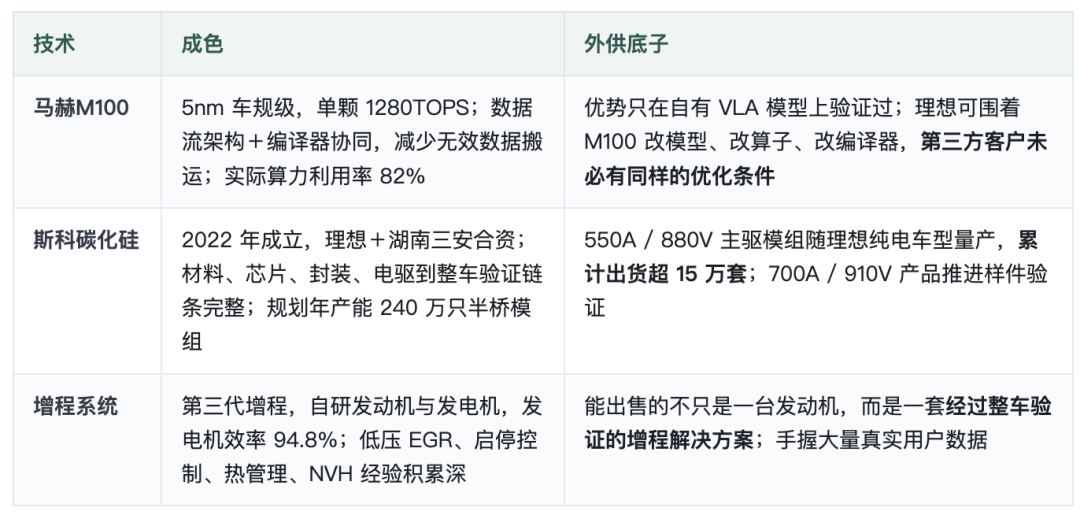
01 Three Cards, Three Levels of Promise
Mach M100: Highest Computational Power
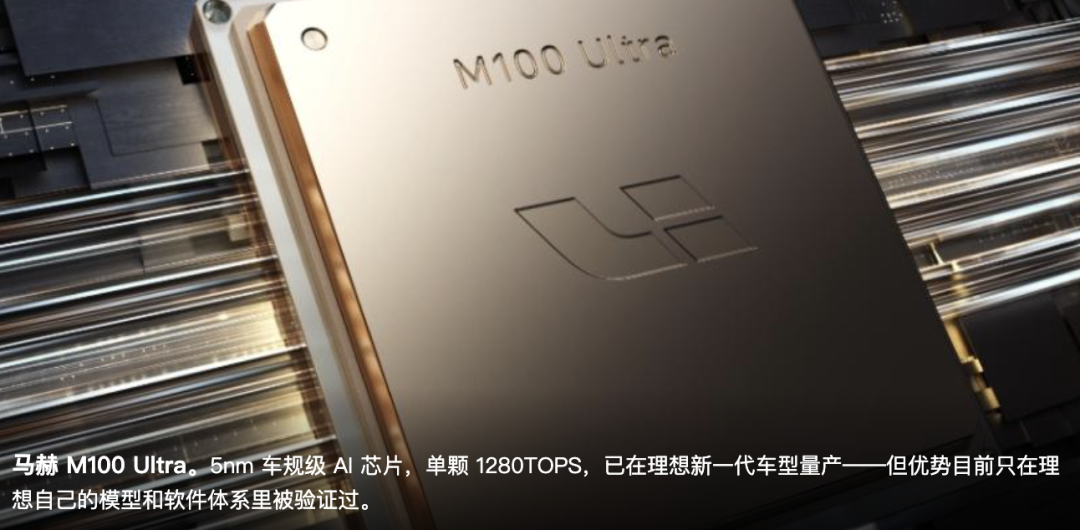
The Mach M100 is the easiest to attract capital market attention, featuring a 5nm automotive-grade AI chip with a single-chip computational power of 1280 TOPS, already in mass production for Li Auto's next-generation models.
Technical materials released by Li Auto mention that the M100 adopts a dataflow architecture, with co-designed compilers and hardware to reduce inefficient data movement during AI computations. This is how its actual utilization rate is improved.
In intelligent driving and robotics scenarios, peak computational power and the computational power actually usable by models are two different things. Model structure, memory bandwidth, operator support, compilation efficiency, and data scheduling all affect final speed.
Li Auto emphasizes that the M100's effective computational power on its proprietary VLA model is more meaningful than raw TOPS figures. This advantage has only been validated within Li Auto's own model and software ecosystem so far.
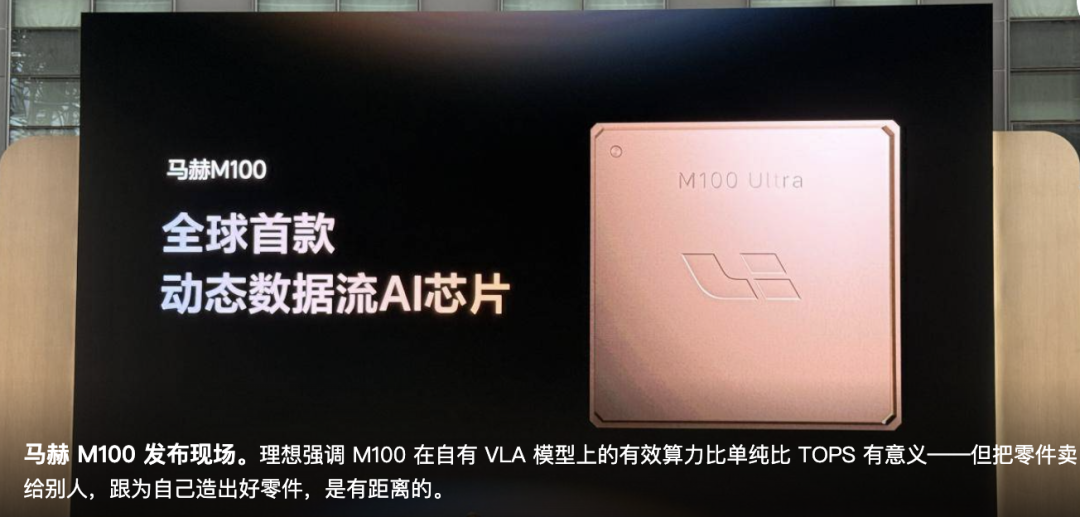
Li Auto has stated that the M100's actual usable computational power is several times that of NVIDIA's Thor-U. However, the two chips differ in computational precision, sparsity calculation methods, and test models, making a direct comparison difficult.
Li Auto can optimize models, operators, and compilers around the M100, but third-party customers may not have the same optimization conditions. Advantages must be re-evaluated for each client.
Sike SiC: External Supply Foundations
Sike Semiconductor was established in 2022 as a joint venture between Li Auto and Hunan Sanan Semiconductor.
Li Auto handles module design and vehicle integration, while Sanan provides SiC substrates, epitaxy, and chips. Sike is responsible for packaging and testing. Initial planned annual capacity was 2.4 million half-bridge power modules. The supply chain is complete, covering materials, chips, packaging, electric drives, and vehicle validation.
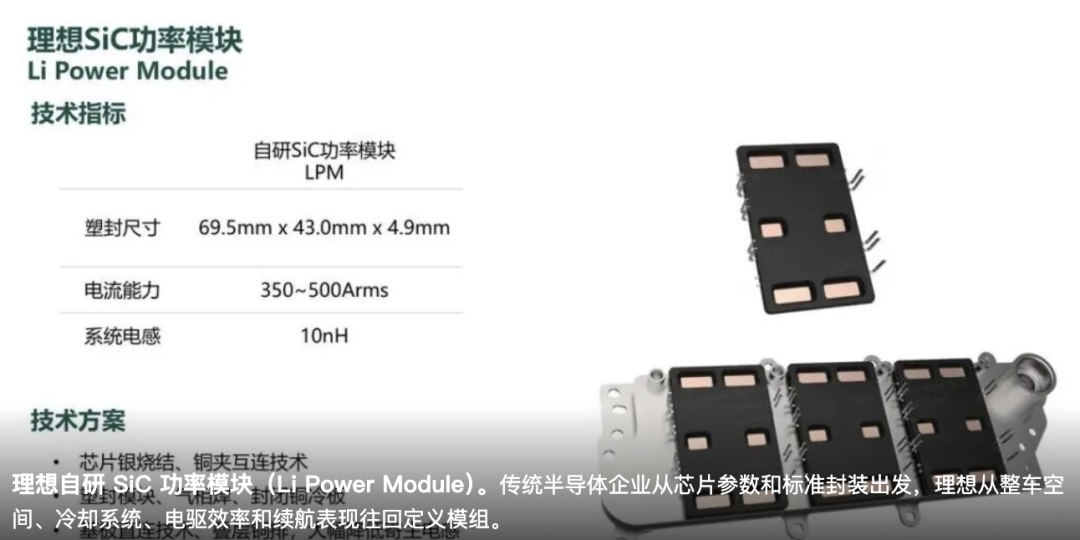
The challenges for SiC modules lie not in low laboratory losses or high power density.
Automotive clients scrutinize thermal cycling, power cycling, soldering and sintering processes, batch consistency, cooling structures, and decade-plus reliability.
Sike's products have already entered mass production with Li Auto's pure electric models, with cumulative shipments of over 150,000 main-drive SiC modules (550A, 880V). 700A and 910V products are undergoing sample validation.
Traditional semiconductor firms typically start from chip parameters and standard packaging, whereas Li Auto defines modules based on vehicle space, cooling systems, electric drive efficiency, and range performance.
Automakers seeking to quickly build 800V platforms but lacking SiC packaging capabilities will value this integration capability.
Extended-Range System: Strong Product Competitiveness, but Supplier Position Already Occupied
The extended-range system is Li Auto's most mature technology. The third-generation system uses a self-developed engine and generator, with generator efficiency at 94.8%. Li Auto has also accumulated extensive experience in low-pressure exhaust gas recirculation, start-stop control, thermal management, and NVH.
Rather than selling just an engine, Li Auto offers a complete extended-range solution validated in whole vehicles.
Its value lies in saving clients time. The extended-range experience depends not just on engine thermal efficiency but also on when the range extender activates, its operating speed, how it adjusts power generation based on battery level and road conditions, and how it manages vibration and noise.
Li Auto has long focused on extended-range SUVs and possesses extensive real-world user data, an advantage traditional engine suppliers may lack.
02 The Other Side of the Shelf: Established Players
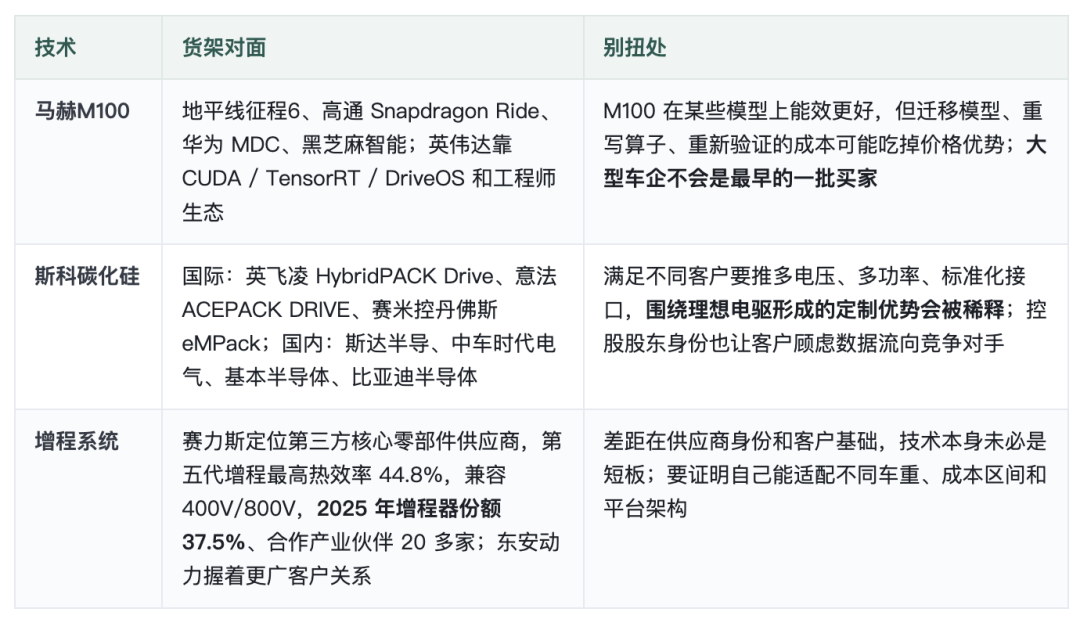
Chip Competitors Don't Just Sell Hardware
In the automotive market, the M100 faces platforms like Horizon Robotics' Journey 6, Qualcomm's Snapdragon Ride, Huawei's MDC, and Black Sesame Intelligence. These companies' competitiveness stems not just from chip parameters but also from functional safety, mass production experience, toolchains, and on-site service teams.
NVIDIA relies on CUDA, TensorRT, DriveOS, development tools, sensor adaptation, and an engineer ecosystem. Many automotive and robotics teams have already developed on NVIDIA's platform. While the M100 may offer better energy efficiency for certain models, the costs of migrating models, rewriting operators, and re-validating could erode its price advantage.
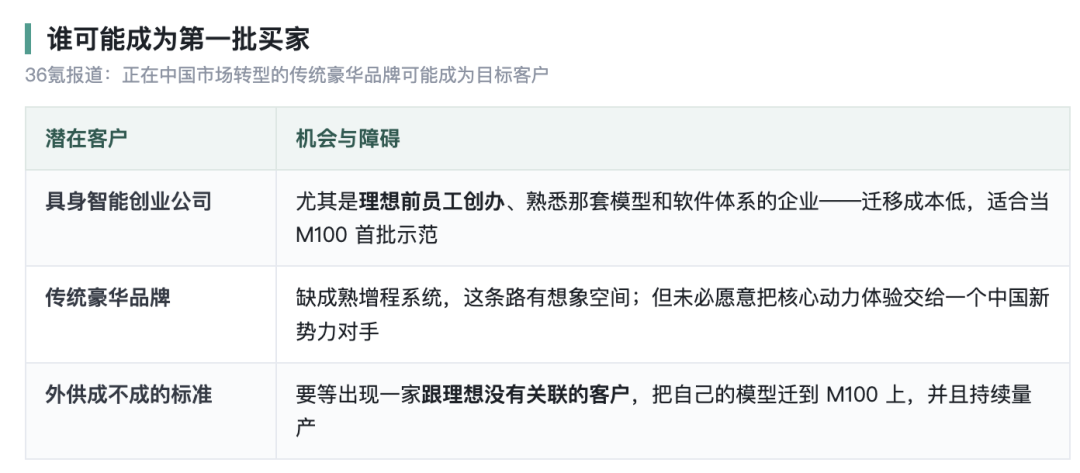
Large automakers are unlikely to be the first buyers. The M100's initial external customers will probably be embodied AI startups with technical routes similar to Li Auto's, especially those founded by former Li Auto employees already familiar with its model and software ecosystem. Migration costs are low for these firms, making them suitable as early adopters.
This will allow the M100 to take its first step from an internal chip to a commercial product. External supply success hinges on attracting a client unrelated to Li Auto that migrates its model to the M100 and achieves sustained mass production.
SiC Segment: Standardization May Erode Customization Advantages
Sike faces established competitors globally, including Infineon's HybridPACK Drive, STMicroelectronics' ACEPACK DRIVE, and Semikron Danfoss' eMPack. Domestically, competitors include StarPower Semiconductor, CRRC Times Electric, Basic Semiconductor, and BYD Semiconductor. These firms boast stronger customer bases, product portfolios, and reliability records.
If Sike aims to serve diverse clients by offering multi-voltage, multi-power, and standardized interfaces, its customization advantages built around Li Auto's electric drive system will be diluted. This is its primary dilemma.
There's also the issue of identity. Li Auto remains Sike's controlling shareholder, raising concerns among other automakers about product planning, cost information, and even technical data flowing to a direct competitor. Introducing external capital and restructuring governance can alleviate but not immediately eliminate these concerns.
Extended-Range Segment: Position Already Occupied by Seres
This market already has more mature suppliers. Seres explicitly positions its powertrain business as a third-party supplier of new energy core components.
The company disclosed that its fifth-generation extended-range system achieves a maximum thermal efficiency of 44.8% and supports both 400V and 800V platforms. By 2025, it aims for a 37.5% market share in extended-range systems and has established partnerships with over 20 industry players.
Traditional powertrain firms like Dongan Engine hold broader customer relationships, products across different displacements, and mature after-sales systems.
The gap between Li Auto and these competitors lies in supplier identity and customer base, not necessarily technology. Li Auto must prove it can serve not just RMB 300,000–500,000 family SUVs but also vehicles with different weights, cost ranges, and platform architectures.
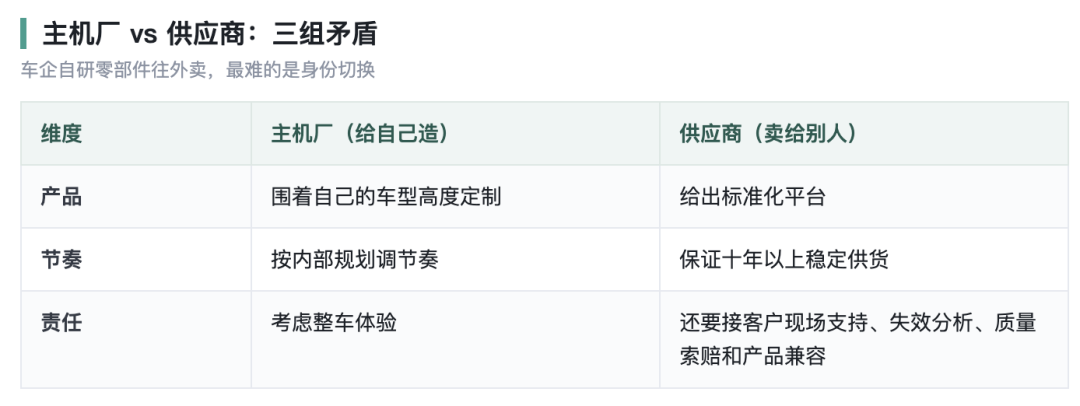
Automakers selling in-house developed components externally is not new. BYD Semiconductor, NIO's Shenji, and Seres Power are all pursuing this path.
The automotive industry involves heavy capital expenditures. When internal sales cannot sustain continuous investment, opening up technologies, seeking external clients, and independent financing become logical choices.
◎ Automakers can highly customize for their own models; suppliers must offer standardized platforms. ◎ Automakers adjust timelines based on internal plans; suppliers must guarantee stable supply for over a decade. ◎ Automakers focus on whole-vehicle experience; suppliers must also handle on-site support, failure analysis, quality claims, and product compatibility.
36Kr mentioned that traditional luxury brands transitioning in the Chinese market could become target clients. This path offers imagination but also significant challenges. Luxury brands lack mature extended-range systems but may hesitate to entrust core powertrain experiences to a Chinese new-force competitor.
Summary
The technologies invested in over the past few years will reveal whether they are internal capabilities serving only Li Auto's models or products that can be independently priced by the market.
Does full-stack in-house development bring cost and efficiency advantages, or does it simply shift money originally paid to suppliers into Li Auto's own R&D and factory accounts?
The SiC module has the best chance to achieve scale first; the extended-range system has strong product competitiveness but must overcome client trust and platform adaptation challenges; the Mach M100 offers the greatest technological imagination but is furthest from commercialization.
-
![]()
ZTE’s New Doubao Phone: Playing It Safe in the AI Race
-
ZTE’s New Doubao Phone: A More Cautious Approach
-
![]()
Samsung, Spurred by Apple, Steps Up Its Game, with LY Technology Reaping the Greatest Benefits
-
Blue Heart Xiaov Set to Introduce Paid Pro Version, Revealing vivo’s Large Model Strategy
-
Three-Way Struggle for Market Share: BYD, Chery, and Geely Challenge Great Wall, Posing Immediate Risks to Wei Jianjun
-
![]()
The Reason Behind Valve's Headset Price Surge of 2400 Yuan: The End of an Era of Selling at a Loss
-
![]()
Decoding the '4S' Architecture | Report on Enterprise-Level AI Services in China
-
![]()
Li Auto Aims to Sell Three Technologies, First Buyers Unlikely to Be Major Automakers