Did Trump Make Concessions? Chinese Automakers Are Invited to Establish Factories in the U.S., but Importing Fully Assembled Vehicles Is Off the Table
 09/20 2026
 385
385
Chinese automakers should meticulously analyze Trump's recent statements.
He explicitly stated, "If China is interested in setting up a car manufacturing plant here, I have no objections. Japan follows a similar approach; the crucial aspect is that they employ our workforce."
The initial layer of meaning is the endorsement of factory construction and the employment of American workers.
The second layer swiftly unfolds. He rejected the idea of permitting the direct importation of fully assembled Chinese vehicles into the U.S., citing a straightforward rationale: If existing restrictions were removed, the U.S. domestic market could be inundated.
The third layer conveys a clear disapproval of the strategy employed by Chinese automakers of establishing factories in Mexico and subsequently exporting vehicles to the U.S. He clarified, "But I'm not criticizing Chinese cars."
When these three layers of meaning are combined, the full picture emerges. The door is slightly ajar, but only for factories, not for finished products. If you aim to profit in the U.S. market, you can—relocate your production line there and create jobs locally.
1
This Is Not a Novel Approach; It's the Japanese-Korean Strategy
Those well-versed in the automotive industry recognize that this tactic is not groundbreaking.
Toyota, Honda, and Hyundai took a similar route when entering the U.S. market. They constructed factories on American soil, hired U.S. workers, progressively localized their supply chains, and gained market access through job creation and investment. Over the years, Japanese and Korean vehicles have firmly established themselves in the U.S. market, while the Big Three automakers from Detroit have been forced to retreat.
While Trump verbally extends a welcome to Chinese automakers, he is essentially providing them with the Japanese-Korean blueprint. If Chinese automakers genuinely aspire to penetrate the U.S. market in the future, this is likely the sole viable path. Americans will eventually drive affordable Chinese cars, but the labels will read "Made in U.S. Factories."
In fact, one company has already successfully implemented this strategy—BYD.
Many are unaware that BYD's top-selling product in the U.S. market is not passenger cars, but electric buses. This initiative was launched during Arnold Schwarzenegger's tenure as governor of California. After over a decade of development, BYD's electric buses now dominate the U.S. market, holding approximately an 80% market share. By manufacturing locally, hiring locally, and quietly generating profits, BYD has emerged as the industry leader.
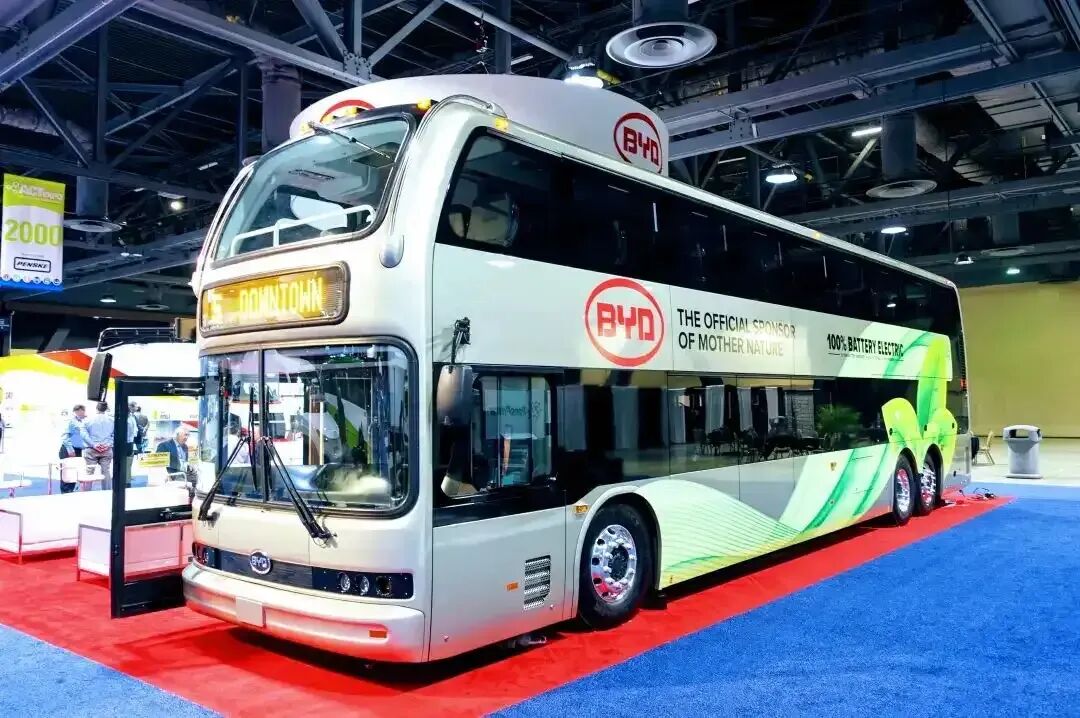
Although the bus market may not be vast, it demonstrates one thing: Chinese automakers are fully capable of local production, compliant operation, and market share acquisition in the U.S. The strategy Trump is now proposing is one that BYD has been executing for over a decade.
2
The Primary Concern Lies with Mexico
The most crucial aspect of Trump's statement is not the endorsement of factory construction, but his opposition to the Mexican model.
Currently, Chinese automakers, including BYD, are expanding into Mexico. Mexico offers tangible advantages: low labor costs, proximity to the U.S. market, and tariff benefits under the USMCA. Manufacturing cars in Mexico and transporting them to the U.S. by land is significantly more cost-effective than direct exports.
The issue is that this approach is perceived as exploiting loopholes in U.S. regulations.
The so-called Mexican model essentially involves relocating production sites without localizing production. Factories do not bring jobs to the U.S., taxes remain in Mexico, profits are repatriated to China, and the U.S. market still absorbs the output. The Trump administration's tolerance for this is clearly waning.
Similar scenarios are unfolding across various industries.
Televisions serve as a prime example. Mexican-made TVs have become the best-selling TVs in the U.S. market. This is not solely the work of Chinese brands like Haier, Hisense, and TCL; Samsung also manufactures in Mexico and sells into the U.S. with Mexican origin labels.
The list extends beyond automobiles. Power batteries, home appliances, photovoltaic modules—an increasing number of Chinese-made goods are entering the U.S. through routes involving Mexico, Vietnam, and Thailand. Production diversification is a natural response for companies facing high tariffs.
However, between natural market forces and policy barriers lies an election cycle. Given current trends, new regulations targeting Mexican re-exports are likely to emerge, attempting to close this loophole. The success of these regulations will hinge on the U.S.'s ability to dismantle supply chains and on the renegotiation of the USMCA.
3
Under Pressure, Each Forges Its Own Path
When these signals are considered collectively, it becomes evident that the global expansion of Chinese manufacturing is entering a new phase. Xingkongjun reminds us that comprehending these three layers of statements is far more crucial than focusing on individual news stories.
The initial phase involved selling products through direct exports—the most efficient method. The second phase entailed selling production capacity by establishing overseas factories to circumvent tariffs. Now, the U.S. is attempting to compel everyone into a third phase: To access the U.S. market, you must relocate factories, jobs, and supply chains there entirely.
This is a classic example of using planned-economy thinking to dictate market-economy behavior.
Yet, companies emerge from market competition and are far more attuned to trends than politicians. Some will opt to build factories in the U.S., embracing the Japanese-Korean model; others will persist in deepening their presence in Mexico, wagering that the loopholes will remain open; still others will pivot to Europe, Southeast Asia, or the Middle East to reduce their reliance on the U.S. market. Chinese companies will be present on every path.
The U.S. can erect barriers, but market forces will persist. In the future global manufacturing landscape, the same Chinese car might assume three identities: a localized product manufactured in U.S. factories, a re-exported good from Mexican factories operating in a gray area, and a pure import blocked by high tariffs.
Trump has opened the door to factory construction, closed the door to imports, and attempted to block Mexico's window.
Between the door and the wall, Chinese automakers' globalization is carving out its own unique third path.
-
![]()
ZTE’s New Doubao Phone: Playing It Safe in the AI Race
-
ZTE’s New Doubao Phone: A More Cautious Approach
-
![]()
Samsung, Spurred by Apple, Steps Up Its Game, with LY Technology Reaping the Greatest Benefits
-
Blue Heart Xiaov Set to Introduce Paid Pro Version, Revealing vivo’s Large Model Strategy
-
Three-Way Struggle for Market Share: BYD, Chery, and Geely Challenge Great Wall, Posing Immediate Risks to Wei Jianjun
-
![]()
The Reason Behind Valve's Headset Price Surge of 2400 Yuan: The End of an Era of Selling at a Loss
-
![]()
Decoding the '4S' Architecture | Report on Enterprise-Level AI Services in China
-
![]()
Li Auto Aims to Sell Three Technologies, First Buyers Unlikely to Be Major Automakers