Is Another 'Jie' on the Horizon? Two Automakers Team Up to Launch 'Chu Jie,' Leaving Hongmeng Zhixing Puzzled
 10/02 2026
 459
459
As the automotive world buzzes about AITO's 'solo flight' away from Hongmeng Zhixing, a new 'Jie' has made its entrance into the industry. On September 20th, Zhengzhou Chujie Automobile Research and Development Co., Ltd. (dubbed 'Chu Jie R&D') was officially registered with a registered capital of 1 million yuan. However, this 'Chu Jie' has no ties to Hongmeng Zhixing; instead, it is backed by Haima Automobile and Chugneng Automobile.
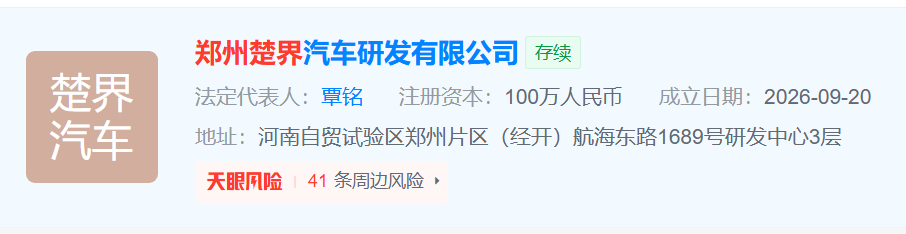
According to Qichacha, Chu Jie R&D is a joint venture between Haima Automobile Co., Ltd. (referred to as 'Haima Automobile') and Wuhan Chugneng Passenger Vehicle Co., Ltd., with a 51% and 49% shareholding respectively. Its business scope encompasses engineering and technology research, automotive parts R&D, as well as the sales of new energy vehicles, batteries, and charging piles. In fact, rumors surfaced as early as June last year that Chugneng Automobile's brand name might be 'Chu Jie,' with the tipster humorously suggesting that Chugneng was 'striving to be the sixth Jie.'
Chugneng Automobile's decision to partner with Haima and establish Chu Jie is likely driven by its interest in Haima's production capabilities. The joint venture is registered on the 3rd floor of the R&D center at 1689 Hanghai East Road, Zhengzhou Economic and Technological Development Zone, which happens to be the location of Haima Automobile's Zhengzhou base.

Chugneng Automobile is currently the newest entrant in the cross-border car manufacturing arena. Its main car manufacturing entity, Chugneng Automobile Co., Ltd., was established in December 2024 and is wholly owned by Hengxin Automobile Group Co., Ltd. Hengxin Automobile Group is an automotive dealer, and its subsidiary, Wuhan Chugneng Passenger Vehicle Co., Ltd., is the entity that funded the establishment of Chu Jie R&D.
Hengxin Automobile's founder, Dai Deming, began his career as a home appliance agent before venturing into the automotive dealership industry in 2000. Today, his Hengxin Automobile Group ranks second among China's top 100 automotive dealer groups in 2026. Dai also established Chugneng New Energy in 2021, focusing on energy storage and power batteries. In the first half of this year, Chugneng New Energy ranked third globally in energy storage cell shipments, trailing only CATL and EVE Energy. With one company in distribution and another in battery manufacturing, Dai's two ventures are both thriving and deeply intertwined with the automotive industry.
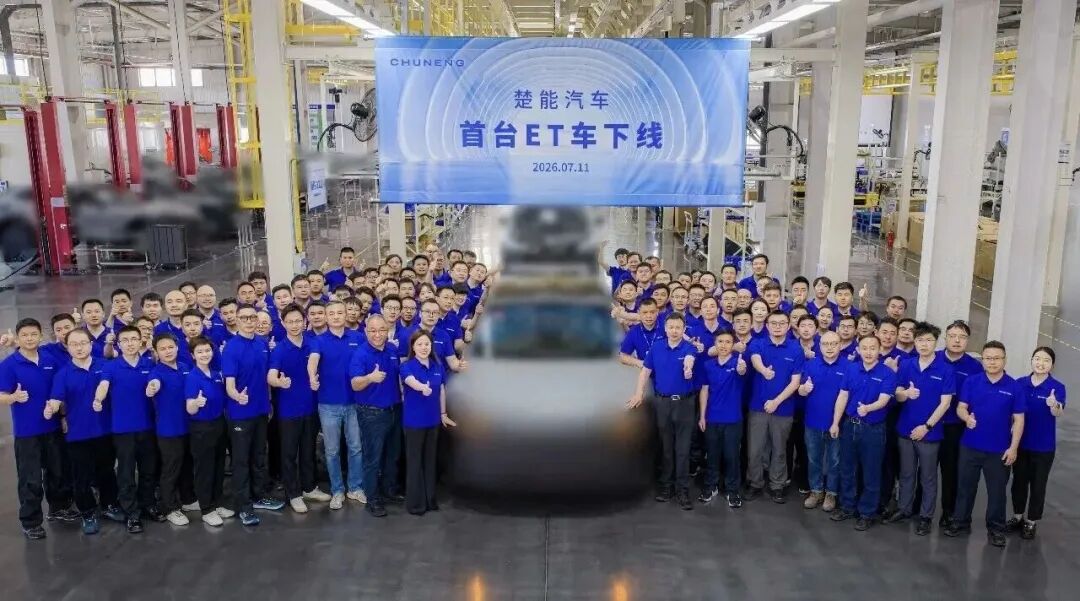
News of Chugneng Automobile's foray into vehicle manufacturing first emerged in June last year, with reports indicating that its debut model would be an extended-range SUV comparable to the AITO M5, with long-term plans for both extended-range and pure electric models. Since then, Chugneng's car manufacturing progress has accelerated significantly. Starting in May this year, Chugneng Automobile has inked agreements with suppliers such as Valeo, Aptiv, Fuyao, Mahle, and Schaeffler. On July 11th, the first ET engineering prototype rolled off the line in Jiangxia, Wuhan, marking the beginning of the real vehicle verification phase. Reports suggest that its debut model is positioned in the 150,000-200,000 yuan price range, with a target launch date around mid-2027.
Compared to other cross-border car manufacturers, Chugneng's relative strength lies in its comprehensive industrial chain layout: upstream, it has Chugneng New Energy supplying batteries, which currently account for about one-third of a vehicle's cost—a strategic move as many automakers are now developing batteries in-house to reduce costs. Downstream, it benefits from Hengxin's established dealership network, making touchpoint construction far easier than for other newcomers.
However, Chugneng's vehicle production qualifications remain uncertain. The most widely circulated plan was that Chugneng Automobile would acquire WM Motor's Xinghui factory in Huanggang, Hubei, which has a planned Phase 1 capacity of 150,000 units. Currently, WM Motor is undergoing bankruptcy reorganization. By leveraging Haima's production qualifications instead of purchasing WM's factory, Chugneng can operate with lighter assets and reduce financial pressure. Thus, it appears that Chugneng has abandoned the acquisition option.
On the other hand, Haima Automobile is also in need of new growth drivers to reverse its fortunes. As a seasoned independent automaker, Haima reached its peak in 2016 with annual sales exceeding 215,600 units before experiencing a decline and gradually becoming marginalized. Today, Haima's vehicle sales mainly rely on exports of models like the S5 Pro and S7 Pro, with modest total volumes. In 2025, Haima's total annual production was 17,900 units, while its combined capacity in Haikou and Zhengzhou bases is 300,000 units/year, resulting in a mere 6% utilization rate and 94% idle capacity. Furthermore, Haima had extensive contract manufacturing experience, having produced the Xpeng G3 for Xpeng from 2019 to 2021.
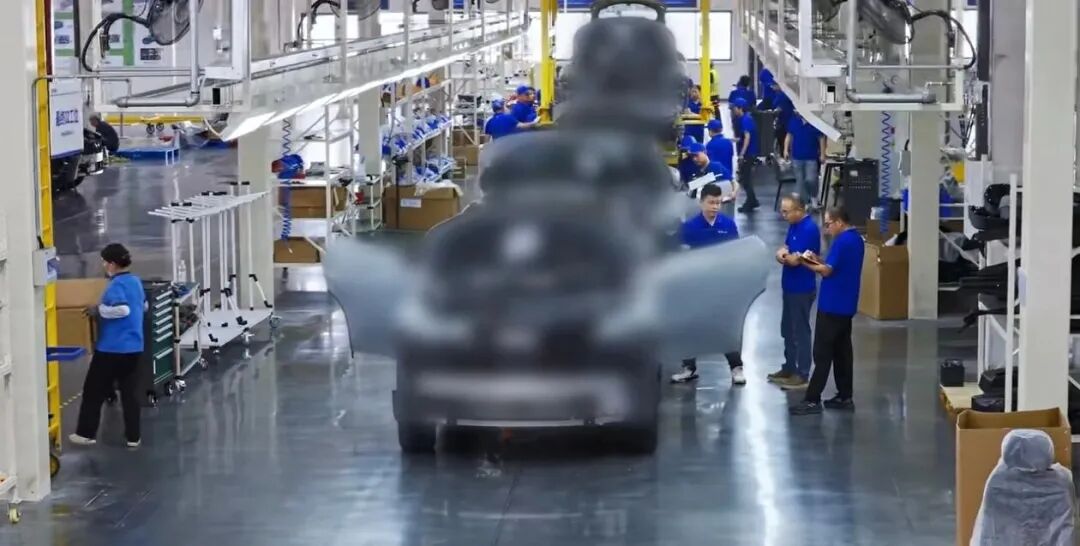
Meanwhile, Haima Automobile continues to face persistent losses. Since 2022, Haima has incurred losses for four consecutive years. In the first half of this year, Haima's revenue was 314 million yuan, down 52.04% year-on-year, with a net attributable loss of 97.3648 million yuan, approximately 30.66% worse than the same period last year. Activating its idle capacity has become a pressing issue for Haima.
From this perspective, the collaboration between Haima Automobile and Chugneng Automobile is a win-win situation. However, it should be noted that the core focus of the new company's business scope is on R&D. Its establishment indicates that both parties intend to collaborate at the R&D level. If Haima's production qualifications are utilized later, it would be a natural progression. It remains unclear whether Chugneng Automobile is simply seeking contract manufacturing from Haima or jointly creating a new brand with Haima.
With batteries, distribution channels, and production capabilities in its arsenal, is Chugneng Automobile poised for success? Obviously, it's not that straightforward. On one hand, car manufacturing is a multifaceted endeavor encompassing R&D, product definition, manufacturing, marketing, and distribution—the three aspects mentioned earlier are just one piece of the puzzle. On the other hand, competition in the domestic market is far fiercer than a few years ago, with leading newcomers already reaching monthly sales of 30,000 units and Leapmotor surpassing 100,000 deliveries, widening the gap and increasing pressure on latecomers.
More importantly, China's automotive industry is now entering a consolidation phase, with state-owned enterprises like FAW and GAC leading the charge. Among newcomers, Leapmotor has aligned with FAW, while NIO has deepened cooperation with Geely in charging and battery swapping. Against this backdrop of resources converging toward industry leaders, venturing into car manufacturing is indeed a high-risk endeavor.
-
Tech Innovation | Silicon-Based Flow’s ‘Token Factory’ Debuts on HKEX as MaaS Revenue Soars 653%
-
The Anxieties of 007: Humanity’s Enduring Fear of Technological Evil
-
![]()
Is Another 'Jie' on the Horizon? Two Automakers Team Up to Launch 'Chu Jie,' Leaving Hongmeng Zhixing Puzzled
-
![]()
August Online Market for Consumer-Grade Action Cameras: Volume, Value, and Price All Rise Year-on-Year, with New Products Fueling High-End Expansion
-
![]()
Surging by 1.3 Trillion Yuan in a Single Day! Meta's AI Triumph Led by a Chinese AI Guru
-
The Hidden Risks in Second-Hand Transactions of Intelligent Driving Vehicles
-
Yutong Optics’ Array-Molded C-Lens Hits Monthly Shipments of Tens of Millions!
-
Survival Game of New Energy Vehicles Accelerating Industry Reshuffle