Did the 'Golden September' Phenomenon Fail to Materialize? Auto Market Experiences Sales Dip Amidst High Base, Yet 'Not Cold'
 10/10 2026
 359
359
September has long been considered the peak season for the domestic auto market, a period often dubbed 'Golden September' within the industry, heralding the commencement of the annual sales race. However, this year's peak season appeared to fall short of expectations. Prior to the release of the monthly sales data, the China Passenger Car Association (CPCA) had already cautioned that the domestic passenger car market in September 2026 would not witness the explosive growth seen in previous years, predicting only a slight month-on-month rebound and significant year-on-year challenges.
As major automakers gradually unveiled their monthly delivery figures, the CPCA's assessment largely held true. In September, automakers generally reported a month-on-month increase in sales, reflecting the influence of the peak season. Nevertheless, due to the high sales base in the same period of 2025, overall market sales experienced a year-on-year decline. The performance gap among automakers and across different sectors continued to widen.
▍Overall Decline, Market Engages in Existing Stock Competition
From a macro perspective, domestic narrow passenger car retail sales in September 2026 reached approximately 1.69 million units, marking a 9.7% month-on-month increase from August and continuing the trend of slight recovery during the peak season. However, compared to September 2025, sales plummeted by 24.6% year-on-year.
Although the 24.6% year-on-year decline appears substantial, it can be attributed to clear, objective factors rather than a sudden downturn in consumer demand. In September 2025, automotive consumption subsidies in numerous regions were nearing expiration, prompting a surge in vehicle purchases during the policy window. This drove retail sales of narrow passenger cars to 2.241 million units, creating a temporary peak. Faced with such a high base, the double-digit year-on-year decline in September 2026 represents a reasonable adjustment due to base effects. Weekly data from the China Automobile Dealers Association corroborates this: from September 1 to 20, cumulative retail sales of passenger cars nationwide reached 878,000 units, down 22% year-on-year but up 8% compared to the same period in August. The market exhibited a gradual week-by-week recovery trend, with terminal demand remaining robust.
More noteworthy than the overall sales fluctuations are the structural changes within the market. According to Cui Dongshu, Secretary-General of the CPCA, in previous years, the growth during 'Golden September' was inclusive, with both first-time and replacement demand being released simultaneously, benefiting both fuel-powered and new energy vehicles. However, by 2026, the auto market had transitioned to a new phase, with overall growth potential significantly diminished. Only the new energy sector maintained stable new demand, while fuel-powered vehicles essentially ceased to grow, competing solely for existing users.
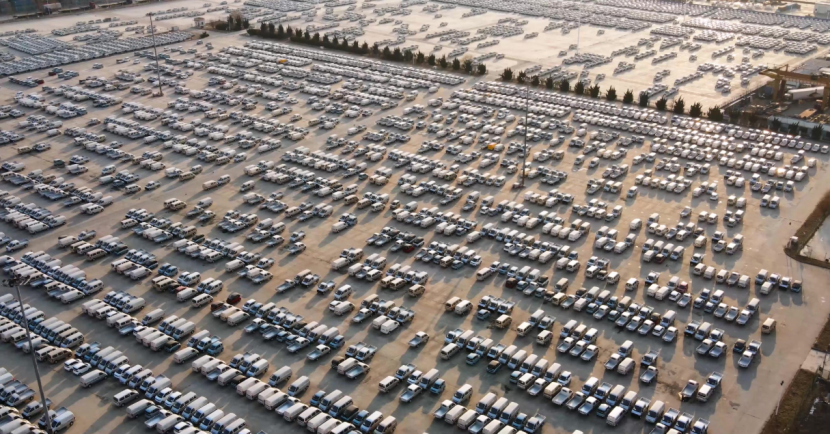
CPCA terminal retail data revealed that in the first three weeks of September, domestic new energy passenger car retail sales reached 596,000 units, down 9% year-on-year—a much smaller decline than the overall market's 22%—and up 14% month-on-month, with a retail penetration rate of 67.9%.
Faced with sales pressure, all industry stakeholders took proactive measures. In September, over ten automakers, including FAW, SAIC, Changan, Geely, BYD, and Li Auto, accelerated new vehicle launches, with more than 50 all-new, next-generation, and facelifted models hitting the market—the highest monthly density for the year. Notably, on September 23 alone, nine new models were unveiled. Local governments also intensified their efforts to promote consumption, with provinces such as Gansu and Qinghai, as well as cities like Yangzhou, Lanzhou, Qingdao, and Nanjing, launching new rounds of vehicle purchase subsidies. In some regions, subsidies per vehicle reached up to 5,000 yuan, directly reducing consumer purchasing costs.
Automakers iterated their product lines, and local governments offered subsidies, jointly driving the month-on-month recovery trend in September. However, these short-term boosts could not fully counterbalance the year-on-year decline caused by the high base. Industry insiders believe that the fourth-quarter market outlook hinges on two key factors: whether local subsidies continue to be implemented and whether automakers can maintain delivery efficiency during their year-end sales push.
▍Leadership Reshuffle: Differentiation and Overseas Expansion Emerge as Keywords
Amidst overall market pressure, the gap between automakers widened further, with leadership positions undergoing a new round of adjustment. Overseas market expansion and breakthroughs in the new energy business are now defining the differences between automakers.
BYD maintained its position as the top-selling domestic automaker. According to BYD's September 2026 production and sales report, the company sold 463,561 new energy vehicles that month, up 17% year-on-year, and was the only domestic automaker to surpass 400,000 monthly sales.
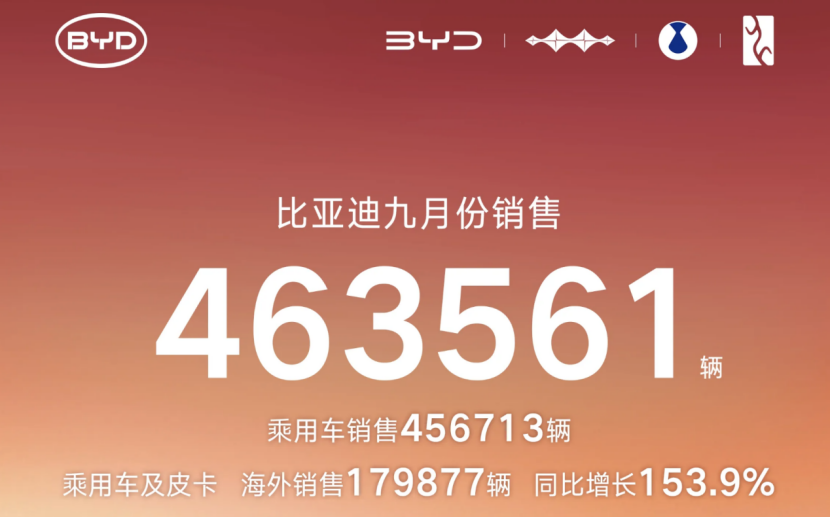
However, a closer look at the sales structure reveals a shift in BYD's growth drivers. The company exported 179,877 new energy vehicles overseas that month, accounting for nearly 40% of total sales, with overseas markets becoming the new growth engine. Over the first nine months, BYD's cumulative sales reached 3,131,576 units, down 3.94% year-on-year, still in a slight decline. Analysts note that BYD has entered a phase of 'defending domestic market share while seeking overseas growth,' with the pace and performance of its overseas business directly impacting its full-year 2026 results.
Competition in the second tier intensified, with Chery, Geely, and Great Wall Motors adopting different strategies but all relying heavily on overseas markets for growth.
Chery Group sold 292,308 vehicles in September, up 4.2% year-on-year, maintaining overall stability. Of this, overseas exports reached 207,814 units, a new single-month export record, accounting for nearly 70% of total sales, with overseas markets becoming Chery's primary growth driver. In the same month, Chery's new energy vehicle sales reached 133,310 units, showing initial transformation results.
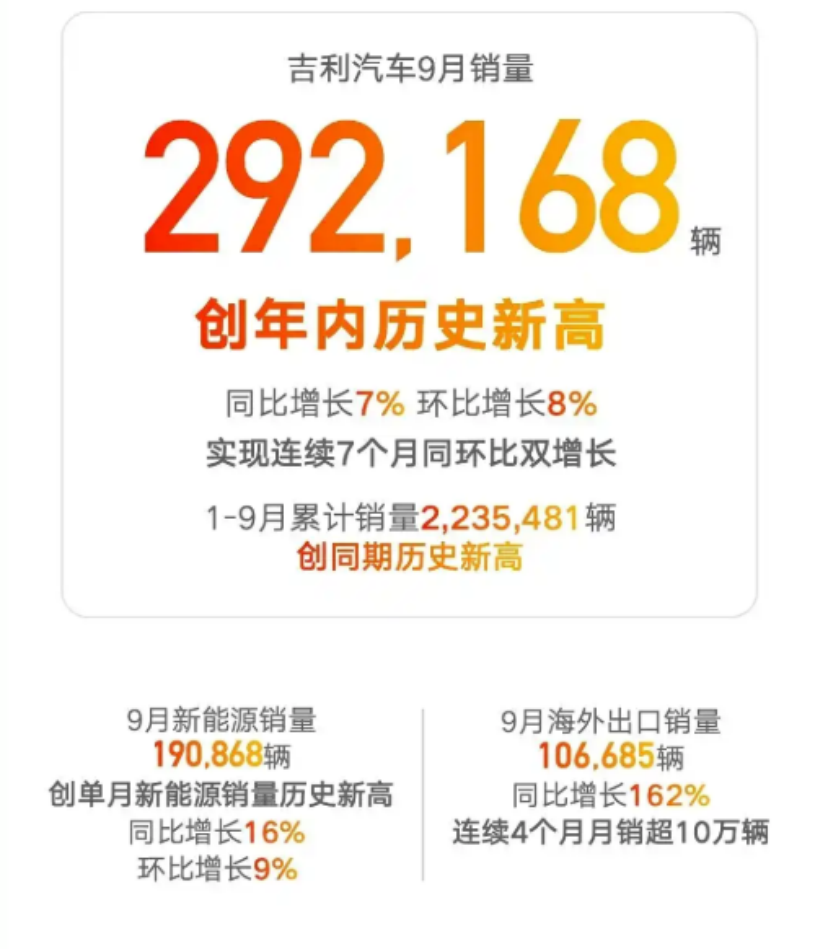
Geely Auto performed even more strongly, selling 292,168 vehicles in September, up 7% year-on-year and 8% month-on-month, marking seven consecutive months of double-digit year-on-year and month-on-month growth. In new energy, it sold 190,868 units, up 15.54% year-on-year, with a new energy model penetration rate rising to 65%. Overseas markets saw explosive growth: September overseas sales reached 106,685 units, up 162% year-on-year, and surpassing 100,000 units for the fourth consecutive month. Geely has explicitly set a target of 1 million overseas sales for the full year.
Great Wall Motors' performance was relatively sluggish, with 114,944 new vehicles sold in September, down 13.99% year-on-year; cumulative sales over the first nine months reached 920,302 units, down 0.33% year-on-year. That month, Great Wall's overseas sales reached 60,019 units, accounting for 52% of total sales, representing one of its few growth areas.
Significant changes also occurred in the rankings of new energy upstarts. Leapmotor performed most strongly, delivering 105,656 vehicles in September, up 59% year-on-year, surpassing 100,000 monthly deliveries for the third consecutive month and solidifying its lead among upstarts. Overseas, Leapmotor exported over 150,000 vehicles from January to September, exceeding its full-year export target ahead of schedule. XPENG and Xiaomi Auto also gained momentum, with both companies surpassing 40,000 monthly deliveries in September. Xiaomi Auto broke the 40,000-unit monthly delivery threshold for the first time this year, with its new model Pengcheng delivering over 10,000 units in its first month, providing strong support for the company's growth.
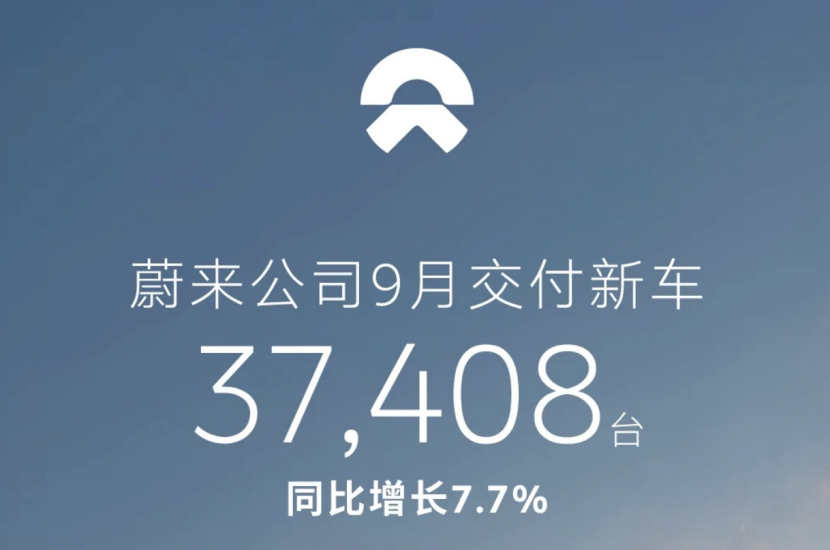
NIO and Zeekr maintained steady growth. NIO delivered 37,408 vehicles in September, up 7.7% year-on-year, performing stably; Zeekr delivered 37,216 units, up 103.85% year-on-year, making it one of the fastest-growing new energy brands that month. In contrast, Li Auto and HiPhi experienced declines, with Li Auto delivering 31,817 vehicles, down 6.29% year-on-year, and HiPhi delivering 37,490 vehicles, down about 29% year-on-year and 11% month-on-month.
On October 1, Huawei and Seres officially announced a new five-year cooperation agreement, forming a dedicated operations team for the AITO brand to further integrate resources. The competitive logic among upstarts has shifted, with the pace of model iterations and product launch cycles now directly determining market rankings for each brand.
The year-on-year sales decline in September stemmed from the ultra-high base in the same period of 2025, not from weakening consumer demand, as the fundamental trend of month-on-month recovery during the peak season remained intact. In a market environment characterized by existing stock competition, growth is concentrated in the new energy sector, while the market space for fuel-powered vehicles continues to contract. Domestic market competition is intensifying, with overseas markets transitioning from an optional to a must-win arena, becoming a crucial source of new growth for automakers. The competitive landscape among upstarts remains fluid, with product update rhythms, new model launch cycles, and the reputation of existing products still serving as core variables reshaping industry rankings.
As the final three months of the year approach, major automakers are launching their final annual sales and performance sprints, with local vehicle purchase subsidy policies still in effect. The final sales results and profitability levels of each automaker will be determined by year-end.
Layout | Yang Shuo Image Sources: Qianku.com, BYD, Geely Auto, NIO
-
![]()
Keynote Speaker Announcement | Wang Peng, Alibaba's QianWen Office Business Development Expert, Confirmed for WAIE (10th) 2026 AI Industry Conference & AI Agent Industry Application Summit
-
![]()
A Chaotic Battle in the Smartphone Market: Who is Redefining the Imaging War?
-
![]()
Chaotic Competition in the Smartphone Market: Who is Redefining the Imaging War?
-
![]()
AI Is Not a Get-Out-of-Jail-Free Card: Why Only Microsoft Is Being Rewarded for Its AI Investments
-
![]()
Li Auto’s 2026 i6: The Brand’s Debut Global All-Electric Model Headed to Europe
-
![]()
Kimi K3 Goes Viral and Suspends Service in 48 Hours: Model Wins Benchmarks, Compute Falls Short Against Big Players
-
![]()
Zhixiang Future Secures 2.1 Billion Yuan in Three Months of Financing, Yet Founder Maintains: 'We Haven't Achieved World-Model Status'
-
11 Days, Five Launch Events: The Battle Behind the 2026 Domestic Flagship Smartphones