Robotaxi's Year of Fierce Competition: No One Has Yet Reaped the Rewards of Commercialization
 11/23 2026
 446
Layout | Xiaoxi
As 2026 draws to a close, L4 has become widely recognized across the industry as the most disruptive ride-hailing technology, yet the first to sprint toward commercialization is not passenger vehicles, but Robotaxi.
Over the past decade or so, the global Robotaxi sector has burned through more than a hundred billion dollars in real money, but for most players, there are grievances they cannot voice—making money from Robotaxi is no easy feat.
2026 is billed as the critical year for Robotaxi to transition from technical validation to large-scale commercial deployment. More and more cities are covered, paid orders keep hitting new highs, and tech companies, automakers, and mobility platforms are all rushing in, making the sector look hot.
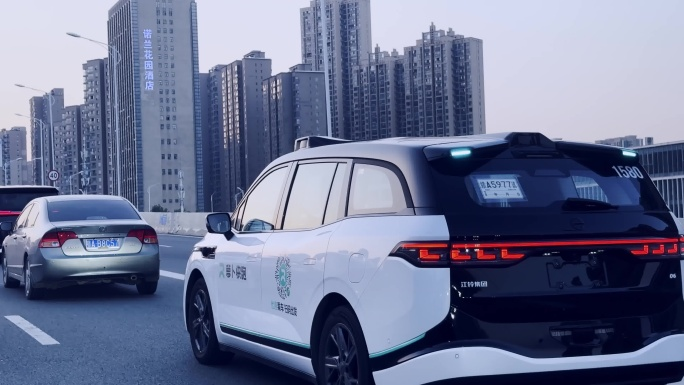
But after a full year of fierce battle, combined with the latest third-quarter financial data, the entire industry still has not reached the turning point of large-scale profitability, and no player has been the first to obtain stable commercialization dividends.
Years ago, Robotaxi competed on technical parameters and capital narratives; now it competes on operational efficiency. From grabbing licenses to grabbing orders, the exam questions for the Robotaxi industry have completed a full cycle of change.
From another perspective, slower commercialization is not a bad thing. The most expensive thing in this industry is not money, but trust: one accident, one falsely reported "profit," will take years to repay.
| 1.0 Hardcore Technology, 2.0 Racing Competition |
After years of market reshuffling, the camps in the Robotaxi sector have basically taken shape. The first tier consists of full-stack closed-loop tech giants, typically represented by Baidu Apollo Go and Google Waymo. Both companies possess full in-house R&D capabilities in algorithms, computing power, and high-precision maps, and with brand and traffic advantages, they can directly complete C-end commercialization.
Relying on the Baidu ecosystem, Apollo Go has been operating stably in dozens of cities at home and abroad and has smoothly entered markets in the Middle East, Europe, and many other cities. After completing a new round of financing of 16 billion dollars, Waymo's valuation exceeded 100 billion dollars. They are also among the few main players in the industry that possess both large-scale orders and preliminary commercialization validation. But the asset-heavy full in-house R&D model requires high investment.
The mid-tier players in the sector are vertical companies focused on technology R&D, with Pony.ai and WeRide as core representatives. Such enterprises iterate flexibly and deploy agilely. The two companies' Hong Kong IPOs raised more than a billion dollars in total, and they are deeply cultivating both domestic and overseas markets. Compared with tech giants, they face greater pressure in commercialization deployment and need to continuously open new scenarios to spread long-term high R&D expenses.
New entrants have recently emerged in the sector. Mainstream mobility platforms such as Didi, Amap, and Cao Cao Mobility are key participants in this new round of competitive landscape. Robotaxi is not their core business, but is regarded as a new growth curve for the platforms. Didi plans to expand the Robotaxi testing scope to 10 cities this year; Cao Cao Mobility proposed: achieve a cumulative GTV scale of 100 billion yuan in unmanned mobility over the next decade.
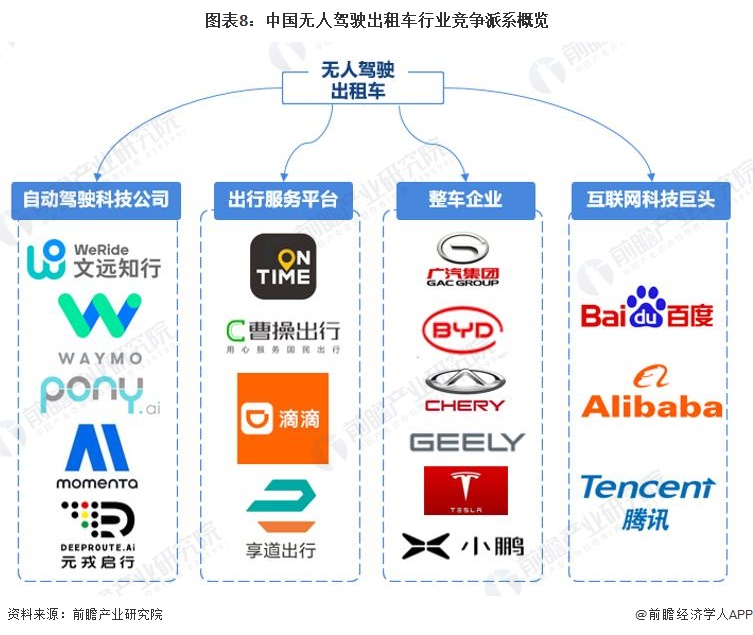
Old and new forces are all entering the Robotaxi sector. Three years ago, the core industry discussion was still "can fully unmanned operations be achieved" and "how high can technology penetration reach." Now the topic has long changed. Technology maturity is no longer the biggest barrier; cost control and efficiency improvement under large-scale operations have become the common exam question faced by all players.
In fact, this principle is intuitive: when everyone can run fully unmanned operations in designated areas, the technology gap is gradually leveled, and what comes next is who can run more orders at lower cost and who can make the per-vehicle economic model positive.
This also means that the Robotaxi industry has officially moved from the 1.0 technical validation stage to the 2.0 operational racing stage. But the finish line of the race is not winning more cities or deploying more vehicles, but a commercial account book that can break even.
Let us first look at the operating scorecards delivered by relevant major players in the third quarter. It first confirms the industry's direction of progress and also first exposes the awkwardness of profitability.
| Order Volumes Continue to Surge, So Why Has the Scalable Profit Model Still Not Broken Even? |
Scale growth is real. Baidu's third-quarter 2026 financial report shows that Apollo Go's autonomous driving mileage in the quarter was about 34 million kilometers. As of October 31, cumulative autonomous driving mileage had exceeded 390 million kilometers, with global operations covering 30 cities. Growth in key cities is particularly rapid. Shenzhen has become one of Apollo Go's largest operating markets, with fully unmanned operating orders in the third quarter growing about 170% quarter over quarter; the Dubai market also expanded simultaneously, not only expanding the operating area but also directly doubling the fleet size.
Pony.ai's growth curve is even steeper. Its third-quarter total revenue reached 299 million yuan, up 75.2% year over year, a record high for a single quarter; among that, Robotaxi business revenue was 119 million yuan, up 165.4% year over year, passenger fare revenue rose nearly 400% year over year, and its share of total revenue increased from 26.3% in the same period last year to 39.9%, basically level with the Robotruck business for the first time. As of the end of September, Pony.ai's global Robotaxi fleet reached 2,768 vehicles, steadily advancing toward the year-end target of 3,500.
Although WeRide has not released a complete third-quarter financial report, its publicly disclosed operating data also maintains high growth. Second-quarter overseas revenue grew 164.4% year over year, business has covered 13 countries and 60 cities globally, and its L4 autonomous driving fleet is about 3,400 vehicles, including more than 1,800 Robotaxis. In Guangzhou alone, average daily orders per vehicle have exceeded 21, up 24% quarter over quarter, with core areas supporting 24-hour uninterrupted commercial operations.
Looking back, the proportion of commercial orders paid by real users has steadily increased, and the service value of unmanned mobility has been validated by the market. But with orders rising so much, many players are still only profitable per vehicle, and the industry's long-called profitability has still not caught up.
Where are the core bottlenecks?
Further analysis easily reveals that changes on the cost side are misleading. The vehicle manufacturing cost of seventh-generation unmanned vehicles has dropped into the range of traditional mobility vehicles, and the decline in hardware costs is visible.
But hidden operating costs have not been diluted in sync with fleet expansion. In the industry's common cost structure, vehicle depreciation and operating costs each account for about half. The latter includes multiple rigid expenditures such as remote takeover teams, depot operations and maintenance, insurance, and computing power scheduling.
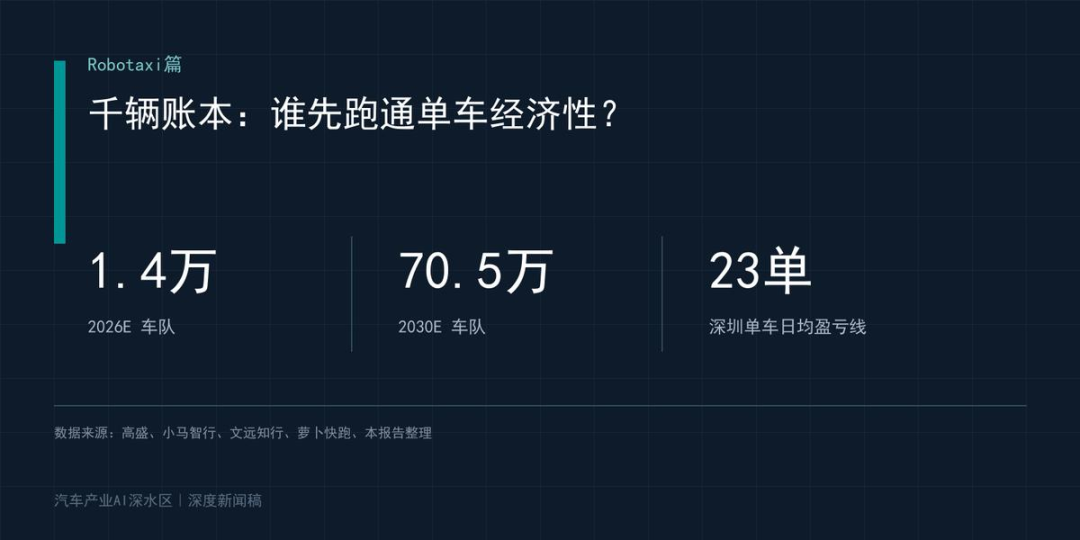
A research report by Shenwan Hongyuan once estimated the profit models of vehicles of different generations. The fifth-generation converted vehicle cost 480,000 yuan per vehicle, with an average daily total cost of 575 yuan and daily revenue of only 240 yuan, resulting in a daily loss of more than 300 yuan; by the seventh-generation mass-produced vehicle, the per-vehicle cost dropped to 180,000 yuan, and average daily total cost was compressed to 254 yuan. Based on revenue of 2 yuan per kilometer per day, a daily gross profit of 66 yuan could be achieved. It sounds like the model has turned positive, but this is only an estimate at the per-vehicle operating level. Once full-caliber costs such as R&D, headquarters management, and market customer acquisition are added, profitability is still far away.
At present, the industry's comprehensive operating cost per kilometer is still 1.5 to 2 times that of traditional ride-hailing. Pony.ai's seventh-generation vehicles can achieve peak daily revenue of 394 yuan in core areas of Shenzhen, but can only achieve per-vehicle break-even in core areas of a single city, still far from covering full-cycle, full-caliber costs.
Frost & Sullivan survey data also confirms this. The per-kilometer cost of traditional converted Robotaxis generally ranges from 2.5 yuan to 4 yuan. Even if the latest mass-produced models greatly reduce costs, they only approach break-even in high-density core areas and are far from achieving profitability in all scenarios and all regions.
Even more troublesome is the pricing side.
In order to cultivate user habits and seize market share, the industry as a whole has maintained a low-price strategy for a long time, and the average ticket price of Robotaxi in many cities has long been below the cost line. Users have become accustomed to subsidized low prices. Once prices rise, order volumes immediately decline, forming a cycle of "no orders without subsidies, more losses with orders."
The logic of "scaling reduces costs," widely believed in the industry, has so far not been validated. Commercialization has completely changed from a technical proposition to an operational proposition, and there is still no clear timetable for the return cycle.
In addition, one detail cannot be ignored: operational fluctuations brought by regulation may often further disrupt the pace of scaling to dilute costs. At the end of March 2026, nearly a hundred Apollo Go vehicles in Wuhan collectively stopped operating. Subsequently, three ministries and commissions jointly deployed industry rectification, and the regulatory scale clearly tightened, directly causing fully unmanned orders in Wuhan in the second quarter to fall from 3.2 million in the first quarter to about 1 million.
Obviously, a regulatory adjustment triggered by a single technical failure can discount the results of several months of scale expansion. Such uncertainty is a hidden cost that all players cannot avoid.
So when can full profitability be achieved?
Tesla may be the most intuitive reference. Founded in 2003 and launching its first mass-produced model, the Roadster, in 2008, it did not achieve its first full-year overall profit until 2020. During its seventeen-year development cycle, it first raised per-vehicle gross profit from negative to above 20%, then iterated annual production capacity from thousands of vehicles to the million-vehicle level. Turning per-vehicle gross profit positive is only the first step of commercialization. The subsequent scale ramp-up, cost optimization, and supply chain refinement are each far more difficult than initial product launch.
Summarizing various factors, although technology has strong scale effects—as the number of operating vehicles expands, underlying models, algorithm platforms, and cloud infrastructure can serve more vehicles, and unit allocated costs will gradually decrease—if prices cannot rise, or even face the risk of price wars, and the operating rhythm is also interrupted by external factors, the profit model will naturally remain unworkable for a long time.
It can be predicted that the Robotaxi industry's primary task in the future will still be pursuing scale, but there are industry bottlenecks here more complex than technology.
| The Bottlenecks Preventing the Public from Riding Robotaxis Go Far Beyond Deploying Vehicles and Technology Itself |
Now it seems that technology is no longer the biggest bottleneck. Multiple non-technical bottlenecks are lengthening the profitability cycle. And pinning hopes on overseas markets is not a universal cure.
Involution in the domestic market is still intensifying. New players continue to enter, and automaker-affiliated players and mobility platforms are all joining in. It cannot be ruled out that they will use low-price strategies to seize share. Leading players can only passively follow, average ticket prices remain under pressure, and the profitability node can only be pushed back again and again. Everyone knows that exchanging low prices for scale is not a long-term solution, but no one dares to raise prices first, for fear of handing users to competitors.
A relatively realistic problem is that vehicle utilization has a natural policy ceiling. Restricted by open areas and operating hours, Robotaxis can only take orders within designated pilot areas. Order density is sufficient during the evening peak and in core business districts, but during off-peak periods and in non-core areas, the empty-driving rate rises sharply. Traditional ride-hailing can flow across the city to take orders, while Robotaxi's activity range is locked in, making it naturally difficult to match the operating efficiency of human-driven vehicles.
Overseas deployment is regarded by many players as a second growth curve, counterattacking operating results by expanding supply, but turning it into profit is also not easy. Pony.ai reached a cooperation with Uber and plans to deploy more than 2,000 Robotaxis in Europe. In September, it launched Europe's first fully unmanned Robotaxi passenger testing in Croatia and is simultaneously expanding to cities such as London and Manchester. WeRide has moved faster, having achieved commercial operations in Dubai and Singapore, obtained Spain's first L4 autonomous driving passenger vehicle operating license, and covered 13 countries.
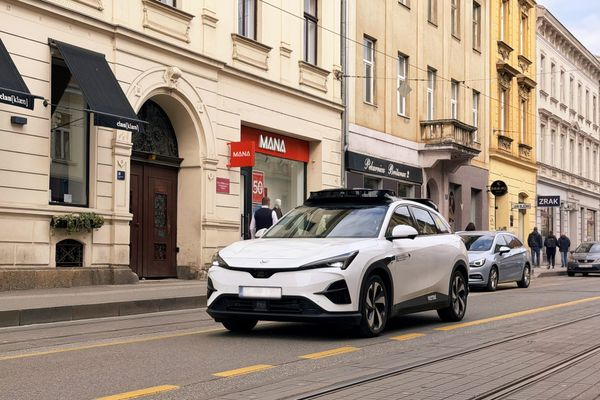
However, data compliance requirements, differences in road environments, and local operating qualification thresholds across regions all pose new barriers. Europe has strict requirements for cross-border data flows and algorithm transparency; the Middle East market demands adaptation to local driving habits and traffic rules; and each new market requires fresh localization efforts, qualification applications, and operating team building. Localized operating costs in overseas markets are far higher than in China, making it difficult to achieve large-scale profitability in the short term.
Whether at home or abroad, the long-tail effect of safety trust persists, and public opinion risk looms over the industry for the long haul. In the United States, Cruise was suspended from fully driverless operations in San Francisco following an accident, directly causing a sharp drop in corporate valuation and slowing the overall pace of industry expansion; the collective stoppage incident in Wuhan also sparked a new round of public doubts about the reliability of autonomous vehicles. This fragility at the trust level is an invisible threshold on the road to large-scale adoption.
There is another easily overlooked problem: the current Robotaxi profit model is too narrow, relying basically on ride-hailing alone. Expansion into non-commuting scenarios such as short- and long-term rentals, corporate commuting, scenic area shuttles, and airport express lines remains far from sufficient, and the potential utilization of vehicles during idle times is insufficiently tapped. Running ride-hailing during morning and evening peaks, corporate commuting and scenic area shuttles during off-peak periods, and logistics delivery at night—such multi-scenario reuse ideas mostly remain at the planning stage, with very few projects truly implemented. Under a single revenue structure, once orders fluctuate, risk resistance will be very weak.
After a year of fierce competition, Robotaxi has completed the key step from technical validation to scale experimentation, but still has not been able to knock open the door to profitability.
From a technical perspective, it is already stunning enough: it can drive smoothly in busy downtown areas, respond to unexpected road conditions, and allow ordinary people to experience autonomous driving at affordable prices. But from a commercial perspective, it still looks like a product that has just walked out of the laboratory—cost, pricing, regulation, and business model all remain works in progress.
No one will deny its future, but no one can say clearly how long it will take to become profitable. The next stage of the sector will most likely still be expansion and losses running in parallel, with excitement and anxiety coexisting.
After all, a technology that transforms mobility cannot complete the entire commercialization journey through just one or two years of fierce competition.
Images are from the internet and will be deleted if infringing.
-
![]()
BMW i3 and Lexus TZ Step Up: Joint Venture Brands Are Not Backing Down at the Guangzhou Auto Show
-
Understand This AI Evolution Diagram and You Understand the Essence of AI: 'Intelligence Moves Up, Users Stay Down'
-
![]()
NetEase's Latest Financial Report: High Gross Margin, Low Debt
-
![]()
AI Unemployment Buffer Period
-
![]()
"It's a Bit Late Now," Ma Huateng Said Point-Blank: Tencent Has Reached a Life-or-Death Moment
-
![]()
AI Short Dramas Begin to Impact the Gaming Industry?
-
![]()
Fangchengbao's October Domestic Sales Hit 34,761 Units, Titan 7 Duo Accounts for 68%
-
![]()
GM China October Retail: How Are Buick, Cadillac, and Zhijing Performing?