Xiaomi Searches for a "New Rhythm"
 11/26 2026
 413
On November 24, Xiaomi Group reported third-quarter 2026 results showing single-quarter revenue of 107.239 billion yuan, holding above the 100-billion-yuan mark, while adjusted net profit came in at 4.884 billion yuan, down 56.8% year on year. Judged on the numbers alone, it is easy to read the report as a quarter under pressure. At the earnings call, Xiaomi Group Partner and President Lu Weibing put it bluntly, calling it "the toughest quarter since I entered the industry."
Yet break down the income statement and then look beyond the financial report, and what Xiaomi's moves this quarter point to is not contraction for its own sake but a deliberate "deep squat" with clear coordinates: smartphones completed a proactive gear shift in product structure amid a revaluation of costs, automobiles rolled out a second product line with the launch of extended-range models, and R&D spending continued to flow into chips, large models, and production lines at a single-quarter intensity of 9.2 billion yuan.
Smartphones Shift Gears to Protect Gross Margin
Memory chips were the cost challenge facing the global smartphone industry this quarter. The combined share of DRAM and NAND in smartphone bills of materials rose from 13% in the first quarter of 2025 to 49% in the second quarter of 2026, and on flagship models the standalone cost of DRAM exceeded that of the SoC for the first time.
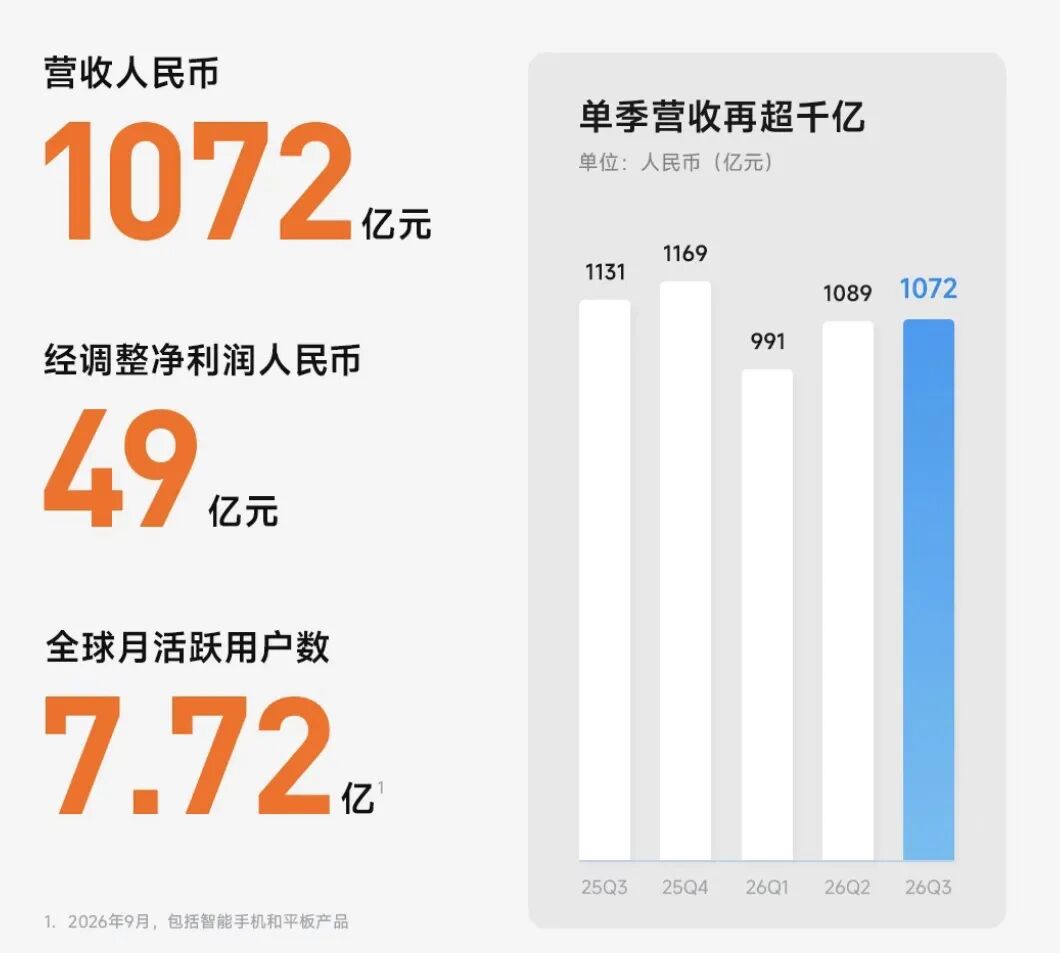
Faced with an impact of this magnitude, Xiaomi chose the harder path: cut low-end shipments, shift the product focus toward higher price bands, and use changes in the product mix to offset rising material costs. Quarter-on-quarter data for the smartphone business offered direct evidence of the shift. In the third quarter, Xiaomi's smartphone revenue was 45.6 billion yuan, up 8.2% quarter on quarter; gross margin was 9.2%, up 0.6 percentage points from the second quarter and ahead of market expectations. Even more telling is the average selling price: the global smartphone ASP reached 1,486 yuan, up 39.8% year on year and a record high.
Lu Weibing laid out the logic behind the change clearly at the earnings call: keep optimizing the product structure in the global market, proactively reduce low-end handset shipments, safeguard channel health, and adjust pricing dynamically in line with the market amid sharply rising costs, striking a balance between cost pressure and user acceptance. The approach is to counter rising costs with product innovation and stabilize gross margin through structural upgrades, rather than simply passing the pressure on through price increases.
In fact, Xiaomi's progress in premiumization shows up not only in ASP. In mainland China's 6,000-yuan-and-above price band, Xiaomi's sales share reached 4.4%, up 1.2 percentage points year on year. The Xiaomi 18 Fold, released in September, entered the foldable flagship segment with a starting price of 10,999 yuan, while the Xiaomi 18 Pro series anchored the starting price of bar-type flagships at 5,999 yuan, building density in the premium price band across both foldable and bar-type lines.
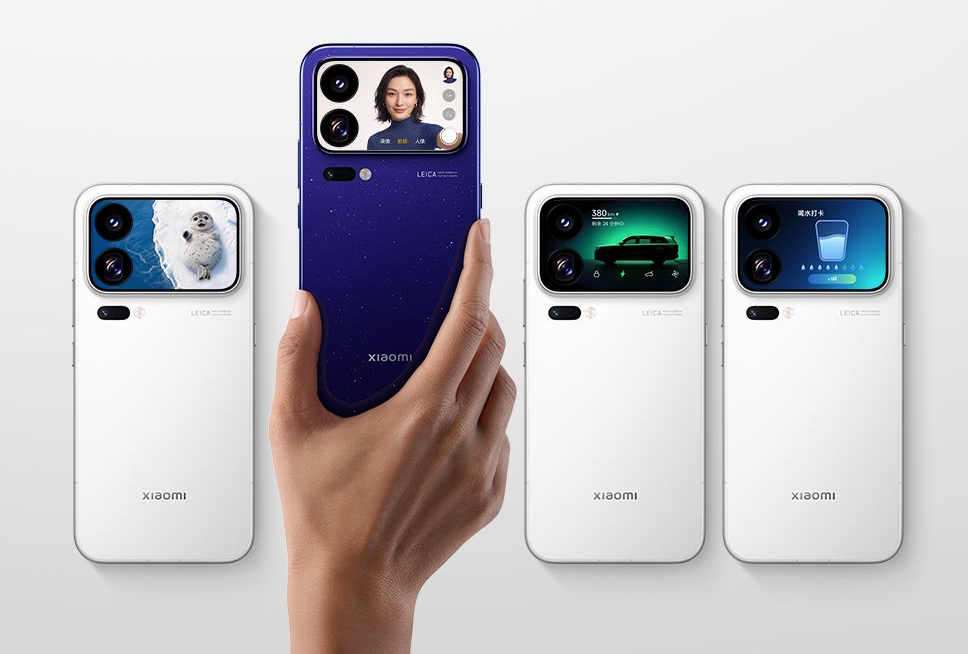
In the global market, Xiaomi's smartphone shipments ranked in the top three for the 25th consecutive quarter, with a 12.1% share in the quarter, rising quarter on quarter for three quarters running. Against an overall contraction in industry shipments, consecutive quarter-on-quarter share gains say more than the absolute value of single-quarter shipments: the foundation of Xiaomi's smartphone business has not loosened; what has changed is the arrangement of the product mix, with the space vacated by low-margin models taken up by higher-priced products.
In addition, overall gross margin for Xiaomi's smartphone × AIoT segment also improved. The financial report showed segment revenue of 83.4 billion yuan for the quarter, with gross margin of 20.4%, up slightly quarter on quarter; smartphone gross margin recovered from 8.5% to 9.2%.
Lu Weibing's outlook also centers on structure: memory costs will stay relatively high in 2027, another increase in smartphone ASP over 2026 is a certainty, and he is confident of maintaining a good gross margin performance. The direction of the gear shift is set; what comes next is whether the product rhythm can sustain it.
Automotive Business Remains "Healthy"
The financial report showed that Xiaomi's segment for new energy vehicles and innovative businesses such as AI generated revenue of 23.9 billion yuan in the quarter, of which automotive sales revenue was 22.7 billion yuan, with 100,975 new vehicles delivered, segment gross margin of 19.2%, and an operating loss of 3.4 billion yuan. But the highlight of the automotive business in this quarterly report is not the absolute size of the loss, but the changes taking place in the product structure behind it.
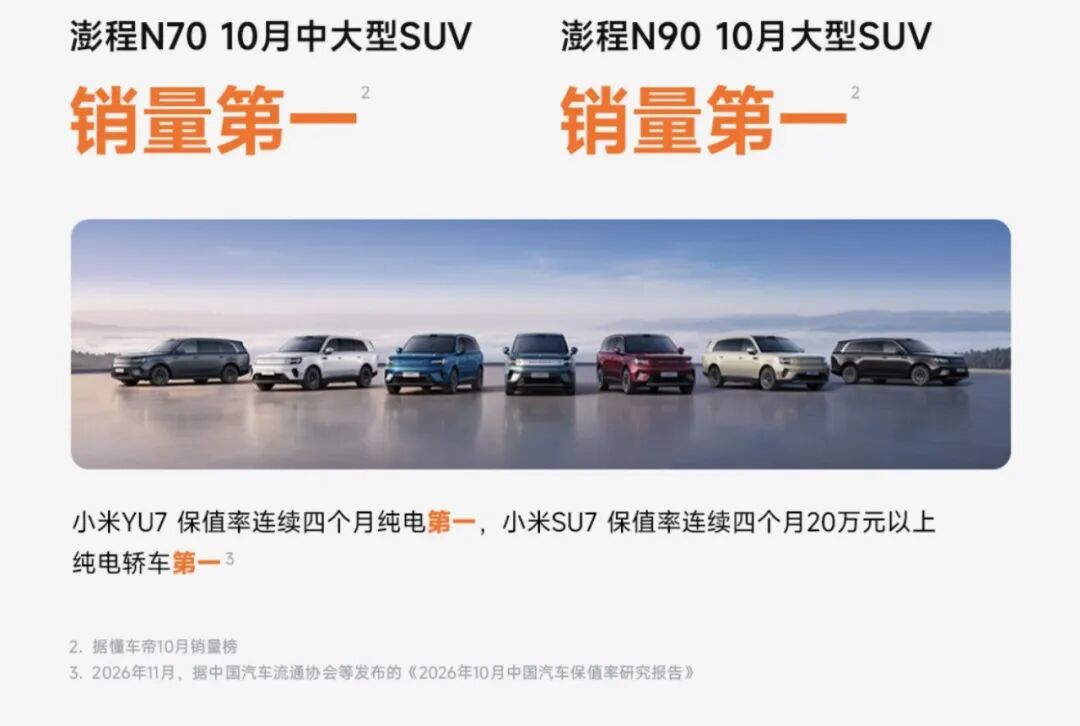
In September this year, Xiaomi's Pengcheng series of four extended-range SUVs officially began deliveries, with starting prices ranging from 209,900 yuan to 299,900 yuan. Locked orders exceeded 10,000 units within four minutes of sales opening and topped 70,000 units in the first sales month. October data further confirmed the product line's ability to capture demand: Xiaomi Auto's monthly deliveries exceeded 50,000 units, a new monthly high for the year, with the Pengcheng N90 ranking first on the large SUV sales chart and the N70 ranking first on the extended-range vehicle and mid-to-large SUV sales charts.
Among brands with starting prices of 200,000 yuan and above, Xiaomi Auto ranked first in sales; in the top ten of the retail sales chart for new energy vehicles priced above 200,000 yuan, all four Xiaomi models on sale made the list, each with sales exceeding 10,000 units.
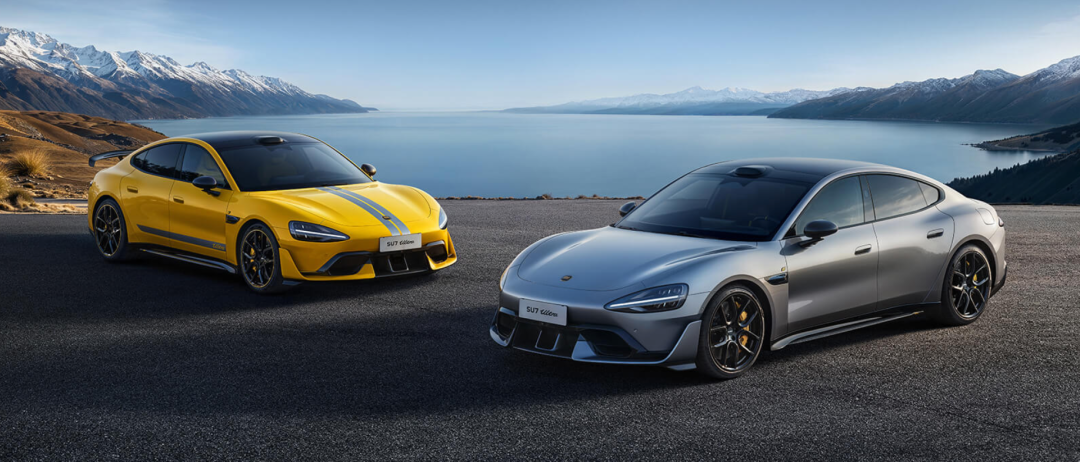
Lu Weibing offered a notable judgment at the earnings call: after the launch of the extended-range models, sales of the SU7 and YU7 were not affected but instead grew, as the user bases for extended-range and pure electric models differ enough that they did not cannibalize each other internally. This means the automotive business has moved from a model driven by a single hit product to a stage where pure electric and extended-range models run in parallel and the user base has significantly broadened.
Xiaomi's deliveries held steady at the 100,000-unit level in the quarter, segment gross margin was flat at 19.2% quarter on quarter, and the effect of scale in amortizing expenses is becoming visible. The Pengcheng series exceeded 70,000 locked orders in its first sales month, corresponding to simultaneous expansion in production ramp-up, channel deployment, and delivery system capacity. Xiaomi management described the outlook for gross margin as "relatively high and healthy" and expressed confidence in maintaining automotive gross margin.
In addition, the timetable for Xiaomi Auto's overseas expansion has also been translated into concrete actions. In September, Xiaomi officially announced that its cars would enter the European market in 2027 and signed memoranda of cooperation with eight leading German auto dealers at the Berlin International Consumer Electronics Exhibition. From the expansion of the product matrix to the rollout of regional markets, what the automotive business did this quarter was a set of clearly directed advance moves: Pengcheng expanded the base from one car to four, October deliveries reached 50,000 units, and the framework of European channels began to take shape.
R&D Directed Toward Chips and Models
This quarter, Xiaomi's R&D did not slow down. In the third quarter, Xiaomi's single-quarter R&D investment was 9.243 billion yuan, with a cumulative 27.428 billion yuan in the first three quarters, up 16.5% year on year, and AI-related R&D expenses accounted for more than 30% of total R&D in the first nine months.
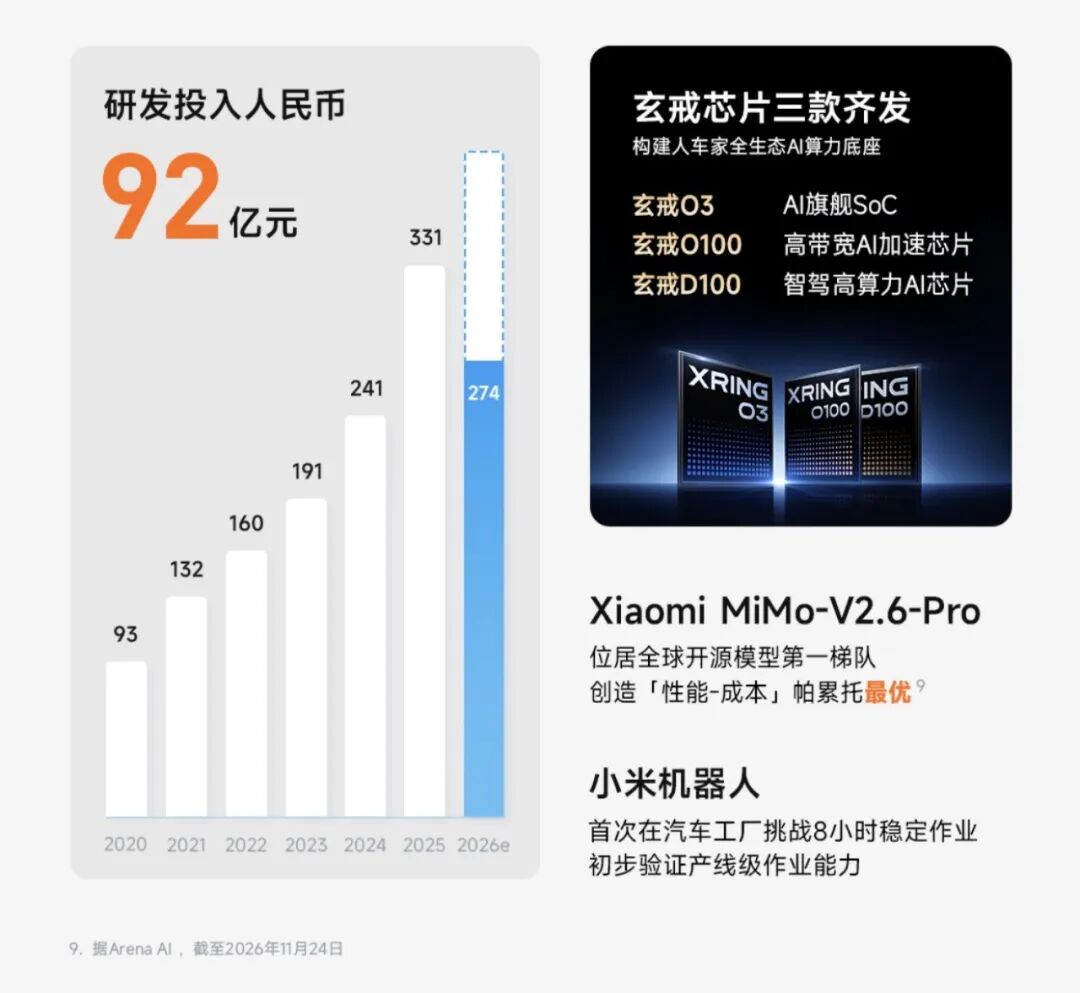
At the chip level, the three self-developed chips Xiaomi released in August—XRING O3, O100, and D100—all completed tape-out verification. As an AI flagship SoC, XRING O3 has already been adopted in the Xiaomi 18 Fold and Xiaomi Pad 9 Pro Max and entered mass production and commercial use; O100 targets high-bandwidth AI computing with bandwidth reaching 1.22TB/s; D100 targets high-compute intelligent driving scenarios.
The three chips cover flagship devices, high-bandwidth computing, and intelligent driving respectively. Completion of tape-out verification means the chain from design to fabrication has been proven, while the mass production and commercial use of XRING O3 means self-developed chips have entered the shipment sequence of real products. Xiaomi also showcased an AI Cube prototype integrating the three chips, capable of running dual models with 120 billion parameters and 3 billion parameters locally.
At the large-model level, the MiMo-V2.6 series, released and open-sourced by Xiaomi in September, achieved a per-task cost about 1/20 to 1/60 that of comparable overseas models at a similar level of intelligence, becoming the highest-scoring open-source model globally at the time; the core architecture of the next-generation MiMo-V3 has also been disclosed, optimized for long-context processing and the execution efficiency of multi-turn Agent tasks.
Xiaomi Robotics also moved from the laboratory to the production line: a biomimetic hand designed based on data from 1,827 automotive factory workflow processes completed 8 consecutive hours of stable operation at a sorting station in an automotive factory and achieved two autonomous recharges. With 8 consecutive hours of stable operation and autonomous charging, the robot has gained the ability to work continuously within real production rhythms.
Xiaomi Group founder, chairman, and CEO Lei Jun has previously made clear that Xiaomi plans to invest at least another 200 billion yuan over the next five years, using chips, OS, and AI as the three core technology foundations to drive the upgrade of the entire ecosystem.
What provides room for maneuver for R&D and automotive expansion are two stable gross-margin foundations in Xiaomi's traditional businesses. Among them, the IoT and lifestyle products segment generated revenue of 27.2 billion yuan in the quarter, with gross margin of 21.7%, up 1.6 percentage points quarter on quarter, and revenue from key categories such as major appliances, tablets, laptops, and TVs all achieved year-on-year growth. Internet services revenue was 9.5 billion yuan, with gross margin of 73.8%, global monthly active users reached 771.9 million, a record high, and domestic monthly active users were 199 million. The number of connected devices on the AIoT platform reached 1.2035 billion, up 16.2% year on year.
It can be seen that the structural moves completed across Xiaomi's three business dimensions have already provided clues more worth tracking: smartphones are moving upward, automobiles are expanding the product line, and investment in technology is laying a solid foundation for Xiaomi.
END
-
![]()
Million Satellites Approved: SpaceX to Move Data Centers into Space
-
![]()
Q1 Orders Top Ten Million! How Did Metalens Secure Over 100 Million Yuan in Financing?
-
![]()
Zhongrun Optics: New Facility Enters Capacity Ramp-Up Phase in First Half of 2026
-
![]()
AI Helps Citizens Mass-Produce FOIA Requests as Startups Mine Public Data, Straining Transparency Systems
-
Used Car Sales Stall as Small Dealers Begin to Band Together
-
![]()
Why Have Japanese Coffins and Robot Clothing Become Caoxian's Business?
-
Three Ministries Issue Landmark Document: The "Policy Floor" for Optical Communications Has Arrived
-
5. FSD V15 Major Upgrade: Deconstructing the Engineering Core UVE Behind Reality View