Wei Jianjun Seeks Solace from Yu Donglai: Can a Supercar Ease Great Wall's "Anxiety"?
 11/27 2026
 521
Produced by Radar Finance | Text by Zhou Hui | Edited by Meng Shuai
After landing yet another order from Yu Donglai—this time for 310 Tank 700s—Great Wall Motor Chairman Wei Jianjun made the trip to Xuchang in person to meet the entrepreneur friend who shares his ideals.
During their conversation, Wei Jianjun brought up his "anxiety" of recent years, admitting candidly that Great Wall Motor is under pressure from both capital markets and the media. "We were once No. 1 in sales among China's own brands, and now we've fallen to ninth."
Yu Donglai consoled him: "Why let the pressure get to you? Just be yourself!" He then shared an insight he had drawn from Lamborghini—do your best to make good products on your own track, and if one day you are eliminated, accept it calmly.
As a veteran domestic automaker, Great Wall Motor was once hailed by the UK's Financial Times as "a dark horse of China's auto industry," but it is now under pressure on both the sales and performance fronts.
According to narrow passenger vehicle manufacturer wholesale data disclosed by the China Passenger Car Association, from January to October this year, Great Wall Motor's cumulative sales stood at about 891,100 vehicles, down 2.7% year on year, with a market share of about 4%.
In terms of performance, in the first three quarters of 2026, Great Wall Motor achieved revenue of 159.869 billion yuan, a slight year-on-year increase of 4.09%; it recorded a net profit attributable to shareholders of 3.826 billion yuan, down 55.69% year on year.
It is worth noting that Great Wall Motor has recently disclosed progress on its supercar project on multiple occasions, a project personally led by Wei Jianjun. The supercar is reportedly benchmarked against the Ferrari SF90 and is expected to debut at the end of the year and go on sale next year.
Wei Jianjun "Complains" About Heavy Pressure, Yu Donglai Advises Him to "Be Yourself"
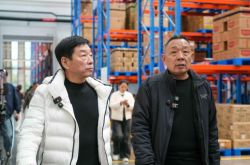
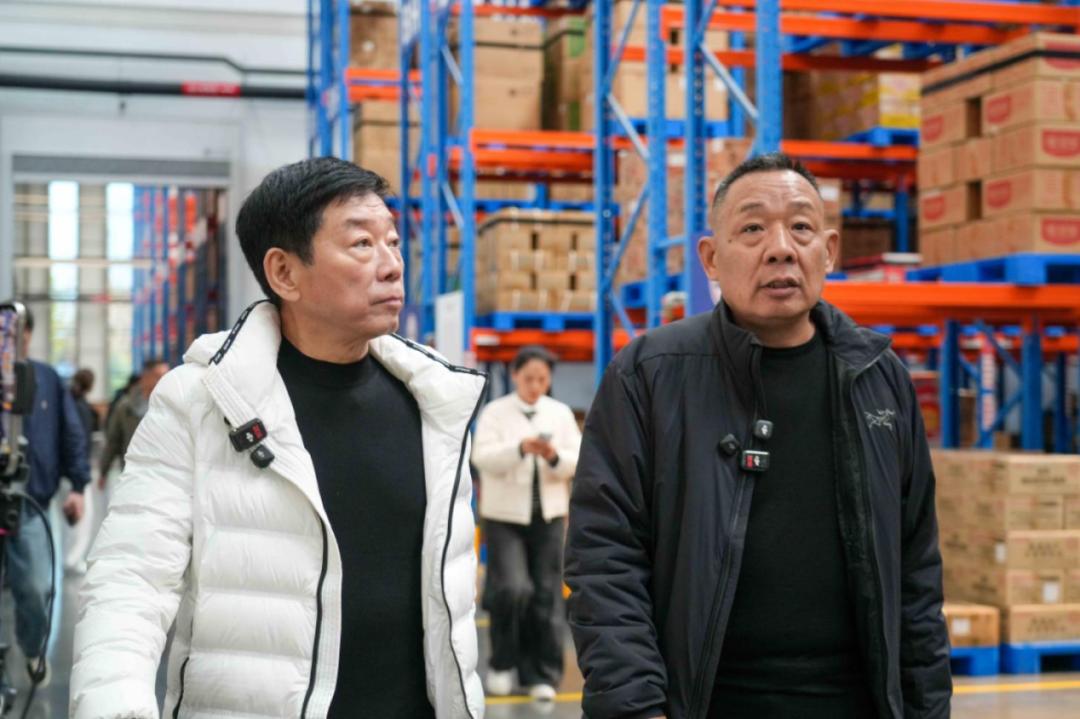
On November 21, Great Wall Motor Chairman Wei Jianjun made a special trip to Xuchang to meet Pang Dong Lai founder Yu Donglai. The meeting between the two well-known entrepreneurs quickly drew widespread attention from netizens.
According to a video posted by Wei Jianjun on social media, during this meeting he had in-depth exchanges with Yu Donglai and together they visited Pang Dong Lai Angel City and the Dream City project under construction.
During their conversation, Wei Jianjun also proactively laid his "anxiety" of recent years on the table: "We were once No. 1 in sales among China's own brands, and now we've fallen to ninth."
Wei Jianjun said that Great Wall Motor today is under multiple pressures from capital markets and the media, and even "competitors mock you." In response, Yu Donglai advised him bluntly: "Why let the pressure get to you? Just be yourself!"
Wei Jianjun then remarked, "Great Wall is somewhat like Pang Dong Lai: it does not chase volume, but per-vehicle value. At present, Great Wall's average selling price per vehicle is 180,000 yuan, while most peers' average price is between 100,000 and 110,000 yuan."
The implication of these remarks is that Great Wall Motor is unwilling to engage in low-price "involution," yet the reality of its declining sales ranking cannot be avoided.
Regarding Wei Jianjun's "anxiety," Yu Donglai shared with him an insight he had drawn from Lamborghini—on your own track, do your best to make products well and benefit society. If one day the market no longer needs you, accept being eliminated calmly and do not be anxious.
Yu Donglai also used himself as an example: "Just like us running supermarkets, we do our best for society, and if we are eliminated we will still be happy. If better people replace us, at least we can rest." Wei Jianjun smiled and replied, "We won't let you rest."
Radar Finance has learned that, as helmsmen of leading companies in their respective fields, Wei Jianjun and Yu Donglai became acquainted in May 2025. At that time, a certain self-media account released multiple videos publicly disparaging the quality of Pang Dong Lai's jade products.
Just as Yu Donglai was in the eye of the public opinion storm, Wei Jianjun, who did not know him, proactively spoke out in support: "Pang Dong Lai is an excellent company worth learning from. I do not know Yu Donglai, but as a person in the business community, I also want to speak up for him."
In March this year, while experiencing off-roading in the Ulan Buh Desert in Inner Mongolia, Yu Donglai test-drove a Great Wall Tank 300 and gave it high praise. At the same time, he also called on Wei Jianjun to go off-roading in the desert together.
The next day, Wei Jianjun posted a video responding to Yu Donglai's invitation and expressed his desire to meet as soon as possible: "Either I go to Xuchang to drink hulatang, or you come to Baoding to eat donkey meat fire cakes, or we find a piece of desert to play with cars together."
Soon after, on April 2, Yu Donglai visited Great Wall Motor's Baoding factory, and the two officially met in person. During the visit, Yu Donglai revealed that Pang Dong Lai had purchased more than 300 Great Wall vehicles in total and had recently ordered another 20 Tank 700s for senior executives.
In November this year, Yu Donglai revealed on his social media account that he planned to purchase another 310 Tank 700s for his management team. Calculated at the market guide price of the all-new Tank 700 (428,000 to 508,000 yuan), the amount of this order exceeds 130 million yuan.
Faced with Yu Donglai's support in real money, Wei Jianjun later specially posted a video to express his gratitude, saying that this honor is both encouragement and pressure.
Sales Pressure on the Core Business, Net Profit Halved in the First Three Quarters
According to Tianyancha information, Great Wall Motor Company Limited (referred to as "Great Wall Motor") was registered and established in 2001 and was listed in Hong Kong and A-shares in 2003 and 2011, respectively.
At the beginning of its establishment, Great Wall Motor mainly produced utility pickup trucks and once dominated the pickup market for many consecutive years. However, in the auto industry, pickups are low-end products with small market capacity, numerous competitors, and thin profits.
In 2002, Great Wall Motor launched China's first economy SUV, the Safe (predecessor of Haval), priced at only 80,000 yuan, thereby formally entering the passenger vehicle field and laying the foundation for the later explosion of the full Haval SUV lineup, including the H6.
In 2013, Great Wall Motor reached a highlight moment, with cumulative annual sales of 754,200 vehicles, beating Geely, Chery, BYD and many other automakers to become the sales champion among China's own auto brands. Among them, Haval SUV sales reached 417,400 vehicles.
Thanks to the outstanding performance of the Haval brand, Great Wall Motor was also once described by the UK's Financial Times as "a dark horse of China's auto industry."
However, with the strong rise of new energy vehicles, Great Wall Motor, this "dark horse" born in the fuel vehicle era, seems to be somewhat "unable to run."
Narrow passenger vehicle manufacturer wholesale data for October 2026 released by the China Passenger Car Association shows that Great Wall Motor's sales that month were about 107,300 vehicles, down 16.8% year on year, with a market share of 4.1%, ranking seventh on the list.
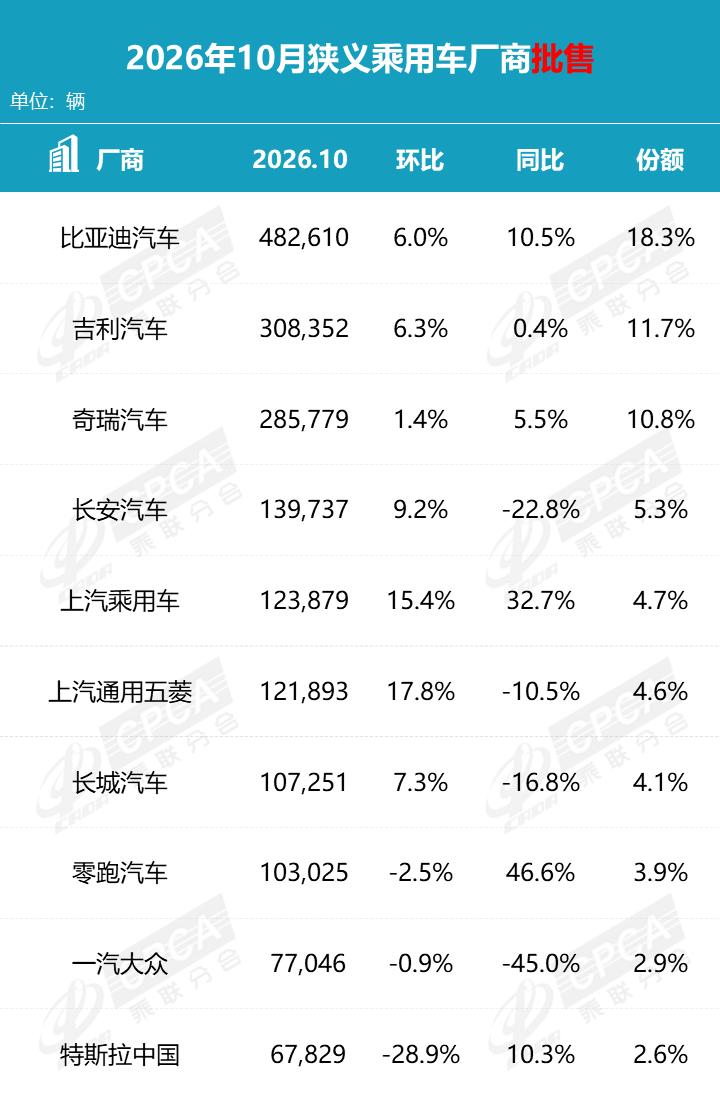
Taking a longer time span, narrow passenger vehicle manufacturer wholesale data shows that from January to October this year, Great Wall Motor's cumulative sales were about 891,100 vehicles, down 2.7% year on year, with a market share of 4%.
In the same period, BYD, ranked first, had sales as high as 3,558,400 vehicles, with a market share of about 15.9%, a huge gap between the two.
By brand, according to Great Wall Motor's October production and sales bulletin, that month the Haval brand, the company's core business, sold about 71,000 vehicles, down nearly 20% year on year; its cumulative sales in the first 10 months of the year were 586,100 vehicles, also down 4.96% year on year.
In the same period, the WEY brand, Tank brand, and Great Wall Pickup sold 75,200, 158,200, and 148,900 vehicles respectively in the first 10 months, down 1.39%, 15.61%, and 0.95% year on year, respectively.
The only brand to achieve positive sales growth was ORA, which sold about 71,600 vehicles in the first 10 months, up 102.68% year on year. However, due to its low base in the same period last year, it was difficult for it to drive an overall increase in the company's sales.
The pressure from declining sales of automotive products quickly transmitted to Great Wall Motor's financial report performance. In the first three quarters of 2026, Great Wall Motor achieved revenue of 159.869 billion yuan, a slight year-on-year increase of 4.09%; it recorded a net profit attributable to shareholders of 3.826 billion yuan, a sharp year-on-year drop of 55.69%.
Among them, in the third quarter, Great Wall Motor's single-quarter revenue was about 57.767 billion yuan, down 5.68% year on year; net profit attributable to shareholders was 1.362 billion yuan, a decrease of more than 40% from the same period last year, presenting an awkward situation of declines in both revenue and net profit.
It is worth noting that against the backdrop of continued pressure in the domestic auto market, Great Wall Motor, like many leading automakers, has set its sights on overseas markets and chosen to go abroad to "dig for gold."
In the first 10 months of this year, Great Wall Motor's cumulative overseas sales reached 538,800 vehicles, up 37.69% year on year, with the sales share jumping from 36.7% in the same period last year to 51.78%.
However, the impressive performance in overseas markets has not yet fully translated into profit returns. In both its semi-annual report and third-quarter report, Great Wall Motor mentioned that factors such as delays in recovering overseas tax policy subsidy income and exchange rate fluctuations affected the company's profit performance.
Can Wei Jianjun's "Supercar Dream" Bring New Increment to Great Wall?
At a time when performance is under pressure, Great Wall Motor is accelerating the implementation of its supercar project.
On November 12, Wei Jianjun posted a video on social media, publicly revealing footage of Great Wall's first hybrid supercar being benchmark-tested against the Ferrari SF90.
According to Wei Jianjun, this supercar is equipped with China's first self-developed 4.0L twin-turbocharged V8 engine, combined with a PHEV plug-in hybrid system, and is expected to officially debut at the end of this year and go on sale in 2027.
On November 23, Great Wall Motor tested this supercar again. Wei Jianjun said that this test took place two weeks after the previous one, and the test vehicle had made significant progress. He hoped to further accelerate the pace of tuning and obtain more complete results as soon as possible.
Speaking about the original intention behind Great Wall's development of a supercar, Wei Jianjun said that he had the urge to build sports cars as early as 25 years ago. At that time, in order to study global benchmark models, the team successively purchased sports cars from brands such as Lotus, Toyota, Lamborghini, and Ferrari, totaling more than 20 vehicles.
In January 2025, Great Wall Motor newly established the "Great Wall Brand Ultra-Luxury Car BG," with Wei Jianjun personally serving as chairman and former Great Wall Motor technical vice president Song Dongxian as CEO.
In an internal document, Great Wall Motor once mentioned that "Great Wall Brand Ultra-Luxury Car BG will help the group enhance brand awareness and create longer-term profit growth points."
Entering 2026, Wei Jianjun accelerated the advancement of Great Wall Motor's "supercar dream." In April, Great Wall Motor's Ultra-Luxury Car BG officially released the GF (Great Faith) high-performance architecture.
According to China Economic Net, the GF high-performance architecture is a high-performance platform created by Great Wall Motor through six years of strategic layout and continuous investment. It adheres to the core development logic of track first, civilian later, focuses on pure track performance, and simultaneously plans two major product series: GT3 racing cars and supercars.
Among them, the GT3 racing car is built strictly in accordance with international competition standards and targets top global circuit events; the supercar shares the core technology of the GT3 and is equipped with a hybrid four-wheel-drive system centered on a V8, committed to creating a world-class performance experience.
On September 6, Wei Jianjun began a week-long inspection tour in Europe. During the trip, he successively visited the headquarters of international automakers such as Ferrari, Lamborghini, and BMW, and held in-depth exchanges with Great Wall Motor's European team, local suppliers, and dealer partners.
On September 8, Wei Jianjun posted on Weibo: "Visiting Lamborghini's museum and factory was deeply impressive. Great Wall Motor will also continue to work hard to build our own sports cars well."
Radar Finance noted that the acceleration of Great Wall Motor's supercar project comes at a time when the domestic ultra-luxury car market landscape is changing.
According to Economic Observer, in the first half of 2026, China's imported car market had a total import volume of 200,000 vehicles, down 11% year on year; terminal retail sales were only 190,000 vehicles, a drop of as much as 29%.
Among them, ultra-luxury brands came under the most significant pressure. Sales of Bentley, Rolls-Royce, and Ferrari in China fell by about 30% year on year, Maserati sales nearly halved, and McLaren's market performance nearly collapsed.
In sharp contrast, domestic ultra-luxury brands are quietly rising. Domestic executive sedans such as the Zunjie S800 continue to squeeze the market space of Maybach and Audi A8.
Not long ago, BYD's Yangwang U9 Xtreme even set a top speed of 503.17 km/h, achieving a milestone in which the speed limit of human automotive industry exceeded 500 km/h.
In the test video mentioned above, Wei Jianjun remarked candidly, "I believe building sports cars in this era is timely." He noted that after more than two decades of technological accumulation, the team now possesses the technical reserves to develop supercars, and the market environment has also matured.
Can the former sales leader among China's domestic auto brands achieve a breakthrough through its supercar project? Radar Finance will continue to follow the story.
-
![]()
Too Tough! Xiaomi, Boasting the Highest Gross Margin Among Automakers, Lost Another 3.4 Billion Yuan in Q3—Does Lei Jun Regret It?
-
![]()
Yu Chengdong's Latest Quote Goes Viral: 1% Battery Can Stream Video for 50 Minutes
-
![]()
Memory Price Hikes Hit Android Hard: US Q3 Phone Shipments Fall 9%, Apple's Share Soars to 57%
-
![]()
PC Sales Plunge 20% While AI Servers Triple: Are PC Makers Betting Their Future on Data Centers?
-
![]()
799 Yuan! First Android Wide Bar Experience: Everything Is Lackluster, AI Physical Button Stands Out
-
![]()
Xiaomi's Profit Halved in the First Three Quarters: Has the "Toughest Quarter" Passed?
-
![]()
Wei Jianjun Seeks Solace from Yu Donglai: Can a Supercar Ease Great Wall's "Anxiety"?
-
![]()
Lei Jun's First Visit to Weibo HQ: The Real Agenda Is the Pengcheng N70