Polarizer, Wave Plate, and Polarized Light Path Design: The Essential Framework of Polarization Optical Systems
 10/08 2026
 367
367
Abstract:
Polarization serves as the invisible yet pivotal core of AR optical waveguide design, underpinning conventional parameters such as gratings and field of view (FOV). This article delves into the core functions and collaborative logic of polarizers and wave plates, integrating PVG grating characteristics with industrial practical results to elucidate the decisive role of polarized light path design in waveguide efficiency and uniformity. Polarization management acts as the "invisible scaffolding" of AR optical waveguide design, setting the upper limit for overall system performance.
In essence, polarizers are tasked with "filtering polarization states," while wave plates handle "converting polarization states." Their synergy and light path arrangement directly determine the three key performance indicators of AR devices: contrast, optical efficiency, and exit uniformity.
Mastering polarization logic is indispensable for excelling in high-end optical waveguide design. AR optical waveguide engineers often prioritize grating design, FOV alignment, and image uniformity adjustments, yet tend to overlook a fundamental aspect—polarization control. Diffraction gratings are inherently polarization-sensitive, particularly PVG polarization volume holographic gratings, which respond exclusively to a single circularly polarized light and waste orthogonally polarized light through direct transmission.
Thus, a thorough understanding of the working principles and design logic of polarizers and wave plates is crucial for constructing efficient, low-loss optical waveguide systems. Polarizers—the "gatekeepers" of light—precisely filter polarization states. The core function of a polarizer is straightforward yet vital: filtering polarization states and blocking ineffective light paths. As the "polarization gate" in the optical system, it permits only light beams with vibration directions parallel to the transmission axis to pass, while absorbing or reflecting perpendicularly polarized light, achieving normalized purification of polarization states. 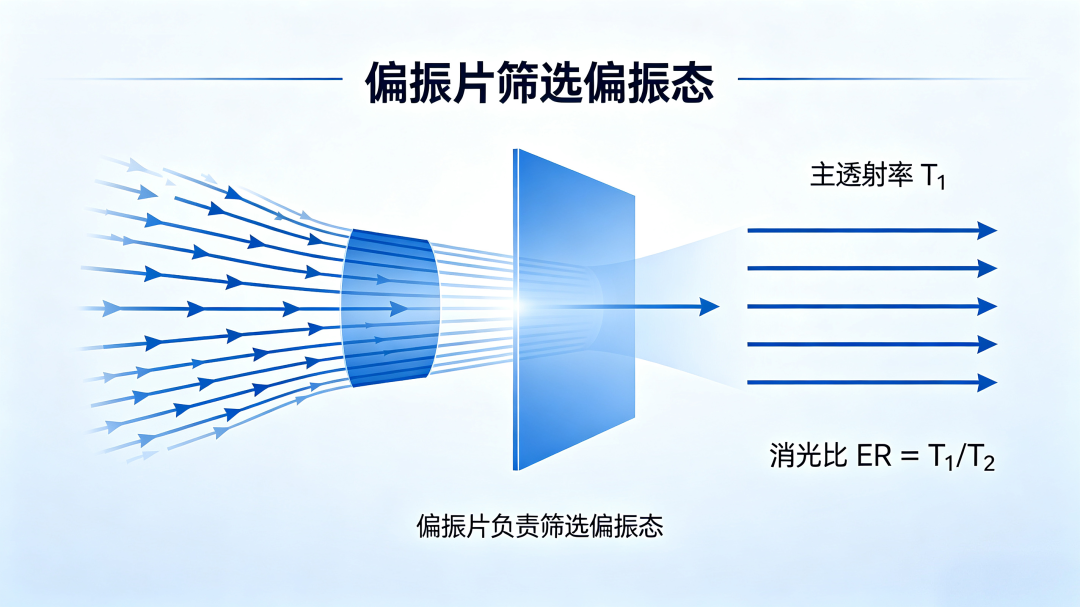
In engineering applications, polarizers are evaluated based on two key performance indicators: principal transmittance T (the transmittance of light beams along the transmission axis) and extinction ratio ER = T⊥/T∥ (the ratio of transmittance between the extinction axis and transmission axis, as defined by industry standards). A higher extinction ratio indicates superior polarization filtering purity and better suppression of stray polarized light, with conventional devices achieving magnitudes of 10⁻³ to 10⁻⁴.
In AR optical waveguide systems, polarizers are typically positioned at the light source exit to provide a pure, single linearly polarized incident base for subsequent wave plate modulation and grating diffraction. Wave plates—the "phase modulators" of light—flexibly convert polarization states. If polarizers are "filters," wave plates serve as the polarization phase modulators of the optical system, primarily altering polarization states rather than filtering light. Constructed from birefringent crystals, wave plates introduce a fixed phase difference between ordinary (o) and extraordinary (e) light due to their differing propagation speeds, enabling precise conversion of polarization states. 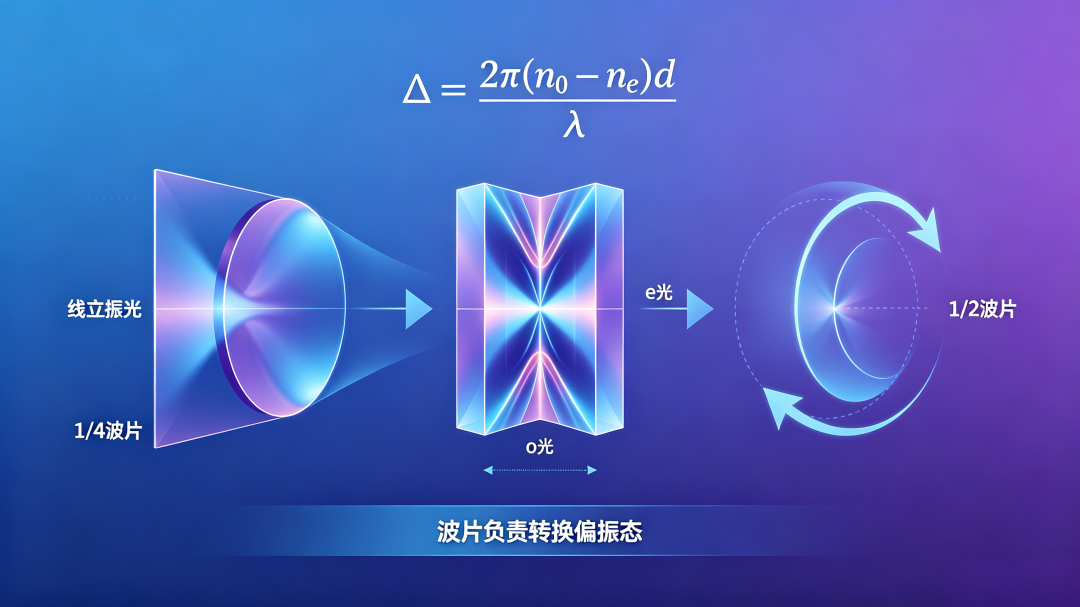
The phase difference formula is: Δφ = 2π(nₑ - nₒ)d/λ, where nₒ and nₑ represent the refractive indices of o-light and e-light, respectively. The sign of their difference depends on the crystal's positive or negative uniaxial properties, and the absolute value of the phase difference determines the type of polarization conversion.
Based on phase difference variations, two types of wave plates are predominantly used in engineering: 1/4-wave plates (Δφ = π/2), which facilitate bidirectional conversion between linearly polarized light and circularly polarized light; and 1/2-wave plates (Δφ = π), which rotate the vibration direction of incident linearly polarized light by an angle of 2θ.
In AR-PVG optical waveguides, wave plates are key components for enhancing efficiency. PVG gratings are exclusively sensitive to a single-handed circularly polarized light, and orthogonally polarized circular light cannot diffract, leading to direct transmission and energy loss. The core value of wave plates lies in their ability to precisely convert the standard linearly polarized light output by polarizers into the target circularly polarized light compatible with PVG, minimizing energy waste at the source. PVG Grating's Polarization Logic—Polarization Management Dictates System Efficiency Limits. Polarization volume holographic gratings (PVG), fabricated using liquid crystal photoalignment technology, offer industrial advantages such as low cost, high yield, and ease of mass production, making them the mainstream solution for consumer-grade AR optical waveguides.
However, their core characteristic is highly restrictive: strict circular polarization chirality selectivity. They respond solely to a single left-handed or right-handed circularly polarized light, while orthogonally polarized light cannot couple into the waveguide, resulting in significant energy loss and power waste. 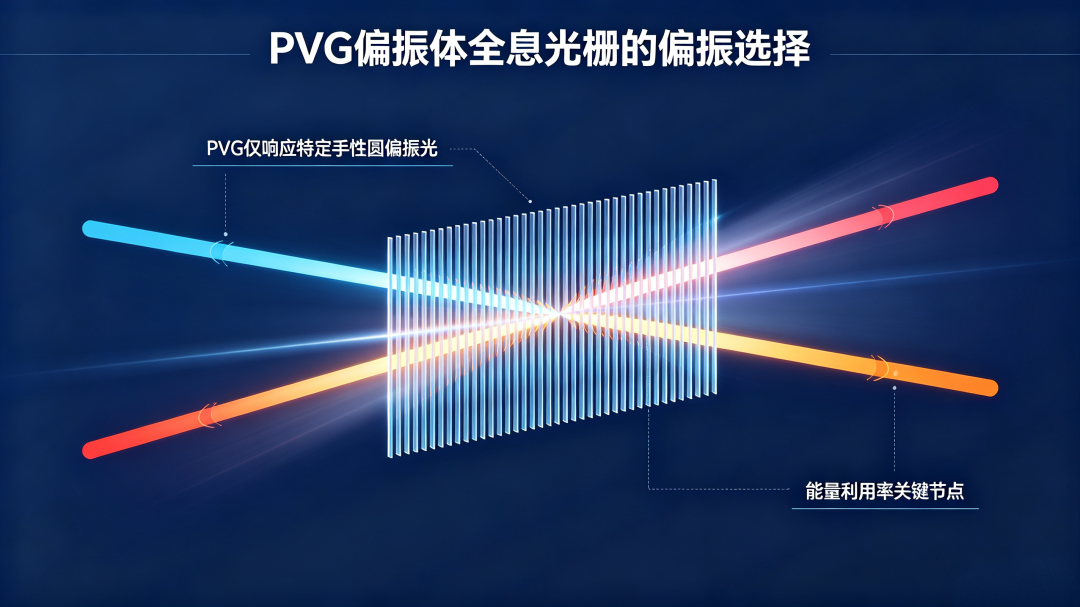
The engineering significance of polarization management is amplified in PVG systems. Research conducted by Chen En'guo's team at Fuzhou University, published in Optics Express in 2024, demonstrated that through polarization-optimized layouts utilizing both left-handed and right-handed circularly polarized light, device image uniformity improved by 48.8%, overall optical uniformity by 34.1%, and waveguide optical efficiency increased by 1.2 times compared to single-polarization response schemes.
Industrial implementations also corroborate this logic: Gudong Smart, at its 2025 AR optical waveguide technology conference, unveiled engineering results of the anomalous polarization conversion (APC) effect. By actively modulating polarization states within the optical waveguide, it achieved dynamic conversion of orthogonally circularly polarized light, effectively suppressing energy leakage caused by parasitic diffraction. This ultimately enhanced waveguide coupling efficiency by over 50%, visually demonstrating the efficiency-boosting potential of polarization control.
Polarized Light Path Design—System Efficiency Hinges on Component Collaboration. High-end polarization optical design does not rely on the extreme performance of a single component but rather on the collaborative layout and phase matching of components. Even with superior individual performance, misaligned or angularly mismatched polarizers and wave plates can significantly degrade overall system performance. 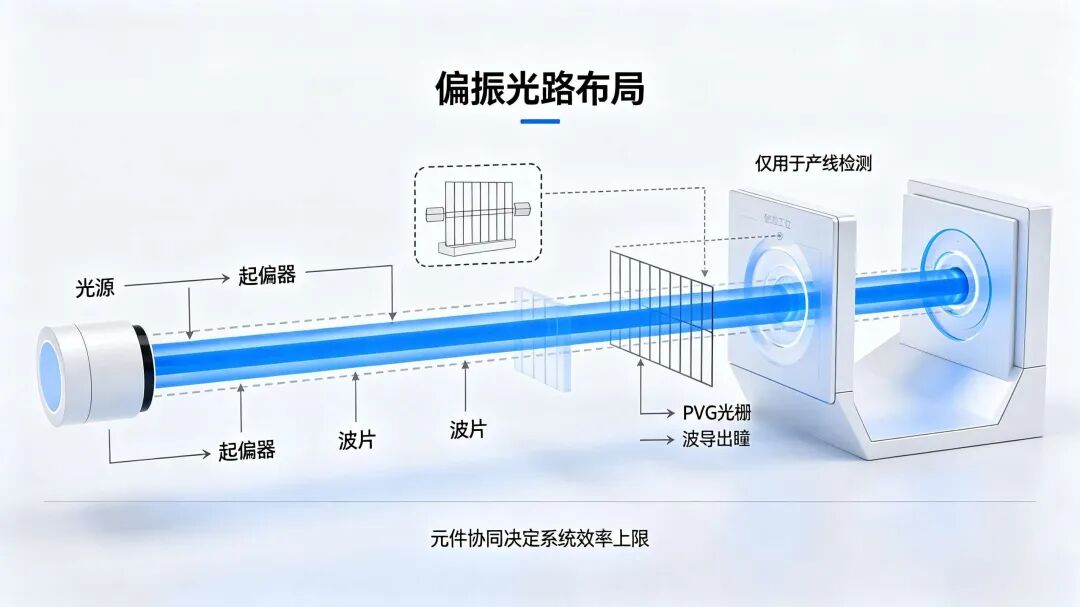
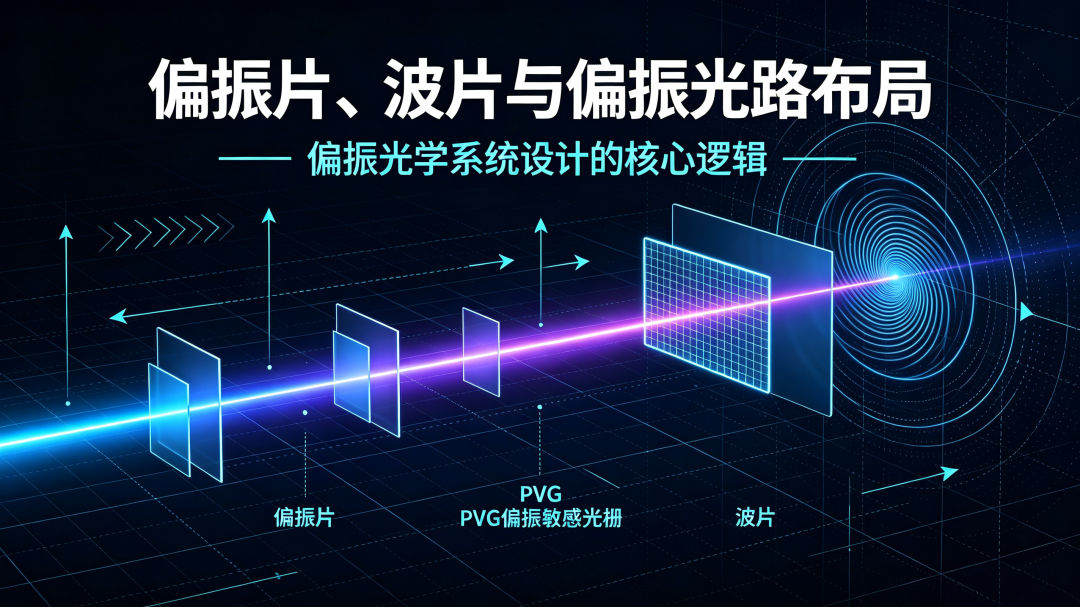
The working light path architecture of AR optical waveguides is straightforward: light source → polarizer (polarization filtering) → wave plate (phase modulation) → PVG polarization-sensitive grating. It should be noted that analyzers are not part of the complete light path in AR wearable devices; they are only added during production line debugging and optical testing to verify waveguide exit pupil polarization states and calibrate component angles without obstructing the imaging light path or exit light. The placement and rotation angles of each component adhere to strict engineering specifications.
For instance, pairing a 1/4-wave plate after the polarizer enables flexible output of elliptically polarized light or standard circularly polarized light by fine-tuning the component angle, adapting to the polarization requirements of different PVG devices.
This entire layout directly determines three core outcomes: the effective utilization rate of light beams coupled into the waveguide, the polarization stability of light propagating within the waveguide, and the human eye reception efficiency of the final exit light, serving as the fundamental guarantee for waveguide efficiency and image quality. Conclusion. For AR optical waveguide design, polarization is not an optional "elective" but a core compulsory course that must be mastered. Polarizers set the entry threshold, determining "which light can enter the system"; wave plates handle polarization regulation, determining "whether light can adapt to components"; 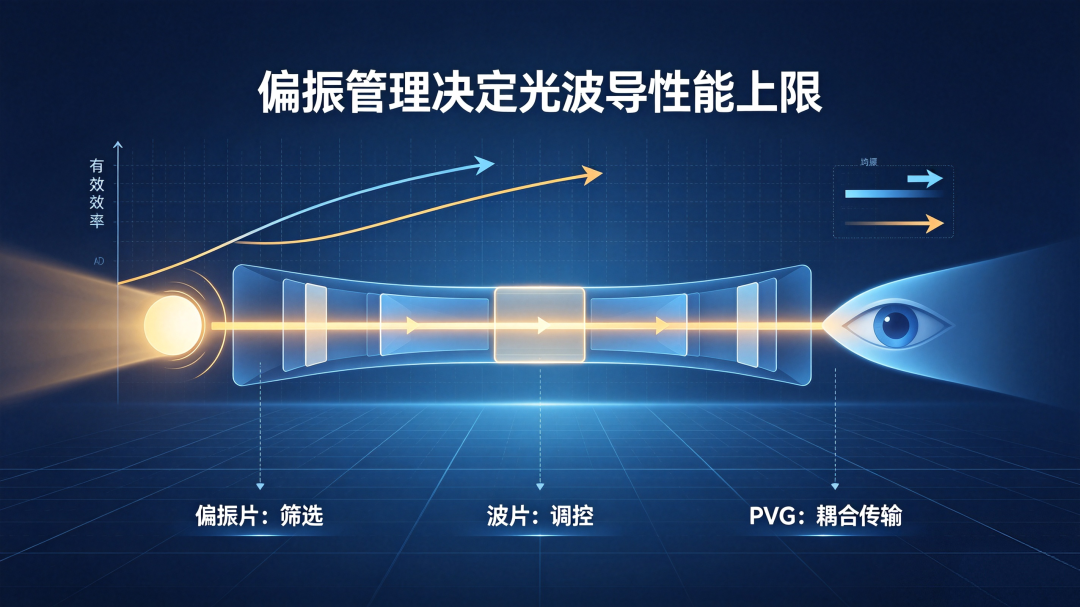
PVG and other polarization-sensitive components set the transmission ceiling, determining "how far effective light energy can ultimately travel." Only by mastering these three layers of polarization logic can one truly achieve efficiency improvements, uniformity optimization, and power consumption reduction in optical waveguides.
Interactive Topic: Is polarization management the most challenging aspect of your AR optical design work? Feel free to leave a comment and share your experience. — AR Andy
| Focusing on the optical waveguide and AR microdisplay sectors, we deeply dissect the underlying logic of the optical industry. [Risk Disclaimer]
This article is intended for industry optical science popularization. The principles of related components, light path logic, and industrial data are derived from publicly available academic research and industrial implementation results, intended solely for technical learning and industry exchange, not as the sole basis for specialized product design and mass production selection.
-
![]()
Polarization of Light: The ‘Sense of Direction’ in the Realm of Transverse Waves
-
![]()
Polarizer, Wave Plate, and Polarized Light Path Design: The Essential Framework of Polarization Optical Systems
-
![]()
JAC Motors’ Stock Price Rockets for Three Days Straight: Is the ‘Huawei Partnership’ Being Treated as a Cash Cow?
-
![]()
What Does China's Motorcycle Industry Still Lack After 7 Billion Views?
-
![]()
Yijing’s First Car Hits the Market: Timing, Location, and Target Audience—How to Get Them Right?
-
![]()
Volkswagen Lays Off 100,000 Employees but Builds Three Battery Factories in Europe with Gotion High-Tech
-
![]()
GAC Group: Pioneering Integration Among Domestic Automakers
-
![]()
Huawei and Seres Forge Alliance: A Strategic 'Remarriage'!