Bypassing Optical Waveguides? TDK Leads the Way in Retinal Direct Projection Optical Tech
 10/14 2026
 546
546
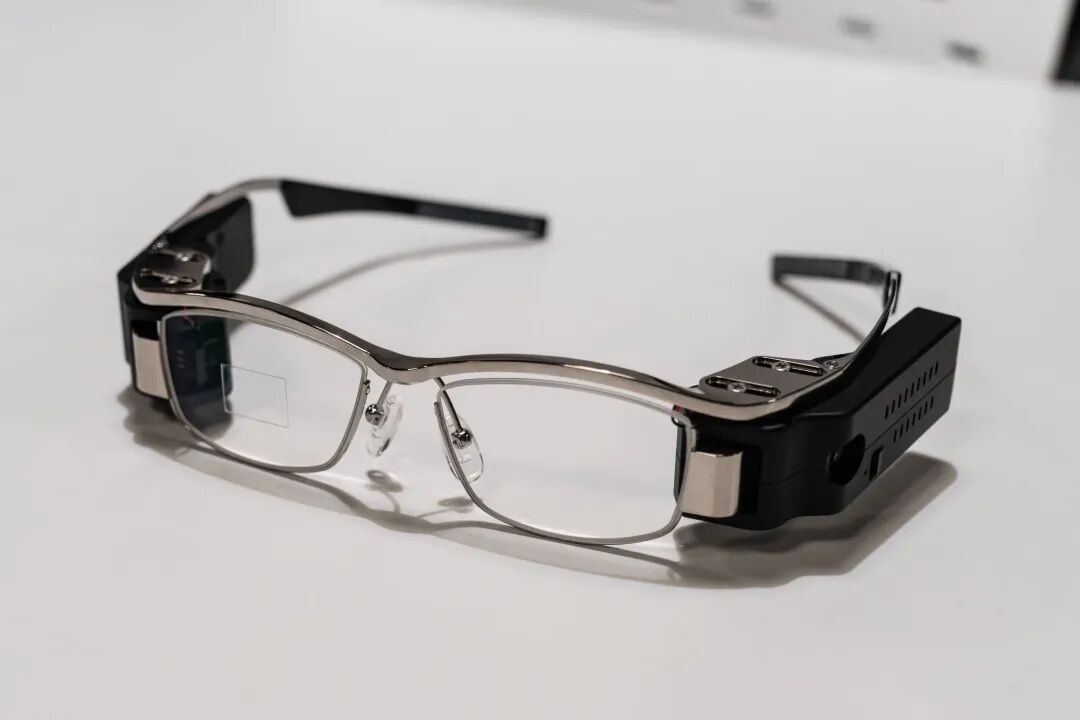
The Combined Exhibition of Advanced Technologies (CEATEC) is currently underway in Tokyo, Japan. At this event, TDK is exhibiting an ultra-thin meta-optical mirror tailored for smart glasses that employ retinal direct projection technology. This breakthrough is touted as a "pioneering innovation on a global scale."
The current prototype is a green monochrome system, boasting a resolution of 750p and a diagonal field of view spanning 45 degrees. TDK has plans to roll out this green monochrome variant by the close of 2026, followed by a full-color edition in May 2027, with the aim of achieving mass production in the years ahead. Future endeavors will be centered on elevating the resolution to 4K.
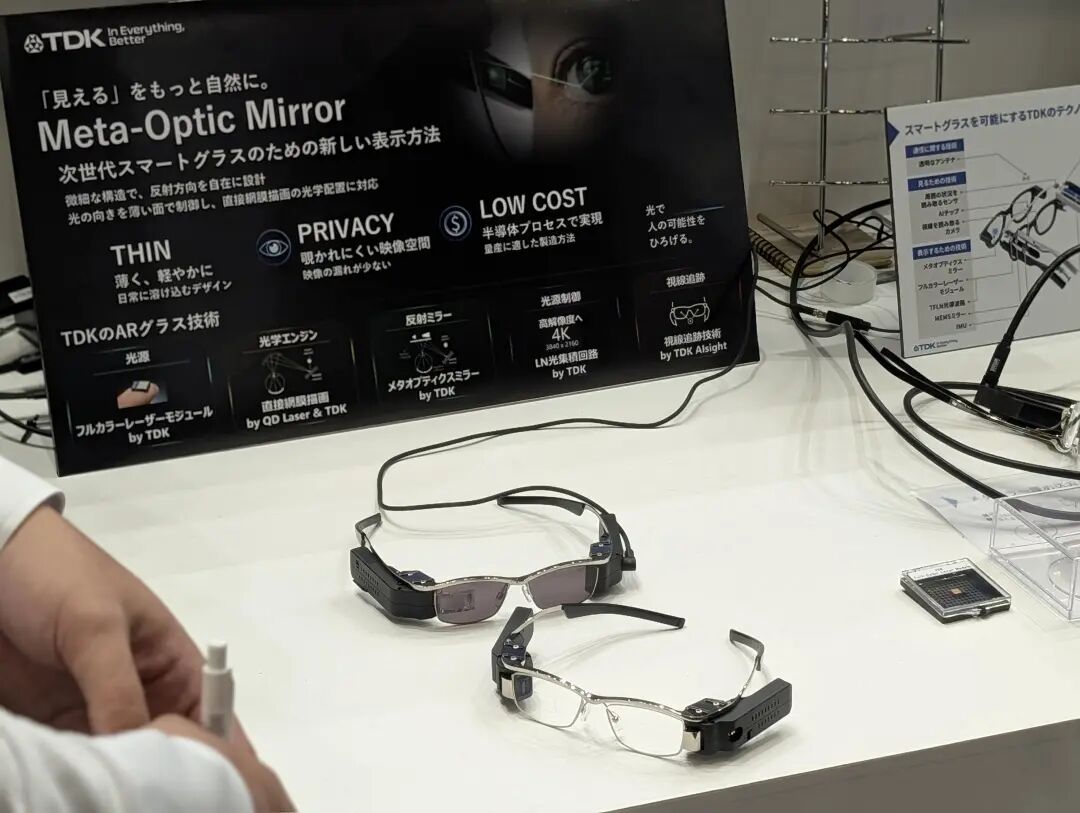
This meta-optical mirror is astonishingly thin, measuring just 150 nanometers—roughly 1/500th the diameter of a human hair. It offers a visible light transmittance of 80%, giving it an appearance akin to that of a regular pair of glasses.
Leveraging its expertise in thin-film and microfabrication technologies from the hard drive sector, TDK has intricately etched microscopic trapezoidal structures onto the mirror's surface. These trapezoids feature base widths of 160 nm and 380 nm, with lengths varying from 200 nm to 1500 nm, resulting in a rare "negative reflection angle." This unique structure allows laser beams from the MEMS scanning mirror, located on the temple side, to reflect directly into the pupil with an incredibly low power consumption of just 1 microwatt.
This technology supplants the bulky curved mirrors previously used in retinal projection devices. Since light is scanned directly onto the retina, the image does not require focusing, ensuring sharpness for wearers with myopia, hyperopia, astigmatism, or presbyopia. However, some testers have pointed out that the infinite depth of field lacks the natural visual accommodation cues that our eyes are accustomed to.
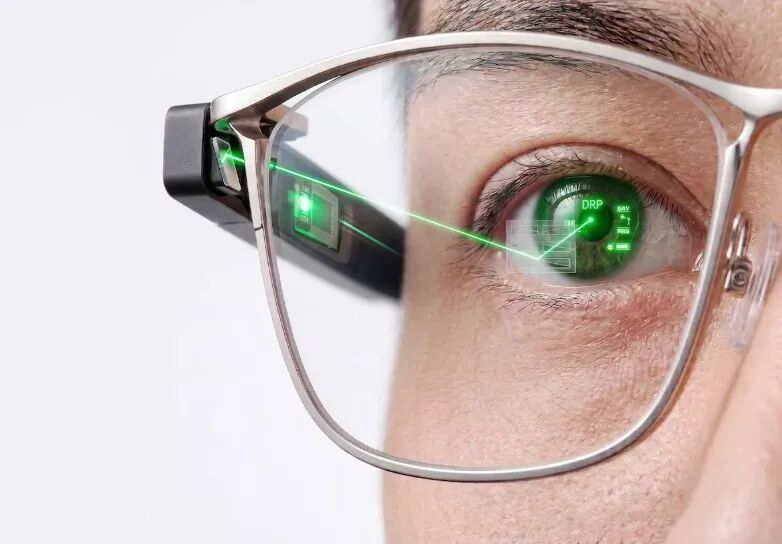
Moreover, the design addresses two significant shortcomings of optical waveguide technology: it eliminates rainbow-like interference fringes and guarantees absolute visual privacy by preventing light leakage to the front.
Crucially, the mirror is manufactured using standard semiconductor wafer processes, which substantially reduces the number of parts and production costs compared to optical waveguide components. TDK also showcased functional prototypes that are integrated into transparent myopia lenses and tinted sunglasses frames.
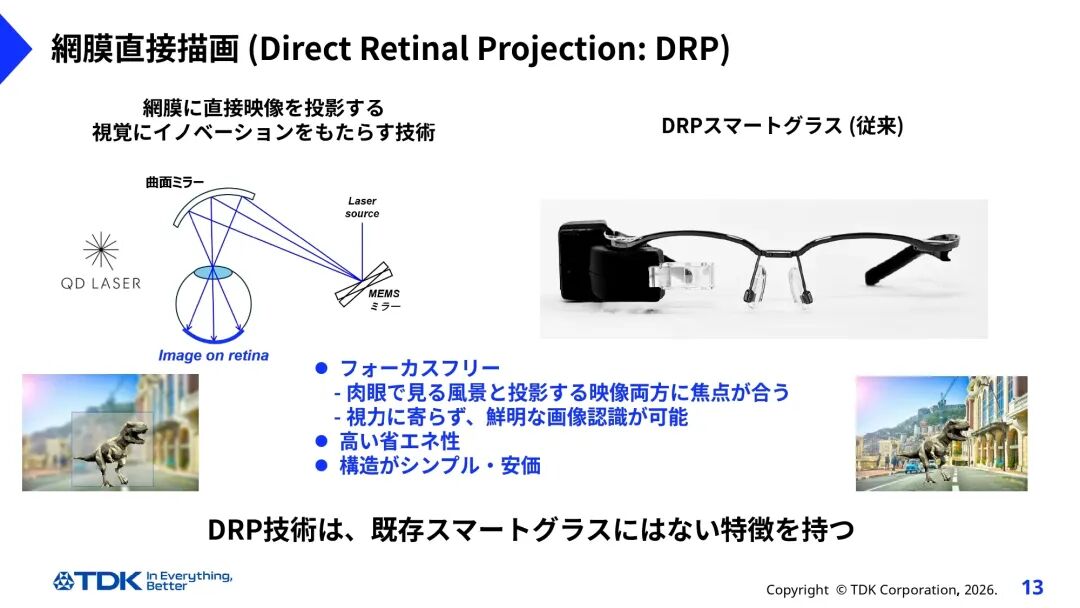
As a B2B supplier for smart glasses manufacturers, TDK is collaborating with key partners and acquired companies to construct a comprehensive hardware and sensor ecosystem for this display. The retinal optical engine was co-developed with QD Laser, while TDK acquired German MEMS laser beam scanning developer OQmented and supports it with eye-tracking technology from its TDK Aisight subsidiary.
To enhance display performance from 750p to up to 4K (3840 x 2160) resolution, TDK is developing lithium niobate (LN) thin-film photonic integrated circuits to complement its ultra-compact full-color laser module (FCLM) chips.
Beyond optical components, TDK unveiled a range of miniaturized hardware, including: a 4.6 x 4.6 mm low-power edge SoftEye AI chip, a 2.2 x 2.2 mm eye-tracking camera, a 5.1 x 5.0 mm scene context sensor, a battery with an integrated wireless charging coil, an inertial measurement unit (IMU), a transparent antenna, and haptic feedback actuators (including temple touch sliders and mastoid bone haptic feedback behind the ear).
These components enable low-power active AI functions such as: foveated camera capture (high-resolution photos only at the user's gaze center), automatic food and calorie logging, visual shopping assistance, and memory recall features to confirm daily tasks (e.g., whether morning medication was taken).
TDK's smart glasses platform clinched the CEATEC 2026 Japan Ministry of Economy, Trade and Industry Award, serving as a cornerstone of its broader AI hardware portfolio. Long-term plans encompass applying this meta-optical technology to high-speed optoelectronic fusion devices in AI data centers.
Text/Watcher (All images sourced from the internet)
-
![]()
[Attendee Guide] The WAIE (10th) 2026 AI Industry Conference & AI Agent Industry Application Conference Kicks Off on October 23! (Including Conference Schedule + Transportation Guide)
-
![]()
Achieving 100% Year-on-Year Growth! Domestic Ultra-Precision Optical Equipment Emerges as a 'Dark Horse' with Thousand-Unit Shipments
-
Q3 Report | Inspur Information’s Net Profit Soars 176%, Fueled by Robust Server Demand
-
Chinese Automakers Shine Bright at the Paris Auto Show
-
![]()
Changan Technology Strikes Out on Its Own, Leaving Parent Company Behind
-
![]()
US/China: The All-Out War for AI Gateways
-
![]()
Leqi’s Second-Gen AI Glasses: The Path to Blending In—Four Optical Hurdles to Tackle!
-
![]()
GAC Toyota’s September Vehicle Registrations Reach 49,000 Units, with Camry Registering 6,898 Fewer Units Than Wholesale Volume