Ban AI Glasses! German Consumer Association Formally Sues Meta
 11/26 2026
 465
German consumer organizations have recently taken action against smart glasses, and their target is none other than Meta. This time, however, unlike other countries and institutions that issued mild recommendations, they have gone straight to filing a lawsuit.
On November 24, the German Federal Consumer Association (vzbv) announced that it had filed an injunction lawsuit over Ray-Ban Meta AI glasses at the Berlin Regional High Court, with the defendant being Luxottica Group S.p.A., the parent company of the famous eyewear brand Ray-Ban.
On the same day, the association also announced the launch of judicial proceedings against internet giant Meta. In other words, vzbv's lawsuit against Ray-Ban has been formally initiated, while the proceedings against Meta have only just begun.
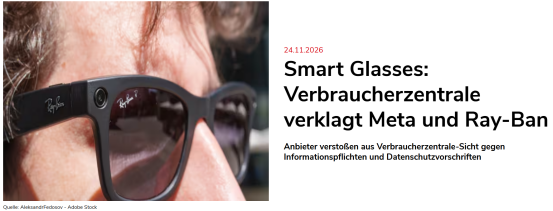
After carefully reviewing German media reports, Xingqiu found that the background of this news is rather vague—neither the case number nor the filing date was reported. However, all media outlets listed vzbv's four allegations in detail:
First, vzbv believes that Ray-Ban's official online store did not provide data security warnings when selling the glasses. For example, when a wearer records their surroundings or other people, the wearer themselves would be classified as a data controller under the General Data Protection Regulation (GDPR), and this identity entails corresponding legal responsibilities.
Second, the design of Meta's smart glasses does not meet standards. According to vzbv, the physical structure of the glasses makes it difficult for users to fulfill the notification obligations under Articles 12 and 13 of the GDPR—namely, that others have the right to know they are being recorded. In other words, it is difficult for the public to distinguish recordable devices other than cameras and mobile phones.
Third, the recording indicator light is too small. Citing Article 25 of the GDPR on the principle of privacy by design, vzbv alleges that the white flashing light on the Ray-Ban Meta glasses is too small to notify the person being recorded.
Fourth, advertising claims are exaggerated. vzbv believes that Meta is misleading users, making them easily believe that all functions of the smart glasses can be used freely without any obstacles.
Do these four allegations send a chill down your spine? Unlike previous classifications and protections for those being recorded, the essence of these allegations is to treat camera-equipped smart glasses themselves as "prohibited goods." The German tech media Golem simply condensed vzbv's allegations into one sentence: smart glasses are currently products that cannot be legally used.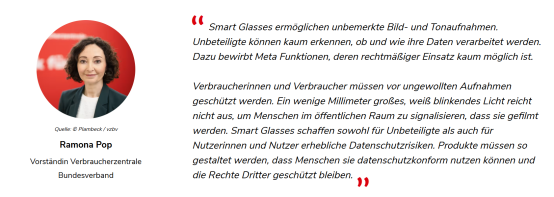
Undoubtedly, this legal characterization is far more serious than a fine.
It should be noted that smart glasses are of great significance to Meta. In the post-smartphone era, Meta, having weathered the VR downturn, has placed its bets on lightweight devices. Ray-Ban's task is to bring smart glasses into mainstream stores so that more consumers notice and choose them. At this point, if a court in Europe's largest economy rules that they are "illegal products," the consequence would be the entire business being uprooted.
In addition, if we look at the timeline a bit more broadly, we will find that this wave of regulatory tightening is not an isolated case. In October, the European Data Protection Board (EDPB) issued preliminary GDPR guidance on smart glasses products; on November 19, the Dutch Data Protection Authority, after actually testing six commercially available camera-equipped smart glasses, offered consumer advice in just two words: Don't buy!
On November 20, the plenary session of the German Federal Council also adopted an opinion paper targeting the government's draft "Anti-Digital Violence Act," demanding tougher measures. However, this is only legislative pressure—not a law, nor a ban.
Now, it is finally the consumer association's turn to enter the fray and file a lawsuit itself.
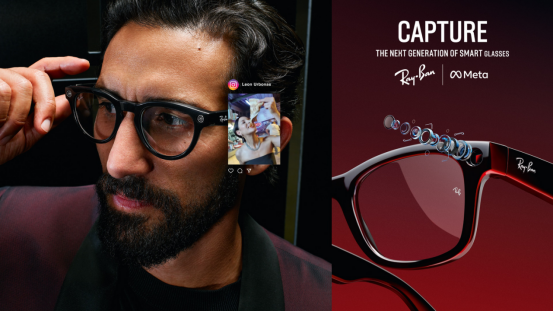
Xingqiu Jun believes that this matter also serves as a warning for Chinese eyewear companies.
As is well known, the warning effect of recording indicator lights is limited, but it has already become common practice in the smart glasses industry, and no better solution has emerged so far. However, when foreign brands expand into Europe, they will also face the test of Article 25 of the GDPR mentioned above. vzbv's allegations against Ray-Ban Meta glasses regarding the overly small white flashing light and exaggerated advertising claims cover almost all smart glasses. Once vzbv's allegations take effect and the lawsuit is won, the unlucky ones will be far more than just Meta.
After years of tempering and hard work, Chinese eyewear companies have achieved remarkable results in optics, micro-displays, supply chains, and even ecosystems, having tackled tough challenges such as optical waveguides and Micro-LED one by one. However, when it comes to the "long-standing difficult problem" of privacy, everyone started late, and inadequate preparation is hard to avoid.
Closing viewpoint: Regardless of the outcome of this lawsuit, manufacturers must make "clearly identifiable" the bottom line for the camera modules of smart glasses. Whoever can meet the standard in a short time will avoid a major pitfall. Strictly speaking, this is not a product issue, but a matter of survival for the entire category.
Text/R Xingren (All images in this article are from the internet)
-
![]()
Million Satellites Approved: SpaceX to Move Data Centers into Space
-
![]()
Q1 Orders Top Ten Million! How Did Metalens Secure Over 100 Million Yuan in Financing?
-
![]()
Zhongrun Optics: New Facility Enters Capacity Ramp-Up Phase in First Half of 2026
-
![]()
AI Helps Citizens Mass-Produce FOIA Requests as Startups Mine Public Data, Straining Transparency Systems
-
Used Car Sales Stall as Small Dealers Begin to Band Together
-
![]()
Why Have Japanese Coffins and Robot Clothing Become Caoxian's Business?
-
Three Ministries Issue Landmark Document: The "Policy Floor" for Optical Communications Has Arrived
-
5. FSD V15 Major Upgrade: Deconstructing the Engineering Core UVE Behind Reality View