Taking Shenzhen as Benchmark! Ganzhou, Jiangxi, Launches Pilot for Express Delivery Driverless Vehicles—A Hard-Fought Battle Over a Mere Dime
 09/22 2026
 455
455
Introduction
On September 18, Ganzhou convened a mobilization and deployment meeting to kick off the citywide pilot application of express delivery driverless vehicles.
From that day onward, Ganzhou's express delivery driverless vehicles officially shifted from the "planning and layout" stage to the "implementation" phase. The Economic Development Zone, Nankang District, and Yudu County were designated as the first batch of pilot areas.
Why is a city in the old revolutionary base area of southern Jiangxi "racing ahead" with express delivery driverless vehicles?
The answer lies in a set of figures: The cost per parcel for a driverless vehicle traveling from a primary distribution hub to a secondary hub is approximately 0.06 yuan, roughly 0.1 yuan cheaper than human delivery.
The WeChat public account "Driverless Vehicles Are Coming" posits that while ten cents may seem negligible in urban areas, in rural and township settings, it represents the line between feasibility and failure.
(For further reading, please click: "Longnan City, Ganzhou, Jiangxi: Driverless Logistics Vehicles Enter the 'Last 100 Meters' of Urban Delivery! Autonomous Driving Accelerates Penetration into Third- and Fourth-Tier Cities")
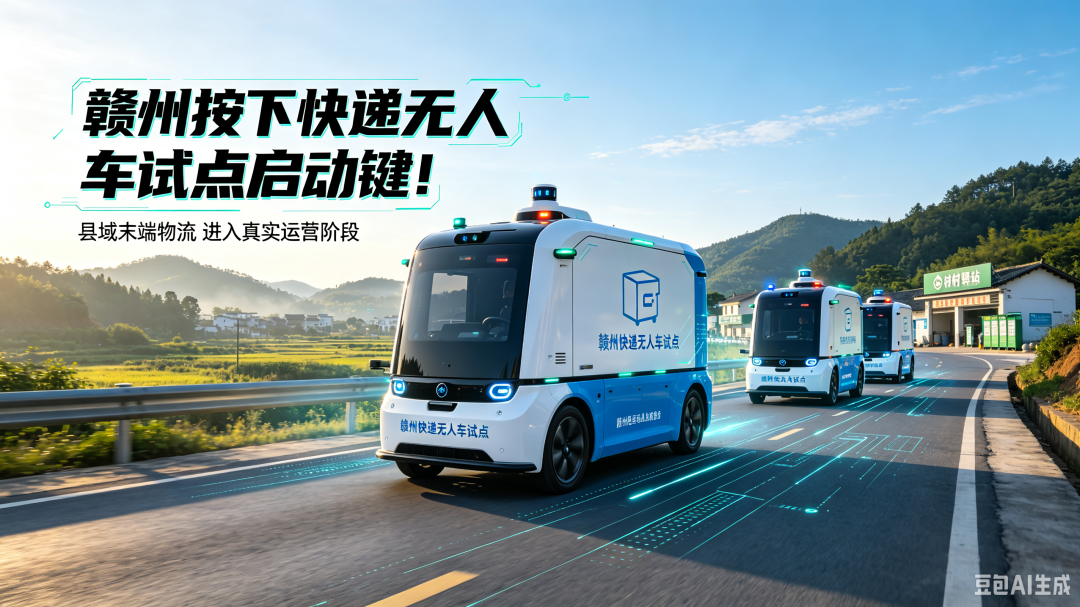
I. Why Ganzhou? Because the 'Rural and Township Delivery Endpoint' Challenge Demands a Pioneer
Located in southern Jiangxi, Ganzhou is the largest prefecture-level city in the province by area, encompassing 18 counties (cities and districts). Its predominantly mountainous and hilly terrain has kept the costs of "express delivery to villages" persistently high.
Delivering a parcel to a remote village often entails traversing dozens of kilometers of mountain roads from the county-level distribution hub to the village-level service station.
When delivery personnel make the trip on electric bikes, fuel costs, time, and physical effort represent significant expenses.
When parcel volumes are low, each trip results in a financial loss.
This is a common challenge in last-mile delivery across rural and township areas nationwide: scattered parcel volumes, long distances, high costs, and recruitment difficulties.
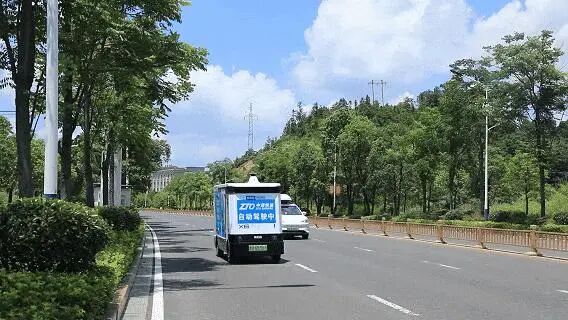
On June 2, 2025, at the Shengshi Jiayuan Community express delivery station in Dayu County, Ganzhou, Jiangxi, a driverless delivery vehicle docked smoothly following voice prompts. Source: People's Daily Online
Ganzhou's choice is straightforward: Replace repetitive rural and township delivery transport with driverless vehicles.
The meeting emphasized that the pilot should "focus on rural and township delivery endpoints, highlight real-world application scenarios, and consider Ganzhou's unique city and county conditions."
In plain terms: No superficial gestures—tackle the most challenging and essential areas first.
Notably, this pilot has been incorporated into the tenth batch of initiatives under Ganzhou's "Benchmarking Against Shenzhen Rules and Regulations Reform."
This means Ganzhou aims to match Shenzhen's level of openness and standardization in driverless vehicle management regulations.
Shenzhen's "five-party joint operation" model has already established an institutional framework for driverless delivery, and Ganzhou seeks to replicate this logic in rural and township scenarios.
II. Clarifying Three Key Considerations: The Tough Battle Behind a Dime
The most noteworthy aspect of this meeting was the requirement to "clarify three key considerations."
The first is the "rights consideration of road access openness."
Road access is a prerequisite for driverless vehicles. Ganzhou is one of many cities in Jiangxi experimenting with driverless vehicles.
In April 2025, Anyi County, Nanchang, issued Jiangxi's first road access license for driverless logistics vehicles;
In August 2025, Nanchang issued the first batch of 147 specialized license plates for express delivery driverless vehicles, covering over 100 demonstration routes.
In April 2026, the "Notice on Conducting a Pilot Demonstration of Postal Express Driverless Vehicles in Jiujiang City" was issued, standardizing the use of postal express driverless vehicles.
Ganzhou's exploration involves applying the "rights" of road access openness to real-world rural and township scenarios within the provincial institutional framework.
In fact, as early as March 2025, Ganzhou's streets welcomed the first driverless logistics vehicle, initiating intelligent delivery operations.
The second is the "economic consideration of joint construction and sharing."
Can driverless vehicles really save money? Industry data provides an answer.
A branch manager in Shenzhen reported that the cost per parcel for a driverless vehicle traveling from a primary to a secondary distribution hub is approximately 0.06 yuan, about 0.1 yuan lower than human delivery.
Early tests in Nanchang also showed that using express delivery driverless vehicles reduces delivery costs by about 30% and improves delivery efficiency by about 40% compared to traditional manual methods.
What does 0.1 yuan represent? For rural and township express delivery outlets with thin profit margins, this is not "icing on the cake" but "timely assistance."
The third is the "social consideration of people's livelihood development."
Ganzhou is a revolutionary base area, and rural revitalization is its core mission.
Successful deployment of driverless vehicles in rural and township areas means that villagers in remote villages can enjoy the same express delivery timeliness as urban residents.
The meeting particularly emphasized "putting the people at the center and upholding the safety bottom line," indicating that Ganzhou understands: Driverless vehicles can operate quickly, but safety cannot be compromised.
III. Pioneering 'Three New Pathways': Scenario-Driven Industrial Development, Systemic Risk Control, and Institutional Dividends
The "three new pathways" proposed at the meeting represent Ganzhou's true "ambition" for this pilot.
The first is "scenario-driven industrial development."
Ganzhou is not simply introducing a few driverless vehicles for testing but aims to attract driverless vehicle industry chain enterprises to settle by offering real-world application scenarios.
Nankang District has already provided a model: Its low-altitude economy industrial park has attracted 34 upstream and downstream enterprises, with a full industry chain turnover exceeding 1.2 billion yuan, forming a complete industrial ecosystem encompassing "R&D testing—production and manufacturing—scenario application—science popularization and research."
The logic for the driverless vehicle industry chain is the same: If you have scenarios, enterprises will come.
The second is "systemic risk control."
The meeting called for "establishing a manageable and controllable operational system," meaning Ganzhou will implement a comprehensive risk control mechanism covering vehicle access, operational monitoring, and emergency response, based on cross-departmental collaborative supervision and unified access registration.
This is not about "running first and regulating later" but "regulating first and then running."
The third is "institutional dividends."
The pilot plan and technical specifications have been issued, and cross-departmental collaborative supervision and unified access registration mechanisms are being established.
Ganzhou aims to "localize" Shenzhen's institutional framework and develop a replicable set of management rules in real-world rural and township scenarios.
IV. Ganzhou's 'Strengths': A Triple Overlay of Policy, Industry, and Scenarios
Ganzhou's decision to lead the province in launching the express delivery driverless vehicle pilot was not impulsive.
At the policy level
The revitalization measures for revolutionary base areas issued by Jiangxi Province in June 2025 explicitly state, "Support eligible revolutionary base areas in developing the low-altitude economy and advance the construction of Ganzhou's National Civil Unmanned Aerial Vehicle Pilot Zone."
Ganzhou has placed driverless vehicles and the low-altitude economy within the same "future transportation" framework, demonstrating a clear vision.
At the industrial level
Nankang District's low-altitude economy industrial park has established "five national firsts" as core strengths:
The nation's first pilot for unmanned aerial vehicle logistics delivery, the nation's first unmanned aerial vehicle air operator certificate, the nation's first batch of civil unmanned aerial vehicle pilot bases, the nation's first industrial-grade unmanned aerial vehicle jet-type wind tunnel laboratory, and the nation's largest contiguous unmanned aerial vehicle flight airspace.
Driverless vehicles and unmanned aerial vehicles share significant technological commonalities, allowing for industrial chain reuse.
At the scenario level
Ganzhou comprises 18 counties (cities and districts), providing a sufficiently "thick" demand for rural and township delivery endpoints.
Once a rural delivery network in Yudu County is successfully implemented, the model can be replicated in other counties.
In summary, the WeChat public account "Driverless Vehicles Are Coming" argues:
The most noteworthy aspect of Ganzhou's pilot is not the "driverless vehicles" themselves but the chosen direction: Starting with the most challenging rural and township endpoints and beginning with cost calculations down to a dime.
If Ganzhou can succeed in this endeavor, it will not merely complete a pilot for a single city but establish a replicable "rural unmanned delivery model."
For the thousands of county-level administrative regions across the country, this value may far exceed that of any pilot in first-tier cities.
What's your take?
References: Media reports from Ganzhou Daily, the official website of the Jiangxi Provincial Postal Administration, CCTV, People's Daily Online, and the Ganzhou Government Affairs WeChat public account.
-
RSI: How Much Valuation Can It Support for Zhipu?
-
Young People Are Secretly Enjoying 4399 Game Suite on Xiaohongshu
-
![]()
China’s Premier Independent Token Factory: Secures 2.9 Billion Yuan in Funding
-
FAW and GAC Toyota: Collaborating Without Full Merger?
-
Honor Expands Partnership with Alibaba: Who Will Lead the AI Smartphone Revolution?
-
![]()
Yunqi Conference Heralds Computing Power Growth: Alibaba Cloud’s Data Center Capacity to Surpass 20GW by 2032, T-Head Reveals AI Chip Zhenwu V900
-
![]()
Singapore Hardware Veteran Creates an AI Golf Personal Trainer
-
![]()
Data Integration Throughout the Production Chain! Haomi Optics Initiates MES and ERP System Upgrade Project