Top 20 Cities for Startups in Six Key Future Industries: First Three Quarters of 2026
 10/14 2026
 461
461
In our previous article, we delved into the market vitality of emerging sectors—such as biopharmaceuticals, the low-altitude economy, and aerospace—across various cities. This was achieved by analyzing data on startups in six major emerging pillar industries during the first three quarters of 2026 (refer to: Top 30 Cities for Startups in Six Emerging Pillar Industries: First Three Quarters of 2026 for details).
While emerging industries address the question of who is rising as new industrial pillars, future industries focus on who is positioning themselves for the industrial landscape five to ten years down the line. They represent the next frontier in urban industrial competition.
Utilizing the Huoshi Xinglan Industrial Intelligence Desktop, we reviewed data on startups in six major future industries during the first three quarters of 2026. This analysis reveals which cities are taking the lead and quietly positioning themselves, offering insights for regions to gauge market expectations, entrepreneurial activity, and industrial chain support capabilities.
01 Overall Landscape
Data from the Huoshi Xinglan Industrial Intelligence Desktop indicates that over 4,000 startups were established in the six major future industries nationwide during the first three quarters of 2026. A clear hierarchy has emerged among these industries in terms of startup numbers:
Embodied intelligence leads by a significant margin, accounting for over 60% of new startups. It is followed by 6G, with nearly 1,000 new startups, representing about 24% of the total. Brain-computer interfaces and biomanufacturing each saw over 200 new startups. In contrast, quantum technology, hydrogen energy, and nuclear fusion industries witnessed fewer new entrants.
Behind these figures lie differences in industrialization stages and entry barriers. Embodied intelligence and 6G can swiftly integrate with existing industrial bases, such as electronic information, smart manufacturing, and terminal manufacturing, offering greater opportunities for entrepreneurship and supporting industries. Conversely, quantum technology, hydrogen energy, and nuclear fusion are characterized by high barriers, long cycles, and significant capital requirements, naturally resulting in fewer new startups.
02 Industry-by-Industry Observation
Embodied Intelligence: Shenzhen and Dongguan Lead, with Yangtze River Delta Support
Embodied intelligence witnessed the highest number of startups among the six future industries, with over 2,500 added in the first three quarters. Shenzhen ranked first with over 250 new startups, followed by Dongguan, Guangzhou, Suzhou, and Hangzhou. Regionally, Pearl River Delta cities hold a prominent advantage in embodied intelligence, collectively accounting for approximately 30.7% of the national total. The Yangtze River Delta is bolstered by multiple cities, including Suzhou, Hangzhou, Nanjing, Wuxi, Changzhou, Ningbo, and Jiaxing.
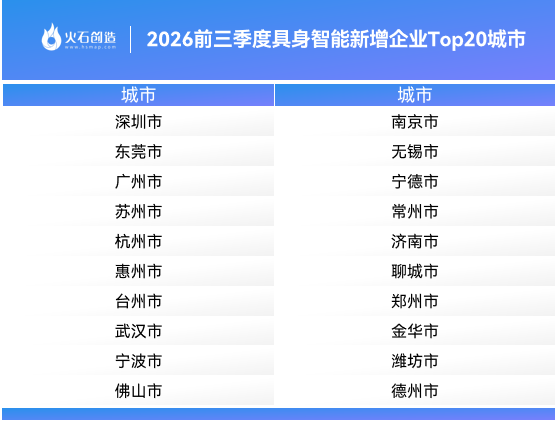
Notably, the concentration of top players in embodied intelligence is not particularly high, with the top three cities accounting for about 22.9% of the total. Non-traditional tech hubs such as Taizhou, Ningde, Dezhou, Liaocheng, and Jinhua also rank among the top. This suggests that embodied intelligence is rapidly spreading from core cities to manufacturing powerhouses and specialized industrial cities, with notable growth in industrial chain-supporting enterprises. The spread of industry enthusiasm to second-tier cities presents both opportunities and risks of homogeneous competition.
6G: Shenzhen Dominates, with a Forming Communications Manufacturing Corridor
The 6G sector saw over 980 new startups in the first three quarters, with Shenzhen, Dongguan, Huizhou, Suzhou, and Zhongshan ranking among the top five. Regionally, the Pearl River Delta dominates, with Shenzhen, Dongguan, and Huizhou accounting for over 50% of the total, and Guangdong Province representing over 60% of the national total, followed by Jiangsu and Zhejiang.
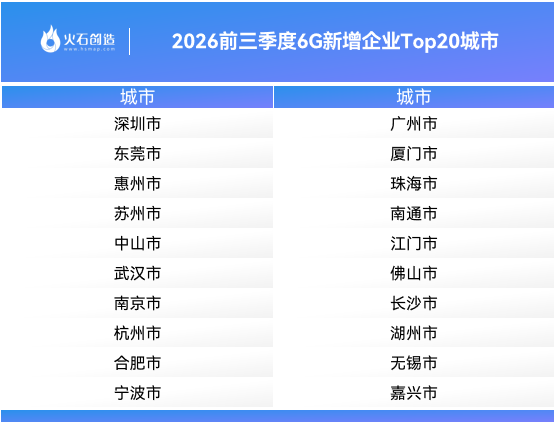
This landscape is closely tied to the existing industrial base in communications equipment, RF devices, antennas, terminal manufacturing, and precision machining. While future 6G competition will commence with standards and core technologies, the initial surge in enterprise registrations is concentrated in hardware manufacturing and supporting sectors.
Brain-Computer Interfaces: Dongguan Leads, with Guangdong Representing Over 80%
Brain-computer interfaces exhibit the highest concentration among the six industries. Dongguan added over 120 new startups in the first three quarters, accounting for 41.4% of the national total, followed by Shenzhen and Huizhou. The top three cities collectively account for 71.6%, and the top five account for nearly 80%. Regionally, Guangdong-based enterprises have a pronounced advantage, collectively representing over 80% of the national total.
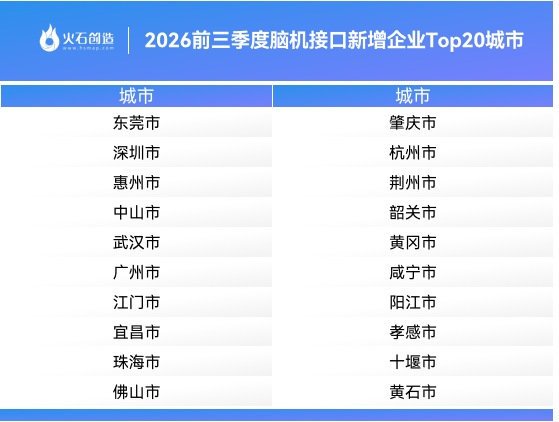
In reality, the registration of invasive medical devices and clinical resources are primarily concentrated in Beijing, Shanghai, and other locations. The high concentration of brain-computer interface startups in the first three quarters primarily reflects the aggregation of manufacturing links such as EEG acquisition devices, sensors, smart hardware, and consumer electronics support, rather than simply equating to core algorithms, medical qualifications, and clinical translation capabilities. To gauge the true competitiveness of this sector, further observation is needed, combining R&D investment, patent quality, medical device registration, and clinical resources.
Biomanufacturing: Small Total, Long-Tail Distribution, Still in Cultivation Stage
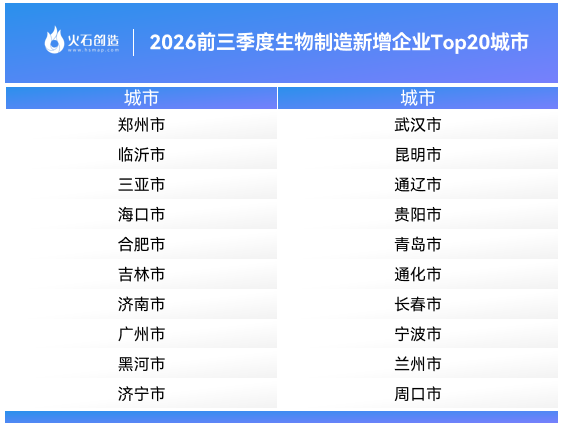
Compared to embodied intelligence and 6G, biomanufacturing does not have prominent leading cities, with the top 20 cities collectively accounting for only 33% of new startups. New industry players exhibit a pronounced long-tail distribution. Biomanufacturing encompasses multiple directions, including fermentation engineering, synthetic biology, and biopharmaceutical manufacturing, with industrial implementation closely tied to raw material and strain processing conditions. From the perspective of enterprise registration locations, it is primarily concentrated in agricultural product processing zones, grain and livestock areas, tropical biological resource regions, and chemical and by-product hydrogen areas. This indicates that the implementation of future industries does not necessarily require "high-end" carriers, as resource-endowed cities also have real entry points in this sector.
Quantum Technology, Hydrogen Energy, and Nuclear Fusion: Low Numbers, High Barriers
The quantum technology, hydrogen energy, and nuclear fusion sectors saw relatively few new startups in the first three quarters, with each having fewer than 100 new additions. Quantum technology startups are generally located in cities with strong manufacturing and scientific research industrial bases. The number of enterprise registrations in this sector is constrained by R&D cycles, talent density, equipment investment, and industrial maturity, making it more suitable for observation under a "small but refined" logic rather than simply comparing registration scale.
Hydrogen energy and nuclear fusion, as capital-intensive, technology-intensive, and heavily regulated sectors, remain in the demonstration exploration and cultivation stage. For these industries, the number of new startups is not the main focus; key projects, technological routes, energy scenarios, and capital investment hold greater observational value.
03 Urban Landscape
Based on the ranking of new startups in the six major industries across cities in the first three quarters of 2026, urban competition can be roughly divided into three categories:
First are "dual-core" cities. Shenzhen ranks first in the number of new startups in quantum technology, embodied intelligence, and 6G, and second in brain-computer interfaces. Dongguan ranks highly in brain-computer interfaces, embodied intelligence, 6G, and quantum technology. The implementation of several major future industries is highly dependent on the existing stock of electronic information and precision manufacturing, with Guangdong Province demonstrating outstanding overall performance.
Second are "balanced" cities. Wuhan is represented in five industries: quantum technology, biomanufacturing, embodied intelligence, brain-computer interfaces, and 6G. Ningbo appears on the lists for embodied intelligence, 6G, and biomanufacturing. Hangzhou maintains a stable presence in embodied intelligence, 6G, and quantum technology. Hefei continues to position itself in quantum technology, hydrogen energy and nuclear fusion, biomanufacturing, and embodied intelligence, demonstrating strong capacity to undertake cutting-edge industries.
Third are "industrial chain-type" cities, such as Suzhou, Guangzhou, Huizhou, Zhongshan, and Foshan. These cities rely on existing industrial bases in electronic information, home appliances, equipment manufacturing, and communication terminals to appear on the lists for embodied intelligence, 6G, and brain-computer interfaces. Future industries do not emerge from thin air but continuously branch, upgrade, and reorganize along existing industrial chains.
Overall, the new startups added in the first three quarters of 2026 outline the preliminary landscape of the six major future industries: Embodied intelligence and 6G have entered a stage of large-scale expansion, while brain-computer interfaces, biomanufacturing, quantum technology, and hydrogen energy and nuclear fusion remain in the cultivation stage. The number of registrations does not necessarily equate to industrial strength. For the six major future industries, it is more appropriate to observe them on a sector-by-sector basis: For industrialized sectors, focus on scale and ecosystem; for frontier breakthrough sectors, emphasize technological quality, capital investment, and output achievements.
-
![]()
[Attendee Guide] The WAIE (10th) 2026 AI Industry Conference & AI Agent Industry Application Conference Kicks Off on October 23! (Including Conference Schedule + Transportation Guide)
-
![]()
Achieving 100% Year-on-Year Growth! Domestic Ultra-Precision Optical Equipment Emerges as a 'Dark Horse' with Thousand-Unit Shipments
-
Q3 Report | Inspur Information’s Net Profit Soars 176%, Fueled by Robust Server Demand
-
Chinese Automakers Shine Bright at the Paris Auto Show
-
![]()
Changan Technology Strikes Out on Its Own, Leaving Parent Company Behind
-
![]()
US/China: The All-Out War for AI Gateways
-
![]()
Leqi’s Second-Gen AI Glasses: The Path to Blending In—Four Optical Hurdles to Tackle!
-
![]()
GAC Toyota’s September Vehicle Registrations Reach 49,000 Units, with Camry Registering 6,898 Fewer Units Than Wholesale Volume