Hosts Log Off, AI Takes Over: Baidu's Digital Humans Are Making Waves Across the Globe
 11/14 2025
 606
606
Author|Yang Zi
Editor|Liu Jingfeng
The 2025 Double 11 shopping extravaganza has just drawn to a close. Apart from consumers making more judicious purchasing choices, another significant shift is that AI is busier than ever before.
If you happen to be awake at 3 a.m. and decide to tune into a livestream, you might spot an energetic, indefatigable host passionately promoting products. There's a good chance that this host isn't a flesh-and-blood person but a digital human. During the recent Double 11, a staggering 83% of merchants on Baidu's e-commerce platform employed digital humans for livestreaming. Moreover, 76% of participating merchants made use of three or more AI tools, with the penetration rate of AI products among Double 11 merchants reaching a full 100%.
In the fiercely cutthroat e-commerce landscape, where shopping festivals are stretched to unprecedented lengths and every aspect—ranging from product selection to delivery and responsiveness—becomes a battleground for competition, one effective way to boost efficiency and accuracy is through the widespread adoption of AI tools in the e-commerce sector. This includes digital human technology, which is capable of delivering natural, human-like interactions.
At Baidu World 2025, Baidu's founder, Robin Li, announced that Baidu's Huiboxing digital human technology is now accessible globally. During the 2025 Double 11, Huiboxing digital humans witnessed a remarkable 91% year-over-year increase in Gross Merchandise Volume (GMV), with the number of livestreaming rooms growing by 119%.
It's worth noting that digital human technology isn't confined to domestic use; there's a clearer and more pronounced demand for it in overseas markets. On one hand, in contrast to China's well-established host ecosystem, overseas hosts are generally more fragmented, loosely organized, and individualistic, making management significantly more challenging. On the other hand, the e-commerce penetration rate in overseas markets appears more promising, providing an ideal testing ground for digital human technology.
Currently, Huiboxing digital humans have made their grand debut in the Brazilian market, appearing on major platforms like Shopee and Lazada. They are also set to expand their reach to key countries in Southeast Asia and the United States.

While the trend of livestream shopping has gone global, the host ecosystem overseas is far less mature than in China, presenting a unique set of challenges.
“In Southeast Asia, Europe, and the U.S., managing hosts isn't just difficult—it's often a Herculean task to even find suitable ones,” said Chen Yi, the head of an overseas influencer marketing company, in an interview with Xiaguang Society. Unlike in China, where hosts are frequently created and managed by Multi-Channel Network (MCN) agencies using a “influencer + e-commerce + livestream” model, overseas hosts are typically freelancers or part-time creators who emerge organically from content sharing and gradually step into the spotlight as key players in brand marketing.
Managing overseas hosts is a daunting challenge due to their strong emphasis on free expression and individuality. Many operate as independent contractors rather than employees, making direct oversight a tough nut to crack. This results in low loyalty and high turnover rates, with hosts frequently switching platforms. “One day they're on TikTok, the next on Instagram,” Chen Yi noted. “Additionally, even if communication is possible, in the U.S. and Europe, censorship or 'speech guidelines' may be perceived as infringing on creative freedom, posing significant risks.”
Another management hurdle stems from time zone differences. Coordinating with overseas hosts, waiting for their responses, and establishing partnerships can take months.
The growth in high-quality influencers lags far behind merchant demand, creating a direct supply-demand imbalance. Digital humans could potentially fill this gap, potentially accelerating the commercialization of livestream shopping overseas compared to China's already well-established ecosystem.
Some overseas influencer marketing firms are already exploring AI-powered solutions to streamline host communication and automation. Chen Yi estimated that AI-driven processes could boost efficiency by up to a whopping 150%.
“The overseas livestream market is a few years behind China's, but enthusiasm remains high. We're optimistic about the future,” said Wu Chenxia, the head of Baidu's e-commerce business unit and director of Baidu's digital human innovation business.
For example, in Brazil, Huiboxing digital humans have been launched in hundreds of livestreaming rooms, with about 50% of them surpassing the Orders Per Mille (OPM) of human hosts within just two weeks. “The Brazilian livestream market is still in its infancy, and we're growing alongside it,” Wu said.
Moreover, the linguistic diversity of Southeast Asian, Latin American, and Middle Eastern markets necessitates multilingual operations. Cultural preferences also vary widely; for instance, Southeast Asian audiences prefer lively, interactive “shouting-style” livestreams, while such approaches are less effective in Europe and the U.S. “We initially used China's shouting style, but it didn't work. After switching to a more laid-back, conversational approach, user engagement improved,” Wu explained.

Southeast Asian hosts during a livestream
Different brands and merchants have varying influencer and business ecosystems. “Some prioritize influencers, so we focus on optimizing their personas. Others rely on store-based livestreaming, so we adapt accordingly,” Wu said. “We leverage our successful experience with highly persuasive digital humans in China to empower overseas expansion, typically seeing results within 2–3 weeks of entering a new market.”
For cross-border merchants, digital humans offer greater control. Industry practitioners note, “Digital humans don't get sick, quit, or disappear. I decide when and how they appear, and they always perform at their best. This is a godsend for merchants needing constant content updates.”
Digital humans also excel in delivering precise, professional industry insights, further meeting merchant needs. At Baidu World 2025, it was highlighted that e-commerce is increasingly targeting professional sectors like marketing, healthcare, and law—areas where digital humans can truly shine—rather than entertainment-focused scenarios.

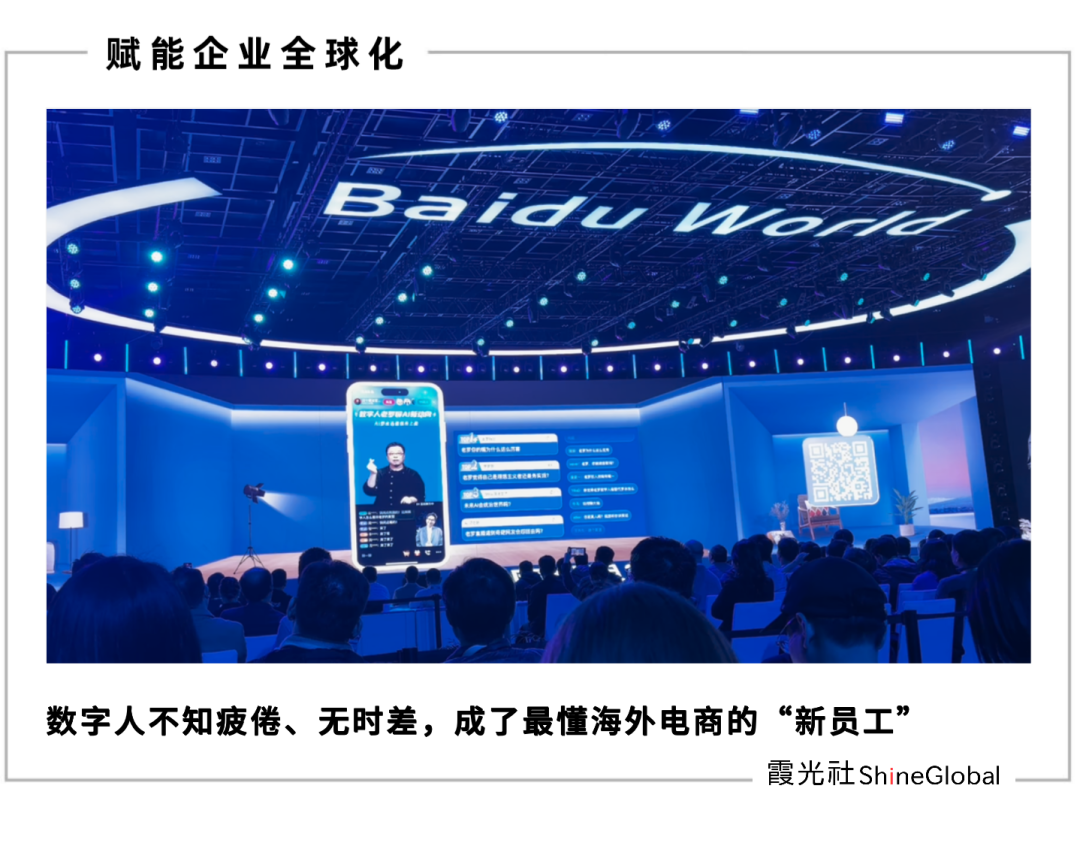
During Baidu World 2025, staff demonstrated Huiboxing's real-time interactive digital human by connecting to Luo Yonghao's digital avatar. Wearing his signature black T-shirt and delivering “Lao Luo-style humor,” the digital Luo was virtually indistinguishable from the real person. He engaged with the host on topics like “evaluating digital humans” and “Double 11 livestream experiences,” showcasing near-human interactivity.
The on-screen “Lao Luo” was a demonstration of Baidu Huiboxing's “real-time interactive digital human,” capable of understanding the real world, providing instant feedback, and expressing natural emotions with full-modality precision. Baidu CEO Robin Li stated, “Digital humans are fundamentally a foundational technology—even a universal interface for the AI era.”
Unlike traditional digital hosts, real-time interactive digital humans comprehend context, make judgments, and respond naturally in real time. In other words, they don't just speak—they understand.
During the demo, this capability was distilled into three keywords: instant responsiveness, expressive delivery, and perceptive insight. First, the digital human responds to speech within two seconds, achieving multi-modal synchronization. Second, its voice, expressions, and gestures align precisely with semantic emotions, such as smiling knowingly, reacting in surprise, or giving a thumbs-up. Third, it perceives the environment and interaction state, recognizing objects, interpreting tone cues, and even detecting emotional shifts.
This transforms interactions from scripted responses to real-time, natural, and emotionally rich exchanges that can even outperform human hosts.
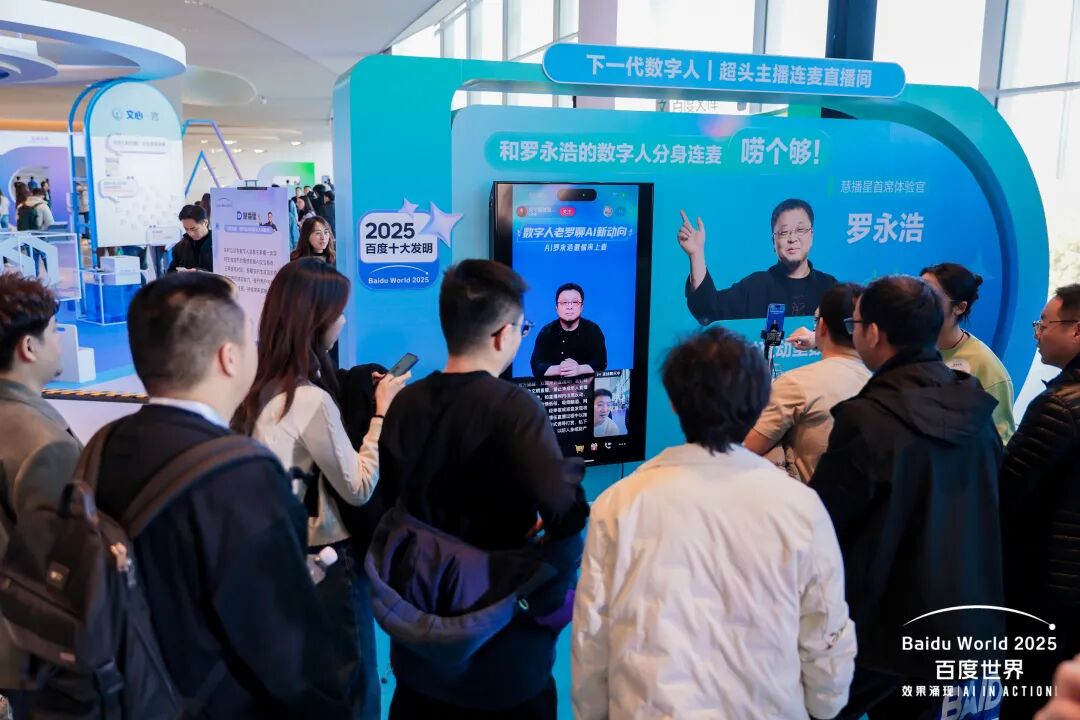
At Baidu World 2025, audiences flocked to interact with Luo Yonghao's digital human
This wasn't Luo Yonghao's digital debut. In June, his highly persuasive digital avatar “debuted” in a Baidu e-commerce livestream, promoting products nonstop for six hours while sipping milk tea, holding cola, and bantering with Zhu Xiaomu's digital co-host. The AI-driven livestream attracted 13 million viewers and generated 55 million RMB in GMV, setting a new record for digital human livestreaming.
That livestream was a stress test for generative AI. The system called knowledge bases 13,000 times, generated 97,000 words of commentary, and coordinated over 8,300 subtle movements between the two digital hosts, achieving human-like interactions like “eye contact” and “speaking in unison.”
According to Baidu, Huiboxing digital humans are expected to see a staggering 202% year-over-year increase in livestreaming scale and a 228% growth in related revenue by the end of the year. The technology has been adopted in over 30 industries, including e-commerce, law, and healthcare, and extended to content scenarios like culture, emotions, and military affairs, serving over 100,000 merchants globally.
From a business standpoint, Yang Jiacheng's digital avatar improved livestream conversion rates by 21% and Return on Investment (ROI) by 176% by replicating his speaking habits and tone via AI. Leapmotor's digital Chief Operating Officer (COO), Xu Jun, co-created with Huiboxing, dynamically adjusts scripts based on audience demographics. For example, when the system detects northern viewers, it shifts to highlighting air conditioning and heated seats, enabling “personalized smart shopping.”

Leapmotor COO Xu Jun's digital host
The process is seamless, covering modeling, script generation, product configuration, and livestreaming with full automation. Businesses can customize personas, language styles, actions, and scenarios, combining digital human livestreams, videos, and intelligent agents into a “one-click super host clone.”
“Humans see limited information during livestreams, but digital humans comprehend the entire context and make optimal decisions in real time,” said Ping Xiaoli, Baidu's VP of e-commerce.
Behind Huiboxing lies Baidu's integration of AI large models and multimodal fusion technology. Through speech recognition, semantic understanding, visual generation, and motion prediction, digital humans become intelligent agents capable of understanding and interacting with the world.
Traditional digital humans merely replicate a host's appearance and voice, with limited expressiveness. Huiboxing's breakthrough lies in its “multi-agent collaborative system,” where not just the host but also co-hosts, floor managers, and marketing roles are digitized and orchestrated by an AI brain. The AI brain monitors livestream signals—such as viewer count fluctuations, repeat customers, and product clicks—and adjusts commentary strategies, pushes discounts, or switches topics accordingly. While humans can't make such judgments in seconds, the digital team reacts in milliseconds.

Actor He Jiajin's digital host
At its core, Huiboxing digital humans achieve breakthroughs in three dimensions:
1. Multimodal Alignment: A large language model generates script plans with multimodal content, including lines, actions, and emotional cues. Visual and speech models then execute the script in sync, ensuring perfect alignment of expressions, tone, and gestures. When users interrupt or ask questions, the digital human adjusts language and demeanor instantly for natural interaction.
2. Team Intelligence: Under the AI brain's coordination, each livestream function has an independent agent—interaction agents handle Q&A, marketing agents distribute coupons and run contests, and co-host agents manage pace and atmosphere. This multi-agent collaboration enables highly automated livestream logic.
3. Text Intelligence: Powered by Baidu's Wenxin large model, digital humans generate stylized scripts tailored to brand tone and persona, seamlessly switching between rational analysis, emotional storytelling, humorous roast (tucao, or “roasting”), and trending commentary.
During Luo Yonghao's digital livestream, this “persona consistency” was striking. The digital Lao Luo retained his unique tone and rhythm while carrying on his product views and humor, creating a nearly seamless virtual-real transition.
To date, Baidu's digital humans have been deeply adopted in over 30 industries, including e-commerce, healthcare, law, and culture, with cumulative usage by over 100,000 merchants and year-over-year growth exceeding 200%. In terms of external capabilities, Ping Xiaoli revealed that Huiboxing ranked first in a JD.com internal digital human tech competition, becoming the top choice for leading brands. “We initially focused on refining the product within Baidu's ecosystem before expanding outward. Now that we've achieved human-surpassing experiences, we'll open up more service provider systems and bring digital humans to more industries,” she said.

China's e-commerce industry has evolved from shelf-based e-commerce to content-driven e-commerce, whereas overseas, these two stages have unfolded almost simultaneously.
Live commerce exists in Southeast Asia, Latin America, North America, and other regions. However, the maturity of content-driven e-commerce and the structure of consumer trust vary significantly across regions, which also determines the broad application scenarios for new forms like 'digital humans.'
This year, the competition among e-commerce platforms in Brazil has intensified to an unprecedented level. With swift growth and escalating cargo volumes, Brazil's e-commerce market has become exceedingly appealing. It boasts a penetration rate (the proportion of total retail sales) of approximately 13% and sustains an annual growth rate surpassing 20%. In the global market landscape, e-commerce platforms experiencing double-digit growth rates can be aptly described as entering a 'brave new world.'
In Latin America, the widespread use of social media platforms (such as Instagram, WhatsApp, and TikTok) has spurred platforms like Mercado Libre and TikTok Shop to venture into live commerce. This has led to a rapid expansion of the market from a relatively small base. A forecast report by Grand View Research on the Latin American live commerce market from 2025 to 2033 also projects a double-digit Compound Annual Growth Rate (CAGR) for live commerce in the upcoming years.
Beyond Latin America, the Southeast Asian market, characterized by a young demographic, a mix of impulsive spending habits, and significant social media influence, seems to be the quickest to adopt live commerce. The North American market is substantial and expanding, but its overall penetration rate is still lower compared to Asia. In Europe, e-commerce is experiencing an overall rebound, with notable growth in live and video shopping. However, there are substantial disparities between countries; Northern Europe and the UK are more receptive, while Southern and Eastern Europe are slower to embrace this trend.
As live commerce takes on diverse forms across different regions, will overseas markets embrace digital humans?
Southeast Asia's content-driven e-commerce is in a high-growth phase. Platforms like Shopee, TikTok Shop, and Lazada are reshaping consumer pathways through short videos and social virality. Young users in this region are highly receptive to virtual avatars and are sensitive to 'personalized content.' If digital humans can express themselves in a friendly manner and utilize local language systems, they may have opportunities to serve as partial substitutes for live streamers and customer service representatives. Perhaps a 'real human + digital human' dual-track operation will gradually become a reality.
Latin America is still in the early stages of live commerce adoption. Although social platforms are highly active in countries like Brazil and Mexico, live commerce remains a novelty. 'Latin American consumers place a high value on authenticity. Therefore, we emphasize emotional expression and cultural details in our avatar design, such as incorporating local holiday greetings and musical elements,' said Tracy, a Brazilian cross-border e-commerce merchant. For the Latin American market, the connection between digital humans and consumers may be even more crucial.

A Brazilian live streamer utilizing a digital human for broadcasting
The dynamics of the North American market are entirely different. Live commerce penetration remains relatively low in North America. While platforms like Amazon, TikTok Shop, and YouTube Live are promoting video-based shopping, users still tend to make rational decisions. 'North American companies place a great deal of importance on brand consistency and data security. Therefore, digital humans must strictly adhere to brand tone and regulatory requirements,' Chen Yi pointed out. In reality, North American consumers are not averse to AI; they are willing to let AI explain products and demonstrate functionalities but may not necessarily trust AI to directly facilitate transactions. Bridging this trust gap may take a considerable amount of time.
A deeper underlying factor is that overseas e-commerce is still in the infrastructure-building phase. Fragmented payment systems, logistics networks, content platforms, and services are constraining efficiency gains. Digital humans, as part of the intelligent infrastructure, can precisely overcome physical bottlenecks by cost-effectively establishing cross-lingual and cross-timezone service networks.
Wu Chenxia told Xiaguang Society that user consumption habits and live streaming preferences vary significantly across countries. In some markets, incorporating excessive influencer persona or fan culture-related traits into digital human scripts may have a negative impact on conversion rates. She noted that her team continues to accumulate experience across regions to develop more localized digital human live streaming strategies.
In Baidu's vision for digital humans overseas, the e-commerce infrastructure remains weak, and digitization is one way to build the underlying network. The future direction lies in deploying models and services directly to overseas nodes as part of a full-link service solution, which holds greater value than merely having a digital presence. Additionally, beyond e-commerce, sectors such as education, finance, healthcare, brand communication, and others may all become potential applications for digital humans.
E-commerce connects transactions, while digital humans connect interactions. When live streamers go offline, AI steps onto the stage. In late-night live studios powered by algorithms and computing, tireless digital humans are quietly illuminating corners across the globe.
-
![]()
Hunan’s Wealthiest Entrepreneur Eyes Comeback with Apple’s Foldable iPhone
-
![]()
Planning to Secure 1.055 Billion Yuan to Propel AR Optics Forward! Lante Optics Receives Green Light for Private Placement on the Science and Technology Innovation Board
-
![]()
MiniMax: At the Heart of the AI Maelstrom
-
![]()
Securing 600 Million Yuan in Funding: This AR Optics Company Steps into the Limelight!
-
![]()
From a 706% Surge to a $340 Billion Market Cap Plummet: Has MiniMax's Moment Passed?
-
![]()
High Demand, Low Stock Price: Can the Emotional Companion Robot Ease UBTECH’s Worries?
-
![]()
Why Does Yin Qi, Who 'Doesn't Listen to Advice,' Insist on Making AI Agent Smartphones? | Interview with Jieyue Xingchen
-
![]()
AI-Generated Code Reveals Surprise That Thrills China