Deciphering AI's 'Whampoa Military Academy': 10 Pioneers Driving a $70 Billion Valuation
 11/17 2025
 691
691
When the innovation dividends of a premier lab reach their zenith, the outflow of talent and ideas becomes an almost inevitable phenomenon.
In a manner reminiscent of Silicon Valley's historic 'PayPal Mafia', OpenAI has emerged as the AI sector's very own 'Whampoa Military Academy' in the wake of the ChatGPT phenomenon.
According to partial statistics compiled by Wuya Jun, a total of 25 individuals departed from OpenAI between 2022 and 2025. Among these, 9 ventured out to establish their own startups, founding 8 AI companies. Excluding three firms with undisclosed valuations, the combined worth of the remaining 6 nears $70 billion. Furthermore, 16 others found new homes at other AI enterprises like Meta.
These individuals occupied nearly every pivotal role at OpenAI: model research and development, training systems, alignment and safety protocols, product engineering, and toolchains. They were not just contributors to the GPT series but also witnesses to its evolution from research prototypes to products serving hundreds of millions of users.
This signifies a substantial talent exodus with far-reaching organizational implications.
In the business arena, these individuals have chosen not merely to 'clone OpenAI' but to reconstruct certain systemic logics that were once exclusive to OpenAI. Some prioritize safety above all, others rebuild toolchains, and some directly implement intelligent agent applications. Some startups have achieved a $5 billion valuation within just three months of inception, while others have secured over $100 million in funding even before launching a product.
To a certain extent, the departure of these individuals has not diminished OpenAI's influence but has instead allowed its technical pathways and organizational wisdom to permeate a broader industrial landscape through new ventures.
/ 01 /
OpenAI Alumni Propel a $70 Billion Valuation
As the innovation dividends of a top-tier lab approach their peak, the outflow of talent and ideas becomes a near-certainty.
In a manner akin to Silicon Valley's legendary 'PayPal Mafia', OpenAI, spanning from 2022 to 2025, has risen as the AI world's 'Whampoa Military Academy'.
Based on partial statistics from Wuya Jun, over these three years, 9 key members have left OpenAI to establish 8 AI companies. Excluding two firms with undisclosed valuations, their cumulative valuation stands at approximately $70 billion.
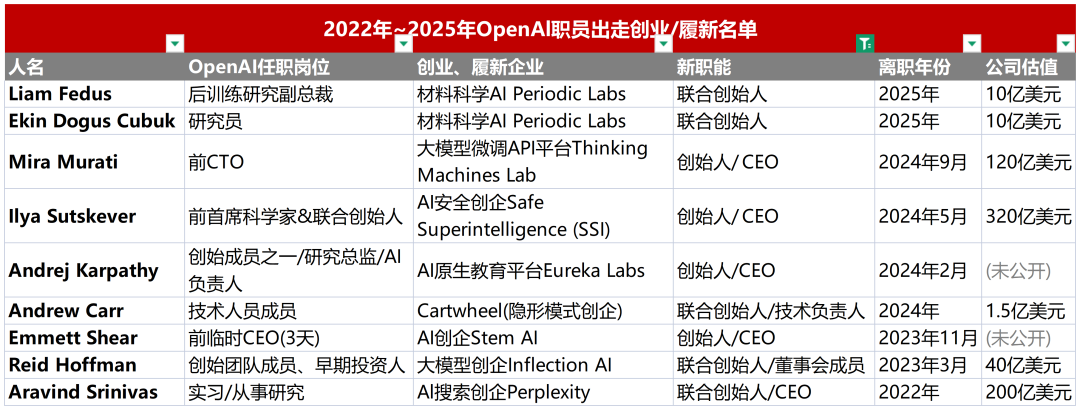
These individuals are no ordinary engineers; most served as research leads, chief scientists, or core team members before their departure, directing efforts in model architecture, training systems, safety mechanisms, and product deployment—essentially encompassing OpenAI's technological core.
Judging by their entrepreneurial ventures, they primarily focus on AI safety, intelligent agents, and AI applications.
Firstly, there's the entrepreneurial wave centered around 'AI safety'.
In May 2024, OpenAI co-founder and long-time chief scientist Ilya Sutskever chose to depart and establish Safe Superintelligence (SSI). This is a purely research-oriented entity that advocates for 'regulation as a service' as a prerequisite for superintelligence, offering capability assessments, risk modeling, and interpretability frameworks to global AI developers.
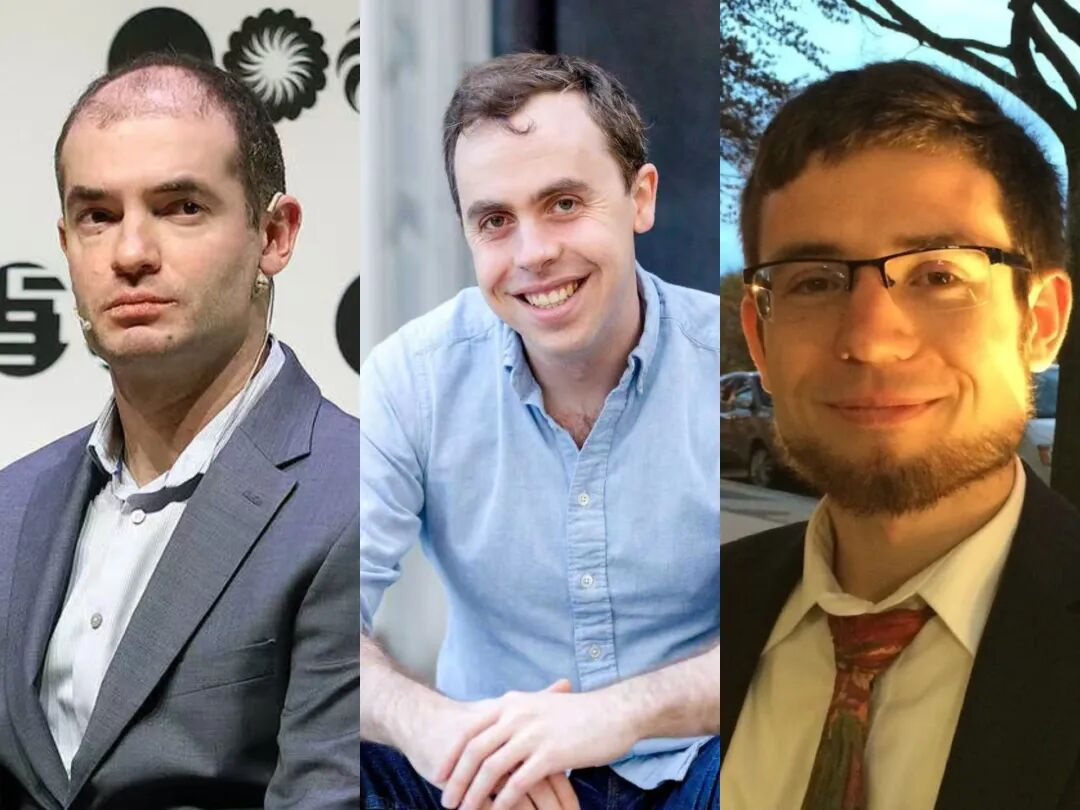
▲From left to right: Ilya Sutskever, Paul Christiano, and Daniel Kokotajlo.
SSI's founding team includes former Alignment lead Paul Christiano and strategy researcher Daniel Kokotajlo. Within months of its establishment, it secured joint investment from Sequoia Capital and Founders Fund, raising over $500 million in its initial funding round and becoming one of the highest-valued AI safety companies globally.
Meanwhile, former CTO Mira Murati and OpenAI co-founder John Schulman co-founded Thinking Machines Lab, aiming to reconstruct 'research as a platform' infrastructure for universities and enterprises.
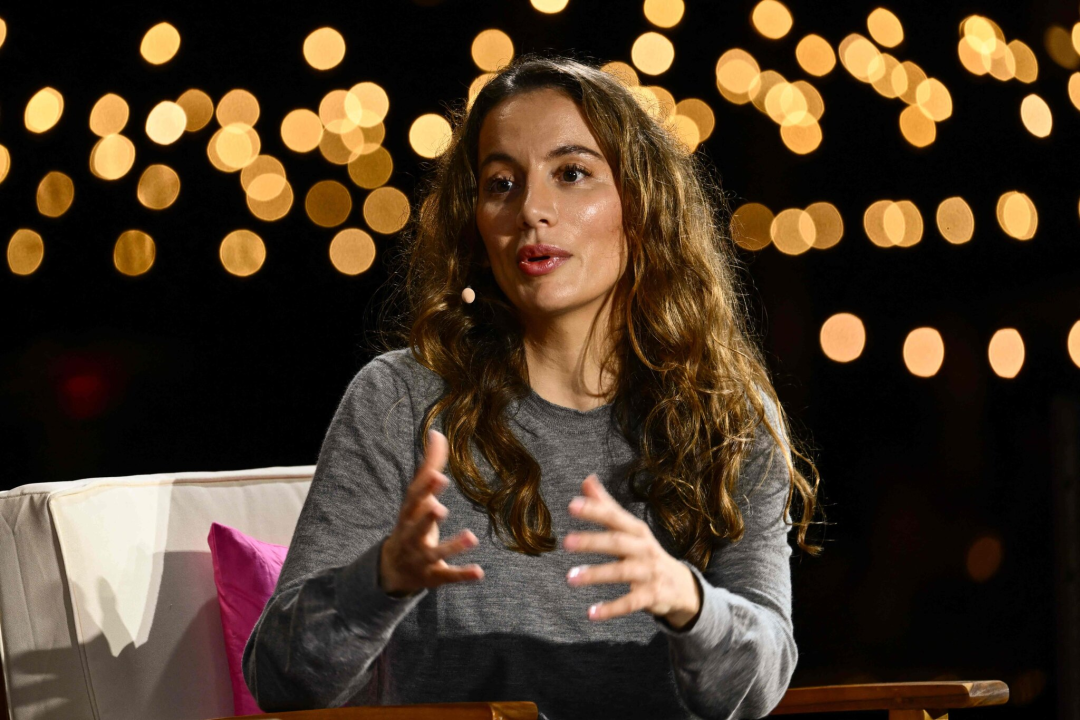
▲Mira Murati
This company reuses OpenAI's toolchain philosophy, emphasizing data governance, model reproducibility, and AI responsibility tracking. It completed a $2 billion seed round in July and reached a $20 billion valuation by October.
The second category involves entrepreneurship centered around 'intelligent agents' and human-computer interaction.
Adept AI, founded by former Engineering VP David Luan, focuses on 'AI assistants capable of operating computers'. He previously led the training systems for GPT-2 and GPT-3 and swiftly assembled a team after his departure, securing over $400 million in funding.
Inflection AI, co-founded by DeepMind co-founder Suleyman and former OpenAI strategy advisor Simonyan, boasts a 35-person core team including multiple GPT project engineers. The company emphasizes 'conversation as an intelligent agent', with its product Pi recognized as the 'most personable' AI assistant, currently valued at nearly $4 billion.
Perplexity AI, founded by Aravind Srinivas, who previously oversaw reasoning systems and multimodal search at OpenAI, leads a team mostly from OpenAI's toolchain group. It has raised $1.5 billion in funding and surpassed a $20 billion valuation. Its 'conversational search + citation tracing' model is seen as a pivotal turning point in AI search.
The third avenue involves migrating general model capabilities to vertical scenarios.
Eureka Labs, founded by Karpathy, specializes in AI education and adaptive learning systems, creating a teaching platform that automatically generates courses, feedback, and assessments. Most of its team hails from OpenAI's toolchain group, securing $400 million in its initial funding round and surpassing a $5 billion valuation.
Covariant, founded by Pieter Abbeel, focuses on a general-purpose robot operating system; Periodic Labs centers on materials science and laboratory AI automation, completing its Series A funding in 2025 and reaching an $800 million valuation.
Compared to other startups, entrepreneurs from OpenAI tend to secure high valuations in a short time.
Ilya Sutskever's SSI, without a product or user base, completed $1 billion in funding within three months, reaching a $5 billion valuation; former CTO Mira Murati's Thinking Machines Lab secured $2 billion in seed funding just five months after establishment; former OpenAI Research VP Liam Fedus's Periodic Labs obtained $200 million in funding led by a16z just three months after founding.
The commonality among these companies: they lack a clear product pathway, but their founders hail from OpenAI's core management team. They have not yet begun building revenue models, yet their valuations have already soared to billions of dollars.
This represents a rare market signal. From a capital perspective, as long as the starting point is close enough to OpenAI, it warrants a bet.
/ 02 /
From Meta to xAI: How OpenAI Became a Global AI Talent Hub
Beyond entrepreneurship, OpenAI is quietly becoming the most crucial talent 'reservoir' for the entire AI industry. According to partial statistics from Wuya Jun, since 2022, at least 16 core members have left OpenAI to join other AI companies.
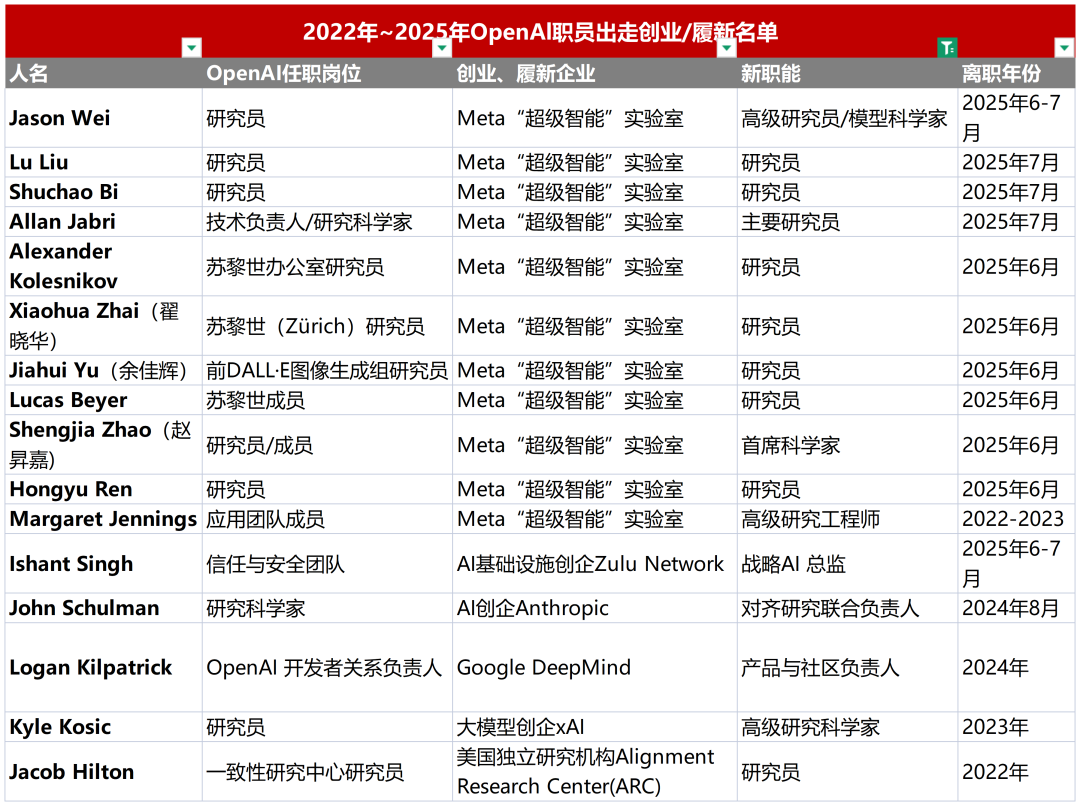
Many enterprises now view OpenAI as a 'supply source' for top-tier technical capabilities. Over the past six months, the most aggressive move has come from Meta.
From June to July, a structured team migrated from OpenAI's Zurich and San Francisco research teams to Meta—this was not an individual move but a collective, team-based relocation.
According to statistics, up to 11 individuals from OpenAI joined Meta's newly formed 'Superintelligence Labs', including Shengjia Zhao, Jason Wei, Lu Liu, Shuchao Bi, Allan Jabri, Alexander Kolesnikov, Xiaohua Zhai, Jiahui Yu, Lucas Beyer, and Hongyu Ren.
They cover nearly all of OpenAI's key capabilities in multimodality, model alignment, training optimization, and underlying systems:
Shengjia Zhao became Meta's chief scientist, rebuilding the team's core research route—from model alignment and reasoning frameworks to retraining visual Transformers; Jason Wei took over model science work, focusing on multitask generalization and reasoning consistency; Allan Jabri and Jiahui Yu continued research on DALL·E image generation and visual-language fusion, integrating OpenAI's multimodal accumulations into the Llama architecture. Xiaohua Zhai and Lucas Beyer, both from Zurich, fine-tuned distributed capabilities such as PyTorch's FSDP/DTensor, enabling Meta to catch up with OpenAI's internal architecture in distributed training and data sharding.
This represents a 'purebred OpenAI team' that Meta is using to replicate and upgrade its AGI research system.
However, Meta is not the sole 'beneficiary'.
Kyle Kosic, one of xAI's founding members, jumped from OpenAI to xAI in 2023 as infrastructure lead, directing relevant model development work. He helped Musk's team quickly build a reasoning framework similar to OpenAI's, but in May 2024, he chose to return to OpenAI.
At DeepMind, former OpenAI Developer Ecosystem Lead Logan Kilpatrick took over as Gemini's Developer and Community Lead. He previously spearheaded the ecosystem construction for GPT API and now follows a similar path, strengthening Gemini's developer interfaces and commercialization feedback mechanisms.
Why have individuals from the OpenAI camp become the most sought-after on the market?
The answer is straightforward. They are among the few who have witnessed the entire process of models like GPT-4, GPT-4.5, GPT-5, and Sora from training, evaluation, safety alignment, to global launch. They know how to translate cutting-edge algorithms into commercial systems for hundreds of millions of users—a capability that is scarce and cannot be quickly replicated.
More critically, OpenAI's extremely flat organizational structure has provided them with a highly composite practice field.
Within OpenAI, there are two main branches: the research team and the engineering team. The research team is responsible for model prototypes, safety strategies, and alignment mechanisms, while the engineering team builds stable deployment systems.
There is no clear division between the two; researchers can directly influence product decisions, and developers participate in model validation. The teams operate in a 'small group' system, with each group having end-to-end permissions from research to deployment, akin to mini startups.
This highly autonomous and tightly coupled R&D system has fostered a group of 'versatile yet deep' talents: they are familiar with underlying algorithms and possess engineering implementation and productization thinking.
To find such individuals, OpenAI's hiring standards differ significantly from mainstream research institutions. It has two clear 'non-requirements':
First, it does not prioritize academic qualifications. A doctoral degree is not a prerequisite for entry; many core researchers hold only undergraduate degrees. For instance, Aditya Ramesh, the author of DALL·E, has only a bachelor's degree from New York University.
Second, it does not prioritize seniority. OpenAI is accustomed to letting newcomers take on significant responsibilities. The project lead for Sora, Bill Peebles, was a fresh PhD graduate in 2023 and began leading a team within a year of joining.
This mechanism has forged a group of individuals with interdisciplinary knowledge structures, strong implementation orientation, and a willingness to take responsibility for the final product. They are familiar with cutting-edge technologies and understand how to scale them into products.
For Meta, xAI, and many emerging companies, what they are competing for is never just technical resumes themselves but the key talents cultivated under OpenAI's organizational mechanisms and product philosophies.
These individuals can integrate mission-driven research spirit with deliverable product standards—a capability precisely needed to build the next generation of AI companies.
Text/Lang Lang
-
![]()
Hunan’s Wealthiest Entrepreneur Eyes Comeback with Apple’s Foldable iPhone
-
![]()
Planning to Secure 1.055 Billion Yuan to Propel AR Optics Forward! Lante Optics Receives Green Light for Private Placement on the Science and Technology Innovation Board
-
![]()
MiniMax: At the Heart of the AI Maelstrom
-
![]()
Securing 600 Million Yuan in Funding: This AR Optics Company Steps into the Limelight!
-
![]()
From a 706% Surge to a $340 Billion Market Cap Plummet: Has MiniMax's Moment Passed?
-
![]()
High Demand, Low Stock Price: Can the Emotional Companion Robot Ease UBTECH’s Worries?
-
![]()
Why Does Yin Qi, Who 'Doesn't Listen to Advice,' Insist on Making AI Agent Smartphones? | Interview with Jieyue Xingchen
-
![]()
AI-Generated Code Reveals Surprise That Thrills China