China Set to Unveil Its First Mandatory AEB National Standard! Vehicle Safety Enhancements Kick Off Countdown
 11/17 2025
 643
643



Source: Zhiche Technology
Recently, the Science and Technology Department of the Ministry of Industry and Information Technology released an announcement, seeking public feedback on the mandatory national standard titled "Technical Requirements and Test Methods for Automatic Emergency Braking Systems in Light-Duty Vehicles" (submitted draft). The deadline for submitting comments is set for November 11, 2025.
This new standard will supersede the current GB/T39901-2021, transitioning from a recommended standard to a mandatory one. It mandates that all M1-class (passenger vehicles) and N1-class (light-duty trucks) must be equipped with automatic emergency braking systems.
The public announcement of the submitted draft by the Ministry of Industry and Information Technology signifies the final stage in the standard's formulation process.
Compared to the initial public consultation held in May 2025, the release of this submitted draft indicates that the technical content and requirements have been largely finalized.
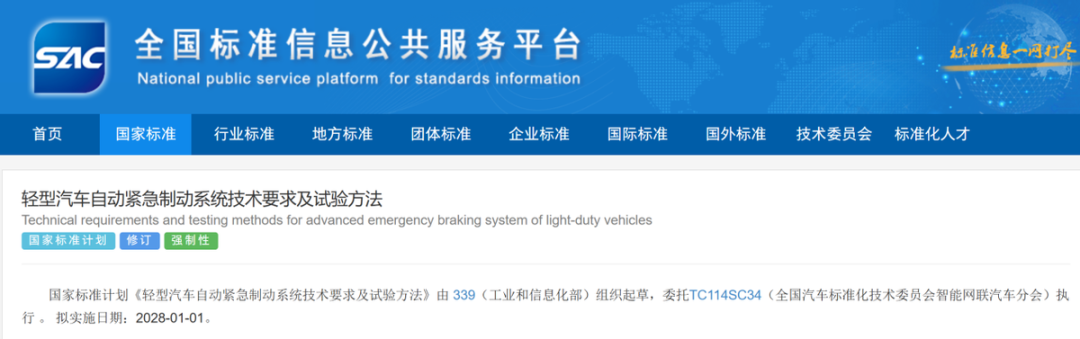
According to information from the National Standard Information Public Service Platform, the standard is slated for official implementation on January 1, 2028. From that date, all newly produced light-duty vehicles must adhere to this standard.

Standard Upgrade: From Recommended to Mandatory, Broadening the Scope
In comparison to the current standard, the new national standard achieves significant advancements across multiple dimensions. The most fundamental change is the shift from a recommended (GB/T) to a mandatory (GB) standard, implying that vehicles without AEB systems will be prohibited from entering the market.
The scope of application has been substantially broadened, extending from M1-class passenger vehicles to include N1-class light-duty trucks. This expansion significantly enhances road safety coverage, bringing a greater number of vehicle models under the safety regulatory framework.
Currently, China's light-duty truck fleet exceeds 20 million vehicles. These vehicles frequently operate on urban roads and in urban-rural fringe areas, making them a high-risk group for traffic accidents. The mandatory installation of AEB will effectively address the gap in active safety protection for commercial vehicles.
Technical requirements have also been significantly enhanced. The new national standard introduces assessments of recognition capabilities for vulnerable road users, such as pedestrians, bicycles, and pedal-type two-wheeled motorcycles. It also incorporates simulation testing items to ensure a more comprehensive and stringent evaluation.

Technical Indicators: China's Standards Surpass International Benchmarks
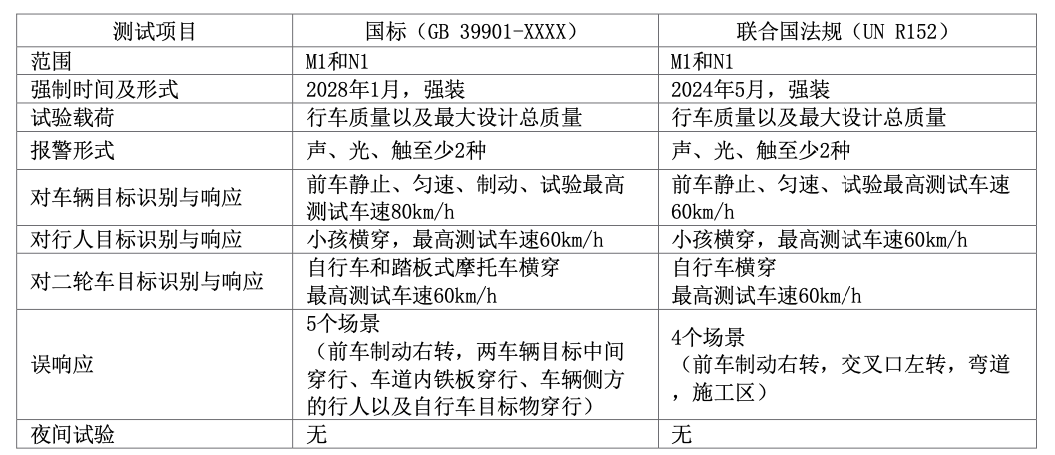
The technical requirements of the new national standard align with international regulations, specifically UN-R152, indicating that China's automotive safety standards have reached global parity.
The test speed range has been substantially increased. The test speed for stationary vehicles ahead has been raised from 30 km/h in urban areas to 80 km/h applicable to expressways, with a requirement to completely avoid collisions at 40 km/h. The new standard distinguishes requirements for M1-class and N1-class vehicles: M1-class vehicles must activate for vehicles ahead between 10 km/h and 80 km/h; N1-class vehicles between 10 km/h and 60 km/h. Monitoring speed ranges for pedestrians, bicycles, and pedal-type two-wheeled motorcycles are set between 20 km/h and 60 km/h. This enhancement will significantly bolster the system's safety protection capabilities in highway scenarios.
The test error tolerance rates have been scientifically and reasonably established. The standard introduces, for the first time, assessments of recognition capabilities for vulnerable road users, such as pedestrians, bicycles, and pedal-type two-wheeled motorcycles. The test error tolerance rate is set at 10% for vehicle and pedestrian targets, and relaxed to 20% for bicycle and two-wheeled motorcycle targets, accurately addressing key pain points in China's road environment.
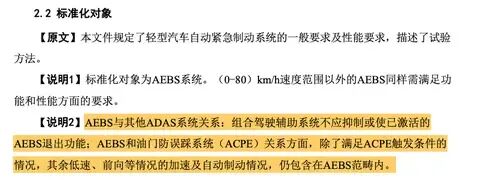
Notably, the standard clearly defines priority relationships among systems. The explanatory notes emphasize that combined driving assistance systems should not suppress or deactivate an already activated AEBS, establishing AEBS as the highest priority within the safety system hierarchy. This provision directly addresses industry pain points, as the current coordination and management among different systems remain challenging. Many automakers' advertised high-speed braking capabilities are, in fact, AEB functions enabled by intelligent driving systems.

Safety Benefits: Reducing Accident Rates, Safeguarding Lives
As a crucial automotive active safety technology, AEB utilizes sensors such as radar and cameras to measure the distance to vehicles or obstacles ahead. When the distance falls below the safe threshold, it automatically initiates emergency braking or decelerates the vehicle.
According to statistics from the U.S. National Highway Traffic Safety Administration (NHTSA), AEB functionality can reduce traffic accidents by approximately 31.3%.
China, boasting the world's largest vehicle fleet, still faces a severe road traffic safety situation. Data from the Traffic Management Research Institute of the Ministry of Public Security indicates that passenger vehicle-related accidents account for 82% of total accidents, with 81.50% of these being related to driver factors.
However, the reliability of AEB systems still requires continuous improvement. Data from CheZhi.com reveals that from 2019 to May 2025, there were over 650 complaints regarding AEB malfunctions across multiple automotive brands. These issues primarily manifest in two forms: one is AEB functionality failure, including complete failure and delayed activation; the other is false activations, such as "phantom braking," which accounts for 47.4% of total complaints.

Industry Impact: Vast Development Opportunities for the Industry Chain
Currently, the AEB penetration rate in China's automotive market exhibits significant "price discrimination," highly correlated with vehicle pricing. Data from January to April 2025 shows that the overall AEB installation rate for passenger vehicles in China is 60.1%, with new energy passenger vehicles slightly higher at 62.9%.
Observing by price range, vehicles priced above 400,000 yuan have achieved a 100% AEB installation rate, essentially reaching full standardization; while entry-level vehicles priced below 80,000 yuan have an installation rate of only 2.7%, nearly non-existent. This pronounced "safety configuration price discrimination" underscores the necessity and urgency of implementing the new mandatory national standard.
The implementation of the mandatory AEB national standard will create vast development opportunities for related industry chains. The AEB system encompasses a complete technology chain of perception-decision-execution, with its core challenge lying in precise perception and intelligent control under complex environments.
The localization process of the industry chain is accelerating. In the core component sector of AEB, the localization rate has increased from less than 20% in 2020 to approximately 45% in 2024, and is projected to exceed 70% by 2027.
This policy incentive has already attracted capital market attention, with multiple listed companies actively deploying AEB-related businesses. As the primary drafting entities, the China Automotive Technology and Research Center Co., Ltd., China FAW Group Co., Ltd., Huawei Technologies Co., Ltd., and other enterprises have accumulated considerable expertise in AEB technology research and application.
As the 2028 implementation deadline approaches, the automotive industry will undergo profound adjustments. High-end vehicles priced above 400,000 yuan will be minimally affected, as their AEB installation rates are nearly saturated; while entry-level vehicles priced below 80,000 yuan will experience a complete reshuffle, with the current 2.7% installation rate indicating substantial upgrade potential.
The implementation of the mandatory AEB national standard will lead China's automotive safety technology to a comprehensive upgrade, driving the industry's strategic transformation from "passive safety" to "active safety," and from a "function-centric" to a "user safety-centric" philosophy, deeply reconstructing the underlying logic of automotive industry development.
- End -
Disclaimer:
All works marked "Source: XXX (not Zhiche Technology)" on this official account are reprints from other media, intended to disseminate and share more information. This does not represent this platform's endorsement of their views or responsibility for their authenticity. Copyright belongs to the original authors. If there is any infringement, please contact us for removal.
-
![]()
Hunan’s Wealthiest Entrepreneur Eyes Comeback with Apple’s Foldable iPhone
-
![]()
Planning to Secure 1.055 Billion Yuan to Propel AR Optics Forward! Lante Optics Receives Green Light for Private Placement on the Science and Technology Innovation Board
-
![]()
MiniMax: At the Heart of the AI Maelstrom
-
![]()
Securing 600 Million Yuan in Funding: This AR Optics Company Steps into the Limelight!
-
![]()
From a 706% Surge to a $340 Billion Market Cap Plummet: Has MiniMax's Moment Passed?
-
![]()
High Demand, Low Stock Price: Can the Emotional Companion Robot Ease UBTECH’s Worries?
-
![]()
Why Does Yin Qi, Who 'Doesn't Listen to Advice,' Insist on Making AI Agent Smartphones? | Interview with Jieyue Xingchen
-
![]()
AI-Generated Code Reveals Surprise That Thrills China