AI Business Revenue Growth Surpasses 50%: What's Baidu's Secret to Success?
 11/19 2025
 563
563
Baidu has long branded itself as an AI - centric company. However, it was only with the release of its Q3 financial report today that we truly witnessed the firmness and assertiveness of Baidu's commitment to AI.
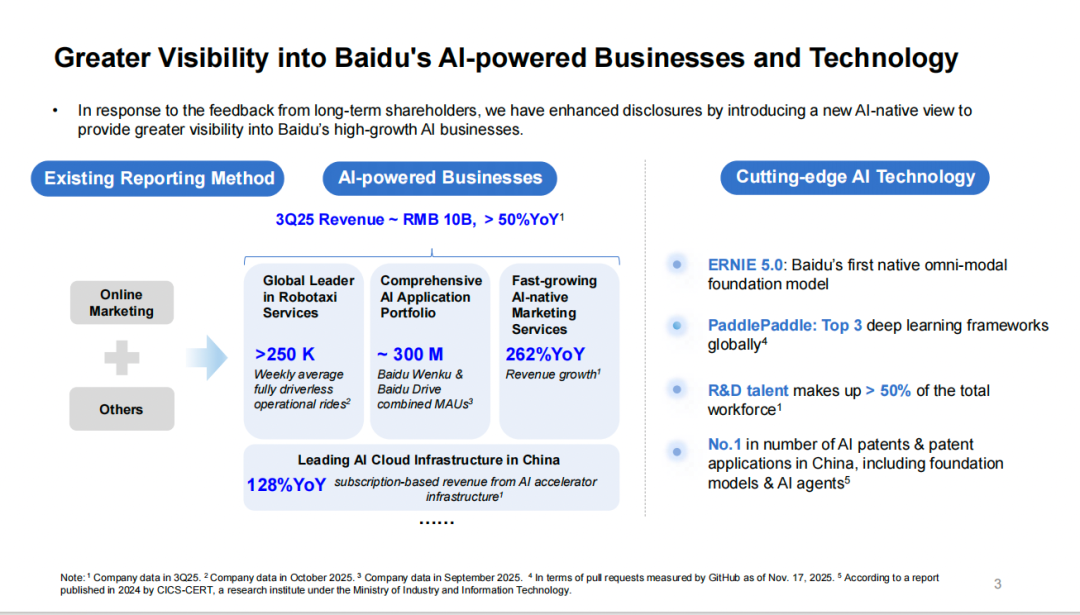
On the evening of November 18, Baidu unveiled its financial report for the third quarter of 2025. The report showed a total quarterly revenue of 31.2 billion yuan, with Baidu's core revenue hitting 24.7 billion yuan. What truly stood out was that Baidu disclosed its AI business revenue data for the first time, revealing a year - on - year increase of over 50%. Among these figures, AI cloud revenue grew by 33% year - on - year, AI application revenue reached 2.6 billion yuan, and AI - native marketing service revenue soared by 262% year - on - year to 2.8 billion yuan.
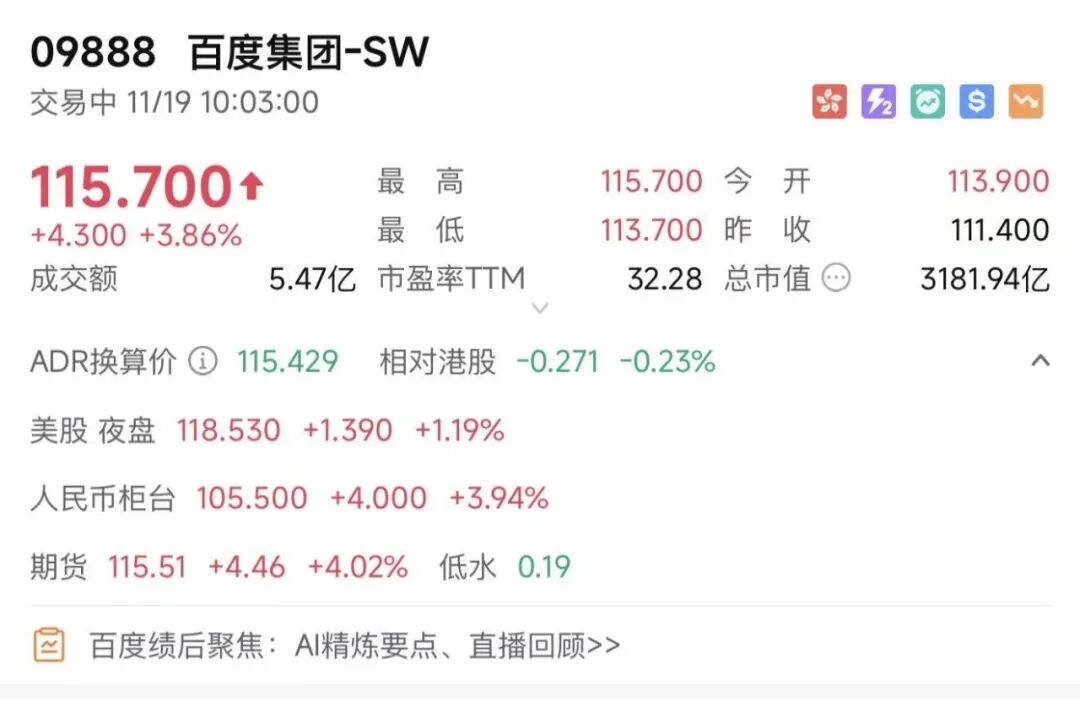
The capital market reacted enthusiastically. Today, Baidu's Hong Kong stock opened nearly 4% higher.
After long - term cultivation, a breakthrough has finally been achieved. Over the past 10 quarters, Baidu has made substantial investments in AI.
If cloud computing made computing power as accessible as utilities like water and electricity 20 years ago, then today, AI is emerging as the new infrastructure for the digital economy. This consensus is stronger than that of any previous technological revolution. This isn't just a growth figure for a single business segment; it represents the underlying logic of industrial transformation. When AI capabilities can be easily accessed like APIs, the innovation thresholds for various industries will be redefined. Vibe Coding is enabling one - person companies to spread rapidly across the globe, and Baidu is becoming the all - in - one toolbox for these frontier pioneers.
Unlike merely providing computing power or models, Baidu is constructing a complete AI infrastructure system.
From the underlying Kunlun chips to the framework - level PaddlePaddle, to the intermediate - level ERNIE large model, and then to the upper - level applications and industry solutions, this full - stack layout is based on Baidu's consistent belief: True AI infrastructure isn't just about packaging technology but using AI's native thinking to reconstruct the entire technology stack, enabling each layer to provide optimized support for the layer above.
The explosive growth of Baidu's AI business presented in its Q3 financial report provides indirect proof that this "native" thinking is transforming the way AI technology is supplied.
01 From Computing Power to Intelligence: The Infrastructure Vision of a Full - Stack Ecosystem Builder
The rapid growth of Baidu's AI business isn't driven by a single business segment but represents a "full - stack" transformation.
AI cloud, AI applications, AI - native marketing services, Apollo Go, ERNIE large model... every level and every aspect have exceeded expectations. As Robin Li (Li Yanhong) said, the comprehensive value comes from "more and more enterprises adopting its AI products and solutions."
Traditional IT infrastructure and AI infrastructure have fundamental differences. The former mainly focuses on computing power supply and storage management, emphasizing resource scheduling efficiency. The latter's core is the standardized output of intelligent capabilities, focusing on how algorithms, models, and applications can seamlessly collaborate.
At the computing power level, Baidu's self - developed Kunlun chips recently launched two new products, the M100 and M300, which will be available in 2026 and 2027 respectively. At the model level, Baidu's ERNIE large model 5.0, as a unified native full - modal model, excels in full - modal understanding, creative writing, intelligent agent planning, and instruction following. At the framework level, the PaddlePaddle deep learning platform plays a role similar to an operating system. At the application level, a complete product matrix covering both consumer and business ends has been built, realizing intelligence as a service.
The AI cloud business achieved a strong 33% growth in the third quarter, with subscription revenue for AI high - performance computing infrastructure surging by 128% year - on - year. This indicates that more and more enterprises are recognizing AI as a key factor determining future competitiveness.
IDC's latest "China AI Public Cloud Service Market Share" report shows that Baidu Intelligent Cloud has topped the China AI public cloud market for six consecutive years and ten times in total, which can be seen as a certification of its strength.
02 From Self - Transformation to Industry Transformation: Accumulation Leads to Breakthroughs
When people's perception of AI was still limited to chatbots, Baidu had already decided to use AI to reconstruct all its businesses.
The search engine was the first Baidu product to undergo AI - native reconstruction. The difficulty of this transformation far exceeds imagination. It's not simply adding an AI assistant next to the search box but reconstructing from the underlying logic of information retrieval—from "finding information" to "generating answers," from "listing links" to "directly solving problems."
Subsequently, changes occurred in the digital marketing field.
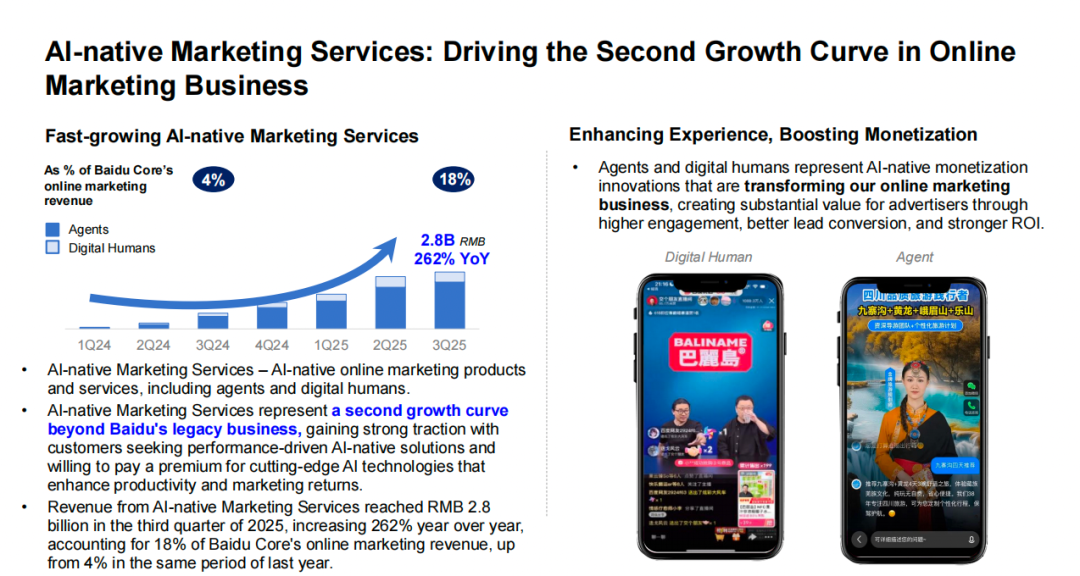
AI - native marketing services generated 2.8 billion yuan in revenue this quarter, a year - on - year increase of 262%. Innovative service forms, including intelligent agents and digital humans, are gaining market recognition with significant advantages. More and more clients seeking AI - driven solutions and willing to pay for technology have achieved dual improvements in productivity and marketing effectiveness through this service.
AI applications also performed outstandingly, with Q3 revenue reaching 2.6 billion yuan. The all - end universal intelligent agent GenFlow, jointly launched by Baidu Wenku and Baidu Netdisk, has been upgraded to version 3.0, with over 20 million active users. The no - code development tool "Miaoda" has evolved to version 2.0, enabling the development of over 400,000 AI applications through no - code means, allowing ordinary users to enjoy the convenience of AI development. Most AI applications adopt a highly sticky subscription model, sustainably generating high - quality revenue.
The experience accumulated from these internal practices is now being externally output through productization. The world's first commercially available, self - evolving super intelligent agent—Famou, released at Baidu World 2025—can find the "global optimal solution" in real industries and has been applied in finance, energy, transportation, logistics, scientific research, and other fields.
From Baidu's perspective, AI transformation isn't a simple superposition of technologies but necessarily involves a deep reconstruction of business processes.
03 Awakening Opportunities for Countless Industries: Doing It Again with AI
A closer look reveals that the 33% growth rate of the AI cloud business and the 128% surge in subscription revenue for AI high - performance computing infrastructure reflect enterprises' urgent demand for intelligent transformation. If digital transformation a decade ago was still a nascent attempt for many industries, this wave of intelligent transformation carries a stronger sense of urgency.
At the foundational empowerment level, it mainly involves the inclusive output of computing power and model capabilities. Through AI cloud services, small and medium - sized enterprises can access the ERNIE large model with extremely low thresholds, without needing to build their own computing power clusters or cultivate dedicated AI teams. The "plug - and - play" service model significantly lowers the barriers to AI technology application.
At the application empowerment level, Baidu provides a series of standardized AI products. For example, digital employees can take on various roles such as customer service, sales, and administration, helping enterprises enhance service capabilities without increasing labor costs. Creation tools like GenFlow double content production efficiency, and "Miaoda" makes no - code development a reality.
At the solution empowerment level, deep customization for specific industries becomes the focus. For instance, Famou's application in finance, energy, transportation, logistics, and other fields integrates industry know - how with AI capabilities. This deep customization requires a profound understanding of the industry and strong technological integration capabilities.
Enterprises can start with basic AI cloud services, gradually try standardized products, and ultimately achieve deep customization.
From Baidu's role in AI infrastructure, it's clear that as an AI technology company, Baidu positions itself more as a co - builder with industries and developers, pursuing collaborative evolution with traditional enterprises. In short, Baidu isn't seeking to replace traditional industries but to become their "enhancer."
In manufacturing, AI helps improve product quality and production efficiency; in finance, AI strengthens risk control capabilities and service experiences; in healthcare, AI assists in diagnosis and drug research... The integration of AI and traditional industries is clearly not a zero - sum game but a win - win development.
This co - builder role positioning is also the core philosophy that Baidu has adhered to for decades.
From its early goal of "enabling people to access information most equally and conveniently" to today's "using technology to make the complex world simpler," Baidu has always played the role of a technology inclusivity promoter.
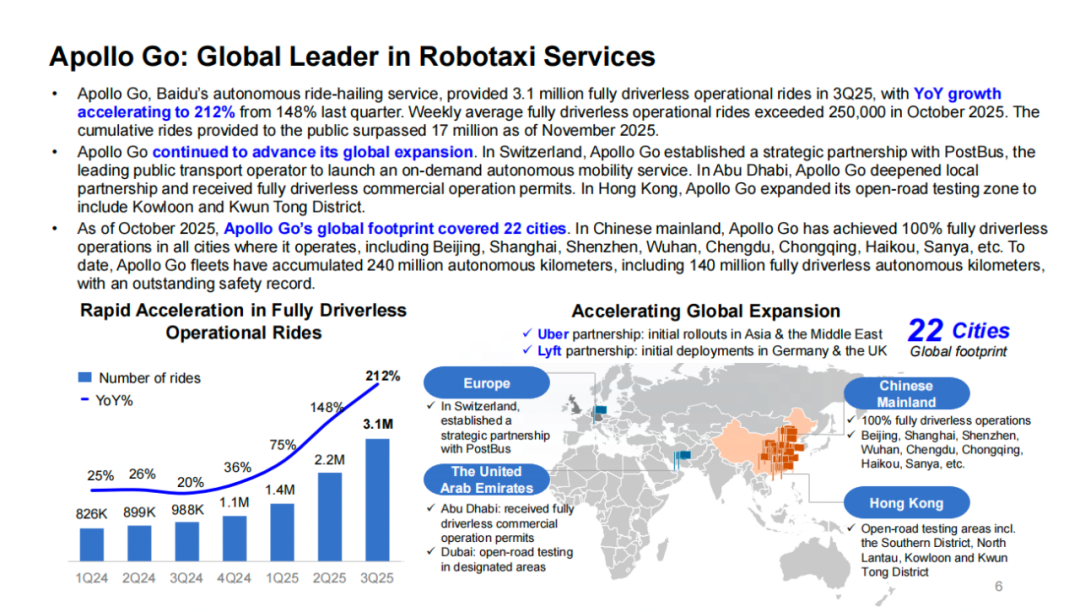
The arrival of the AI era has provided this philosophy with a broader space for practice. When AI business revenue grows by over 50%, when AI cloud becomes a growth engine, and when Apollo Go begins scaled operations and goes global, these signals all point to the same trend: AI is moving from concept to reality, from the laboratory to the market, and from an auxiliary tool to a core capability.
04 Final Thoughts:
Beneath the 31.2 billion yuan revenue figure lies a qualitative shift in the revenue structure. Compared to the steady 33% growth of AI cloud, what truly catches the industry's attention is the explosive 262% growth of AI - native marketing services. This set of data reveals a long - underestimated truth: AI isn't just Baidu's second growth curve but is also reshaping its foundational search advertising business.
Baidu's aggressiveness lies not in how much it continues to invest in R&D but in its courage to completely overhaul its core "cash cow" with AI. When AI application and marketing revenue can contribute over 5 billion yuan in real money this quarter, it means that large model commercialization has officially moved from the "trial phase" to the "value realization phase."
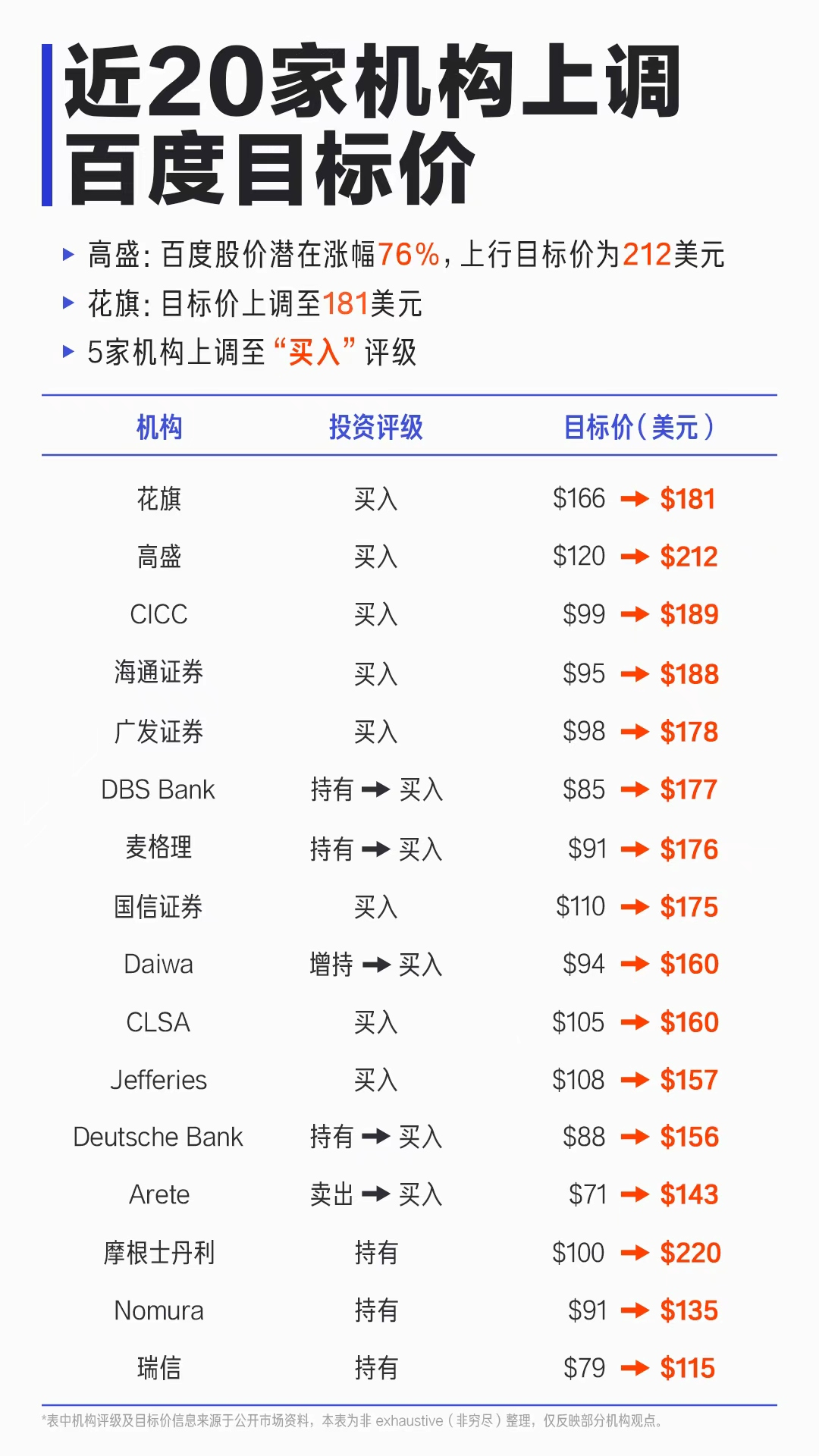
This continuous strategic investment is now entering its harvest period—the rapid growth of AI business confirms the value of long - termism. Nearly 20 institutions, including Goldman Sachs and Morgan Stanley, have raised their ratings and target prices for Baidu, reflecting the capital market's recognition of Baidu's AI transformation achievements.
For the industry, Baidu's report is a watershed moment: it proves that AI companies no longer need to prove their future through losses. Once the technology monetization closed loop is established, the flywheel effect will be even more rapid than in the mobile internet era. This time, Baidu isn't just telling a good story but has also presented a strong hand.
-
![]()
It's already crowded in car manufacturing, yet Chunnan insists on joining in.
-
Confirmed: Fossil Fuel Vehicle Ban! Hainan Unveils New '15th Five-Year Plan', Weakening Passenger Vehicle Sector and Initiating Petroleum Asset Depreciation
-
![]()
Research on the Underlying Industrial Logic of the Booming Sales of Chinese Action Camera Brands in Japan and the Decline of GoPro: The UGC+AIGC Creation Wave Reshapes the Market Landscape
-
![]()
Half-Year In-App Purchases Reach 105 Billion: The Most Lavish Starting Point and the Most Challenging Second Half
-
![]()
AI Enters Its Next Phase: From DeepSeek to Robots, What Lies Ahead for AI?
-
![]()
Jieyue Paves the Way for Agents with a New Phone and AgentOS
-
![]()
Research on the Industrial Logic Behind the Surge of Chinese Action Camera Brands in Japan and GoPro's Decline: How the UGC+AIGC Creative Wave is Reshaping the Market
-
![]()
Has Doubao Started Charging? Does ByteDance Face Commercialization Pressure?