With 80 Billion Starting Point, Who Profited Most from the 'First GPU Stock on Hong Kong Stock Exchange'?
 01/04 2026
 644
644
Introduction: Five investors witnessed paper returns surpassing HK$1 billion.
Making its debut as the first stock of 2026 and the 'First GPU Stock on Hong Kong Stock Exchange,' Biren Technology had a triumphant launch on the Hong Kong Stock Exchange. On its listing day, the company opened at the maximum price of HK$19.6 per share, with its stock price soaring throughout the day. It once surged by over 110%, reaching a peak of HK$42.88, and its market value briefly exceeded HK$100 billion. As of the close on January 2, the stock price stood at HK$34.46, marking a 75.82% increase from the issue price and corresponding to a market value of approximately HK$82.6 billion (about RMB 73 billion).
Compared to previously listed domestic GPU companies on the A-share market, this performance was not the most aggressive. By the end of 2025, Moore Threads and MetaX Technologies had successively gone public on the STAR Market, with first-day gains reaching 425.46% and 692.95%, respectively. Their closing market values were approximately RMB 282.3 billion and RMB 332 billion, respectively, reshaping market perceptions of the valuation of domestic computing power assets on their listing days.
In contrast, Biren Technology's first-day gain on the Hong Kong Stock Exchange was relatively modest. However, given the overall scarcity of tech assets in the Hong Kong market, its performance is still deemed 'phenomenal.' More notably, Biren Technology does not consider the Hong Kong listing as its final destination and plans to list on the A-share market at an appropriate time in the future, making it worthy of continued investor attention.
From late 2025 to early 2026, domestic GPU and AI computing power companies have intensively moved toward the capital market. Moore Threads and MetaX Technologies have been listed on the STAR Market, Biren Technology has completed its Hong Kong listing, Illuvinate is set to list on the Hong Kong Stock Exchange, Kunlunxin has submitted its listing application, and Enflame Technology has completed its A-share IPO counseling. This wave of capital excitement is far from over.
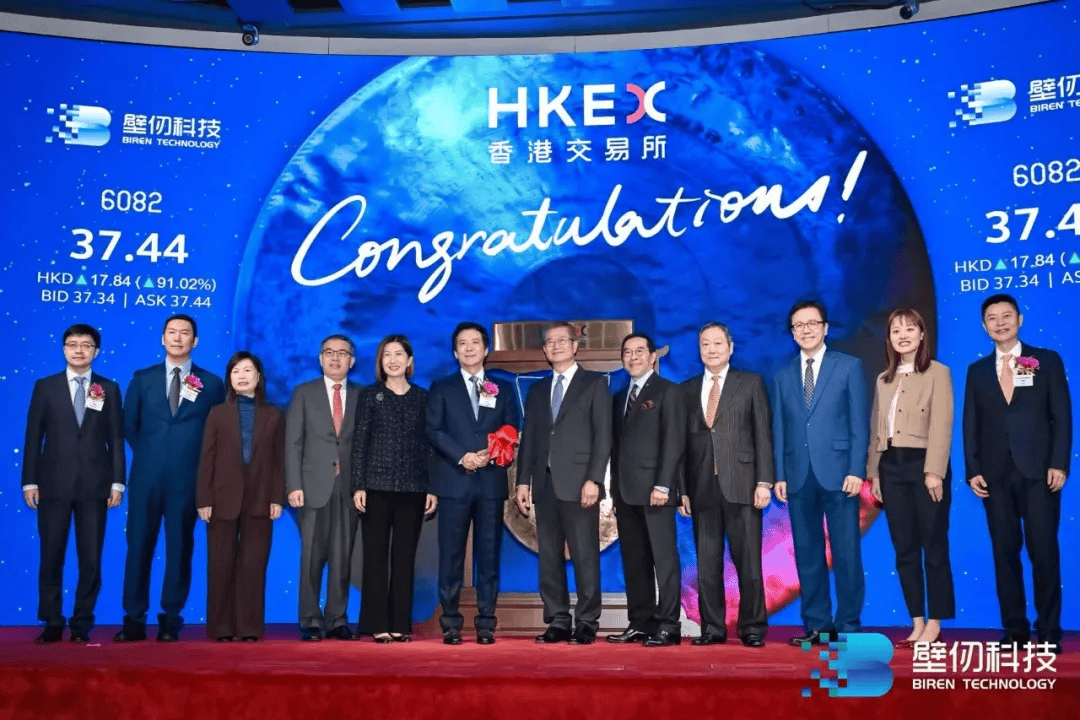
01 Biren Technology Creates Wealth: Five Investors See Paper Returns Exceeding HK$1 Billion
If Biren Technology's listing is seen as a concentrated validation at the capital level, the first aspect to be tested by the market is its six-year financing and shareholding structure.
According to the prospectus, since its establishment in 2019, Biren Technology has completed 10 rounds of financing, raising a total of over RMB 5 billion. Its investors include early-stage venture capital firms, industrial capital, state-owned asset platforms, and large financial institutions. Prior to the IPO, the company had attracted multiple local state-owned asset platforms, including Shanghai Guotou Pioneer Fund, Shanghai Artificial Intelligence Industry Investment Fund, Guangzhou Industrial Investment, Wuxi Liangxi Science and Technology Innovation Mother Fund, as well as market-oriented institutions such as Qiming Venture Partners, Hillhouse Capital, Walden International, IDG Capital, Yunjiu Capital, and Songhe Capital, along with industrial investors like Gree Group, Country Garden Ventures, SMIC Capital, Ping An Group, and ZTE.
These investments were not concentrated in a single window but spanned multiple stages of Biren Technology's development, from its startup phase and technical verification period to its commercialization exploration phase. Especially during the stage when GPU R&D had not yet generated clear revenue and the company continued to invest heavily in R&D, some institutions chose to stay for the long haul, becoming the 'patient foundation' of its capital structure.
From a capital return perspective, Biren Technology's Hong Kong listing provided a concentrated window for multiple institutional investors who had long bet on domestic GPUs to realize 'paper capital' gains.
As one of the company's earliest founding investors, Qiming Venture Partners invested in Biren Technology during the Pre-A round and continued to increase its stake in subsequent rounds. It also added HK$35 million as a cornerstone investor before the IPO. After the listing, Qiming held a 3.89% stake in Biren Technology, corresponding to a market value of approximately RMB 2.883 billion, making it one of the largest external institutional shareholders. While the prospectus did not disclose the cumulative investment amount, Qiming's paper gains rank among the highest among financial investors.
Among industrial capital, Country Garden Ventures' return path is particularly clear. According to the data, Country Garden Ventures participated in Biren Technology's financing starting from the B round, with a cumulative investment of approximately RMB 350 million. After the listing, its shareholding ratio was 2.82%, corresponding to a market value of approximately RMB 2.09 billion and paper gains of approximately RMB 1.74 billion, with an investment return multiple of nearly 6 times, making it a rare high-return case for a real estate-backed CVC in the hard tech sector.
As a long-term supporter, Yunjiu Capital made a significant bet on Biren Technology in its early stages. In the 2020 Pre-B round, Yunjiu Capital co-led an investment of RMB 100 million and subsequently made multiple additional investments through its USD and RMB funds, with a cumulative investment of approximately RMB 400 million. After the listing, Yunjiu held a 2.34% stake in Biren Technology, corresponding to a market value of approximately RMB 1.734 billion and paper gains of approximately RMB 1.334 billion.
Among state-owned background investors, Zhuhai Gree's return rate was particularly prominent. Gree Group, through its subsidiaries such as Gree Capital Investment, invested a cumulative of approximately RMB 140 million in Biren Technology and facilitated the relocation of related subsidiaries to Hengqin. After the listing, Zhuhai Gree held a 1.95% stake, corresponding to a market value of approximately RMB 1.445 billion and paper gains of approximately RMB 1.305 billion, with an investment return multiple exceeding 10 times, making it one of the institutions with the highest return per unit of investment.
Similarly, Songhe Capital, which also invested early, provided approximately RMB 140 million in cumulative investment to Biren Technology and obtained a 1.69% shareholding ratio. With the company's successful listing, its stake corresponded to a market value of approximately RMB 1.252 billion and paper gains of approximately RMB 1.112 billion, with a return multiple of about 9 times, reflecting the high elasticity of returns in early-stage hard tech investments for top projects.
Overall, after Biren Technology's listing, the paper returns of these five core investment institutions have all entered the 'billion-dollar' range, providing a phased capital return sample for the high-investment, long-cycle track of domestic GPUs.
From the fundraising results, Biren Technology's Hong Kong IPO raised a total of HK$5.583 billion, with a net amount of HK$5.375 billion, making it the largest project in terms of fundraising size since the implementation of the 18C rules by the Hong Kong Stock Exchange. The cornerstone investor lineup included over 20 leading Chinese and foreign institutions, with subscriptions reaching US$373 million, accounting for over 60% of the fundraising, demonstrating institutional capital's recognition of the long-term logic of domestic GPUs.
Compared to short-term stock price gains, what deserves more attention is the consensus reflected in the capital structure: In the long-cycle track of domestic computing power, Biren Technology's listing provides a verifiable sample for the investment model of 'heavy R&D, slow commercialization, and long-term companionship.'
02 Harvard Law PhD 'Builds Chips,' Net Worth Exceeds HK$5 Billion
While investors saw their returns multiply, Biren Technology's founder, Zhang Wen, also experienced a significant increase in net worth. He directly holds a 7.77% stake in the company, corresponding to a market value of approximately RMB 5.758 billion based on the opening day's market value.
Among domestic GPU entrepreneurs, Zhang Wen's background is uncommon.
Public information shows that Zhang Wen is not a traditional chip engineer but a former Wall Street lawyer with a PhD in Law from Harvard University. Compared to the founding teams of Moore Threads and MetaX Technologies, he does not have a deep technical background in GPUs but demonstrated strong resource integration and organizational capabilities in the early stages of entrepreneurship.
At the inception of Biren Technology, Zhang Wen chose an extremely challenging path—starting from the underlying general-purpose GPU architecture and insisting on full-stack self-research rather than focusing solely on vertical-scene-specific accelerators. This choice implied a longer R&D cycle, higher capital consumption, and delayed commercial returns.
In the company's early stages, Zhang Wen quickly built a high-density talent structure through large-scale financing, attracting multiple core GPU R&D personnel from international giants to join the team. At the same time, the company simultaneously configured market, product, management, and capital functions at the organizational level, forming a 'structured' architecture uncommon in startups. This organizational capability enabled Biren Technology to demonstrate strong stability and execution amid multiple rounds of financing, technological breakthroughs, and external environmental fluctuations.
In terms of technological pathways, Biren Technology achieved a key breakthrough in 2023: Its first general-purpose GPU chip, BR100, was officially launched, based on an autonomous original architecture, with single-chip peak computing power reaching the PFLOPS level. The accompanying software platform, BIRENSUPA™, was also introduced, initially forming a complete 'hardware + software' ecosystem. In 2024, the company's BR104 series ranked first globally in the MLPerf data center inference benchmark, with its BERT model performance reaching 1.58 times that of NVIDIA's A100, obtaining authoritative validation of its technical capabilities.
Throughout this process, Biren Technology did not rush to amplify short-term achievements through market narratives but continued to invest resources in product iteration and ecosystem construction. This restraint prevented it from becoming the most 'buzzworthy' company during the peak of the domestic GPU craze but laid the foundation for subsequent large-scale deployment.
03 Hong Kong Is Not the Endpoint: Biren Technology May List on the A-Share Market
From an industry perspective, Biren Technology has entered the first tier of domestic GPU companies, alongside Moore Threads, MetaX Technologies, and Enflame Technology, collectively known as the 'Four Little Dragons of Domestic GPUs.'
Among these four companies, Biren Technology focuses on general-purpose GPUs and extends into intelligent computing solutions. Its revenue primarily comes from hardware systems and accompanying software platforms based on self-developed GPGPUs, emphasizing the overall delivery capability of computing power clusters.
At the application level, Biren Technology is one of the earliest domestic companies to achieve commercialization of thousand-card-scale GPU clusters. The company disclosed that its thousand-card cluster can operate continuously for over five days without hardware or software failures and supports uninterrupted large model training services for over 30 days, laying the foundation for the commercial deployment of ten thousand-card clusters in the future.
In terms of competitive strategy, Biren Technology did not directly replicate the overseas manufacturers' approach of prioritizing single-card performance but focused on cluster interconnection, heterogeneous compatibility, and system stability. By simultaneously advancing hardware R&D and software platform construction, its BIRENSUPA™ platform has become one of the more mature GPU development ecosystems in China, with stronger adaptability in local application scenarios such as government affairs and energy.
From a market share perspective, Biren Technology is still in its early stages. According to the prospectus, based on revenue, the company's market shares in China's intelligent computing chip market and GPGPU market in 2024 were 0.16% and 0.20%, respectively. However, given the continuous expansion of China's intelligent computing chip market, its growth potential is still considered promising by the capital market.
Notably, Biren Technology does not view its Hong Kong listing as its final destination. The company explicitly stated in its prospectus that it plans to advance A-share issuance and listing at an appropriate time in compliance with relevant regulations and is currently in the IPO counseling stage.
Following Biren Technology, the pace of listings for domestic computing power companies continues to accelerate. Illuvinate is set to list on the Hong Kong Stock Exchange, Kunlunxin has submitted its listing application, and Enflame Technology has completed its counseling. As more companies enter the public market, the competition among domestic GPUs will shift from technology and orders to financial reports, valuations, and long-term delivery capabilities.
-
![]()
July "MIIT Auto Show" Unveils Major News: BYD Shark Pickup Makes Debut, Xiaomi Pengcheng Releases Official Images
-
![]()
Who is the Imaging King Among 26-Year-Olds? A Head-to-Head Comparison of MiOV's Top Three Ultra Flagships: The Results Will Astound You
-
Hot Topic | Photonics-Based Technology Teams Up with Dongfang Tiansuan to Engineer Optical Computing for Space Applications
-
![]()
Li Bin Claims, 'Denying the Pure EV Trend is Like Ostrichism.' What's Li Xiang's Take?
-
Lenovo: Liu Jun Turns Left, Yang Yuanqing Turns Right
-
Lenovo: Liu Jun Goes Left, Yang Yuanqing Goes Right
-
![]()
MiniMax Shares Unlock: Cornerstone Shareholders Show Long-Term Optimism, Yet Stock Plummets Nearly 30% in Two Days; Zhipu Also Sees Nearly 20% Drop Today
-
![]()
Single-Day Plunge of 40%: The 'First AGI Stock' Faces More Than Just Share Price Concerns