Battle for 3 Billion AI Red Packets: Tech Titans Unleash Cash, Users Observe from the Sidelines
 02/09 2026
 523
523
"Are AI Behemoths Becoming Overly Eager?"
After a hiatus, the familiar trend of red packet giveaways has made a comeback.
On February 1st, Yuanbao officially rolled out its "Spring Festival 1 Billion Cash Red Packet" event—users could simply tap on Yuanbao red packet links in WeChat groups to access the Yuanbao app and claim red packets worth several yuan each.
With no complex participation requirements, users could receive genuine cash rewards with a single click, sparking a nationwide sensation.
Rumour has it that many long-inactive WeChat groups suddenly saw a surge of 999+ messages overnight.
However, this red packet craze was not limited to Yuanbao.
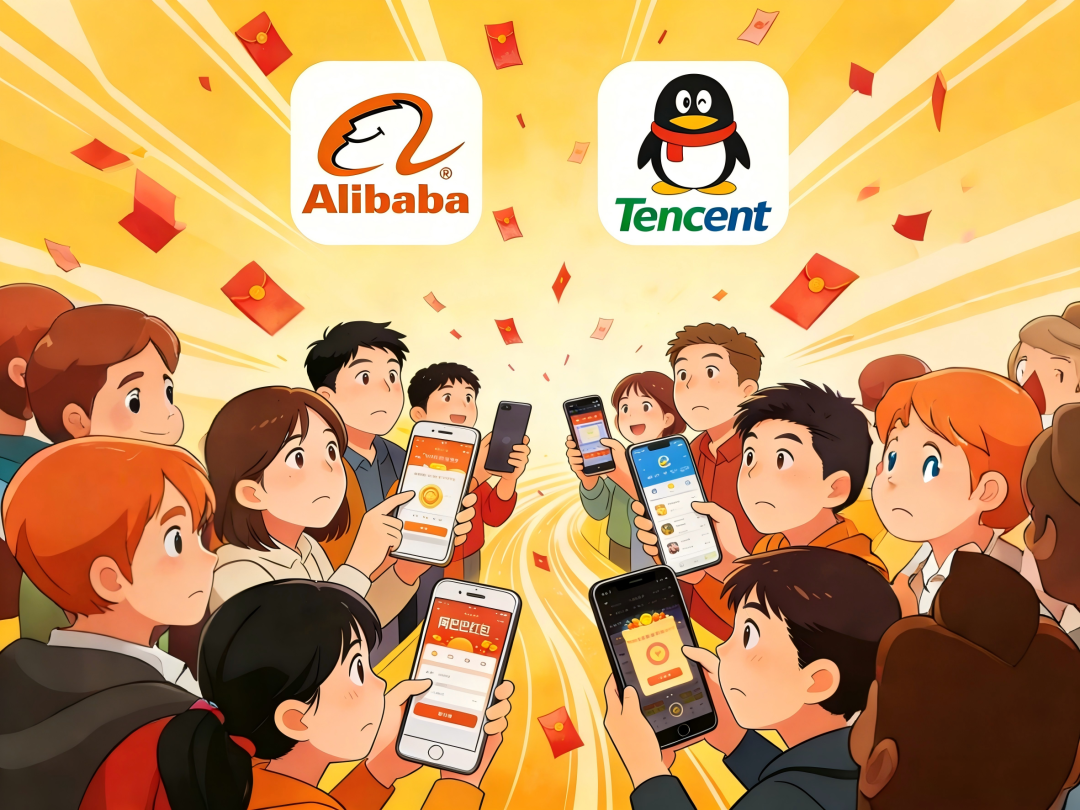
While Yuanbao was making waves with its red packet initiative, Alibaba's Qianwen unveiled its "Qianwen Treats: Split 3 Billion" event. In comparison to Yuanbao's 1 billion, Qianwen's 3 billion not only doubled the amount but also introduced various incentives such as free orders and generous rewards for inviting new users, in collaboration with platforms like Taobao Flash Sales.
While Yuanbao's approach was straightforward cash distribution, Qianwen enhanced interactive entertainment, a move interpreted by some self-media as Qianwen integrating Alibaba's diverse business ecosystems.
With these two titans locked in fierce competition, other major players could not remain indifferent.
Although Doubao, under ByteDance, did not explicitly announce a red packet campaign, its previous high-profile sponsorship of the 2026 CCTV Spring Festival Gala's exclusive AI event by Volcano Engine hinted that Doubao would also launch various interactive red packet activities.
Given ByteDance's recent prosperity and financial muscle, Doubao's cash distribution could potentially outshine both Yuanbao and Qianwen.
Thus, the "AI Three-Kingdoms Showdown" of 2026 officially took shape.
01
Fierce Rivalry Among Titans, Leaving No Stone Unturned
Red packet marketing is not a novel concept. Over a decade ago, WeChat leveraged red packet marketing to establish its dominance in mobile instant messaging.
In 2015, WeChat partnered with CCTV's Spring Festival Gala, using the "Shake" feature to distribute red packets, igniting the red packet marketing frenzy. Public data reveals that on New Year's Eve that year, WeChat users engaged in 11 billion red packet interactions, and the number of users linking their bank cards to WeChat Pay surpassed 200 million.
A decade later, as tech giants vie for a foothold in AI, the 2026 Spring Festival Gala naturally became a battleground.
The titans spared no expense in this campaign.
If Baidu's "Split 500 Million Cash" for Wenxin was merely an appetizer, then Yuanbao's subsequent "Spring Festival 1 Billion Cash Red Packet" doubled down, seizing the spotlight for the 2026 Spring Festival red packets.
But Qianwen's entry raised the stakes to "3 Billion"—double the combined total of Wenxin and Yuanbao.
Thus, the battle for 3.5 billion red packets was set.
Including the participation of smaller AI players, the total red packet amount theoretically allowed every individual in the country to receive 2 yuan.
Moreover, besides distributing cash, the titans even enlisted their top leaders into the fray.
At Tencent's annual meeting on January 26th, Pony Ma acknowledged Tencent's tardiness in AI and directly announced Yuanbao's "Spring Festival 1 Billion Cash Red Packet" campaign. Sure enough, Yuanbao kicked off the 2026 AI Spring Festival with a bang using 1 billion red packets.
Tencent's move prompted Alibaba to respond.
On the evening of February 4th, self-media reported that Alibaba founder Jack Ma visited the Qianwen Spring Festival project team at Alibaba's Hangzhou headquarters—at the onset of the AI red packet battle, Jack Ma's presence at Qianwen's office spoke volumes.
From billions in red packet investments to the personal involvement of top leaders, the scale of this AI red packet battle was unprecedented.
Beyond monetary investments and bosses' involvement, the product lineups of both sides were also fully engaged.
Tencent, besides initially leveraging WeChat, had other products like Tencent News, QQ, Games, Browsers, and Input Methods fully supporting this "group strategy" direction.
As for Qianwen, no further elaboration was needed.
From using Qianwen to place orders via Taobao Flash Sales to Quark's announcement of full integration with Qianwen, Alibaba's ecosystem connectivity efforts surpassed Yuanbao's.
A similar scenario had unfolded with Doubao earlier.
According to LatePost, Doubao received unwavering support from Douyin (TikTok) from its launch—not only promoting it through Douyin's keyword searches, livestreams, and top KOLs but also refusing almost all ad placements for competing AI products to fully back Doubao.
Almost all AI titans in this chaotic landscape share the consensus of leveraging their entire ecosystem to promote their AI products.
But can these all-out marketing efforts ensure success?
02
Anxiety: The Titans' Desperate Measures
Red packets worth 2 yuan per person and 25 yuan in free food delivery are highly enticing to most users, but not everyone is swayed.
Soon after red packet links flooded WeChat groups and personal chats, the novelty began to fade. In one group the author is part of, complaints about the abundance of red packet links started to surface.
Others echoed the sentiment, and shortly after, the group admin issued a notice banning the sharing of any AI-related red packet links.
Despite being aware of the rewards, some users forwent the "free money." One group member deemed the AI titans' red packet marketing as "tacky."
In the past, red packet marketing was seen as a lackluster innovation from brands, but it wasn't inherently novel.
However, in 2026, when AI technology is the trend, internet titans resorting to outdated red packet marketing seems counterintuitive to many.
Their reasoning was straightforward: using outdated methods to promote trendy products suggests the latter might not be truly innovative.
It was ironic.
Some also questioned Tencent's approach.
WeChat has long focused on combating Inducing Sharing (inducement to share) and excessive marketing, but many users found Yuanbao's red packets overly spammy in groups and Moments, with a strong Inducing Sharing undertone.
Yet WeChat, also a Tencent product, took no action, allowing Yuanbao's red packet links to spread freely.
Perhaps due to user backlash, Yuanbao later issued a statement claiming internal review found no violations of platform rules or inducement to share. However, users remained unconvinced.
On February 4th, WeChat officially announced that Yuanbao's red packet links violated platform rules and would be banned immediately.
While many applauded, doubts persisted—Yuanbao had already met its KPI for rapid user acquisition in the previous two days, making the ban seem ineffective. Some suspected WeChat used this as an excuse to block Qianwen's upcoming red packet links.
Outsiders couldn't verify whether WeChat's action truly required this timeline or if Yuanbao had been given a "green light" for over two days.
Even WeChat couldn't please everyone.
One group member concluded, "The AI titans are too anxious!"
03
Can Money Buy Loyalty?
The massive AI red packet campaigns had a predictable impact on user engagement and app daily active users (DAUs).
Public data shows that after Yuanbao launched its 1 billion cash red packet event on February 1st, its app topped the App Store free chart within 14 hours, with DAUs surging by 300%—a direct result of the 1 billion cash incentive.
Qianwen, after launching its event on February 6th, saw orders exceed 1 million in 3 hours, 5 million milk tea orders in 5 hours, and total orders surpass 10 million in 9 hours. The campaign also drove 28 million new users in 7 days, with DAUs peaking at 140 million, eventually surpassing Yuanbao to top the App Store free app chart.
Additionally, Qianwen's integration with Alibaba's ecosystem boosted user monthly activity by 40% compared to regular users, while Taobao Flash Sales' integration improved retention by 34%.
The impact of money was immediate but needed time to validate.
As money drove up metrics, user dissatisfaction grew.
Though the flood of red packet links had subsided, many users noticed diminishing red packet amounts—initially, nearly everyone received around 10 yuan, but over time, amounts dwindled to mere cents.
What was once "sweetheart" became "old hag."
Eagerly logging in daily, asking questions, and participating in interactions, only to receive mere cents—this disappointment led many to delete or uninstall the app.
Qianwen faced server overload issues due to the surge in data, leaving many users unable to place orders. It extended its free order offer until February 28th, but many still chose to uninstall.
Some users were more "practical": having used their first free order, they could only get another by inviting new users. Unwilling to do so and with no other free order opportunities, the app's necessity on their phones diminished, making uninstallation the logical choice.
Regarding users who joined for red packets and left after claiming them, a large model practitioner argued that current large models' intelligence doesn't heavily rely on user numbers, even suggesting that "better applications and more users don't necessarily lead to better models."
In his view, "spending heavily to buy traffic for more users" is akin to using recommendation system tactics for large models, which doesn't inherently improve AI data iteration quality.
He believed that AI-generated data quality might be more valuable than user feedback bought with money.
Discussions in multiple groups revealed many sharing this view.
A widely accepted opinion was: if AI attracts users with astronomical red packets rather than its capabilities, it fundamentally indicates that AI products and capabilities need improvement. The AI product itself should be the draw, not red packets.
This is perhaps the issue AI titans must face: Did the billions in red packets truly win new markets for AI products, or just make the reports look better?
The titans' answers are expected after the Spring Festival.
— / END / —
-
![]()
Li Bin Claims, 'Denying the Pure EV Trend is Like Ostrichism.' What's Li Xiang's Take?
-
Lenovo: Liu Jun Turns Left, Yang Yuanqing Turns Right
-
Lenovo: Liu Jun Goes Left, Yang Yuanqing Goes Right
-
![]()
MiniMax Shares Unlock: Cornerstone Shareholders Show Long-Term Optimism, Yet Stock Plummets Nearly 30% in Two Days; Zhipu Also Sees Nearly 20% Drop Today
-
![]()
Single-Day Plunge of 40%: The 'First AGI Stock' Faces More Than Just Share Price Concerns
-
![]()
Ricoh and Fuji Hike Prices on Legacy Edge; Insta360 Poised to Disrupt Mirrorless Camera Market
-
![]()
Ricoh and Fujifilm Raise Prices in Tandem, Relying on Established Reputations; Insta360 Poised to Disrupt Mirrorless Camera Market
-
![]()
Strategic Shift in Photoelectric Sensing: Maxvision Secures Controlling Stake in CAS Optotech