Manus Secures 'Full Clearance' in a Mere 9 Months
 01/04 2026
 632
632
Written by | Hao Xin
Edited by | Wu Xianzhi
The victor is not ByteDance, Tencent, or Alibaba—it's Meta.
In a remarkable feat, a startup initially dismissed as a mere 'reskin' and 'marketing gimmick' managed to close the loop on AI entrepreneurship just nine months post-product launch, with negotiations wrapped up in a mere ten days.
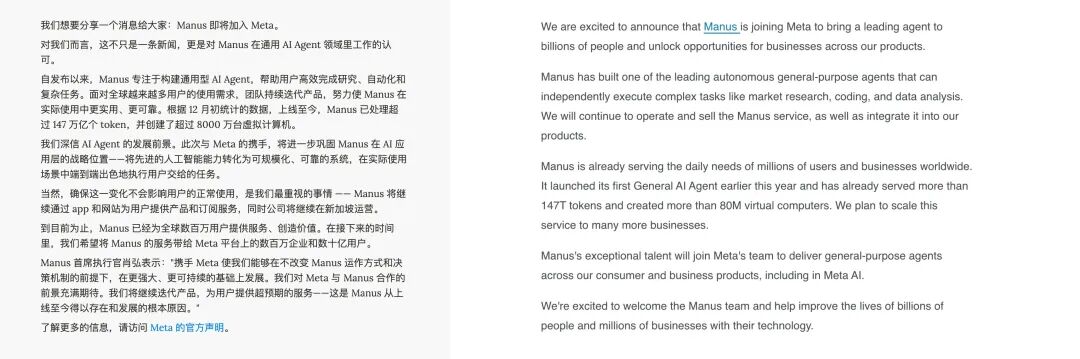
This morning, Manus officially declared on its website its integration with Meta. The announcement revealed that as of December 2025, Manus had processed an impressive 147 trillion tokens and spawned over 80 million virtual computers. Post-integration, Manus will maintain its operations in Singapore, extending its services to millions of enterprises and billions of users on Meta's vast platform.
On the flip side, Meta confirmed the news on its official site, adding details: Firstly, Manus's product services will seamlessly blend into Meta's product ecosystem, with Meta recognizing the value of Manus's enterprise service capabilities. Secondly, the acquisition encompasses 'people,' meaning the entire Manus team will join Meta.
According to additional reporting by LatePost, Meta acquired Manus's parent company, 'Butterfly Effect,' for billions of dollars, marking its second-largest acquisition after WhatsApp and Scale AI. Post-acquisition, Butterfly Effect will operate independently, with founder Xiao Hong appointed as Meta's Vice President.
Amidst a domestic focus on technical prowess, model capabilities, and application Daily Active Users (DAU), Manus stands out with its unconventional traits: product internationalization, team globalization, and synchronized market and capital structure expansion.
While declaring Manus's 'success' premature, it at least demonstrates that in the AI era, Chinese teams can craft world-class AI products, competing with Silicon Valley on equal terms.
A Blueprint for Unconventional Entrepreneurs
The entrepreneurial saga of Manus, or Butterfly Effect, traces back to 'Monica.'
CEO Xiao Hong, a serial entrepreneur, developed two WeChat ecosystem plugins before venturing into AI. These inspired his AI browsing plugin, Monica, a sidebar tool enabling direct AI interaction during web browsing, handling tasks such as webpage summarization and translation.
Monica aggregated models from leading providers, offering users access to all major models with a single subscription. This strategy proved commercially viable, becoming one of the few profitable projects outside AI PPT tools. Monica garnered approximately 3 million users in the Chrome Store, contributing around $15 million in Annual Recurring Revenue (ARR).
Monica provided Xiao Hong with leverage. In early 2024, ByteDance approached him with a $30 million acquisition offer—a substantial sum for a plugin tool. This marked Xiao Hong's first pivotal decision. Had the story concluded here, there would be no subsequent Manus or billion-dollar acquisitions.
Xiao Hong declined ByteDance's offer, opting to pursue something 'bigger.' Before Manus's inception, the team took a detour, attempting to transition from an AI browsing plugin to an AI browser. They invested seven months in an all-out effort, only to halt it completely a week before launch.
The emergence of Cursor and Computer Use prompted Xiao Hong and his team to realize: AI excels at using computers, but it should utilize its own, not yours. Moreover, ordinary users could benefit from AI coding. Combining these insights, the initial form of Manus took shape.
Reflecting on Manus's genesis, Xiao Hong drew a profound analogy, comparing two Agent development paths to 'Baidu' versus 'Hao123' models. The Chatbot/Hao123 model resembles traditional chatbots or navigation sites, where developers pre-implement and integrate specific functions (links) as 'supply-side' providers. Users are confined to capabilities already provided by developers, limiting scalability and fostering homogenization.
The Agent/Baidu model prioritizes building a robust, general-purpose platform (like a search engine capable of crawling and understanding everything). Its versatility attracts a vast user base attempting diverse tasks. By analyzing high-frequency, high-value queries, the platform optimizes and refines 'preset capabilities,' enabling instant completion of common tasks. This strategic choice led Manus to bet on general-purpose Agents from the outset.
The rest is familiar history. In early March 2025, Manus launched prematurely, crashing immediately, with invitation codes in high demand and accusations of 'malicious marketing.'
Unexpectedly, Manus achieved 'black-red' fame. Simultaneously, two flywheels began spinning: rapid product iteration and commercialization, and a complete pivot away from the domestic market, embracing internationalization in product, organization, and capital.
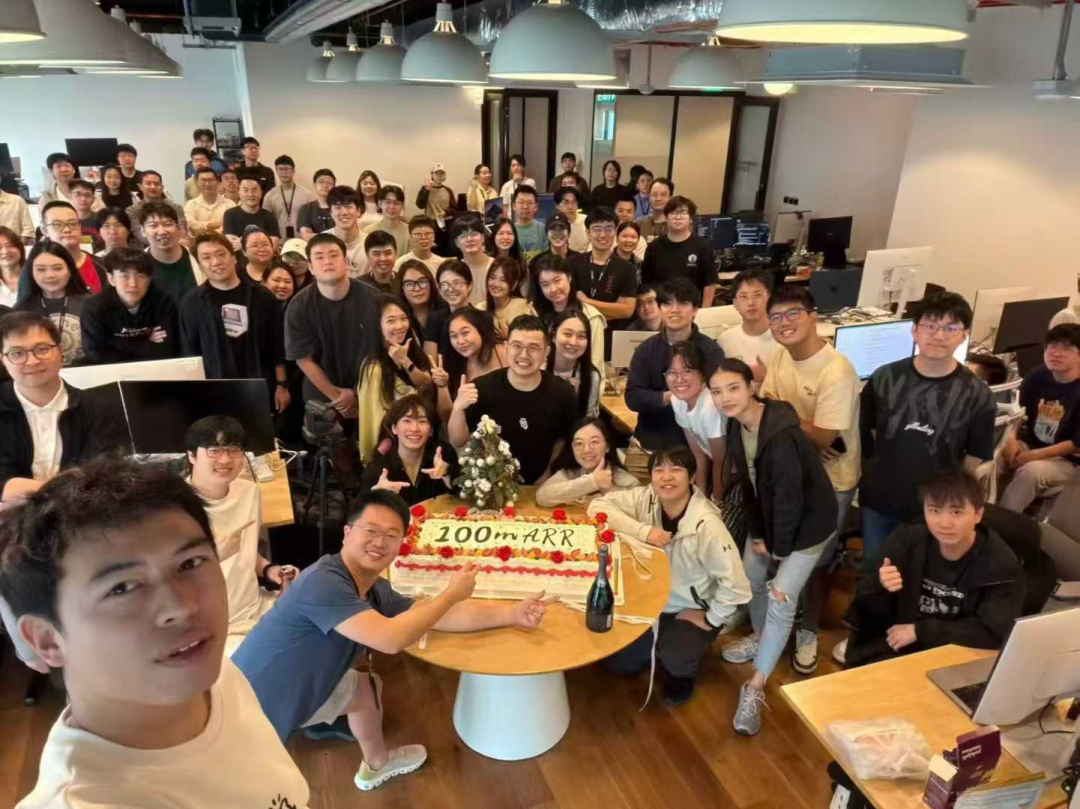
In May, Manus opened to all users, registering over 1 million users on its first day. From October onward, Manus entered a high-frequency iteration phase, releasing nine updates. By mid-December, Manus announced its ARR had surpassed $100 million.
Manus's decision to focus overseas stemmed from multiple considerations. Primarily, its user base—from Monica to Manus—consisted mainly of overseas paying customers. International policies and regulations also subjected Chinese-backed teams to stricter scrutiny abroad.
Thus, during the Agent window, Manus swiftly downsized its domestic team, relocated its headquarters to Singapore, and underwent a 'rebirth' in terms of organization and capital structure.
The team that once rejected ByteDance's offer now stands on the global stage. Compared to $30 million, the current billion-dollar valuation represents at least a 30-fold increase.
Thus concludes the story of an unconventional Chinese entrepreneurial team.
Mutual Gains for Meta and Manus
What does Meta's billion-dollar acquisition of Manus signify?
Domestically, it positions Manus competitively among AI application companies. For reference, MiniMax, with comprehensive model and technology coverage, is valued at approximately $4 billion. Zhipu AI, balancing open-source and closed-source models while focusing on B2B services, is valued near $4 billion. In contrast, Manus secured over a quarter of MiniMax's valuation without proprietary model technology and with only an eight-month-old product.
In Silicon Valley, however, this deal is far from 'extravagant.' Previously, Zuckerberg acquired a 49% stake in 'Scale AI' for $14.3 billion. Many view Scale AI as merely a data annotation company. Considering Manus's global user base and $100 million ARR, the billion-dollar price tag is moderate. While acquisition details remain undisclosed, this figure enables investors and institutions to exit smoothly, ensuring Manus's safe landing.
The collaboration between Meta and Manus stems from mutual needs.

Meta, desperate for solutions, saw its Llama open-source strategy falter. After pivoting to closed-source, Meta's models lagged significantly behind OpenAI and Google. Recently exposed for training models on open-source QianWen data, Meta began investing heavily to assemble a super-intelligent lab.
Zuckerberg envisions Meta AI as an Agent platform for hundreds of millions. Lacking early technical advancements like OpenAI and Google, Meta's short-term strategy to realize this vision through acquisitions seems logical. Meta values Manus's products, clientele, and potential integration into its platform. Additionally, Manus's profitability offers extra revenue.
Manus's product lead argues, 'The Agent competition isn't about models but entire systems.' Even OpenAI must compete with Agent startups, learning to build peripheral environments and toolkits.
Manus's accumulated capabilities, if refined within Meta's larger user base and complex demands, could unlock new potentials. For Meta, this represents an opportunity to overtake rivals in the Agent race, a critical battle for the Agent era.
Xiao Hong recalls burning $500,000 daily at Manus's peak shortly after its March launch. At this rate, bankruptcy loomed within 20 days.
Even now, Manus faces this issue. Token invocation costs remain far from affordable. Most AI application companies still pay large models and cloud providers, creating a negative network effect: more users lead to greater losses. Acquired by Meta, Manus gains long-term financial security, enabling exploration of intelligent boundaries.
Many entrepreneurs congratulate Manus, yearning for a similar outcome. Amid uncertainty, a safe landing trumps world-changing dreams. The founder achieves fame and fortune, rewards the team, and secures funds for future ventures—a happy ending indeed.
Next time, an entrepreneur might tell investors, 'If we fail, we can always sell to Meta.'
Who Reaps the Greatest Rewards?
Behind Manus stands a notable name—ZhenFund.
Prior to Meta's acquisition, Butterfly Effect completed four funding rounds. From its February 2023 seed round to the April 2025 Series B, ZhenFund participated in every round, heavily backing Xiao Hong and Butterfly Effect. Based on the seed round alone, ZhenFund achieved over a 200-fold return in two years.
ZhenFund selected Xiao Hong early on and supported him for a decade. The firm played a pivotal role, introducing Manus's current Chief Scientist, Ji Yichao, and Product Strategy Lead, Zhang Tao, who joined alongside Xiao Hong to form Manus's core team.
After Manus gained traction in March, investors hailed it as a 'success story.' AI application investors faced inevitable questions: 'Why did you miss Manus?'
ZhenFund's Managing Partner, Liu Yuan, finally gained recognition through this bet, delivering a standout 'project.'
But the significance extends further. Manus challenges domestic entrepreneurship and investment models. Traditional approaches, like Zhipu AI and MiniMax, rely on successive funding rounds to reach Initial Public Offering (IPO). Without exceptions like the Sci-Tech Innovation Board (STAR Market) and HKEX, many might fail before going public.
Manus's unconventional approach: secure angel and seed funding, launch products promptly, and enter validation. If the business model and cash flow prove viable, proceed; otherwise, pivot. Repeat until a stable product and business model emerge, attracting acquisition by tech giants and enabling investor exits.
Manus's journey offers hope to fellow entrepreneurs. One founder remarked, 'My WeChat blew up this morning with Manus acquisition news. Grateful to be recognized, it motivates us to work harder. In the General AI Agent space, acquisition is a favorable outcome.'
In this context, investors grow bolder, as trial-and-error costs diminish and validation cycles shorten. Consequently, entrepreneurial teams face higher standards, with valuations based on tangible metrics like revenue and barriers to entry, rather than speculative indicators.
This logic grounds entrepreneurship and investment in reality, forcing a reevaluation of the AI application market. Companies creating genuine user value and healthy cash flows hold ultimate pricing power.
This marks a new beginning. When healthy mergers and acquisitions become predictable exits, more resources will flow into original innovation and product refinement, rather than redundant internal competition and valuation games.
AI-era entrepreneurs have taken their seats at the table. Will the next generation of investors follow?
-
![]()
July "MIIT Auto Show" Unveils Major News: BYD Shark Pickup Makes Debut, Xiaomi Pengcheng Releases Official Images
-
![]()
Who is the Imaging King Among 26-Year-Olds? A Head-to-Head Comparison of MiOV's Top Three Ultra Flagships: The Results Will Astound You
-
Hot Topic | Photonics-Based Technology Teams Up with Dongfang Tiansuan to Engineer Optical Computing for Space Applications
-
![]()
Li Bin Claims, 'Denying the Pure EV Trend is Like Ostrichism.' What's Li Xiang's Take?
-
Lenovo: Liu Jun Turns Left, Yang Yuanqing Turns Right
-
Lenovo: Liu Jun Goes Left, Yang Yuanqing Goes Right
-
![]()
MiniMax Shares Unlock: Cornerstone Shareholders Show Long-Term Optimism, Yet Stock Plummets Nearly 30% in Two Days; Zhipu Also Sees Nearly 20% Drop Today
-
![]()
Single-Day Plunge of 40%: The 'First AGI Stock' Faces More Than Just Share Price Concerns