Cybercab Rolls Off the Line: Is Tesla's Robotaxi a Bubble or the Next Trillion-Dollar Story?
 04/03 2026
 458
458
Author | Dexin
Editor | Wang Bo
On February 18, Tesla announced on X that the first production Cybercab had officially rolled off the line at Giga Texas. As the announcement coincided with the second day of the Chinese Lunar New Year, and Tesla did not launch a large-scale promotional campaign, the news generated little buzz in China.
However, when viewed in the context of Tesla's product and technological evolution over the past few years, this marks a critical milestone: the vehicle without a steering wheel, pedals, and designed almost entirely for Robotaxi operations has finally transitioned from concept to production.
Previously, Elon Musk had announced on multiple occasions that mass production of the Cybercab would begin in April.
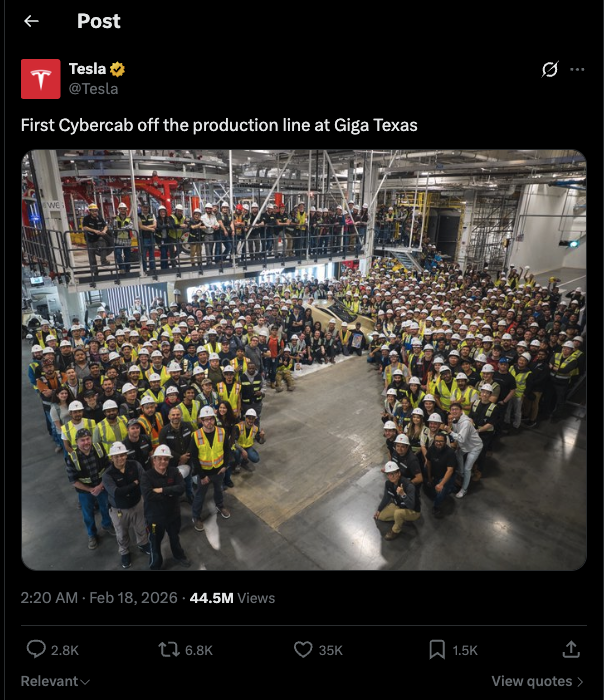
Currently, Tesla's Robotaxi fleet testing primarily relies on the Model Y, with validation taking place in regions such as Austin, Texas, and the Bay Area, California. According to Tesla's previously announced timeline, its Robotaxi fleet will continue to expand to more cities in the first half of the year. The Cybercab represents a key piece of the puzzle for achieving true scalability in this system.
Even Musk admits that initial production ramp-up will be extremely challenging, but it represents Tesla's most crucial bet on the next phase of autonomous driving commercialization.
Looking at Musk's business empire, his rocket company SpaceX is set to go public this year. SpaceX has already merged with xAI, with the combined company valued at $1.25 trillion. In January, Tesla disclosed a $2 billion investment in xAI. Over the next three years, rockets, AI large models, and Robotaxi will serve as the core growth engines of Musk's business empire; extending the timeline further, the Optimus robotics business will also play a role.
In the automotive industry, Tesla is the first company to so clearly advance along this path: starting with L2 driver-assistance systems, adopting a vision-centric, lidar-free technical approach, and moving toward L4 Robotaxi capabilities.
In terms of product form, the Cybercab joins the Waymo Zeekr RT and Cruise Origin as one of the few models specifically designed for native Robotaxi operations. The difference is that Tesla is an automaker with large-scale production capabilities, while also controlling the entire chain from algorithms and vehicles to operational networks.
Musk has even envisioned a future where vehicle owners can connect their cars to the Tesla network when not in use, allowing the vehicles to "earn money on their own." If this model proves viable, it could fundamentally transform the automotive business logic.
Before the Cybercab enters full-scale mass production, let's revisit the most fundamental questions: How was this vehicle designed, and how was it manufactured?
I. A Groundbreaking 'Three-Nones' Vehicle Model
Due to the rapid advancement of AI, the Cybercab's debut at the "We, Robot" event in October 2024 already seems like a distant memory.
The event lasted just over half an hour. Tesla prepared about 20 prototypes for brief guest experiences and announced that the Cybercab would enter mass production in 2026. While the event garnered significant attention, few likely believed afterward that Musk's "overly aggressive" vision could progress to mass production in less than two years.
From the outset, the Cybercab was not a product built on traditional automotive logic. It has no steering wheel, no pedals, and no traditional side mirrors—a true "three-nones" vehicle model that eliminates all human-driving fallback options, placing full trust in machine perception, onboard computation, and end-to-end neural networks.
From a design language perspective, the Cybercab continues Tesla's increasingly vivid (should be "distinct") minimalist and futuristic aesthetic of recent years.
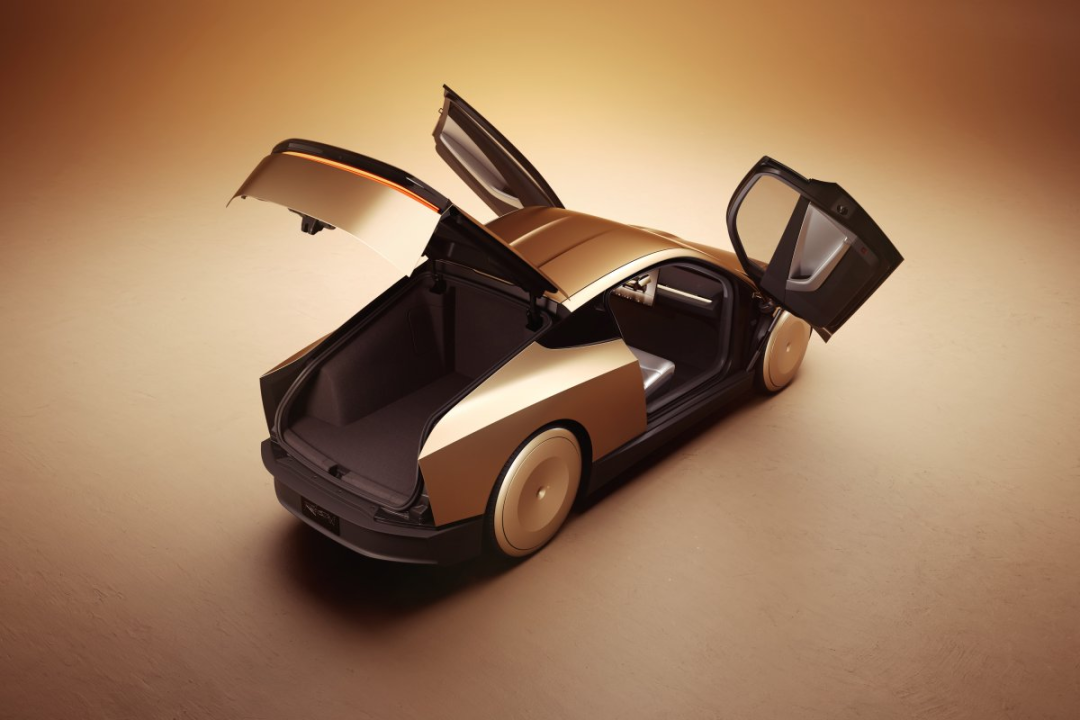
The vehicle's silhouette features sharp, angular surfaces reminiscent of the Cybertruck, but it is lower, more compact, and lighter—resembling an "urban shuttle tool."
Most publicly visible Cybercabs currently sport a striking bright gold exterior. This color offers high visibility. The bright gold finish is not achieved through traditional painting or the stainless steel used on the Cybertruck but through a new process called Paint-Infused Plastic. Simply put, the body panels are made of polyurethane plastic, with color "injected" directly during the molding process. The benefits are clear: a lighter body, simpler manufacturing, and lower costs.
If the exterior represents stylistic "aggression," the cabin design nearly redefines what a "vehicle" is.
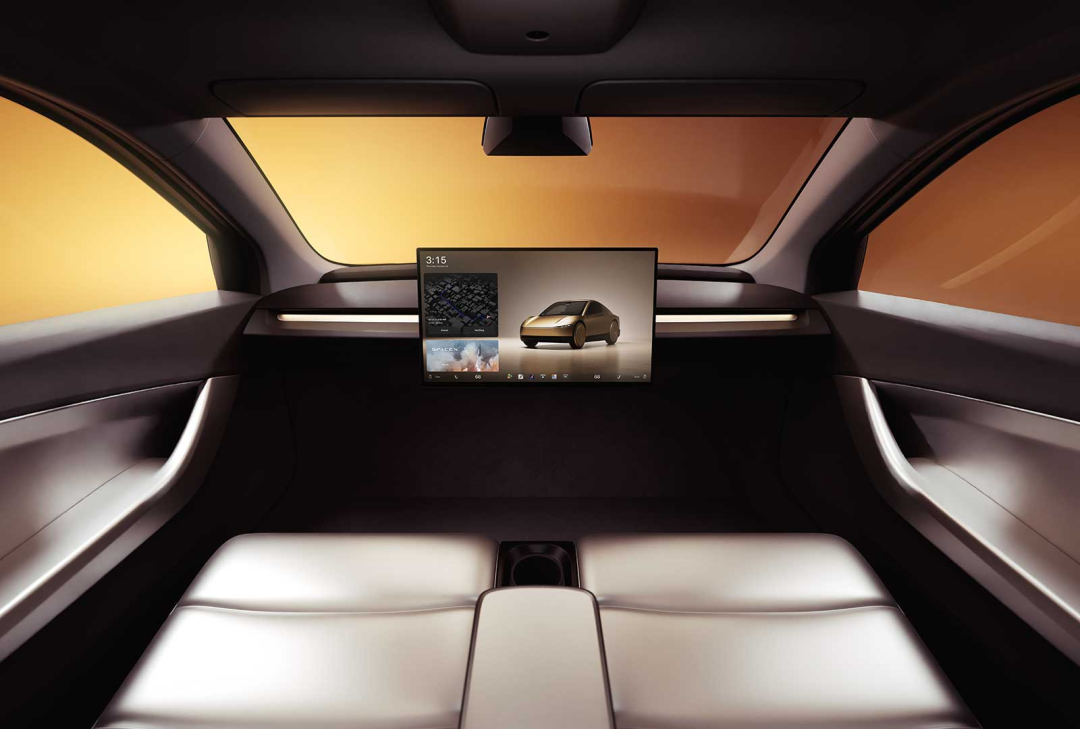
The Cybercab retains only two front seats, with no rear seats.
This means that, at least in this generation, the vehicle does not emphasize multi-person transport. Instead, it functions as a mobility terminal centered around dual-occupant travel, short-distance shuttles, and experiential use. It is not a general-purpose vehicle designed to meet all needs but a highly targeted Robotaxi product.
The doors feature electrically powered upward-opening butterfly doors, a highly distinctive design that also serves a practical purpose in operations. Waymo, for example, faced a specific issue after order volumes increased: some passengers failed to close the doors properly when exiting, preventing the vehicle from accepting new rides and even causing traffic disruptions when parked roadside (should be "on the roadside").
While Robotaxi may seem like a high-tech product, operational efficiency often hinges on minute engineering details.
The most prominent feature inside the cabin is a 20.5-inch touchscreen located centrally in the front row. This serves as the primary interface for user-vehicle interaction. With the steering wheel and pedals gone, the relationship between passengers and the vehicle begins to resemble that of a user and a smart device.
Beyond this, the Cybercab features almost no extraneous design elements. Tesla's explanation for its minimalist interior is to allow passengers to relax fully or focus on their own activities.
From a specifications standpoint, the Cybercab does not follow the well-worn path of "high-performance electric vehicles" and endless competition. Compared to consumer-focused models emphasizing handling and acceleration, it prioritizes efficiency and cost.
Public information indicates that it uses a single-motor rear-wheel-drive setup, with moderately aggressive power output; the battery pack is relatively small (35–60 kWh), with the primary goal of achieving high-frequency urban operations at lower energy consumption.
II. Tesla's Robotaxi Triad: AI, Engineering, and Manufacturing
If the Cybercab is a "reinvented" vehicle, its realization is not the result of Musk's sudden stroke of genius but the parallel advancement of three internal pillars at Tesla: AI software, vehicle engineering, and production manufacturing.
First is AI. Within Tesla, the core figure driving this effort is Ashok Elluswamy, Vice President of AI Software.
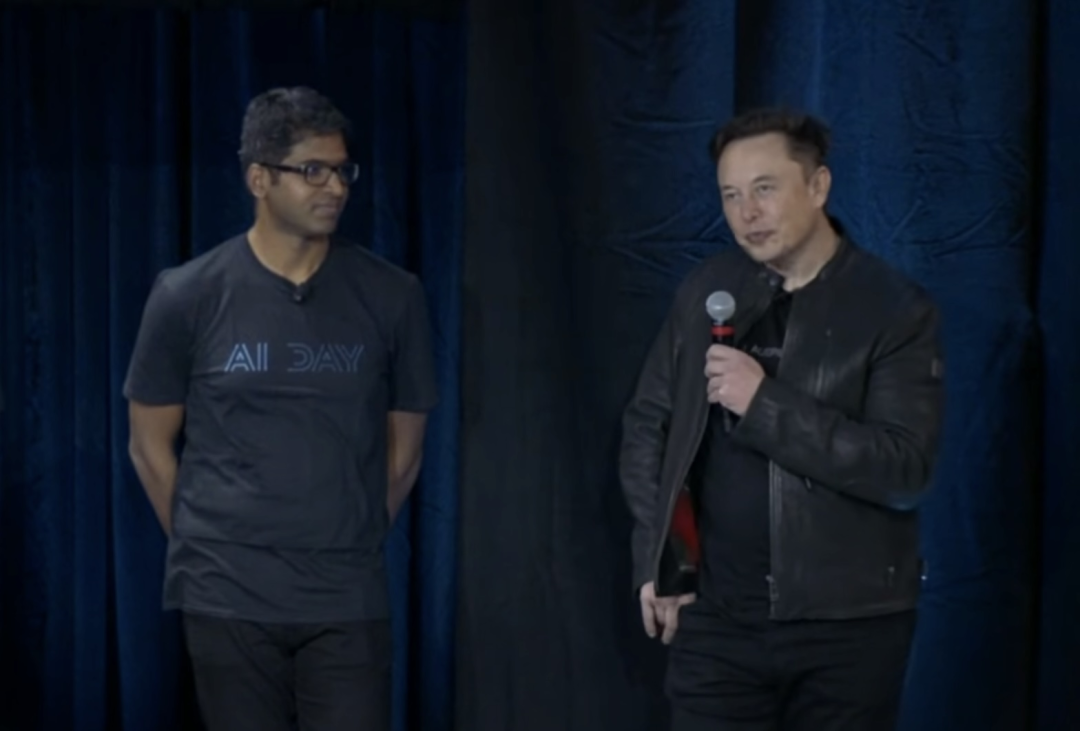
An early member of the Autopilot team, he now oversees a broader range of AI software work, including FSD, Robotaxi, Optimus, and the development of foundational models. In a sense, his team controls the "brain" of the Cybercab.
Why insist on a pure vision-based approach? At an academic conference in January, Ashok made a clear argument: "By 2026, autonomous driving will no longer be a sensor problem but an AI problem. Cameras already provide sufficient information; the key lies in extracting the needed information from the images."
Consumer vehicles use FSD (Supervised), while Robotaxi employs a more aggressive unsupervised variant. However, with FSD V14, Tesla changed the onboard UI label from "Full Self-Driving (Supervised)" to simply "Self-Driving." Chinese media and automakers who experienced FSD in the U.S. this year likely noticed this change.
Musk mentioned this month that v14.3 is currently in testing. This version will significantly increase model scale and introduce a more powerful reasoning architecture. Ashok and his team emphasize that v14.3 will further integrate the AI paths of FSD and Robotaxi, bringing the system closer to a "real-world intelligent agent."
For Robotaxi to become a scalable business, advanced autonomous driving technology alone is insufficient. It must also be built on affordable per-unit costs and an efficient manufacturing system.
This brings us to the second pillar: engineering.
In Walter Isaacson's *Elon Musk*, a pivotal debate during the Cybercab's conception is recounted: Musk initially insisted that Tesla's next platform should serve only Robotaxi, eliminating steering wheels and pedals entirely (no wonder the Model S and Model X were discontinued).
However, Chief Designer Franz von Holzhausen and Vehicle Engineering Lead Lars Moravy ultimately convinced him that the new platform could support two entirely different product forms—a pure Robotaxi and a low-cost model targeting the broader market.
The significance of this debate lies in revealing that the Cybercab is not merely the result of Musk's personal vision but a collaborative effort between design, engineering, and AI to find a realistic path for an extremely aggressive goal.
Franz oversees design language and overall product form, while Lars handles vehicle engineering, chassis structure, and manufacturing feasibility. The Cybercab's highly minimalist form did not arise from a sudden designer's inspiration but from an engineering architecture that made this new product logic possible.
Finally, manufacturing brings us to Tesla's "Unboxed Process," a concept frequently mentioned in recent years.
While Tesla already employs modular technologies like gigacasting, the Unboxed Process takes production a step further—essentially breaking the vehicle into several large modules, building them in parallel, and then assembling them at the end. For example, the vehicle is divided into a front module, rear module, chassis/battery module, and exterior body panels, with these modules produced concurrently at different stations rather than waiting in a single long assembly line.
Tesla's approach aims to build vehicles faster and at lower cost, but implementation is highly challenging. The new system demands extreme synchronization of module timing, requiring precise alignment during final assembly to avoid bottlenecks.
During last year's Q1 earnings call, Lars stated, "Unboxed is the basis for our Cybercab manufacturing process." This is precisely what enables the Cybercab to achieve low manufacturing costs and high automation levels. He also mentioned that the team had spent the past year validating precise assembly of large subassemblies, aluminum structure corrosion resistance, seam sealing, and early crash testing.
Musk's expectations for Cybercab production are clear: an extremely painful and slow initial phase, followed by rapid scaling along an S-curve, ultimately achieving insanely fast speeds and super high volumes.
III. Tesla vs. Waymo: A Clash of Two Approaches
Tesla and Waymo represent two entirely different solutions for Robotaxi.
By the end of 2025, Waymo's weekly paid rides exceeded 450,000, with order volumes in San Francisco surpassing Lyft last year and ranking second only to Uber. Waymo aims to double this figure to 1 million weekly rides by the end of 2026.
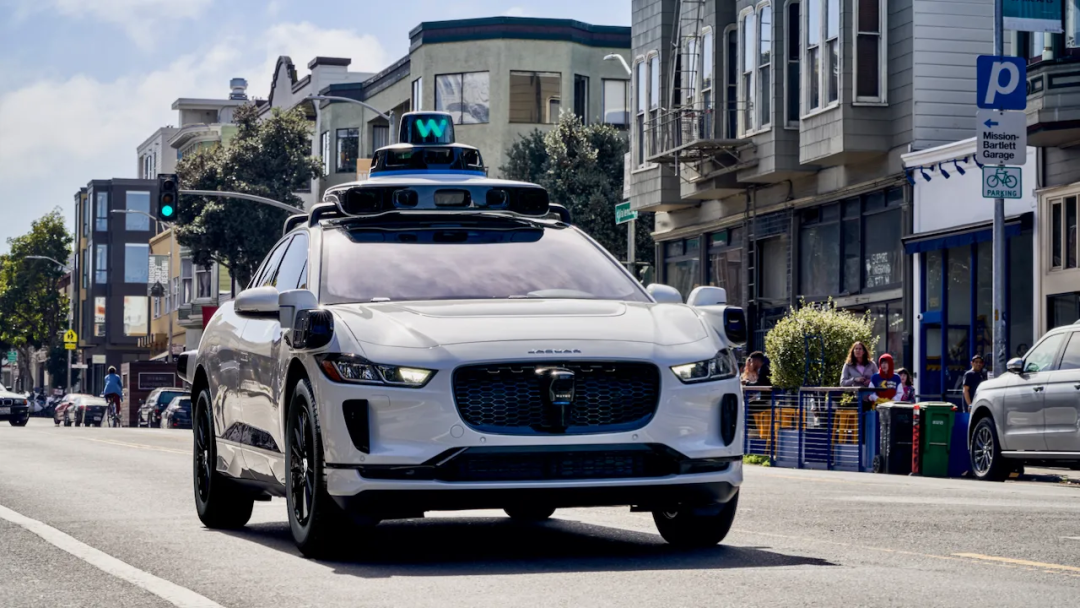
Last year, Ashok directly compared Tesla and Waymo on Indian blogger Gobinath's podcast.
He stated that technically, Waymo is already in operation, and Tesla may lag by about two years. However, he believes Tesla's approach aligns more closely with the essence of "human driving" (relying on vision + brain). Once Tesla crosses a certain threshold, its cost advantages will enable exponential expansion, while Waymo will remain constrained by high costs. Indeed, Waymo's 2026 expansion target is only a doubling.
Tesla's current operations in San Francisco and Austin are far from perfect. Most publicly accessible Tesla Robotaxi rides still include safety drivers. While the Cybercab is designed without a steering wheel and uses wireless charging, some test vehicles spotted recently still feature wired charging ports and temporary steering wheels for testing and debugging.
Videos from some bloggers have also captured "glitchy" moments, such as brief hesitations, sudden braking, or the need for human intervention.
The Cybercab's form factor itself indicates that Tesla is still transitioning from "technology validation" to "business model validation." While its design is already a product thoroughly defined for driverless mobility, it must still overcome technical, engineering, manufacturing, and regulatory hurdles before achieving stable, large-scale operations.
Ultimately, the Cybercab's significance lies not in its lack of a steering wheel or its futuristic appearance. Its true radicalism is that Tesla is attempting, for the first time, to integrate "autonomous driving + low-cost manufacturing + platform-based operations" into a single vehicle.
Over the past decade, many companies have proven that Robotaxis can operate; in the coming years, Tesla aims to demonstrate that Robotaxis can not only operate but also be mass-produced and replicated in the manner of the automotive industry.
If this succeeds, the ultimate competition in the automotive industry may no longer be about who is better at selling cars, but who is better at building "cars that can earn money on their own."
-
![]()
Model Giant Jieyue Xingchen Steps into Smartphone Arena: A Strategic Alliance with Huaqin Technology
-
![]()
Big Model Firm Dives into Phone Market: StepFun and Wingtech Forge a ‘Dynamic Duo’
-
![]()
Zhongrun Optics Makes a Bold Move with 1 Billion Yuan Investment: Is a Turning Point on the Horizon for the Precision Optics Industry?
-
![]()
Deploy CLBO Crystals and YIG Single Crystals! Erythritol Leader Invests 30 Million in Youwei Optoelectronics
-
CXMT’s July 16 Subscription: Leading Domestic Memory Manufacturer—What’s the Earning Potential per Lot?
-
![]()
Rhythm Discrepancy and Premium Value Erosion: Foreign Luxury Brands Must Re-evaluate Their China Strategy
-
![]()
Half-Year, 1 Billion Yuan Financing, 7 Billion Yuan Valuation: A New Dark Horse Emerges in the Embodied AI Sector
-
![]()
Strong Rebound for Tech Stocks in Hong Kong Stock Market: Is It Time to Bottom-Fish?