Is Tesla Set to Launch Supervised FSD in China?
 05/21 2026
 544
544
Has Tesla Officially Announced the Introduction of Supervised FSD to the Chinese Market for the First Time?
On May 21, Jiemian News reported that Tesla officially unveiled its latest deployment plan for Supervised FSD, explicitly stating that the system is now available for use in China. This marks Tesla's first official announcement regarding the availability of FSD in the Chinese market, transitioning the speculation around its entry into China from mere rumors to an official confirmation. However, Tesla has not yet disclosed a specific timeline for the rollout, and the exact timing for when users will be able to fully experience this functionality remains subject to subsequent regulatory approvals.
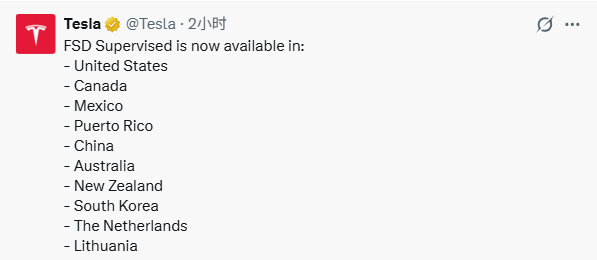
Image Source: Internet
Previously, multiple media outlets reported that Tesla China had recently posted several job openings related to intelligent driving testing, fueling industry speculation about an accelerated launch of FSD in the Chinese market. Some media outlets, acting as consumers, inquired with Tesla's official customer service and received the following response: "The 64,000 RMB intelligent assisted driving functionality is not compatible with all vehicles; some are only compatible with the 32,000 RMB enhanced assisted driving functionality. The company is actively advancing the approval process in accordance with relevant national regulations and will roll out the functionality to domestic customers as soon as approvals are obtained."
This response reveals two key pieces of information. Firstly, there is a hardware compatibility threshold for FSD functionality, meaning that not all Tesla owners can enjoy the complete FSD features by purchasing the 64,000 RMB version. Secondly, regulatory approval remains the biggest current uncertainty, with Tesla actively pushing forward related work.
Jiucheng Urgently Recruits Intelligent Driving Testers: Is FSD Localization Accelerating?
Since May, Tesla China has been making frequent recruitment moves. On May 18, Tesla China simultaneously launched a large-scale recruitment drive for intelligent driving positions on its official recruitment platform, covering nine cities: Beijing, Shanghai, Shenzhen, Guangzhou, Suzhou, Wuhan, Chengdu, Tianjin, and Chongqing. The drive includes approximately 90 core R&D positions for autonomous driving, with intelligent driving test positions accounting for over 70% and marked as urgent hires.
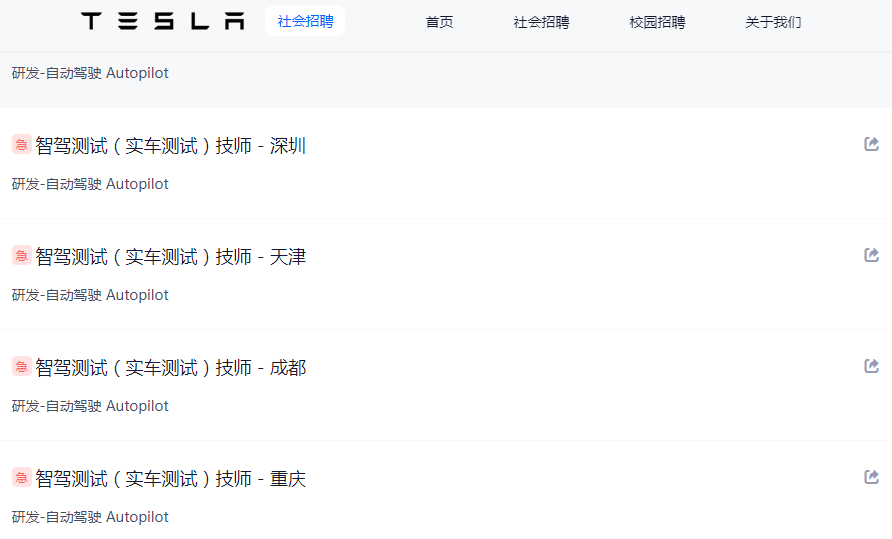
Image Source: Tesla Official Website
The open positions include intelligent driving test (real-vehicle testing) technicians, intelligent driving test engineers, and intelligent driving site test specialists, all under the Autopilot R&D department. Job responsibilities involve real-vehicle testing, regulatory tracking, cross-team collaboration, etc. Explicitly included in the job responsibilities is tracking changes in Chinese certification and regulatory requirements, seen as an important signal of Tesla accelerating the localization adaptation of its intelligent driving solutions. In terms of job requirements, applicants must hold a valid driver's license with over three years of driving experience, an annual mileage exceeding 10,000 kilometers, no major accidents or violation records in the past year, and those with command-line operation experience or a racing background will be given priority.
Multiple market analysts believe that Tesla's large-scale synchronous recruitment of testers in nine cities and the setting of strict driving experience thresholds indicate that it is making a final push for localization verification in China's complex road conditions and massive data collection.
Approval Timeline Adjusted Multiple Times: Is Q3 a Critical Milestone?
The timeline for FSD's entry into China has undergone multiple adjustments. As early as November 2025, Tesla CEO Elon Musk revealed at a shareholder meeting that FSD had only received partial approval in China and predicted full approval around February or March 2026. However, this expectation was not met on schedule.
In February 2025, Tesla launched a functionally limited version of FSD in China, offering only basic urban road assisted driving functionality, with a significant gap compared to the full overseas version. The experience was suspended after just one week. Subsequently, the timeline for FSD's full launch in China was repeatedly postponed.
On April 23, 2026, Tesla's CFO explicitly stated during the Q1 earnings call that FSD functionality had not yet received full approval from Chinese regulators and that the company was in close communication with regulators. The latest timeline adjustment targets full approval in Q3 2026, marking the second official postponement of the time window.
Notably, in April 2026, the FSD V12.4.3 version passed filing with China's Ministry of Industry and Information Technology but has not yet been rolled out to users as of now. This indicates that technical-level reviews are progressing, but final market access still requires broader regulatory approvals.
Localization Challenges Cannot Be Ignored: Data, Hardware, and Scenario Adaptation
FSD's entry into China faces not only approval processes but also deeper technical and compliance challenges. Tesla Vice President Tao Lin previously stated that Tesla's assisted driving data does not need to leave the country and will strictly comply with China's data compliance requirements. Currently, Tesla has established a local AI training center in China and deployed localized training capabilities. However, Chinese regulations require localized storage and processing of intelligent driving training data, preventing Tesla from reusing its global 7.5 billion miles of data and forcing it to retrain models based solely on data collected in China, limiting model iteration speed.
Meanwhile, Tesla's FSD V14.3 version has completed road condition adaptation in China and has been rolled out for internal testing to employee vehicles equipped with HW4.0 hardware (Related Reading: Tesla FSD V14.3: Letting AI Drive Directly?). Tesla China updated its owner's manual to the 2026.14 version in early May 2026, fully incorporating functionality descriptions of FSD V14 for the first time, further improving its intelligent driving support information for the Chinese market.
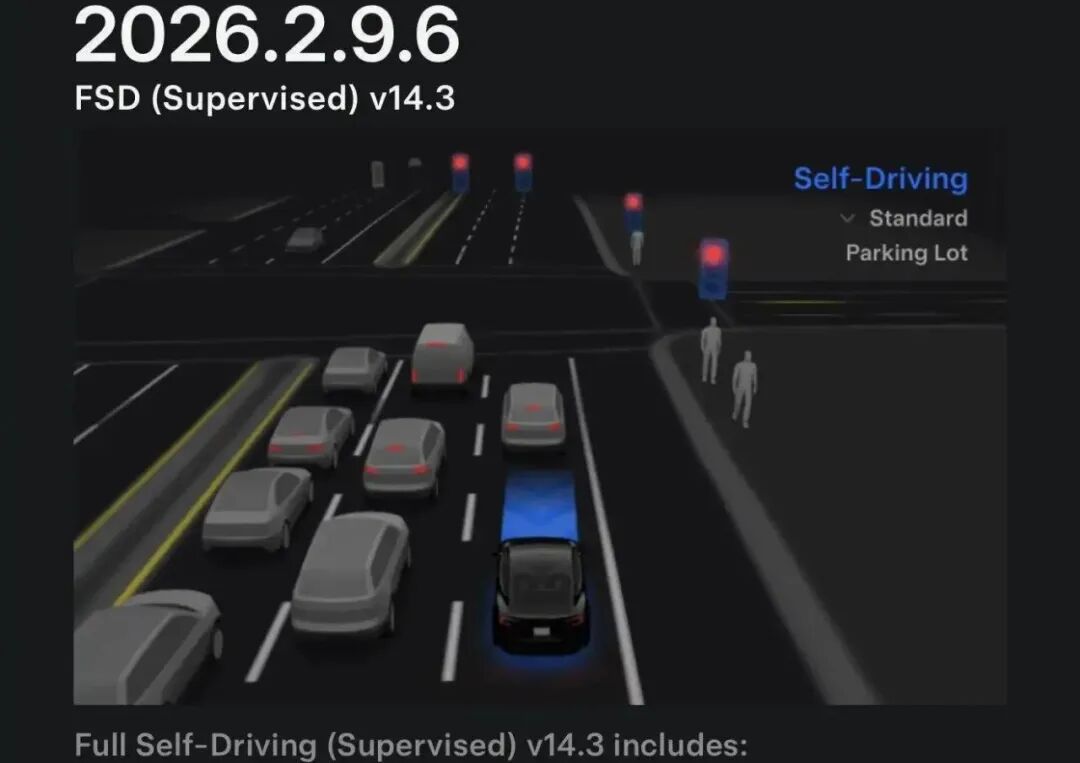
Image Source: Internet
However, the hardware generational gap poses another practical challenge. Musk has publicly admitted that the HW3.0 hardware's memory bandwidth is only one-eighth of HW4's, unable to support the full version of FSD and only capable of delivering 10% to 20% of its capabilities. This means that older Tesla vehicles produced between 2019 and 2023 may not be able to use the full version of FSD even after approval, only able to access the functionally limited V14 Lite version.
In terms of localized scenario adaptation, the pure vision solution still has significant room for optimization in complex Chinese scenarios such as unprotected left turns, mixed traffic with non-motorized vehicles, and reversible lanes. Meanwhile, domestic intelligent driving solutions like Huawei ADS 3.0 and XPENG XNGP have already made deep inroads in urban NOA, providing mature alternative solutions and intensifying market competition.
Global Expansion Accelerates: FSD Launched in Multiple Countries, Key Breakthrough in Europe
While actively pursuing approvals in China, Tesla's global footprint for FSD continues to expand. As of March 2026, Supervised FSD has officially launched in markets including the United States, Canada, Mexico, Australia, New Zealand, and South Korea.
In Europe, Tesla has also made milestone progress. In April 2026, the Netherlands Vehicle Authority officially granted whole-vehicle type certification for FSD Supervised, the first official compliance approval in the EU, with subsequent approvals expected in core countries like Germany and France. Tesla has now listed the Netherlands alongside mature markets like the United States, Canada, Australia, and South Korea on its FSD regional service page. In May 2026, Ireland also initiated consultations with Tesla, marking the latest progress in Europe's FSD expansion. Tesla revealed plans to deploy FSD on a large scale in the EU as early as summer 2026.
In the Asia-Pacific region, FSD has achieved commercialization in South Korea, Australia, and New Zealand. Tesla China's official Weibo account also stated on April 23 that it is working to launch intelligent assisted driving in the Chinese market as soon as possible.
Conclusion
From intensive recruitment of intelligent driving testers to the official announcement of Supervised FSD's availability in China, and customer service confirmation of approval progress, signals of Tesla's FSD entry into China continue to strengthen. Q3 2026 is seen as a critical time window, but the complexity of approval processes, tiered hardware compatibility restrictions, and fierce competition from local manufacturers mean that Tesla still faces significant challenges in truly launching FSD in the Chinese market.
For Chinese consumers, the reminder that the 64,000 RMB intelligent assisted driving functionality is not compatible with all vehicles warrants careful evaluation by potential buyers. While FSD is within reach, its ability to deliver satisfactory performance on China's complex roads remains to be tested by the market.
-- END --
-
![]()
Doubao Work Unveiled! Domestic AI Leaders Fully Commit to the 'Work' Sector
-
![]()
Who’s Sounding the Alarm on ‘Rushed Vehicles’?
-
![]()
Over 5.3 Billion Yuan in Losses Over Three and a Half Years! Can Yonyou Reverse Its Fortunes Through Streamlining and AI Transformation?
-
![]()
Baidu AI Adopts Free Model: A Strategic Maneuver in Traffic and Monetization
-
![]()
Silicon-Based OLED Pioneer Unveils Financial Results: H1 Shipments Outpace Entire 2025 Volume
-
![]()
AI's First "Lost Summer"
-
![]()
Zeiss Makes Another €2.2 Million Bet: Will Eye Tracking Be the Next Big Thing in the Smart Glasses Industry?
-
![]()
RUNTO Ranking | Global Top TV ODM Factories' Shipment Figures for July 2026