OpenClaw Ecosystem Endgame: From 'Big Players Dominate' to 'Tropical Rainforest'
 04/09 2026
 658
658
Produced by | He Xi
Layout by | Ye Yuan
OpenClaw continues to surge in popularity.
OpenClaw, an open-source AI Agent project initially developed by an independent Austrian developer, topped GitHub's global trending list within two months, surpassing Linux and React. By late March, it had amassed over 300,000 stars. From Tencent offering free 'Lobster' installations at its Shenzhen headquarters to Baidu and 360 promoting their solutions in Beijing, and Huawei and Xiaomi integrating similar capabilities into smartphones and vehicles, a 'Hundred Shrimp War' has erupted across the industry chain.
At this fever pitch, the Agent ecosystem revolution ignited by OpenClaw stands at a critical juncture: Will the Agent era culminate in a closed platform dominated by a few big players, or a 'diverse and symbiotic' distributed ecosystem? This article constructs a three-dimensional competitive framework (Token Banking, Skill Stores, Industry Depth) to analyze big tech firms' capabilities and economic rationality in vertical industry Skills, projecting the most likely endgame structure for the Agent ecosystem.
01
Three-Dimensional Competition in the Agent Ecosystem: Where Are the Big Players' Boundaries?
To answer this, we must first understand what OpenClaw has changed.
Jensen Huang, at GTC 2026, drew a striking analogy: 'OpenClaw is to AI what Windows is to personal computers.' Unlike traditional AI assistants limited to 'conversational Q&A,' OpenClaw's modular architecture—gateway + agent brain + skills + memory—enables a complete execution loop: 'task understanding—tool invocation—code execution—result retrieval.' After receiving natural language instructions, it autonomously breaks down tasks, searches online, invokes local software, self-corrects, and delivers tangible results. China Post Securities explicitly states that OpenClaw represents a paradigm shift from 'conversational tools' to 'digital employees.'
This transformation marks AI's evolution from 'answering questions' to 'completing tasks.' AI Agents are upgrading from Chatbot-style 'consultants' to 'digital employees' capable of hands-on work—a shift as significant as the command-line-to-GUI revolution.
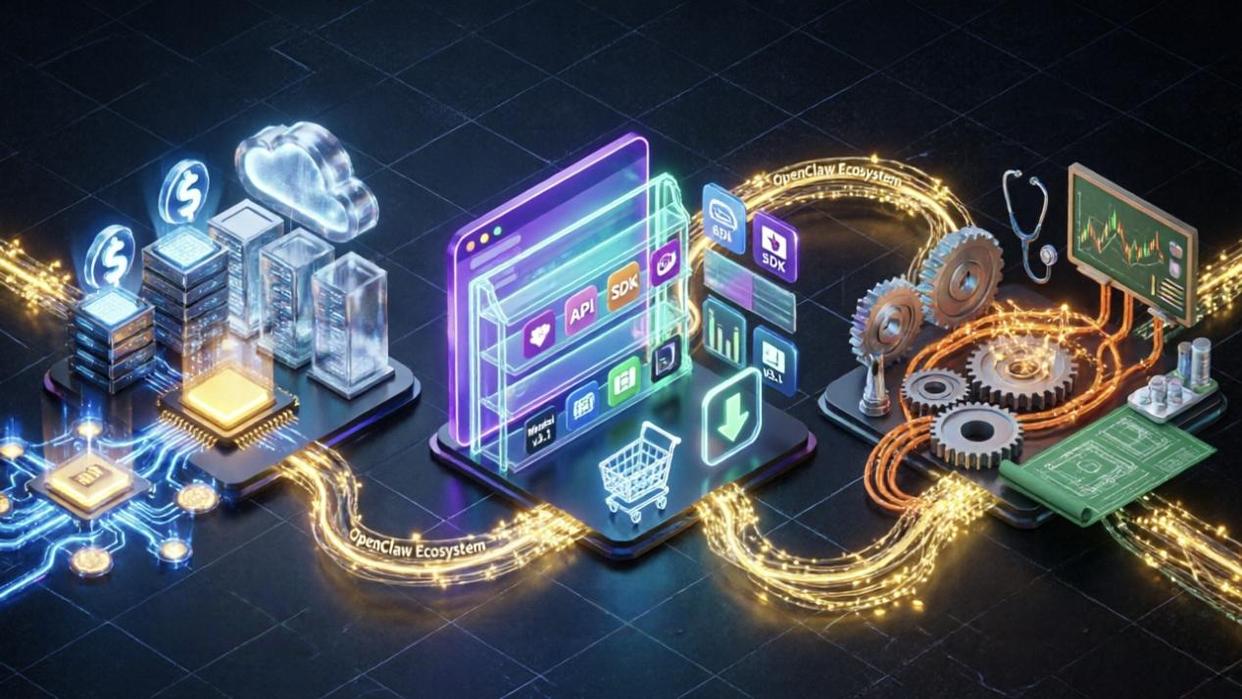
However, understanding the Agent era's competitive landscape requires looking beyond compute power. True competition revolves around three core dimensions: Token Banking (compute and model infrastructure), Skill Stores (ecosystem platforms), and Industry Depth (scenario understanding and Skill engineering).
Token Banking is the battleground big tech knows best. A single OpenClaw deep research task involves perception, planning, execution, and reflection cycles, consuming hundreds of thousands to millions of Tokens—10x to 100x more than ordinary conversational scenarios. IDC predicts that by 2030, global annual Token consumption will skyrocket from 0.0005 Peta Tokens in 2025 to 152,000 Peta Tokens, a 300 million-fold increase. In this dimension, Baidu's full-stack 'chip-framework-model-application' closed loop (closed loop), Alibaba Cloud's deep IaaS accumulation, and Huawei's Ascend domestic compute alternatives are key players.
Skill Stores are the domain of internet platforms. Tencent leverages WeChat and Enterprise WeChat's super-apps to enable 'AI task execution within chats' at the lowest touchpoint cost. ByteDance's Kouzi platform emphasizes 'tradable skills,' attempting to build a developer-driven ecosystem. Alibaba targets enterprise markets with its 'Wukong' platform. As of mid-March, over 20 major internet firms have officially entered the fray, with more than 25 related products launched.
Industry Depth, often overlooked yet potentially the strongest moat, is where the real differentiation lies. While general-purpose Skills cover 80% of scenarios, the remaining 20%—industry-specific edge cases, compliance details, and exception handling—often determine user willingness to pay. Here, the advantage lies not with big tech but with industry ISVs, consultancies, savvy entrepreneurs, and even in-house enterprise teams. Their ability to codify implicit industry knowledge into structured, executable formats cannot be replicated by capital alone in the short term. Wei Liang, Vice President of the China Academy of Information and Communications Technology, also notes that significant room remains for improvement in vertical scenario deep cultivation (deep cultivation).
Can big tech, with their resources, compensate for industry depth over time? The author's verdict: No. Not due to capability, but economic rationality.
Big tech firms face an 'impossible trinity' in any vertical industry: deep customization, economies of scale, and rapid iteration. Deep customization requires onsite research, co-creation with clients, and sustained service—inherently conflicting with big tech's pursuit of 'standardization, replicability, and scalability.' Niche industries have limited client bases, preventing full utilization of scale effects, while big tech's high labor costs become a disadvantage. Rapid policy and client demand changes further slow big tech's response times compared to agile small teams.
Consider a hypothetical case: A big tech firm develops a 'medical record quality control Skill.' It would need a team including a product manager versed in medical workflows, engineers to integrate multiple hospital HIS systems, and salespeople to pitch to top-tier hospitals. Annual labor costs could reach millions. With only a few hundred top-tier hospitals nationwide, charging clients tens of thousands per year would be deemed expensive, while charging a few thousand wouldn't cover costs. This isn't a technical issue—it's a mathematical one. Big tech isn't incapable; it's not worth it. Deploying an elite engineering team for a vertical Skill generating tens of millions in annual revenue pales in comparison to optimizing infrastructure for billions in Token sales.
Even if big tech leadership remains patient, mid-level and frontline incentive structures naturally divert resources to high-return, short-cycle projects. Guosen Securities notes that with OpenClaw's rapid rise in China, lightweight application servers (2C2G, 2C4G) have become mainstream, prioritizing the utilization of low-spec CPU instances, basic storage, and bandwidth—yielding far higher marginal returns than heavy industry investments. Meanwhile, big tech engineers prefer developing 'world-changing' general technologies over refining workflows for niche industries.
History offers parallels: Salesforce and SAP didn't eliminate vertical ISVs but coexisted through ecosystems; cloud vendors didn't monopolize all industry solutions but relied on partner networks for long-tail coverage. This historical inertia will likely persist in the Agent era. Big tech can participate, but it's not worth over-investing. Capital can buy technology but not a decade of industry patience and trust.
02
Endgame Projection: From Platform Centralization to Application Decentralization
Having explored big tech's boundaries, let's envision the Agent ecosystem's future.
Based on the analysis, the endgame may feature a three-tier structure of 'platform centralization + application decentralization.'
The foundational infrastructure layer will be centralized: cloud infrastructure, large model APIs, and general Agent frameworks. This capital-intensive, high-barrier, scale-driven domain will be dominated by a few giants like Baidu, Alibaba, Tencent, and Huawei. However, open standards will prevent single-player monopolies. Around OpenClaw, domestic big tech has adopted four differentiated strategies: Tencent focuses on entry points, ByteDance on scenarios, Alibaba on developers, and Baidu on infrastructure. No single dimension guarantees victory, and no firm can dominate all.
The mid-tier general industry Skill layer will be semi-centralized: standardized solutions for finance, healthcare, retail, etc. Big tech may enter some sectors, while leading ISVs dominate others. This layer requires industry knowledge + productization capabilities, leading to higher concentration but still competitive. In e-commerce, Alibaba's Tongyi Qianwen, paired with Taobao and Tmall's B-end scenarios, holds natural advantages. Tencent's SkillHub covers high-frequency office collaboration and development tools with its 'Top 50' selections. Baidu's Search Skill has exceeded 45,000 downloads on ClawHub, ranking first globally.
The long-tail vertical Skill layer will be highly fragmented: niche scenarios, customization, and localized services. This is the core domain for small ISVs, startups, individual developers, and in-house teams. With dispersed clients, diverse demands, and relationship-driven sales, big tech's fixed cost structures are unsustainable. The industry expects a new wave of AI Skill developers specializing in verticals to emerge—small in scale but high in margins, client loyalty, and big tech resistance.
Over the next 2–3 years, key variables will shape the endgame: adoption of open protocols like MCP, big tech's Skill Store strategies, and the cost inflection point for enterprise self-built Skills.
MCP (Model Context Protocol), introduced by Anthropic in 2024, is becoming the universal language for AI models to connect external tools and data sources, supported by OpenAI, Microsoft, Google, and Amazon. MCP's 2026 roadmap focuses on transmission evolution, scalability, agent communication, governance maturity, and enterprise readiness. The open-source community—especially OpenClaw itself—will play a pivotal role in providing neutral infrastructure and standard checks. While big tech has incentives to build closed ecosystems, open-source forces will counterbalance this trend.
The most likely endgame is an 'open standards + multi-store' ecosystem: open protocols become industry standards, multiple Skill Stores coexist, ISVs distribute across platforms, and power is highly decentralized. Scenario A (Giant Monopoly, 20% probability): Big tech forms de facto standards via closed protocols + developer subsidies but faces antitrust risks. Scenario B (Open-Source Symbiosis, 50% probability): MCP becomes standard, multiple Skill Stores coexist, and ISVs distribute freely. Scenario C (Regional/Industry Fragmentation, 30% probability): Independent ecosystems emerge by industry/region, akin to HarmonyOS vs. Android. Scenario B is most probable due to the open-source community's decentralized DNA and developers' preference for openness.
03
Strategic Implications of the Agent Endgame Projection
With the Agent ecosystem's three-tier structure and endgame scenarios outlined, a pragmatic question arises: How should big tech, ISVs, enterprise users, and investors navigate this transformation?
For big tech, the greatest danger isn't competitors—it's the greed to 'do everything.'
The core battleground should be compute costs, model efficiency, and developer ecosystems. Empower ISVs through open platforms and revenue-sharing mechanisms, shifting from 'selling Skills' to 'collecting platform taxes.' Using capital to crush vertical players is economically irrational. Building a strong foundation, setting fair revenue shares, and serving developers well outperforms building a hundred Skills in-house.
For industry ISVs and entrepreneurs, fear not the big tech. Vertical competition logic has shifted—it's no longer 'who has more compute' but 'who understands the industry's pain points better.' Dive deep into niches, excel in depth and client relationships, and big tech may become your channel or partner. Developers are evolving from 'coders' to 'capability architects,' with expertise gaining digital asset value. A medical informatics startup with dozens of employees can achieve far higher margins than big tech's industry solutions divisions—due to lighter cost structures, shorter decision chains, and deeper client trust.
For enterprise users, collaborate with vertical ISVs for custom private Skills in core scenarios and purchase big tech services for general needs. Simultaneously, build internal Skill engineering capabilities to codify proprietary process knowledge into private Skill assets, rather than relying solely on generic platforms. Enterprise CTOs/CIOs need a procurement framework considering data sensitivity, scenario specificity, team capabilities, and budget scale. Avoid putting all eggs in one basket—multi-platform adaptability is strategic redundancy.
For investors, beyond 'infrastructure' plays like compute chips, large models, and cloud platforms, focus on vertical 'Skill Developers.' These firms may be small but boast high margins, strong client loyalty, and big tech resistance—representing the most resilient assets of the Agent era. China is becoming one of the fastest-growing markets for OpenClaw adoption, accelerated by active developer communities and supportive policies.
Returning to the original question: Will the Agent era be dominated by big tech?
The author's verdict: No. Not due to lack of capability, but economic impracticality. Vertical industry know-how is a 'slow wall'—capital can scale it but not flatten it.
OpenClaw's open-source DNA—300,000+ GitHub stars, surpassing Linux and React—ensures decentralized ecosystem power. Currently, Baidu, Tencent, Alibaba, and ByteDance each hold advantages, but no single dimension guarantees victory. Big tech provides the foundation, industry players deliver depth, and enterprises hold the core—mutually dependent and interconnected.
Big tech are the towering trees, monopolizing sunlight and compute at the canopy; ISVs are the shrubs and vines, thriving in the gaps, rooting deep into industry soil; countless startups and small teams are the forest floor flora, each occupying irreplaceable niches. Tropical rainforest prosperity stems not from one dominant species but from every layer playing an indispensable role.
Decentralized power is the prerequisite for ecosystem flourishing.
-
![]()
Model Giant Jieyue Xingchen Steps into Smartphone Arena: A Strategic Alliance with Huaqin Technology
-
![]()
Big Model Firm Dives into Phone Market: StepFun and Wingtech Forge a ‘Dynamic Duo’
-
![]()
Zhongrun Optics Makes a Bold Move with 1 Billion Yuan Investment: Is a Turning Point on the Horizon for the Precision Optics Industry?
-
![]()
Deploy CLBO Crystals and YIG Single Crystals! Erythritol Leader Invests 30 Million in Youwei Optoelectronics
-
CXMT’s July 16 Subscription: Leading Domestic Memory Manufacturer—What’s the Earning Potential per Lot?
-
![]()
Rhythm Discrepancy and Premium Value Erosion: Foreign Luxury Brands Must Re-evaluate Their China Strategy
-
![]()
Half-Year, 1 Billion Yuan Financing, 7 Billion Yuan Valuation: A New Dark Horse Emerges in the Embodied AI Sector
-
![]()
Strong Rebound for Tech Stocks in Hong Kong Stock Market: Is It Time to Bottom-Fish?