Application of Agentic AI in Cancer Research and Oncology
 05/22 2026
 450
450
-01-
Introduction
Cancer research and oncology are highly complex scientific fields with significant societal impact and a strong demand for human expertise. In cancer research, human creativity is essential to formulate new hypotheses and ideas to understand the molecular and cellular processes of cancer and ultimately attempt to influence these processes to treat or cure the disease.
The daily work of cancer researchers involves mastering numerous complex, multi-step workflows. Some of these involve physical activities in the laboratory, but many do not require interaction with the physical environment. A significant portion of what cancer researchers do is intellectual, requiring interaction only with computer software. Tasks such as consulting scientific literature, reading scientific news articles, reviewing experimental data, or performing bioinformatics analyses on digital data fall into this category. Some tasks even extend to designing molecular structures, which are subsequently evaluated through computational methods. Similarly, the clinical practice of oncology involves processes carried out by trained human experts: reading and understanding clinical trial results, conducting interdisciplinary tumor board discussions, matching treatment guidelines to individual patient characteristics, identifying suitable clinical trials, and conveying complex information to patients—all are intellectual or communicative tasks.
What if we could use computer programs to perform many of the singular tasks done by cancer researchers and oncologists? Agentic AI does precisely that. Agentic AI represents (semi)autonomous systems capable of perceiving, learning, and acting upon their environment, thus performing cognitive tasks that previously required human expertise. Particularly, the new paradigm based on large language models (LLMs), where LLMs serve as the core reasoning engine. In non-medical domains, LLM-based agentic AI with diverse toolsets is already disrupting multiple industries. Software engineering, travel booking, customer support, and many other tasks can now be partially or fully automated by agentic AI. Recently, agentic AI has also become a focal point of discussion in the healthcare and biomedical research communities. The commercial sector has begun investing massively in agent-based R&D tools for research pipelines. This includes drug research, which provides fertile ground for agentic AI applications. Within the research sphere, AI systems can continuously scan thousands of new research publications, identify emerging cross-study patterns that human researchers might overlook, design computational experiments to test new hypotheses, generate potential molecular structures for novel therapies, and provide comprehensive patient data analyses to determine optimal treatment approaches—all operating continuously based on a single high-level prompt from humans.
Meanwhile, hospital systems are increasingly seeking to use agentic AI to automatically assist with complex tasks, such as optimizing diagnostic processes in oncology. Such systems could prepare comprehensive patient briefings before appointments, suggest personalized treatment plans based on the latest evidence and genetic markers, identify suitable clinical trials from global databases, and even draft patient communication materials tailored to individual health literacy levels—ideally allowing oncologists to focus on the humanistic aspects of care and complex decision-making. As of 2025, these capabilities are no longer "science fiction," as the technological foundation already exists, and proof-of-concept studies demonstrating their successful implementation have been published.
-02-
I. From Large Language Models to Agentic AI
The Rise of Large Language Models
The emergence of powerful agentic AI has been enabled by the development of LLMs. Since the late 2010s, natural language processing (NLP) algorithms have seen tremendous advancements. Driven by the invention of the Transformer architecture, coupled with large-scale expansions in model architectures, training datasets, and training hardware, LLMs have become the state-of-the-art for any NLP task (i.e., any task involving language understanding or creation). From 2020 onward, LLMs took the world by storm. The generative pre-trained Transformer-3 (GPT-3), released by OpenAI in 2020, first demonstrated unexpected emergent behaviors in its capabilities, displaying remarkable originality. Subsequent LLMs, such as GPT-3.5 underlying ChatGPT, further expanded these capabilities. Multiple commercial and non-commercial entities have since contributed to this ecosystem: Anthropic's Claude models, Meta's Llama series, Google's Gemini and Gemma, Mistral AI's models, and China's DeepSeek with its DeepSeek v3 have all made substantive contributions. These models have achieved increasingly human-like abilities on complex benchmark tasks, including competitive programming.
Reasoning Models
A particularly relevant advancement that has improved LLMs is the development of "reasoning models" in 2024 and 2025. The first prominent example was OpenAI's model o1, introduced in late 2024. Another notable advancement was the emergence of DeepSeek R1, which became the first open-source reasoning model with capabilities comparable to proprietary alternatives. The field rapidly expanded with more reasoning models from major AI labs, including Google's specialized Gemini reasoning variants (such as Gemini 2.0 Flash Thinking), xAI's Grok 3, and Anthropic's Claude 3.7 models. These models can methodically tackle multi-step physical problems, with some showcasing their internal reasoning to users, making each computation visible and explaining the rationale guiding their responses.
However, the computational resources and time required for these reasoning processes mean they are often unsuitable for many everyday tasks, such as simple factual queries or direct text generation. This has led to the emergence of "hybrid" approaches, where AI platforms dynamically decide whether to use a standard model for immediate responses or a reasoning model for complex problems. In clinical applications, such a hybrid system might instantly provide standard drug dosage information but activate reasoning capabilities when analyzing complex patient cases with multiple comorbidities and drug interactions.
Another interesting development is the rise of latent reasoning models, where the reasoning process occurs entirely within the model's internal representations rather than generating explicit step-by-step tokens. These models may offer the best of both worlds: the thoroughness of reasoning with the efficiency and conciseness of direct answers. This approach effectively integrates the reasoning paradigm into the model's fundamental architecture itself, representing a shift in how AI systems approach problem-solving—from pattern matching to something closer to deliberate thinking.
Agentic AI and Multi-Agent Systems
Despite their impressive capabilities, current LLMs face a fundamental limitation: they cannot natively interact with their environment. In contrast, agentic AI represents LLMs equipped with the ability to access external information sources and interface with software systems. Many real-world problem-solving tasks require up-to-date information or dynamic interactions beyond the model's static training data. For example, an AI system assisting in cancer treatment planning must be able to retrieve the latest clinical trial results and updated treatment guidelines—resources that may have been published only after the model's training cutoff date. Moreover, effective decision-making often relies on the ability to take actions through external tools. In a business context, this might mean not just connecting to an airline booking system to identify the best fares but also completing the reservation. In healthcare, this shift could involve moving from merely suggesting laboratory tests for a patient to actually placing the order within an electronic health record (EHR) system. Similarly, a model recommending clinical trials could go further by automatically checking a patient's eligibility and initiating the trial enrollment process.
Agents are surprisingly easy to implement. At their most basic level, they are combinations of LLMs and tools linked together in simple scripts. The LLM at an agent's core does not strictly require any specialized training. LLMs can be used out-of-the-box, as they already possess reasoning capabilities. By simply providing appropriate prompts and informing them of the available tools, LLMs can effectively use these tools. To improve upon this, LLMs can also be specifically trained to use tools, thereby performing better in agent workflows. Today, many general-purpose LLMs are also trained in agentic tool use.
Agentic AI can be interconnected to form "multi-agent systems." One LLM feeding its output into another LLM instance represents the simplest implementation of such a system. One of the earliest LLM-based multi-agent systems was BabyAGI, a viral GitHub repository that emerged in 2023 with a minimalist implementation. Recently, multi-agent systems have been conceptualized as multiple LLMs working in concert. In such systems, each LLM can potentially serve different functions or represent (or role-play) specific perspectives. For example, in a cancer research context, one agent might assume the role of a molecular biologist, another a clinical oncologist, and a third a biostatistician. Each agent brings its specialized perspective to the problem, and they can debate and refine approaches much like a human collaborative research team. In a clinical context, multi-agent systems could be conceptualized for complex tasks, such as simulating a tumor board. However, it remains unclear whether performing complex tasks strictly requires multi-agent systems or whether all their functionalities could be embodied in a single LLM-based agent.
-03-
II. Applications of Agentic AI in Cancer Research
Recent research on agentic AI has demonstrated proof-of-concept for their use in biomedical research. These studies show that automating cascades of complex tasks that traditionally required human expertise is feasible. While previous generations of AI systems were limited to isolated tasks, such as classification and prediction, biomedical agentic AI can integrate multiple steps, such as literature review, data analysis, and experimental design. Applications of agentic AI are particularly advanced in biomedical data science, where human researchers typically use computational tools to interrogate datasets. This human interaction with computational tools can be performed by agents alone or together with humans. However, agentification of research workflows extends far beyond data analysis, as seen in recently implemented chat-based models for gene expression data exploration, and encompasses a broad range of human research activities.
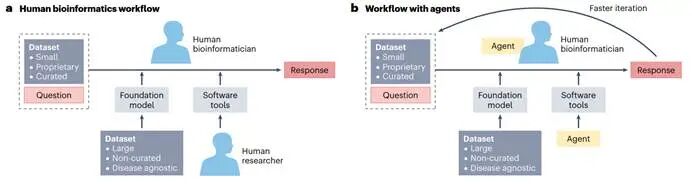
The first step in any research project is ideation. This task has traditionally been far beyond the capabilities of AI tools, but the LLMs embedded in agentic AI make it potentially addressable. Frameworks such as ResearchAgent and BioDiscoveryAgent represent LLM-based systems that can autonomously generate new research questions and potential hypotheses by synthesizing knowledge from scientific literature and datasets once prompted by a user—without step-by-step human guidance. In principle, such systems could be deployed with greater autonomy, continuously monitoring new publications and proactively identifying gaps in existing research without waiting for human prompts. Once a research idea is formed, experiments must be designed effectively. LLM-based agents like BioDiscoveryAgent, mentioned above, aim to assist in planning complex biological experiments based on generated hypotheses. Other agents, such as Coscientist, exemplify how AI can autonomously plan and execute computational experiments, including drug design processes relevant to oncology.
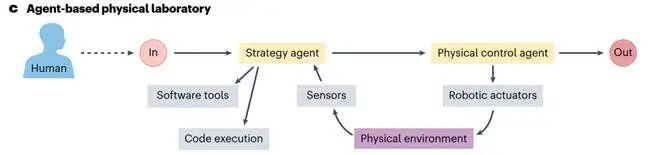
By integrating these ideation and execution capabilities, agentic AI can automate entire research workflows. To date, multiple proof-of-concept studies have demonstrated that (semi)autonomous research agent systems are achievable: for instance, Agent Laboratory aims to automate the general research process from literature analysis to publication. Similarly, the Virtual Laboratory concept proposes a framework where an AI-driven "principal investigator" coordinates a collaborative team of specialized agentic AIs, each embodying different areas of expertise, such as chemistry, biology, or computational science, working together as a multi-agent team. This system was applied to use cases and demonstrated the successful design and validation of novel nanobody therapies targeting emerging severe acute respiratory syndrome coronavirus 2 variants. Ultimately, these developments herald the emergence of fully autonomous "AI scientists" capable of independently managing the entire research lifecycle—including hypothesis generation, experimental design and execution, data analysis, and manuscript writing.
Even the initial frameworks are evolving rapidly, and notably, the commercially developed system AI Scientist-v2 recently produced a fully AI-generated manuscript that successfully passed peer review and was presented at a scientific symposium. In the future, such autonomous AI systems may fundamentally change how we conduct research. Now that this technology is feasible, new questions arise: How do we optimize scientific discovery in a world where agents can perform some repetitive tasks? What is the role of human traits like curiosity, creativity, or perseverance? Despite impressive advancements in AI research agents, evidence is still needed to demonstrate that they can produce truly novel research outputs without relying at least on creative sparks from human minds.
-04-
III. Applications of Agentic AI in Oncology
Parallel to research applications, a natural extension of agentic AI lies in the clinical practice of oncology, where decision-making frequently relies on synthesizing data from multiple sources. A prominent example is multidisciplinary tumor boards, where teams of human experts collaborate to determine the best treatment plan for cancer patients and provide this recommendation to the patient. In principle, such workflows could be well-handled by LLM-based agentic AI. Although as of 2025, no agentic AI system has yet been formally integrated into routine oncology practice, several rigorously validated proof-of-concept studies have been published, and interest in this area is rapidly growing in both academic and commercial circles.
Tools for Clinical Agents
A key concern for applying any modern AI technology in clinical settings is the risk of hallucinations—i.e., fabricated or erroneous outputs by the AI system. While hallucinations in modern AI systems are becoming increasingly rare in well-defined and validated tasks, they remain highly problematic in certain domains. One such problematic area is numerical and arithmetic reasoning, which is critical in cancer research and oncology. Even simple clinical tasks, such as comparing pre- and post-treatment tumor sizes or calculating dosages, require high accuracy and reliability, areas where LLMs can sometimes err.
Studies have shown that LLM performance on such tasks can be significantly improved by equipping them with external computational tools, such as the ability to write and execute code, or integrating specialized calculators like OpenMedCalc. By definition, agentic AI represents a reasoning system capable of accessing tools—thus, an LLM system equipped with a calculator represents a basic agentic system with clear utility.
Another recent study introduced RiskAgent, a system specifically designed to perform medical risk prediction across more than 387 risk scenarios, covering a variety of conditions including cardiovascular diseases and cancers. Rather than relying on extensive fine-tuning that demands significant computational resources, RiskAgent leverages its reasoning capabilities to access hundreds of existing clinical decision tools and evidence-based risk calculators when assessing medical risks. Beyond calculators, a range of additional tools can further enhance agent performance. These include access to medical guidelines and evidence repositories, radiological image processing models, and structured clinical databases. Consequently, the overall utility of clinical agentic AI depends partly on the breadth and quality of accessible tools—a factor of particular importance in oncology.
Clinical Reasoning Agents
Several research groups have developed fully integrated platforms that combine reasoning capabilities, such as chain-of-thought reasoning, with tool use to support complex clinical decision-making. One such system is TxAgent, designed to provide individualized recommendations for cancer therapy through multi-step reasoning and real-time access to biomedical knowledge. It accesses tools from a collection referred to as the Tool Universe, enabling it to synthesize data across molecular, pharmacokinetic, and clinical levels, considering drug interactions, contraindications, and patient-specific variables such as age, genetic markers, and comorbidities. In validation studies, TxAgent demonstrated the ability to generate precise, personalized treatment plans, outperforming standard LLMs.
Adjacent medical fields have also explored the application of agentic AI in structured clinical decision-making. A notable example is the study Agentic AI in the Room, which used a multi-agent framework to simulate a liver transplant selection committee. In this setup, different LLMs assumed specialist roles—hepatology, surgery, cardiology, and social work—to mimic the multidisciplinary evaluation process.
These agents achieved high diagnostic performance, reliably identifying contraindications and predicting survival benefits with high accuracy. The medical field has also seen additional examples of multi-agent diagnostic frameworks, such as MedAgent-Pro, which, while not cancer-specific, demonstrates transferable principles applicable to oncology applications.
Conversational Agents
The key to deploying agentic AI in clinical settings lies in its ability to conduct context-aware conversations. Ideally, such systems will interact with both patients and healthcare professionals. Therefore, they must not only process complex medical information but also act with empathy and effectiveness. One such system, recently released by Google, is known as AMIE (Articulate Medical Intelligence Explorer). It engages in multi-round dialogues with patients and doctors while continuously updating its internal representation of the patient's case. When information is missing, AMIE proactively inquires and strategically directs follow-up questions to complete the patient's assessment. Patients and doctors can input data not only as clinical document PDFs but also provide documentation in real-world settings, such as photos of lesions taken with smartphones or electrocardiogram printouts. A standout feature of AMIE is its use of long-context reasoning capabilities, enabling it to consult 100 or more patient management guideline PDFs. Engaging in dialogues with patients and healthcare professionals in real-world situations represents a core advantage of agentic systems over traditional deep learning systems.
Diagnosis and Treatment Planning
Ultimately, agentic AI needs to support healthcare professionals in the core tasks of making a final diagnosis and deciding on treatment. The aforementioned AMIE provides a diagnosis once it decides that sufficient information has been collected. In a randomized, double-blind, chat-based consultation study involving 25 patient actors, AMIE consistently performed on par with or better than primary care physicians in making diagnoses based on data provided by patients and doctors.
Once a diagnosis and potential differential diagnoses are established, the next step is to decide on treatment. In oncology, this often means sifting through vast amounts of information. Agents, with their ability to use tools such as iterative search, are well-suited to support clinicians in this time-consuming task: they can propose evidence-based treatment plans for individual patients while incorporating the latest clinical guidelines and literature into their reasoning process. They can even assist in finding actively recruiting clinical trials: many cancer patients miss out on optimal treatment opportunities due to inefficient clinical trial matching processes. Agentic AI can automatically analyze patient clinical characteristics and systematically assess eligibility criteria in trial repositories. By automating this critical yet labor-intensive process, agentic AI can significantly improve patient access to relevant experimental treatments while reducing the workload for doctors.
These agent-based capabilities should not aim to replace clinicians' judgment but to enhance it. By automating tedious tasks, agents can directly address key clinical challenges: they can manage incomplete knowledge by actively seeking missing data; reduce medical uncertainty by synthesizing vast amounts of literature and patient data into evidence-ranked options; and provide an objective, data-driven basis for helping resolve disagreements among clinicians. Ideally, this will enable clinicians to focus their expertise and efforts on high-quality patient care and complex ethical considerations, with ultimate oversight and responsibility remaining firmly in human hands.
-05-
Conclusion
We anticipate that cancer research and oncology will undergo "agentification" within the next decade, and as such, researchers and healthcare professionals, as well as our institutions, need to prepare for this transition. Agentic AI can address some of the previous limitations of AI, including the limited focus of AI systems on single tasks and their ability to perform actions. Although challenges remain in validation, regulation, and integration, the trajectory toward increasingly autonomous AI collaborative partners appears feasible and promises to enhance the speed of scientific and clinical operations, ultimately accelerating the path to scientific discovery and care delivery. The question facing the oncology community is not whether agentic AI will transform our field, but how we will shape their implementation to maximize their benefits while ensuring safety and preserving the human elements that are essential to both science and care.
References:
Artificial intelligence agents in cancer research and oncology. Nat Rev Cancer. 2026 Jan 12.
-
![]()
Doubao Work Unveiled! Domestic AI Leaders Fully Commit to the 'Work' Sector
-
![]()
Who’s Sounding the Alarm on ‘Rushed Vehicles’?
-
![]()
Over 5.3 Billion Yuan in Losses Over Three and a Half Years! Can Yonyou Reverse Its Fortunes Through Streamlining and AI Transformation?
-
![]()
Baidu AI Adopts Free Model: A Strategic Maneuver in Traffic and Monetization
-
![]()
Silicon-Based OLED Pioneer Unveils Financial Results: H1 Shipments Outpace Entire 2025 Volume
-
![]()
AI's First "Lost Summer"
-
![]()
Zeiss Makes Another €2.2 Million Bet: Will Eye Tracking Be the Next Big Thing in the Smart Glasses Industry?
-
![]()
RUNTO Ranking | Global Top TV ODM Factories' Shipment Figures for July 2026