Why Is Tencent Not Rushing into the AI Race?
 05/22 2026
 547
547
In the AI era, Tencent may not necessarily create another "WeChat," but it can empower this super ecosystem, boasting 1.4 billion users, to develop new AI capabilities.
Editor | Dr. Qi
"A year ago, we thought we had boarded the ship, only to find out later it was leaking. Now, we feel like we're standing on it but can't sit down yet. We still hope the ship can speed up," Pony Ma candidly expressed Tencent's anxieties about AI at the shareholders' meeting, painting a vivid picture.
In the first quarter of this year, Tencent's main business revenue reached 84.4 billion yuan, up 17% year-on-year. However, the final reported earnings were 75.6 billion yuan, with a growth rate of 9%. The difference, 8.8 billion yuan, represents Tencent's investment in AI.
What is Tencent betting on with such a substantial investment? Prior to the earnings release, the bet seemed to be on Yuanbao. After all, Tencent invested 1 billion yuan during the Spring Festival to propel Yuanbao to the top of the App Store's free app chart.
Looking at it now, the answer is not so straightforward.
During the latest earnings call, Tencent President Martin Lau took a clear stance: A true operating system must remain neutral. Agents utilizing App capabilities require permission; otherwise, it would be considered "plundering." Conversely, if an App attempts to pose as an operating system to "invade" other applications, it is inherently unreasonable and should be blocked by the operating system.
Interestingly, however, Tencent is advancing the integration of WeChat Agent with the Mini Program ecosystem. This includes allowing Agents to help users book flights, order food delivery, and track shipments—directly completing tasks without navigating through the Mini Program interface.
While opposing OS Agents "invading" Apps, Tencent aims for WeChat Agent to "take over" Mini Programs. Behind this contradiction lies Tencent's true intention in this round of the AI battle: not to create the next ChatGPT-style super application but to gain new ecological dominance in the AI era.

Not Obsessed with Super AI Applications
Times have changed.
Traditional internet products have extremely low marginal costs. The more users, the higher the profits. However, this is not the case with AI products. Every AI invocation incurs real costs for GPUs, inference, and bandwidth. Therefore, it is impossible to rely on unlimited subsidies to scale up, as was done in the mobile internet era.
This determines that AI products cannot simply replicate the "scale through unlimited subsidies" approach of the mobile internet era.
Tencent has realized that, compared to blindly pursuing user scale, it is more crucial to find high-value application scenarios and AI services that users are truly willing to pay for.
This change is also reflected in the latest quarterly earnings report. For example, Tencent has started using completely different evaluation metrics for different AI businesses.
For mature main businesses like advertising and gaming, profit is the focus, and AI's role is to "improve efficiency." For instance, AI has been introduced to optimize precise ad targeting and click-through rates in the advertising business. In the first quarter, advertising revenue increased by 20% year-on-year to 38.2 billion yuan, showing initial results.
For new AI products like Yuanbao, CodeBuddy, and WorkBuddy, there are no rigid short-term profitability targets. Instead, they are evaluated based on model capabilities, user engagement, and Token consumption. Initially, free services dominate, with B-end commercialization expected to outpace C-end in the later stages. This explains why Tencent has significantly increased its emphasis on B-end productivity tools like WorkBuddy internally.
The research and training of Hunyuan's large models represent a forward-looking long-term investment. Direct benefits are hard to see in the short term, but it will accumulate technical capabilities for various business scenarios in the long run.
The investment return logic for Tencent Cloud's computing power leasing is clear, with the focus on cloud business revenue growth and market share expansion.
Tencent is advancing AI at different levels rather than creating another super AI application. This approach is markedly different from ByteDance and Alibaba's strategies.
ByteDance is concentrating resources on Doubao, hoping to seize the largest traffic entry point in the AI era. Alibaba is clearly strengthening the synergy between "Qianwen + core businesses," establishing ATH to systematically embed AI across the entire Alibaba ecosystem.
Alibaba's core e-commerce business heavily relies on "entry points." Whether it's Taobao, Tmall, or later local services and payment systems, they are all fundamentally based on users actively entering the platform.
Once AI begins to reconstruct search, recommendations, shopping decisions, and even transaction paths, Alibaba must immediately rebuild its user reach logic. This entry point anxiety has driven Alibaba to form a highly unified strategic consensus, with more decisive organizational adjustments. It is evident that Alibaba is advancing AI with a "restart from scratch" mindset.
Tencent's situation is different. Unlike Alibaba and ByteDance, it does not have a super entry point that needs immediate "reconstruction" by AI.
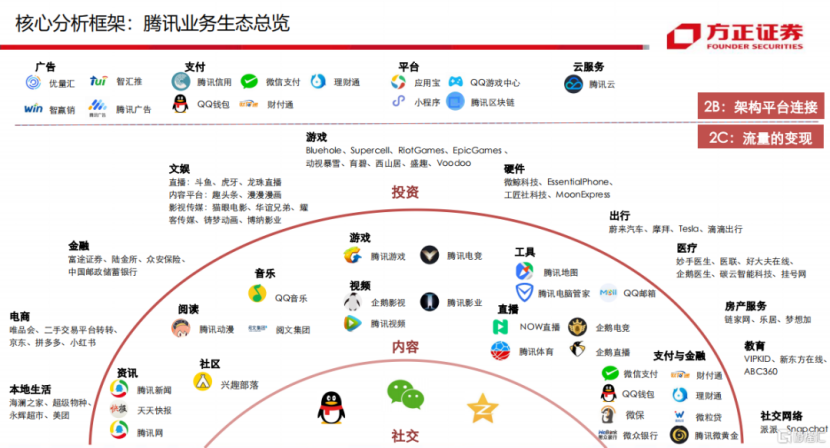
Source: Founder Securities, Gelonghui
Taobao and Douyin are essentially typical information and transaction distribution platforms, and AI will naturally change their traffic logic.
However, WeChat is different. WeChat is more like a "digital social infrastructure" that has been operating for over a decade. It not only supports social relationships but also payment, Mini Programs, content, and enterprise collaboration.
This makes Tencent's AI transformation difficult to carry out in a "rebuild from scratch" manner like Alibaba and ByteDance.
This also explains why, despite Tencent's significant investments, the market has struggled to perceive a particularly strong sense of "AI urgency."

Tencent Aims to AI-Enable WeChat Further
On the day the earnings were released, Yuanbao added support for summarizing WeChat chat records. Users can forward WeChat conversations to Yuanbao with one click to quickly generate summaries and to-do lists.
Prior to this, Yuanbao already supported analyzing WeChat files and official account articles. WorkBuddy, CodeBuddy, and Ardot began integrating into enterprise workflows, while the advertising business started introducing AI to optimize ad placement efficiency.
We found that these functional updates all share a common characteristic: they are not aimed at creating another separate entry point but at amplifying Tencent's existing ecological advantages—or, more precisely, WeChat's ecological advantages.
The reason is that Tencent's internal business divisions have long operated relatively independently. There has been no true unified collaboration between gaming, music, video, and enterprise services. However, within the WeChat ecosystem, capabilities like Video Accounts, Mini Programs, payments, and official accounts possess a kind of operating system-like synergy.
For a long time, outsiders have liked comparing Yuanbao to Doubao. According to QuestMobile data, Doubao has 345 million monthly active users, while Yuanbao has only 57.35 million, just one-sixth of Doubao's.
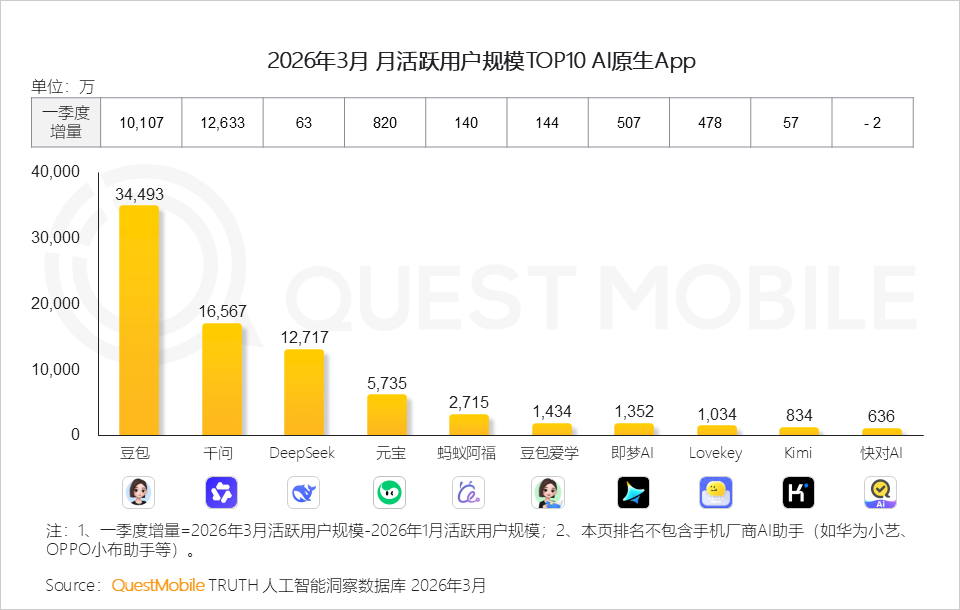
Both Doubao and Qianwen added over 100 million new users in a single quarter, while Yuanbao only added 8.2 million, and Tencent's cost for this was not low.
During the Spring Festival, Yuanbao relied on 1 billion yuan in red envelopes to attract new users, temporarily reaching the top of the App Store's free app chart. However, after the red envelope campaign ended, Tencent did not gain a "second WeChat."
It's not that Tencent doesn't want to create an entry point, but rather that it realizes it is unlikely to have a super AI application that "dominates" the market like ChatGPT in China. Therefore, instead of competing head-on with general-purpose AIs like Doubao and Qianwen for user time, it is better to embed AI into the existing WeChat ecosystem and make AI a "new operation layer" within WeChat.
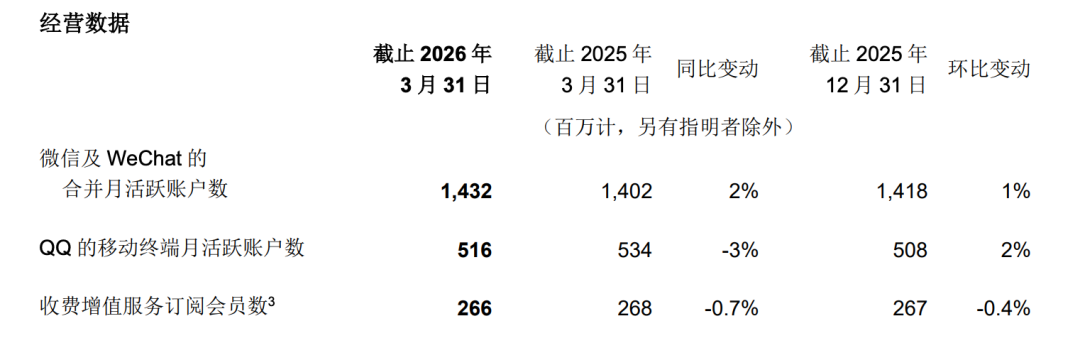 Tencent's Q1 2026 Earnings Report
However, ideals are丰满, but reality is bony. From a product perspective, WeChat still has several gaps compared to mainstream AI products:
Lack of a native, complete AI conversation interface: WeChat currently lacks a native, complete AI conversation interface. Users need to rely on Yuanbao or third-party Mini Programs, resulting in fragmented paths and a disjointed experience.
Underutilization of ecological data: WeChat possesses vast amounts of chat records, official account content, and Mini Program behavior data. However, due to privacy and architectural constraints, this data has not truly become a basis for training or invoking AI capabilities.
Unreconstructed underlying interaction logic: Mainstream AI products are designed as "AI-native," while WeChat "bolts on" AI capabilities to its mobile internet-era architecture. The interaction paradigms of the two are fundamentally different.
These are both "shortcomings" and breakthrough points. WeChat's accumulated social relationship chain data, payment closed loop, and Mini Program ecosystem are assets that no independent AI application can replicate.
If WeChat can achieve synergy with AI capabilities, it can form a differentiated barrier rather than competing directly with other players on model capabilities.

What Makes WeChat's AI Transformation Difficult?
As a super app, WeChat's rich functionality and deep relationship chains have created strong user stickiness, but they also come with a "historical burden," making AI transformation an urgent yet delicate task.
Achieving true deep AI integration in WeChat requires not just adding functions to the existing interface but reconstructing the underlying architecture—or even overhauling the current interaction framework.
Currently, WeChat is primarily opening up some interfaces (such as Reading, Payments, and Chat Summary) without touching the core interaction logic.
Payments were prioritized for opening up because they are an essential part of all commercial closed loops and have infrastructure-like properties. However, payment opening is just the starting point. The real challenge is how to reconstruct the entire interaction paradigm for conversations, searches, and task execution without compromising user experience.
This process faces three constraints: First, WeChat has 1.4 billion daily active users, and any architectural adjustment must ensure extremely high stability, which the current Hunyuan base model capabilities cannot yet support.
Second, the WeChat ecosystem has millions of Mini Program developers. Treating Mini Program code as AI skills would redefine traffic distribution, user paths, and commercial relationships within the entire WeChat ecosystem, requiring an ecological interest realignment.
In fact, outside expectations for WeChat Agent have always been high. In March, The Information revealed that Tencent was secretly developing a new AI agent for WeChat, with the core idea of integrating the millions of Mini Programs running within WeChat. After the news broke, the capital market reacted strongly, with Citibank even raising Tencent's target price to HK$783.
During the earnings call, when asked when "Tencent's AI agent can access the Mini Program ecosystem and use Mini Program code as AI skills" would be realized, Martin Lau's response was very nuanced.
He first acknowledged, "We have a timeline, but we cannot provide a definitive answer yet," then went on to explain, "We need to find the best way to present these functions and how Mini Program owners can actively leverage this. In the future, the agent itself will also have its own identity and be able to obtain accounts for certain services."
The last two sentences are actually very critical, especially the word "identity." In the past, the main entities in the WeChat ecosystem were "people," later followed by official accounts, Mini Programs, and Enterprise WeChat. However, they were all essentially tools for serving people.
Now, what Tencent is discussing is making the Agent a node in the ecosystem as well. In the future, it may not be "people operating Mini Programs" but "Agents calling Mini Programs on behalf of people."
In the past, the value of Mini Programs was built on "users entering." In the future, if Agents complete tasks directly in the background, do Mini Programs still need independent entry points? Is brand exposure still important? Do users belong to developers or Agents?
Many might argue that Mini Programs are already part of the WeChat ecosystem, but we must remember that Mini Program developers are not Tencent employees; they are independent merchants and service providers.
From their perspective, if WeChat Agents complete tasks directly for users: users no longer open my Mini Program, my interface exposure disappears, user paths are bypassed, and brand perception is weakened—what reason would I have to integrate?
Third, WeChat's social nature determines the boundaries of AI intervention, which involves balancing user trust and platform restraint.
A deeper challenge comes from a question that no one can currently answer: How will social interactions evolve in the AI era?
One possibility is that a large portion of human communication will be completed by AI agents in the future, and "AI chatting on behalf of people" will no longer be a sci-fi concept. If this trend materializes, the value foundation of WeChat's relationship chains will be completely disrupted.
Another potential scenario is that the emotional essence of social interactions renders them the most challenging domain for AI to emulate. Herein lies the true value of human "inefficiency" in nurturing relationships.
At present, there are no well-established global precedents to draw upon when discussing "AI-driven social interactions." This ambiguity poses both a challenge and a competitive barrier for Tencent.
Yuanbao continues to hold significance, but the real strategic move for Tencent might be to identify a niche where AI can "flourish" within WeChat's long-standing, expansive ecosystem.
As it stands, it appears that even Tencent itself is yet to fully discern the ultimate outcome of this strategic game.

Editor: Muren Proofreader: Zhang Wenxin Production: Rui Zong
▼
Welcome to follow the video account #I'm Dr. Qi#
-
![]()
Doubao Work Unveiled! Domestic AI Leaders Fully Commit to the 'Work' Sector
-
![]()
Who’s Sounding the Alarm on ‘Rushed Vehicles’?
-
![]()
Over 5.3 Billion Yuan in Losses Over Three and a Half Years! Can Yonyou Reverse Its Fortunes Through Streamlining and AI Transformation?
-
![]()
Baidu AI Adopts Free Model: A Strategic Maneuver in Traffic and Monetization
-
![]()
Silicon-Based OLED Pioneer Unveils Financial Results: H1 Shipments Outpace Entire 2025 Volume
-
![]()
AI's First "Lost Summer"
-
![]()
Zeiss Makes Another €2.2 Million Bet: Will Eye Tracking Be the Next Big Thing in the Smart Glasses Industry?
-
![]()
RUNTO Ranking | Global Top TV ODM Factories' Shipment Figures for July 2026