A New Yardstick in the AI Era Measures the Path of Tech Giants
 05/22 2026
 532
532

Google and Baidu: Same Direction, Different Paths, Different Metrics
Reported by / Chen Jiying
Edited by / Wan Tiannan
A week apart, major Chinese and U.S. tech firms nearly synchronized their efforts, defining a new trend in AI through two major conferences—a comprehensive shift from 'seeking answers' from AI to 'demanding value' from it.
This marks not just a shift for the two companies but also signifies that the entire AI industry has entered a new inflection point of explosive application growth.
As tech leaders, Baidu and Google are aligned in prioritizing agents and applications, following a consistent route of full-stack AI and ecosystem closure, while jointly anchoring AI value in the present.
However, their value metrics show different emphases.
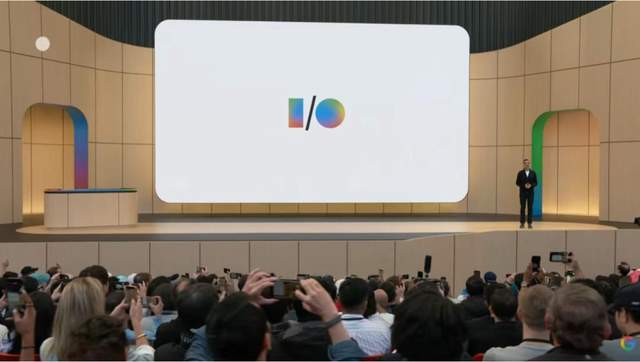
Google appears more focused on tokens. At Google I/O on May 20, CEO Sundar Pichai revealed that Google now processes 32 quadrillion tokens per month across its services, a sevenfold increase from the previous year.
At Baidu Create 2026 on May 13, Baidu founder Robin Li proposed that DAA (Daily Active Agents) might be the universal metric for the AI era. He argued that tokens do not necessarily represent the endgame: 'Tokens represent costs, not benefits; they measure input, not output.'
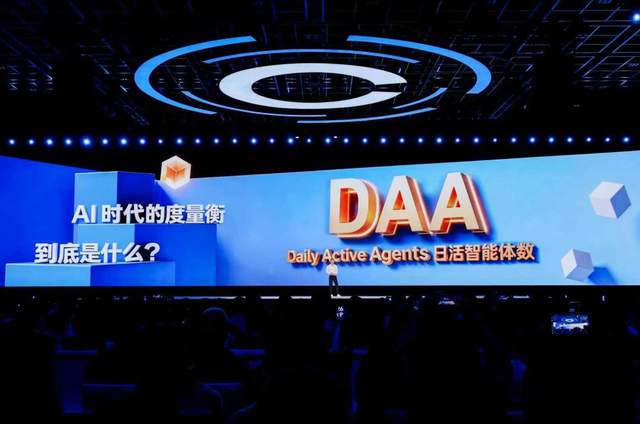
Google and Baidu, observing each other from afar, share the same direction and path but differ in metrics.
I. The AI Inflection Point: From 'Muscle-Flexing' to 'Delivering Value'
Intelligent agents became the absolute protagonists at both conferences.
At I/O, Google announced that it had established an 'Agent-First' ecological barrier across search, office, shopping, and hardware, with agents taking over everything.
A week earlier, at Baidu Create, general-purpose agent DuMate, code agent Miao Da, self-evolving agent Fa Mou, and digital human agents were comprehensively upgraded. To welcome (welcome) the explosion of agent applications, Baidu Intelligent Cloud was simultaneously upgraded to a full-stack AI cloud.
Google and Baidu are aligned—AI is no longer just a chat tool but a 'digital employee' capable of delivering results and creating value.
They share the same direction and route, with full-stack AI being a consensus.
Google showcased its full-stack AI product strength, with releases covering the chip layer, model layer, application layer, and terminal hardware. At Create, Baidu also upgraded its 'chip-cloud-model-agent' ecosystem.
The leaders of both AI companies mentioned 'full-stack' in their opening conference speeches.
Sundar Pichai emphasized, 'We adhere to a unique full-stack AI innovation path'; Robin Li clearly stated that Baidu, as a platform company, has built full-stack capabilities across chips, clouds, models, and agents to support the explosion of agent applications.
Despite synchronized goals and routes, the two companies differ in their 'metrics.'
The commonality is that both Google and Baidu are value-oriented, having take the lead (been the first to) enter a new stage of demanding value from AI.
Google-backed Anthropic saw its ARR (annualized revenue) surge by 400%, but its combined DAU across products is only 2% of OpenAI's. This shows that Google and Anthropic did not follow the internet-era 'traffic-first' DAU metric but directly moved towards 'value-based' payment.
At I/O, Sundar Pichai calculated costs on-site, striving to reduce token expenses. In contrast, Robin Li took AI thinking further, shifting focus from cost to value measurement and proposing DAA as a new metric for the first time.
In Li's view, compared to DAU (daily active users) and tokens, DAA is closer to the essence of value—focusing on how much work agents do, what results they deliver, and how much value they provide.
The core value of DAA lies in providing a quantifiable coordinate system for AI value—the explosion of AI agents has created new productivity, and the accompanying production relations should also be refreshed.
For enterprises, DAA metrics help clarify the business value brought by AI, quantify ROI on AI investments, and guide organizational transformation.
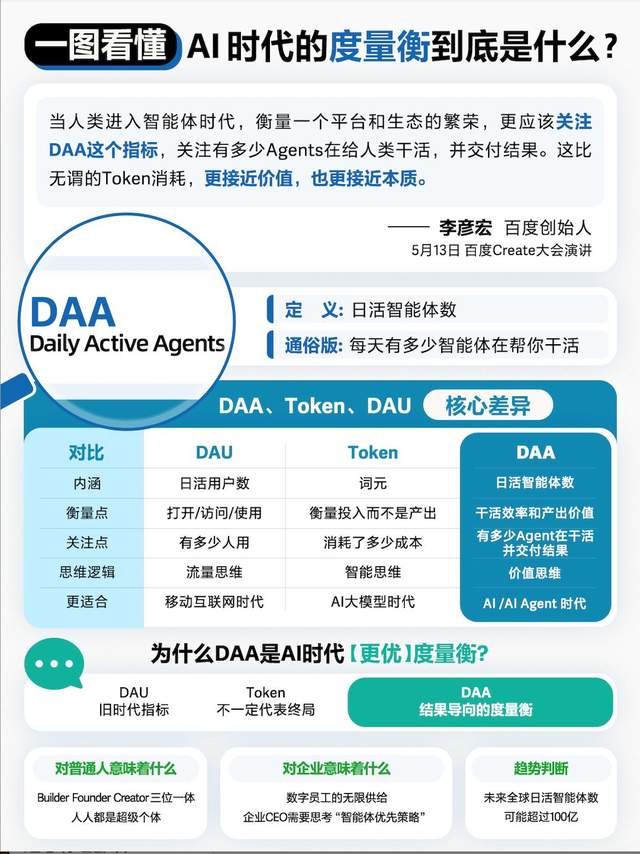
For individuals, DAA helps measure whether AI truly improves efficiency and clearly guides individuals to evolve into super-individuals who collaborate, co-create, and win with AI.
From a broader perspective, for AI to become widespread and turn into a social dividend, it must anchor to a truly effective value metric from the outset.
In summary, DAU is an old yardstick, and tokens are a cost unit. The DAA metric, which better aligns with application effectiveness and value creation, may be a superior metric, making AI output predictable, quantifiable, scalable, and sustainable.
Why has Baidu's DAA value thinking taken a step ahead of Google's?
First, Baidu recognized agents earlier and deployed them before Google. As early as 2024, Robin Li frequently discussed agents, followed by subsequent layout (deployments) from Google and other major firms. Second, Baidu's agents have already achieved commercialization, while Google is busily adopting an 'All In' mode to embed agents across all products.
Overall, Google and Baidu's simultaneous demand for 'value' from AI stems from the fact that the AI inflection point has arrived, shifting from a 'cost center' that burns computing power and engages in idle chat to a 'value center' that improves efficiency and generates revenue.
The choices of leaders serve as beacons for the industry.
II. Baidu and Google Have Secured Full-Stack Tickets
After over a decade of long-term investment, Baidu and Google have both secured scarce full-stack tickets. From underlying cloud computing and chips to the middle-layer large model layer, and then to the application end with dual C-side and B-side lines, they both develop native AI applications and reconstruct existing businesses with AI.
The value of full-stack capabilities continues to be released at both companies. During the Q1 earnings release, Sundar Pichai summarized, 'The full-stack layout is illuminating every link of Google's business'; Robin Li also re-emphasized that the differentiated full-stack AI capabilities built over the years are continuously driving revenue growth in Baidu's AI business.
The industry has shifted from 'invisible' to 'understandable' regarding Google and Baidu's full-stack routes.
Lo Toney, founding partner of Plexo Capital, praised Google, saying, 'Google is probably the most capable company to achieve AI monetization at scale because it controls almost every layer of the entire tech stack.'
Meanwhile, PUYIN International expressed optimism about Baidu in its research report, stating, 'We believe the company possesses differentiated competitive advantages through its full-stack AI capabilities, from its self-developed Kunlun chip to deep learning frameworks.'
Compared to single-point breakthroughs, the full-stack route has a high threshold and requires long-term investment, but its dividends have the greatest staying power.
Under the full-stack model, applications like chips, computing power, models, and agents are all self-developed, allowing optimal solutions for cost and efficiency at every layer, thereby forming a global optimum.
The full-stack model has a high value ceiling, with each layer's layout generating revenue, building an ecosystem, and mutually reinforcing each other, forming a compounding effect over the long term.
This is evident in Baidu's latest Q1 earnings report, where AI business revenue reached 13.6 billion yuan, accounting for 52% of Baidu's general business revenue and contributing over half for the first time.
Additionally, the full-stack model is highly resilient, with every layer being autonomously controllable and stronger in risk resistance. Taking chips as an example, DeepSeek's revolutionary update was disrupted for nearly a year due to its switch from NVIDIA chips to Huawei chips—migration costs were high, cycles were long, and the price was steep.
Full-stack is great, but the threshold is high, requiring deep technical and ecological accumulation at every layer.
Even mighty OpenAI is far from a full-stack player—it purchases computing power from Microsoft and Amazon and chips from NVIDIA. Moreover, OpenAI lacks scenarios and ecosystems, leaving it at a disadvantage in application deployment and commercialization compared to full-stack players.
Therefore, as competition in the AI track intensifies, the strategic value of full-stack tickets grows, and the overall advantages of the full-stack model become increasingly prominent.
Judging by the release outcomes of the two conferences, both Google and Baidu possess strong full-stack capabilities, with each layer being highly competitive. Take the model layer, for example: Google introduced a new multimodal large model, Gemini Omni, capable of full-modal input and output. Baidu's Wenxin large model has iterated to version 5.1, ranking first domestically on the LMArena text and search lists.
Baidu and Google's full-stack layouts did not rely on short-term bets but on high-pressure, sustained heavy investment, cultivating their now-formed full-stack panoramic interfaces.
Full-stack is great, but it doesn't guarantee easy wins. Both Baidu and Google's full-stack models continue to evolve. However, their evolutionary paths differ in rhythm.
Initially, Baidu and Google followed the same path, with full-stack layouts covering four layers: chips, clouds, models, and applications.
By 2025, their full-stack models began to differentiate. As the agent explosion approached, Baidu anticipated this trend earlier, focusing its full-stack model on chips, clouds, models, and agents. At Create, Baidu proposed the concept of a 'New Full-Stack,' with each layer fully upgraded for the agent explosion.
This path adjustment stems from Baidu's alignment of knowledge and action—after insight (insight) into trends, Baidu promptly refined its roadmap and adjusted its methodology upon finding a new direction.
III. Google and Baidu's Value Realization Is Timely, Long-Termism Shows Compounding Returns
The full-stack model has shifted from the investment phase to the harvest phase.
Now, both companies' AI businesses have entered a new cycle of delivering results and value realization, transforming from cost centers into primary growth engines.
In Q1 this year, Baidu's AI business revenue surged—AI cloud revenue reached 8.8 billion yuan, up 79% YoY, and GPU cloud revenue increased 184% YoY; AI-native marketing service revenue hit 2.3 billion yuan, up 36% YoY. After the earnings release, Baidu's U.S. stocks briefly surged 4%.
Looking at Google, its Q1 cloud business grew 63% YoY, and its U.S. stocks soared 7% after the earnings release.
Baidu's early layout (deployment) of agents has also begun to directly generate revenue, contributing 2.5 billion yuan to AI application revenue this quarter. The monetization potential of agents is far from fully released. For instance, Robin Li predicted that code agents would make 'one-time software' viable, 'This is not bad news. On the contrary, it's a huge opportunity—the market could expand tenfold.'
As DAA gradually lands, this metric will also reversely drive value creation. During the Q1 earnings call, Robin Li further envisioned the commercial potential of agent products. He believes that business models will ultimately be results-oriented, with users directly paying for productivity gains, time savings, and specific outcomes—and this market will be far larger than one based solely on token billing.
Market capitalization reflects performance.
Google's stock price has risen nearly 140% over the past year, transforming from Wall Street's 'laggard' to a 'returning king.' Berkshire Hathaway, known for its value investing, significantly increased its stake in Google after selling Apple shares, with its holdings reaching $15.6 billion by Q1's end.
Over the past year, Baidu's Hong Kong stocks have surged over 70%, leading Chinese concept stocks. On May 8, as Kunlun Chip initiated its STAR Market listing, Baidu's stock price continued to rise.
From the internet to mobile internet to the AI era, Google and Baidu have navigated through cycles due to their continuous evolution.
Robin Li recently proposed an AI-era evolutionary theory, including organizational self-evolution. He believes that only enterprises daring to break inertia and continuously reinvent themselves can truly navigate cycles and establish new competitive advantages.
In the AI era, such evolution is not just necessary but also requires higher speed. The two companies also show different rhythms in their evolutionary paths. Relatively speaking, Baidu's recent self-evolution has obvious (noticeably) accelerated. Take AI search as an example: in July last year, Baidu announced its largest search transformation in a decade, sending a strong evolutionary signal; nearly a year later, at I/O, Google presented its major search system upgrade.
Now, Baidu has gone further, refining an AI-era evolutionary theory of 'self-evolution' from its practices and beginning to export and empower others.
In any disruptive innovation, martyrs and pioneers are often one step apart. Any long-termist pioneer faces uncertain risks and requires extreme strategic patience.
Baidu and Google have both faced misunderstandings and controversies along the way.
Google missed the launch (first release) of ChatGPT-like products in the early AI large model stage, leading to market doubts about 'Google falling behind.' Until Google struck back with Gemini 3, TPU chips, etc., staging a 'return of the king.'
Baidu also faced controversies like 'long investment, slow returns' in the AI era but later regained market recognition through thorough AI reconstruction, continuous AI application innovations, AI chips, and autonomous driving.
Looking back at their journeys, the hardest part of long-termism is not persisting in investment but staying the course when misunderstood as 'falling behind' or 'too slow.' The full-stack model has finally moved from sowing to harvest, also serving as a tribute to long-termists—be friends with time, and time will eventually stand by you; the longer you withstand misunderstandings, the greater your reversal will be.
-
![]()
Doubao Work Unveiled! Domestic AI Leaders Fully Commit to the 'Work' Sector
-
![]()
Who’s Sounding the Alarm on ‘Rushed Vehicles’?
-
![]()
Over 5.3 Billion Yuan in Losses Over Three and a Half Years! Can Yonyou Reverse Its Fortunes Through Streamlining and AI Transformation?
-
![]()
Baidu AI Adopts Free Model: A Strategic Maneuver in Traffic and Monetization
-
![]()
Silicon-Based OLED Pioneer Unveils Financial Results: H1 Shipments Outpace Entire 2025 Volume
-
![]()
AI's First "Lost Summer"
-
![]()
Zeiss Makes Another €2.2 Million Bet: Will Eye Tracking Be the Next Big Thing in the Smart Glasses Industry?
-
![]()
RUNTO Ranking | Global Top TV ODM Factories' Shipment Figures for July 2026