UBTECH Bionic Robots: A Fad or a Real Need?
 07/08 2026
 439
439

UBTECH's bionic robots have recently ignited discussions about the future of companion robots.
The notion of bionic robots becoming a part of our daily lives is not entirely new to many.
Countless sci-fi novels and films have already explored the concept of a future where humans and robots coexist harmoniously.
Take, for instance, David from Prometheus and the even more enigmatic androids in Blade Runner.
UBTECH, the pioneer in humanoid robot stocks, has made a bold move by launching several robot products, transitioning from the industrial sector to the realm of household companionship.
This strategic shift has not only excited the capital market but also garnered significant public attention.
However, the initial excitement soon gave way to skepticism, with concerns ranging from exorbitant product prices (ranging from hundreds of thousands to nearly a million yuan), short battery life, limited household functionality, to ethical debates over their overly realistic appearance.
The question now arises: Is the companion robot a technological necessity or merely an overhyped marketing ploy? How much commercial potential does it truly possess?
01 Uncertain Prospects
On June 30, UBTECH unveiled three bionic robot models: the half-body U1 Lite priced at 119,800 yuan, the high-end full-body U1 Pro at 169,800 yuan, and the high-dynamic full-body U1 Ultra in male and female versions priced at 990,000 yuan and 880,000 yuan, respectively.

Image source: Screenshot from UBTECH's official website
Given their lack of household functionality, what are the selling points of these three products?
According to media reports, their core appeal lies in emotional companionship. These robots boast highly realistic hardware and software, equipped with an emotional AI model capable of emotion recognition, long-term conversational interaction, and some basic human-like gestures.
On the same day, UBTECH officials announced that cumulative orders across all channels had surpassed 13,361 units.
Founder Zhou Jian revealed plans to achieve mass production of 50,000 units by 2027, aiming to gradually reduce terminal prices through cost spreading, thereby demonstrating to the market the scalable potential of consumer-grade bionic robots.
The launch generated significant buzz, which also resonated in the capital market.
On June 30, UBTECH's stock price soared by over 7%, closing at 102.8 HKD.
Some market analysts even suggested that emotional companion bionic robots would pave the way for a new consumer sector, with UBTECH leading the charge.
However, the stock price's rally was short-lived, and amid doubts about the products, UBTECH's stock began to fluctuate.
On July 2, UBTECH's stock plummeted by 9.92%, falling to 92.6 HKD;
On July 3, it surged by 17.6%, reaching a high of 108.9 HKD;
On July 6, it plummeted again by 10.01%, with a single-day market value loss of approximately 5.4 billion HKD;
On July 7, it fell by 4.74%, closing at 93.35 HKD.
The stock price fluctuations reflect the capital market's constantly shifting expectations for the company's future. Why does this situation occur?
02 Is It Just a Fad?
Since becoming the first humanoid robot stock, UBTECH has been under pressure to perform.
Of course, as a cutting-edge technology, the application and popularization of robots fundamentally hinge on technological advancements.
However, UBTECH, which went public relatively early, has also experienced stock price fluctuations, significantly retreating from its peak of 328 HKD. This new bionic robot product is seen by many institutions as a key catalyst for boosting the company's performance.
Yet, the capital market's volatile response indicates that investors have not reached a consensus, and there remains significant uncertainty about whether the products can deliver commercial value.
Firstly, there is the issue of matching the high price with functionality.
Starting at 119,800 yuan, the price is dozens of times higher than that of robotic vacuum cleaners, smart speakers, or tablets.
What justifies the high cost? According to reports, the bionic manufacturing process involves extremely high technical barriers, with silicone skin and hundreds of servo motors mostly relying on manual assembly, keeping costs high. The current pricing only allows for reasonable profit margins, with prices expected to decrease after scaling up production.
However, some netizens argue that the entire product line lacks essential household functions like cleaning, delivering items, or cooking, with its core value limited to chatting and emotional comfort.
AI speakers costing a few hundred yuan can also perform functions like conversation and storytelling, making the purchase of an upgraded "voice assistant" with a humanoid shell and expressive capabilities for over a hundred thousand yuan seem like a poor cost-benefit trade-off.
In reality, long-term maintenance also requires significant hidden costs.
The top-end model priced at nearly a million yuan is also controversial, with netizens believing that bulk purchases by exhibition halls and healthcare institutions are unlikely, making it uncertain how much revenue it can generate.
Secondly, battery life is another factor contributing to UBTECH's stock price decline.
According to The Beijing News, on July 6, the headline "990,000 yuan robot companion can't last a night on a single charge" sparked heated discussions, directly targeting UBTECH's recently released full-sized hyper-realistic humanoid robot.
UBTECH told multiple media outlets that the current battery life of full-sized humanoid robots is generally 2-4 hours, which is an industry-wide issue.
This is understandable, as humanoid robots have numerous motors throughout their bodies, along with voice, sensor, and AI computing components, all consuming significant power.
This issue stems from battery technology, with global humanoid robots generally achieving only this level of battery life.
However, given the high price, the battery life issue is magnified, as no one wants to constantly monitor the robot's battery level during companionship.
These realities raise questions: if a high-priced robot cannot address essential household needs or provide long-term autonomous companionship, relying solely on its bionic appearance to offer superficial emotional value, is it a real need or a deliberately created consumer fad?
Finally, there are ethical concerns, which are long-term issues that such products must address.
After the product launch, discussions on emotional attachment, social degeneration, privacy breaches, and impacts on romantic relationships continued to ferment. Industry associations swiftly issued regulatory proposals to establish boundaries for bionic companion robots.
UBTECH has repeatedly clarified that its products are positioned as supplementary tools for elderly care and companionship for friends and family, not virtual companions. However, the highly realistic humanoid design, customizable personalities, and one-on-one emotional comfort features can easily lead users to develop one-sided emotional dependencies.
On the day of the product launch, UBTECH CEO Zhou Jian told BlueWhale News and other media outlets that they are highly interested in the otome game (a genre of video games targeted at a female audience) sector and would not rule out collaboration with professional otome game IPs and companies at the right time and stage.
He stated that relevant demands have already emerged, with many top otome game IPs actively reaching out to UBTECH. This sector has significant market potential and a large fan base. Under the premise of complying with ethical and technological norms and mitigating related risks, UBTECH may well enter this field.
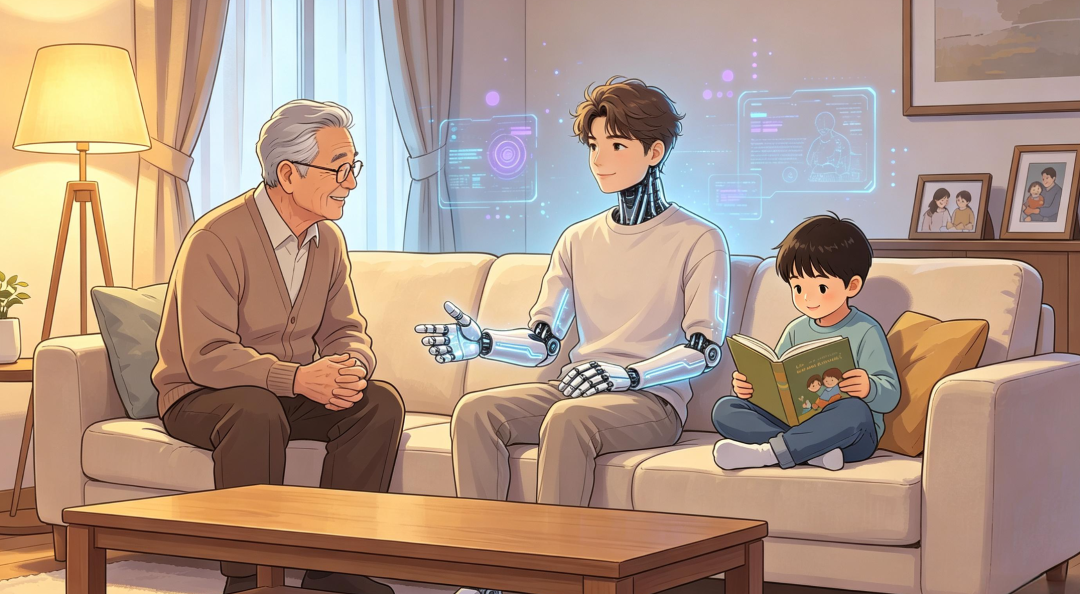
Image source: AI
In fact, emotional companion robots may face ethical and safety issues when integrated into daily life.
According to 21st Century Business Herald, on July 4, the China Humanoid Robot 100 Forum released the "Initiative on Regulating and Guiding the Development of Emotional Companion Humanoid Robots."
It emphasizes adhering to technology for good, preventing ethical and safety risks, staying true to the original intention of serving human well-being, upholding public order and good morals, and integrating safety and ethical norms into the entire process of product design, research and development, advertising, and application. It stresses strengthening personal information protection, safeguarding user privacy and security, enhancing quality management, ensuring product safety, and effectively preventing physical harm risks to users.
This directly addresses the core issue of current bionic robots: technology can provide emotional comfort but should not deliberately create false intimate relationships.
From a demand perspective, emotional loneliness caused by solitary living and aging is a genuine social issue, and the public is willing to pay for emotional value, indicating long-term development potential for the emotional companion humanoid robot sector—undeniably a real market demand.
However, in terms of product maturity, there is still a long way to go.
While technology's role in alleviating loneliness is promising, relying solely on high-priced bionic shells to generate buzz may not ensure long-term success.
-
![]()
Alibaba's AI Offensive: Over Half of Investment Allocated, Time to Reap Returns
-
![]()
Alibaba’s AI Push: Over Half of Investments Made, Time to Harvest Returns
-
![]()
Chinese Enterprises Going Global 3.0: From World Factory to AI Infrastructure Builder
-
![]()
Honor RobotPhone Review: Half Movie Camera, Half Robot
-
![]()
AI-Driven Cheating Surges in Universities! Online Exams Reduced to Mere Formalities, Degree Credibility on the Line
-
Insta360’s Decade in Panoramic Imaging: Making Cameras ‘Invisible’ and Returning Creation to the Masses
-
![]()
Foreign Media Claims Apple is Concentrating Resources on AI Development: Vision Pro and Siri Teams Lay Off 200 People
-
Big News! Huaneng and Huawei Hold Talks in Shenzhen with Ren Zhengfei in Attendance; Huawei Emerging as the 'Second Brain' of China's Energy System