Unlicensed Vehicle Disputes: AutoNavi Ensnared in the Aggregation Model
 07/08 2026
 546
546
Imagine booking a ride through AutoNavi. Within seconds, the system matches you with a driver, plans the route, and everything proceeds smoothly and efficiently. But few pause to consider: Who owns this car? Who employs the driver? Who operates the platform? And who should be held accountable if something goes wrong?
The answer is complex. When passengers open AutoNavi, they believe they are simply booking a ride. Yet, behind this car lies a web involving an aggregation platform, a small-to-medium ride-hailing service, a transportation capacity company, a driver account, the actual vehicle in operation, and a local regulatory framework.
Because of this complexity, AutoNavi Ride-Hailing has increasingly become a focal point where compliance issues in ride-hailing services are more easily magnified. Not because it has the most problems, but because it stands at the 'gateway' to all these issues.
Who Should Be Held Responsible?
On July 5, according to the Xiaoxiang Morning Herald, Ms. Shen (a pseudonym) from Guangzhou, along with two female friends, used AutoNavi Ride-Hailing on the 4th. Upon entering the car, they noticed a foul odor and asked the driver if they could open the windows. The driver refused, citing the air conditioning, but Ms. Shen insisted. The driver then retorted, "I said no, and that's final. You think you're superior just because it's a cheap ride." During the journey, the driver repeatedly slammed on the accelerator and then braked, frightening Ms. Shen and her friends. The driver only stopped after they threatened to "call the police." Additionally, Ms. Shen noticed that the fare displayed on the driver's phone was "11.6 yuan," but the actual payment was "17.50 yuan."
Ms. Shen stated that she had lodged a complaint with the AutoNavi platform and made five demands: Revoke the driver's dual licenses; an official written apology from AutoNavi, along with publicized corrective measures and strengthened safety assessments for drivers; a refund of the fare; compensation of 5,000 yuan for emotional distress damages for the three passengers; and an increase in ride-hailing driver income.
In response to Ms. Shen's demands, AutoNavi's customer service stated that revoking the driver's dual licenses was beyond the platform's purview; they had communicated with the service provider, T3 Travel, to permanently ban the driver; a refund for Ms. Shen's fare would be requested; and a 5,000 yuan compensation had been applied for. The remaining demands would be recorded in detail and escalated to the senior management team.

Traditional ride-hailing regulation focuses on three key aspects: whether the platform, the vehicle, and the driver are all properly licensed. However, AutoNavi Ride-Hailing's aggregation model splits these three elements into a 'chain of dependencies': AutoNavi stands at the forefront, responsible for traffic, entry points, display, and transaction links; the actual vehicle is often provided by a ride-hailing platform connected behind it, such as T3 Travel in the aforementioned incident.
Thus, an industry that was once clearly regulated has been transformed into a complex system of 'traffic entry + multi-platform capacity + local qualifications.' As the process becomes more intricate, responsibility begins to blur.
Users think they are booking a ride through AutoNavi, but the platform claims it is not the carrier; drivers think they are working for the platform, but the aggregation portal says the cooperating platform manages them; in case of disputes, passengers, drivers, and platforms pass the 'blame' around like a hot potato.
This is not an exaggerated description but a real issue that regulators are grappling with.
Compliance Costs Are Being Squeezed
In May 2026, the Ministry of Transport's ride-hailing regulatory information interaction system showed that 400 ride-hailing platform companies had obtained licenses nationwide, receiving 977 million orders that month, of which aggregation platforms completed 286 million orders, nearly 30% of the total. AutoNavi Ride-Hailing ranked third in order compliance rate among aggregation platforms, behind Huaxiaozhu Travel and Didi Chuxing.
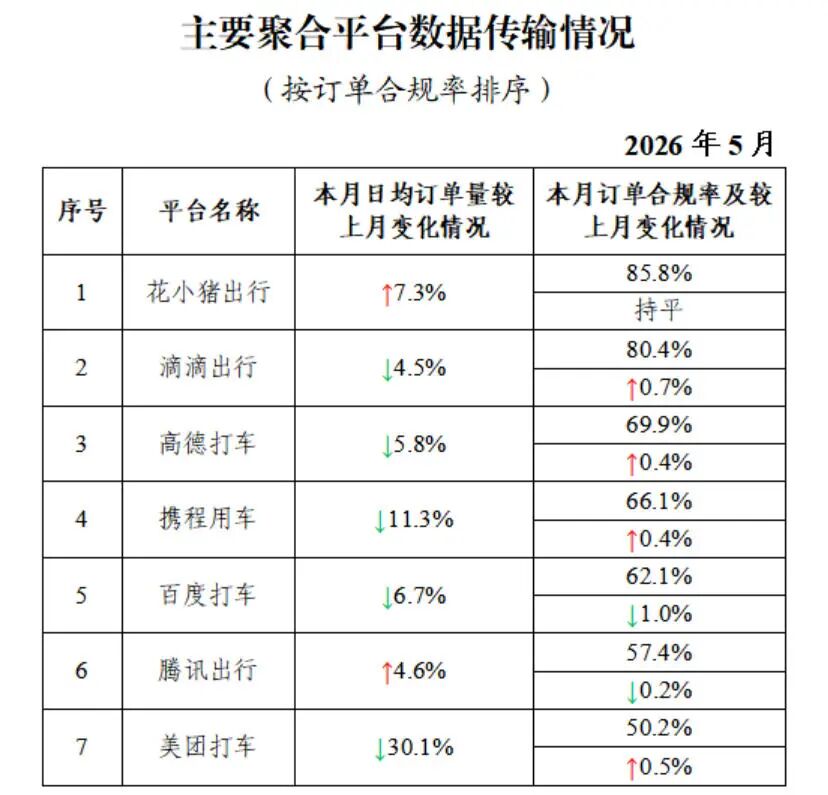
The so-called 'order compliance rate,' as defined by the Ministry of Transport, refers to the proportion of orders where both the driver and the vehicle are licensed. In other words, an order is only compliant if the driver has a Network Pre-booking Taxi Driver's Certificate and the vehicle has a Network Pre-booking Taxi Transport Certificate.
AutoNavi's compliance rate is above average among aggregation platforms, but its problems are particularly glaring because it is both 'large' and 'light.' Large in that it controls user entry points and has a natural scenario; light in that it does not need to build its own fleet or manage drivers.
These two advantages create a vicious cycle: The stronger AutoNavi's traffic, the more dependent small platforms become; the more dependent they are, the more they engage in low-price competition; the more intense the low-price competition, the more compliance costs are squeezed.
Where do these compliance costs lie? Vehicles need transport certificates, drivers need professional qualifications, platforms need operating permits, and they must connect to regulatory systems, upload data, handle complaints, and ensure safety.
According to the Interim Measures for the Administration of Network Pre-booking Taxi Operations and Services, a platform applying to engage in ride-hailing operations must have online service capabilities, data interaction capabilities, regulatory query conditions, service agencies, and service capabilities in the service location; after obtaining a permit, the competent authority issues a Network Pre-booking Taxi Operating License.
Vehicles must meet certain conditions and be registered as pre-booked taxi services to obtain a Network Pre-booking Taxi Transport Certificate; drivers must also pass verification and assessment to obtain a Network Pre-booking Taxi Driver's Certificate. Platform companies also bear carrier responsibilities and should ensure that vehicles have legal operating qualifications and drivers have legal professional qualifications.
The logic of this system is clear: Ride-hailing is not 'a private car picking up a passenger along the way' but a commercial passenger transport service. As long as you charge for transporting passengers, it is a commercial activity regulated by laws and regulations.
However, the regulatory structure becomes complex with the emergence of the aggregation model. A small platform may have a Network Pre-booking Taxi Operating License, but the license has operational area restrictions. Being legal in City A does not mean it can operate in City B; having a license does not mean every vehicle, driver, and order is compliant.
In short, a small platform is not inherently a black platform, but having a license does not equal 'full-chain compliance.'
This may be the most easily overlooked issue in AutoNavi's aggregation ecosystem: It does not connect to a single platform but to an entire layer of complexly distributed transport capacity ecosystems.
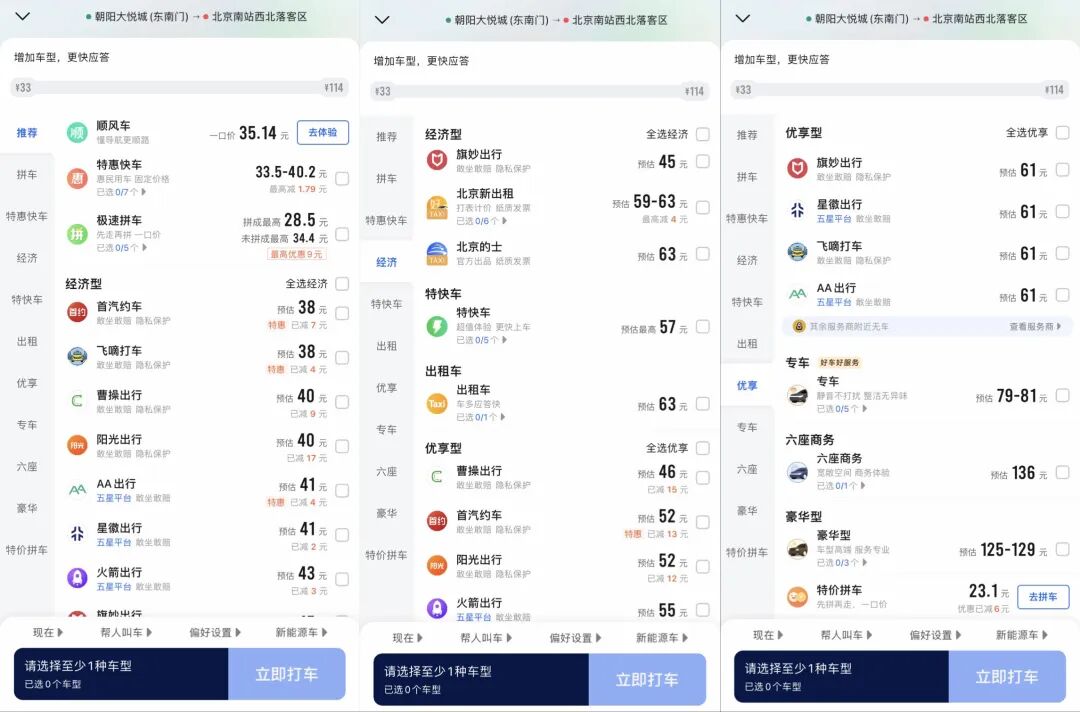
Among them are regular forces, such as local transportation enterprises and taxi companies, which connect to AutoNavi with local resources and may be relatively stable in compliance. There are also intermediaries who, although licensed in some cities, rely on cooperating fleets and leasing companies for transport capacity, with limited management radius and varying verification and complaint handling capabilities. Additionally, there may be a gray tail, with missing qualifications, vehicles, or drivers in one link, or issues like cross-regional operations and order reselling.
Labeling these complex transport capacities as a 'ragtag group' is both lazy and inaccurate.
Aggregation Is Not an Excuse for Exemption
The core issue is not that aggregation platforms are inherently 'bad,' but that they too easily split 'responsibility': The entry point is mine, the order is yours; the traffic is mine, the risk is yours; I influence the price, you bear the responsibility; I acquire the users, you explain the accidents.
In July 2023, the Guangzhou Municipal Transportation Bureau issued a document to regulate the service and operation of ride-hailing aggregation platforms, pointing out that some aggregation platforms evade regulation by engaging in ride-hailing operations in disguise, even incorporating unlicensed vehicles and drivers into the names of ride-hailing companies on their platforms. After disputes between drivers and companies or between drivers and passengers, they shift responsibility, leading to difficulties in protecting the legitimate rights and interests of drivers and passengers.
This, of course, cannot be allowed indefinitely. On April 26, 2023, the Ministry of Transport and four other departments issued the Notice on Effectively Doing a Good Job in the Standardized Management of Ride-Hailing Aggregation Platforms (hereinafter referred to as the 'Notice'), explicitly requiring ride-hailing aggregation platforms to verify the relevant ride-hailing platform companies, not to connect to ride-hailing platform companies that have not obtained ride-hailing operating permits in the local area, and to ensure that the drivers and vehicles providing services have obtained corresponding ride-hailing permits.

The Notice also requires aggregation platforms to prominently display information such as the names of cooperating ride-hailing platform companies, ride-hailing app names, operating permits, and complaint and reporting methods on their apps and relevant web pages; to establish a first-question responsibility system; and to assume relevant responsibilities if passengers suffer damages due to safety incidents and demand that the aggregation platform assume advance compensation responsibilities.
These points are crucial. Regulators are not saying that aggregation platforms cannot exist but are saying: You can aggregate, but you cannot shirk responsibility.
More critically, the Notice also sets boundaries: Aggregation platforms shall not interfere with the pricing behavior of cooperating platforms, shall not directly participate in vehicle dispatch or driver management, and must transmit operational data to regulatory systems in real-time to ensure quality.
AutoNavi's dilemma lies here. Commercially, it hopes to remain asset-light, avoiding offline management costs and not deeply binding vehicles and drivers; however, user experience, price display, sorting, subsidies, and order entry points make it factually influence transaction results. It is not like a fleet manager but increasingly like a dispatch center—not a direct carrier but controlling entry points, links, display, and distribution.
This position is comfortable and dangerous. Comfortable in that profit and growth are close; dangerous in that once regulation begins to penetrate responsibility, it is hard to continue saying, 'I was just passing by.'
An Unhealthy Cycle
On February 9, 2026, the official WeChat account of the Ministry of Transport stated that the Office of the Inter-Ministerial Joint Conference on the Coordinated Regulation of New Transportation Formats had recently conducted a talk with AutoNavi Ride-Hailing, pointing out prominent issues such as inadequate management of cooperating ride-hailing platforms, fare suppression, and improper emergency response. At the same time, it required AutoNavi Ride-Hailing to strengthen aggregation service management, ensure reasonable driver income, strengthen the review and management of connected ride-hailing platforms, vehicles, and drivers, strengthen order traceability monitoring management, prevent order reselling and layered commission charges, and implement first-question responsibility and advance compensation responsibilities.
In fact, these requirements from regulatory authorities are not solely aimed at AutoNavi but are comprehensive requirements for the entire aggregation model. Why do regulators specifically mention 'preventing order reselling and layered commission charges'? Because this may be the most easily distorted aspect of the aggregation ecosystem.
An order flows out from the user entry point, passing through the aggregation platform, cooperating platform, transport capacity company, and driver. Each additional layer in the middle means an additional layer of commission charges and an additional layer of diluted responsibility. Driver-end income is thinned out, platforms continue to lower prices to secure orders, and compliant vehicles and drivers become more costly supplies.
This leads to the most unhealthy cycle: Low prices attract users, low prices compress platform and driver space, platforms expand transport capacity to handle orders, and expanding transport capacity easily relaxes qualification verification, ultimately putting pressure on compliance rates.
Therefore, AutoNavi becomes a compliance focus not because it creates all industry problems but because it amplifies these issues at a single entry point.
AutoNavi is a highly mixed ecosystem, like a large-scale travel wholesale market: There are licensed and regularly operated stalls, roughly managed temporary stalls, and possibly a few stalls with particularly cheap prices but opaque back-of-house operations.
The responsibilities that AutoNavi should shoulder are precisely those of the market manager. It is not the owner of the vehicles or the employer of the drivers, but it cannot say that where the car goes has nothing to do with it just because it does not hold the steering wheel. Especially when it controls entry points, display, sorting, and transaction links, it must bear heavier obligations for review, information disclosure, complaint handling, and safety guarantees. This is also the key to whether the aggregation model can continue to operate in the future.
If AutoNavi can thoroughly verify the qualifications of connected platforms, vehicles, and drivers, make the order links transparent, take responsibility for complaints and compensation, and truthfully upload data to regulatory systems, it can still be an efficient travel entry point.
The aggregation model, in and of itself, is not inherently flawed. It effectively addresses the challenge of matching supply with demand, providing smaller and medium-sized platforms with a viable space to survive. Ultimately, while aggregation platforms can operate with minimal asset investment, they cannot afford to be lax in their responsibilities.
If a platform's role is limited to aggregation, it must ensure robust mechanisms for verification, transparent display of information, efficient complaint handling, proactive compensation, and accurate data uploading. However, if the platform goes beyond mere aggregation and actually influences pricing, dispatching, and driver management, then it should cease to portray itself as a neutral aggregator. (Image credits: Xiaoxiang Morning Herald, AutoNavi Maps app, etc.)
Risk Warning: The information presented in this article is derived from publicly accessible sources and should not be construed as a definitive judgment or investment advice.
-
Alibaba’s Earnings Soar with Triple Catalysts: Full-Stack AI Hits Maturity, Capital Efficiency Drives Sustainable Growth
-
![]()
Raking in Big Profits Overseas! Chery’s Overseas Revenue Makes Up 70% in H1, with Gross Margin Climbing to 16.1%
-
![]()
Alibaba’s New Fiscal Quarter: 45% Revenue Surge in Alibaba Cloud, Enhanced Profitability in AI Cloud, but Widening Losses in the Application Layer
-
![]()
The AI Version of 'PayPal Mafia' Has Arrived: 20 AI Startups Raise Over $4.6 Billion in Funding
-
![]()
Wang Jian's Vision: Paving a Pathway for Alibaba Through AI
-
![]()
Hyundai Motor Workers Strike Today, Fearing Job Losses to Robots
-
![]()
Embracing 'Light': O-film Unveils Its 'Illuminating the Future' Strategy
-
![]()
SenseTime’s SenseNova U1.5 Lite Goes Open Source: Ushering in a New Era of Predictable AI Image Generation