Zhipu Stages a 'Deep V' Turnaround on Lock-up Expiry Day: Can the 'Pioneer Large Model Unicorn' Maintain Its Edge?
 07/09 2026
 364
364
Today, Zhipu (02513.HK), hailed as the "world's first independent large model unicorn," faced its inaugural major challenge as post-listing lock-up restrictions lapsed. Amidst market jitters, its stock price defied predictions of a "plunge," instead executing a dramatic deep V-shaped rebound: touching an intraday low of HKD 1,450 (down ~10%) before closing at HKD 1,830 (up 13.66%).
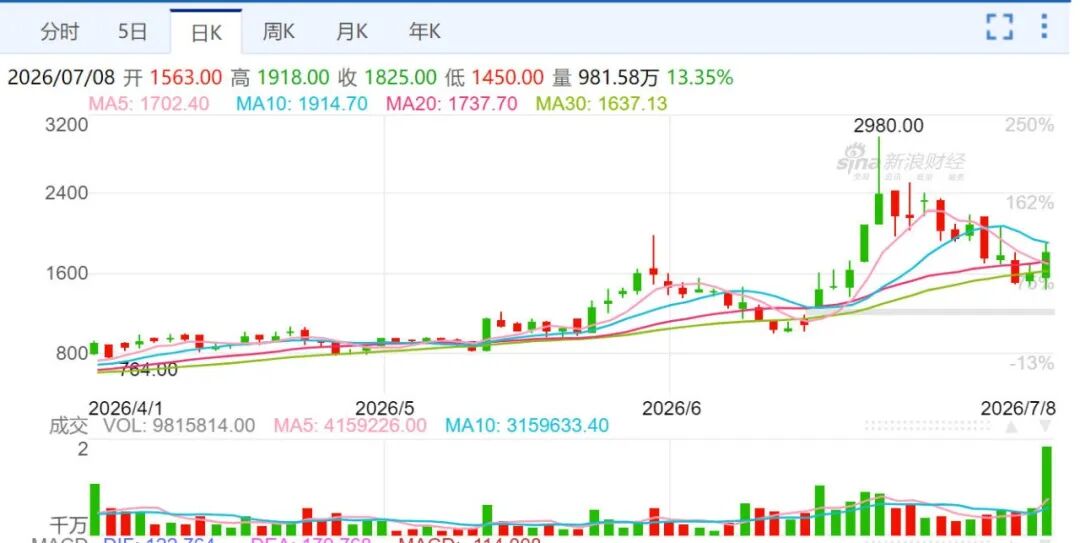
Zhipu's Stock Performance Over the Past Three Months
This heart-stopping capital market clash stabilized its market valuation but also sparked a reassessment: How long can Zhipu sustain its first-mover advantage after the expiration of its Hong Kong IPO's scarcity premium?
1. 'Deep V' Rebound on Lock-up Expiry Day Amid Liquidity Crunch
Market skepticism toward Zhipu peaked ahead of the lock-up expiry. After soaring to a record high of HKD 2,980 in late June, with its market cap surpassing HKD 1 trillion, funds exited en masse before the July 8 lock-up expiration for cornerstone investors. Over the past two weeks, the stock tumbled nearly 50% from its peak, shrinking its market cap to ~HKD 716 billion by July 7, 2026—effectively halving in value.
The panic stemmed from massive profit-taking and fragile liquidity. Zhipu's January IPO price was just HKD 116.2, leaving cornerstone investors with over 10x paper gains even after the 50% drop. Among the 11 cornerstone institutions unlocking shares were pure financial investors like Meituan and Hillhouse Capital, with Meituan's management openly stating plans to exit for gains. Fears mounted of a repeat of SenseTime's 46.77% single-day plunge during its lock-up expiry, with analysts from UBS, HSBC, and others cautioning of severe downside risks for Zhipu.
However, an unseen force reversed the tide on lock-up day. Nearly 70% of the unlocking cornerstone shares were held by institutional investors—including national strategic capital, local government industrial funds, and large state-owned enterprise funds—who pledged long-term confidence and opted to hold. This "national team" and industrial capital lock-up counterbalanced selling pressure from financial investors, attracting outside capital and transforming a feared "plunge" into a bullish triumph.
Meanwhile, Zhipu swiftly quashed rumors of withdrawing A-share IPO counseling a day before the lock-up, confirming regulatory approval of its issuance plan and stabilizing valuation expectations. This averted risks that could have derailed its STAR Market fundraising target of RMB 15 billion, at least in the short term. However, a second wave of lock-ups in January 2027—covering 39.99% of its share capital (founding team, early VC investors, and employee stock plans)—remains a looming liquidity threat.
2. Strong Government-Enterprise Base vs. Cloud Ecosystem Challenges
Beyond short-term capital battles, Zhipu's resilience under lock-up pressure stems from its business fundamentals: a fortified first-mover advantage in the high-barrier government-enterprise privatization sector.
Financial data reveals Zhipu's 2025 total revenue reached RMB 724 million, soaring 131.9% YoY. Privately deployed local solutions contributed RMB 534 million (73.7% of revenue), underpinning its performance. Competition barriers are high here—Zhipu has served over 12,000 government-enterprise clients, with a 95% renewal rate for privatization projects.
Notably, 45% of its clients are provincial governments and state-owned enterprises handling classified data. Zhipu has deeply adapted over 40 domestic AI chips (e.g., Ascend, Cambrian) to meet stringent government and military tender requirements.
With a 300+ strong government-enterprise implementation and O&M team, single projects generate tens of millions in revenue with high migration costs, locking in high-margin legacy contracts.
Yet in the vastly larger cloud MaaS and developer markets, Zhipu's ecosystem trails rivals. According to OpenRouter's weekly rankings, DeepSeek's single-model weekly token calls hit 4.66 trillion (global No. 1), while Zhipu's GLM5.2 managed just 2.11 trillion.
In the large model ecosystem race, token economic efficiency is paramount. DeepSeekV4-Flash slashed input costs to RMB 0.02 per million tokens, combining cost efficiency and speed with a full open-source strategy to win over SMEs and developers.
Zhipu, diverting resources to privatization projects, has a smaller cloud team and higher customer acquisition costs. Rising cloud API revenue share has dragged down overall profitability, with gross margins falling from 56.3% in 2024 to 41.0% in 2025.
3. Capital-Intensive Model and Competitive Headwinds
The large model race is a capital-intensive "arms race" in computing power, trapping firms in a "earn more, lose more" cycle. Despite its "A+H" dual-listing advantage fueling RMB 3.18 billion in 2025 R&D spending, Zhipu's internal finances are strained.
First, massive losses and insolvency risks: Zhipu's 2025 net loss hit RMB 4.718 billion, up 60% YoY. By end-2025, shareholders' equity turned negative at -RMB 8.111 billion, worsening sharply from 2024 and teetering on insolvency.
Second, cash flow crunch: Government-enterprise privatization projects require upfront GPU purchases with 6–12 month payment cycles. By end-2025, accounts receivable surged 142% YoY, tying up capital in long receivables.
Third, competitive pressure: DeepSeek secured a massive RMB 51 billion funding round in June, enabling aggressive hiring and expansion. In contrast, Zhipu's liquid cash stands at ~RMB 6 billion, putting it at a disadvantage.
With rivals like DeepSeek, Moonshot AI, and Jueyue Stellar accelerating fundraising and IPO plans, multiple independent large model firms will list in the next 1–2 years, eroding Zhipu's "first unicorn" scarcity premium.
While Zhipu weathered the initial lock-up storm, buying time for its RMB 15 billion STAR Market IPO, the real test lies in January 2027's second lock-up wave. Then, 39.99% of shares (founding team, early VCs, employee plans) will unlock, a critical juncture for stock trends. If the STAR Market fundraising fails by then, liquidity will crumble under massive selling pressure, risking a stock price collapse.
Thus, Zhipu's priority is to expedite its A-share STAR Market IPO. Only by securing massive funds through "A+H" dual listings can it ease cash flow anxieties for computing power and R&D, brace for the 2027 lock-up tsunami, and buy time to fix its fatal cloud ecosystem shortcoming (weakness) while solidifying its government-enterprise privatization moat.
Undoubtedly, in today's hyper-competitive AI large model arena, capital and first-mover advantages alone cannot build enduring barriers. Only by achieving commercial self-sufficiency and erecting tiered competitive moats can firms survive long-term.
-
![]()
Model Giant Jieyue Xingchen Steps into Smartphone Arena: A Strategic Alliance with Huaqin Technology
-
![]()
Big Model Firm Dives into Phone Market: StepFun and Wingtech Forge a ‘Dynamic Duo’
-
![]()
Zhongrun Optics Makes a Bold Move with 1 Billion Yuan Investment: Is a Turning Point on the Horizon for the Precision Optics Industry?
-
![]()
Deploy CLBO Crystals and YIG Single Crystals! Erythritol Leader Invests 30 Million in Youwei Optoelectronics
-
CXMT’s July 16 Subscription: Leading Domestic Memory Manufacturer—What’s the Earning Potential per Lot?
-
![]()
Rhythm Discrepancy and Premium Value Erosion: Foreign Luxury Brands Must Re-evaluate Their China Strategy
-
![]()
Half-Year, 1 Billion Yuan Financing, 7 Billion Yuan Valuation: A New Dark Horse Emerges in the Embodied AI Sector
-
![]()
Strong Rebound for Tech Stocks in Hong Kong Stock Market: Is It Time to Bottom-Fish?