Seed Eats Meat, Flow Drinks Soup: When ByteDance No Longer Goes 'All in' on a Single AI
 07/14 2026
 540
540

Over the past two years, ByteDance has publicly emphasized 'All in AI,' being in the first tier of models, scaling new heights, and long-term investment. But last month, Doubao entered an unfamiliar phase, intensively advancing commercialization across dialogue, travel, and storage fronts in less than ten days.
On June 22, Doubao began grayscale testing a one-click ride-hailing feature in Beijing and Hangzhou, with Cao Cao Mobility drivers starting to receive 'Doubao Service Order' dispatch notifications. Two days later, Doubao officially launched three tiers of paid subscriptions: Standard at RMB 68, Premium at RMB 200, and Advanced at RMB 500 per month. Six days after that, a cloud storage expansion clause quietly appeared in Doubao's user agreement, capping the previously nearly unlimited AI cloud storage at 5TB.
Doubao is ByteDance's largest, fastest-growing, and most user-aware AI product within its AI matrix. Its daily active users surpassed 200 million after the Spring Festival, making it the only AI application in China to reach that scale at the time. Following mobile internet era experience, such a product should continue scaling, consolidating its gateway, and then wait for advertising, e-commerce, membership, and ecosystem revenue to naturally unfold.
However, around the May Day holiday, a quietly updated paid declaration on Doubao's App Store page trended on hot search. This 'top student' product first drew a wave of criticism for being 'dumb and still charging,' with monthly active users Rare decline (unusually declining) by 6.1 million that month.
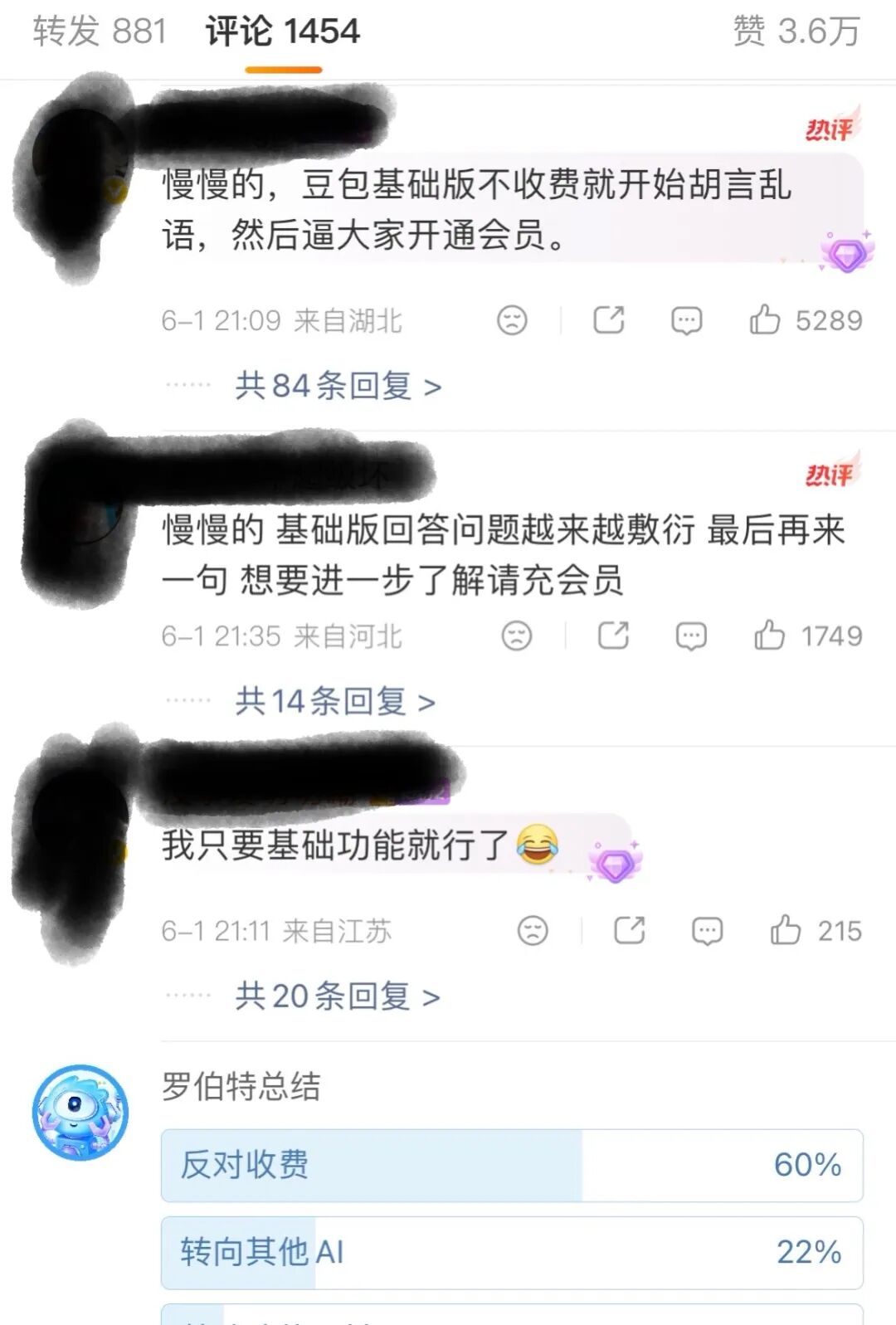
Public opinion had already signaled change, but Doubao's commercialization timeline did not pause.
In ByteDance's past AI narrative, Doubao represented user scale while Seed represented model capabilities, both placed within the same growth loop. However, priorities within this loop shifted this year: Multiple media outlets reported Seedance achieving $2 billion in annualized revenue with ~70% gross margins, with enterprise clients contributing most revenue. Claude Code reached $1 billion in ARR within six months and $2.5 billion by February, serving as ByteDance's reference for office and coding monetization paths. Meanwhile, despite having the largest user base, Doubao struggled to convert user engagement and payment willingness into revenue.
ByteDance has never framed its AI investment narrative around 'lacking funds.' Liang Rubo set 'scaling new heights' as the 2026 keyword, with commitment directly reflected in numbers. The South China Morning Post reported ByteDance plans to increase 2026 capital expenditures by over RMB 200 billion, equivalent to ~60% of 2025 profits. Tech Buzz China reported ongoing negotiations for a ~$20 billion offshore loan with a three-year term and two-year extension option. At least from a funding perspective, ByteDance shows no intention of reducing AI investment. The question now is where these resources should prioritize and which businesses must first demonstrate returns.
Seed must prove model capabilities, while Doubao must preserve large-scale user value. These goals aren't inherently conflicting, but as computing power, talent, and management attention become more expensive, they can no longer always coexist. Initially told 'not to worry about monetization,' Doubao now becomes the first consumer product in ByteDance's AI matrix required to prove revenue capability. Understanding this shift requires revisiting Seed and Flow's positions in ByteDance's AI landscape.

From its inception, Seed enjoyed rare resource priority within ByteDance, reporting directly to group management with looser KPIs, higher talent incentives, and more independent organizational boundaries. This design aimed to let ByteDance sustain a research-oriented model team through mature businesses to solve large model capability issues.
This aligned with a specific historical phase where the global AI industry still believed in 'spend first, ask questions later.'
In 2023, ByteDance assembled Seed by transferring personnel from AI Lab, AML, and search teams. Setting standards to avoid distillation or shortcuts, it allocated nearly 1,000 personnel for proprietary data annotation alone.
Over nearly three years, this structure expanded continuously: The video generation team merged under Zhou Chang, who joined from Alibaba in 2024. By late 2025, AI for Science, Embodied AI, and Responsible AI—originally under AI Lab—fully transferred to Seed. Li Hang, former AI Lab head, retired then returned, reporting to new leader Wu Yonghui. Even MiniMax founder Yan Junjie praised ByteDance's AI talent density.
Seed also established virtual teams like Edge, Focus, and Base to simultaneously advance long-term research, next-gen model development, and current model delivery. This gave Seed research scale rare for large companies, though also common research organizational issues: Too many directions made equal resource allocation unsustainable.
Changes came as the industry questioned AI investment returns. Late Post reported that after ByteDance executives visited Anthropic, the company began adjusting AI resource allocation, shifting focus from purely pursuing consumer-scale users to emphasizing enterprise services and professional scenarios.
Anthropic provided a direct reference: Without ChatGPT-scale consumer users, it pushed its valuation to hundreds of billions through Claude Code and enterprise services. ByteDance's own Seedance also proved video generation APIs could generate high-margin revenue. Model capabilities remained important but now needed secondary validation through revenue.
In 2026, ByteDance internalized four AI priorities:
1. Enable world models to match Google's Genie 3 capabilities by year-end;
2. Maintain video model leadership while exploring 'dynamic generation' allowing real-time plot intervention;
3. Continue strengthening foundational coding capabilities;
4. Help Doubao establish commercialization capabilities in office scenarios.
This list omitted previously heavily invested areas like AI4S and robotics hardware, reflecting not just technical priorities but also resource allocation.
Within Seed, large-scale expansion is making way for targeted reinforcement. It nearly halted external recruitment for mid-to-senior technical management. According to Emerging Intelligence, Seed's few remaining external hires now target senior talent from DeepSeek, OpenAI, DeepMind, and Meta. Candidates like former DeepSeek core member Guo Daya and ex-NVIDIA researcher Dong Xin bring proven track records, eliminating the need for batch screening.
Resources no longer spread evenly across research directions but concentrate on teams most likely to enhance model capabilities, generate revenue, or form product loops. This tilt shows in numbers: Fan Haoqi's world model research group received tens of millions in training data budgets this year, three to four times peers'. Z Finance reported its recruitment salaries exceed market averages by 30-50%. Coding investments rank second only to world models, with internal mandates forcing more business units to use Seed models for data feedback.
Edge businesses are being revalued in this process, with AI4S changes first noticed externally. On June 2, Gu Quanquan, co-leader of large model pre-training and scaling at ByteDance's Seed Lab, posted a farewell letter on his personal account, reviewing his dual tracks over three years: AI drug discovery (SeedFold, SeedProteo, and other biocomputing models) and Seed 2.0 pre-training optimization.
Days later, Jiemian News cited 'ByteDance Seed sources' claiming Gu worked on biomolecular structure prediction and LLM pre-training but wasn't their leader. Gu quickly clarified on Xiaohongshu that his AI pharmaceutical responsibilities and contributions had 'always been widely recognized,' confirming his title as 'AI Pharmaceutical Lead' since joining in July 2023.
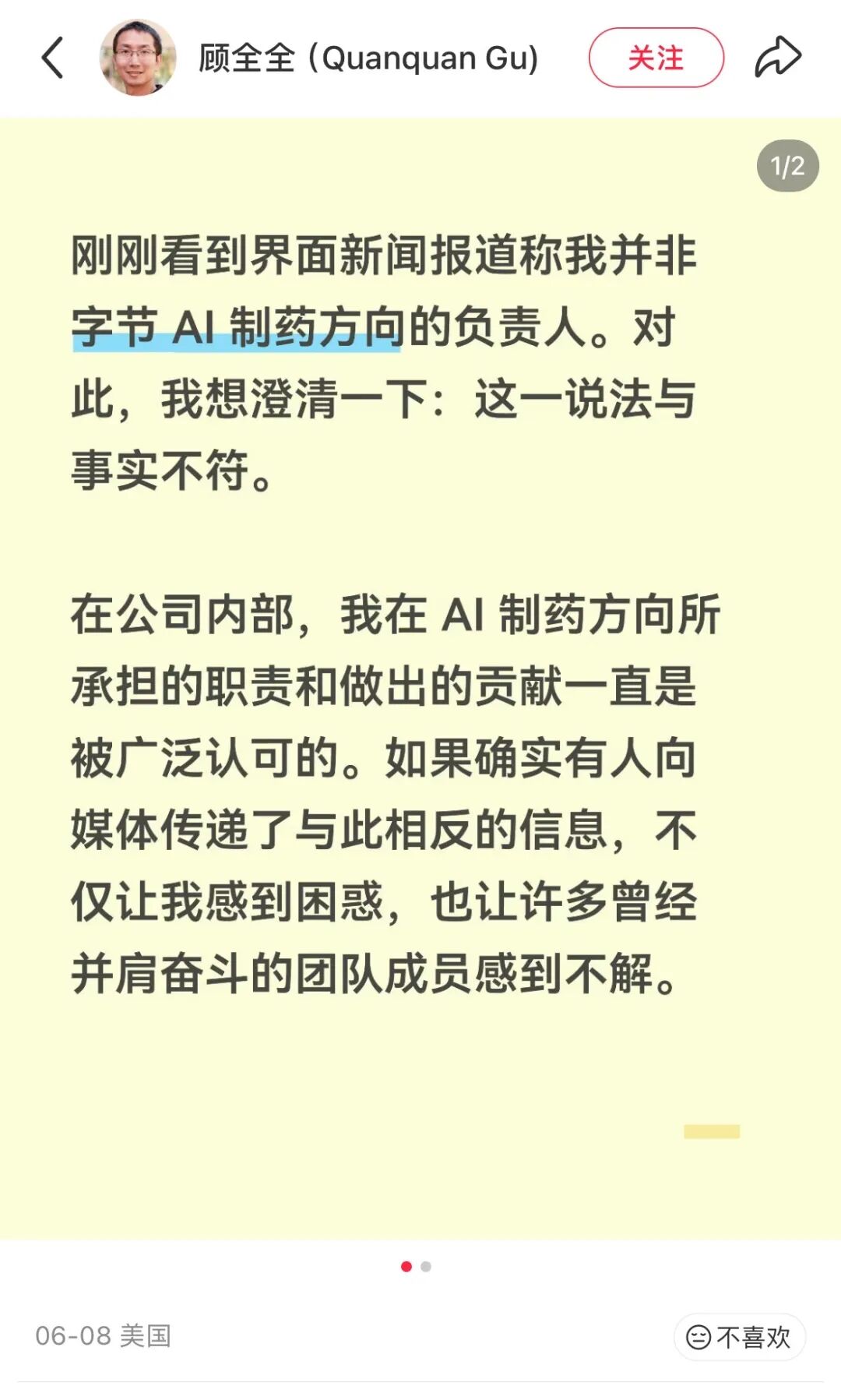
This rare public dispute revealed organizational friction during Seed's edge direction adjustments. More notable than job titles, Z Finance reported that Xiao Wenzhi, ByteDance's computational biology head leading the Protenix open-source project, and several other AI4S members had left or were preparing to leave ByteDance for startups around the same time.
The robotics direction underwent different adjustments. Seed Robotics, evolved from AI Lab's robotics team, transferred to Zhou Chang's leadership after merging into Seed in 2025. Now, this team reports to Zhou instead of Li Hang, who became Academic Collaboration Head, advising university partnerships. This reporting shift indicates further resource concentration: Multimodal, world models, and embodied AI must deeply reuse algorithms and data, with all three directions merged under one management chain.
Lightening the load means Seed retains decision-making power. Whether to chase Genie 3 with world models, invest in dynamic generation, or follow specific product logics for coding—these judgments come from Wu Yonghui and Zhou Chang's research sequence, with resources and talent flowing accordingly.
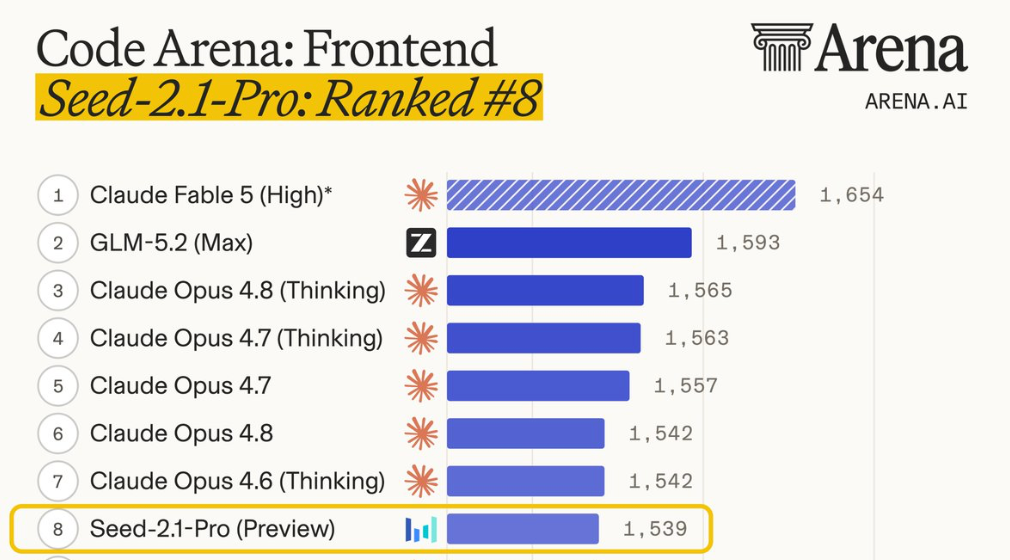
The list's sole direct C-end product reference is helping Doubao establish commercialization capabilities in office scenarios. This goal appears in ByteDance AI's overall strategic list alongside Seed-led technical routes like world models, video generation, and coding. But for Flow, this means commercialization is no longer a product team's self-paced experiment but an upstream-mandated task.

Flow's initial mandate was to make Doubao a high-frequency, ubiquitous consumer gateway. When Doubao launched, internal messaging repeatedly emphasized its strategic importance and freedom from monetization concerns. Its early design avoided ChatGPT's tool-focused approach, instead emphasizing anthropomorphism, companionship, proximity to users, multi-bot interactions, and daily engagement.
These tasks require different product philosophies: The former demands lowering barriers and expanding usage, while the latter requires tiered rights and interests (privileges), creating scarcity, and convincing users to pay for enhanced capabilities.
Flow executes the product side within ByteDance AI. This business group, parallel to Douyin, oversees C-end products like Doubao and the AI hardware team Ocean. Led by Zhu Jun, Flow has over the past two years fully replicated onto Doubao the methodology proven by Toutiao and Douyin: Following user habits, relying on data feedback, and rapid iteration. With relatively restrained marketing, it created China's first and currently only AI product with over 100 million DAU.
This approach solved the 0-to-1 problem but left it more controversial when charging. Users knew it as a free general-purpose assistant, not a professional office tool. With low user migration costs, whoever charges first gives competitors a reason to acquire their users.
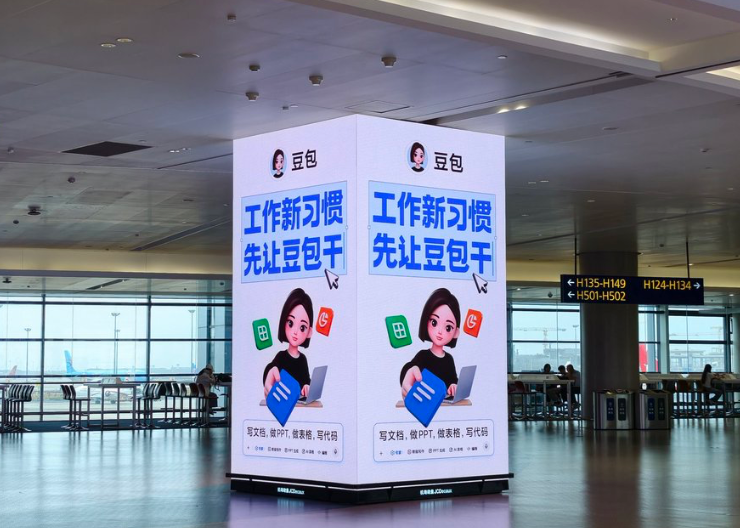
Doubao's paid rumors thus faced immediate backlash. During May Day, the news trended, and public opinion overwhelmingly questioned it. Doubao held internal meetings to address exposed Q&A vulnerabilities.
Flow is not unaware of reputational risks. On June 3, Doubao officially denied rumors of 'degrading basic features for membership,' emphasizing that the professional version targets software development, data analysis, and other professional scenarios while free services for daily Q&A, writing, and image generation remain unchanged. Yet ByteDance proceeded with charging as planned after explanations.
Financial pressure explains this persistence. By mid-2026, over 200 million people used Doubao daily, but daily revenue remained below RMB 1 million, mostly from e-commerce commissions. By May, estimating from Volcano Engine's public API prices and Doubao's large model gross margins, Doubao spent tens of millions daily.
This figure doesn't directly equal ByteDance's internal costs. Proprietary computing usage, procurement discounts, resource reuse, and inference optimizations all alter the final outcome, while public API prices don't reflect internal settlement rates. But this calculation highlights Doubao's challenge: Each new user batch requires upfront payment for corresponding API calls; larger user scales make commercialization delays increasingly untenable.
Subscriptions, ride-hailing, and storage expansions alone may not sustain significant revenue. But their rapid sequential rollout within ten days resembles a group task advancing on schedule.
The group's various ledgers ultimately converge at Doubao's interface. Office subscriptions test user willingness to pay for productivity, Seed seeks feedback from coding and agent tasks, and escalating computing costs demand revenue outlets.
In this division of labor, Seed is responsible for defining capabilities, while Flow bears the consequences of these capabilities being tested by users on behalf of the upstream.
ByteDance's past product organizations excelled at evolving answers from user feedback. Recommendation algorithms could be corrected in real-time through massive clicks, dwell times, and interactions, but the feedback loop for large models is slower and more expensive: more calls first mean higher inference costs, yet they may not necessarily translate into stronger underlying capabilities.
Liang Rubo once mentioned at an all-hands meeting that Doubao has not yet shown the internet product characteristic of "the more people use it, the better it gets." This makes it difficult for Flow to follow ByteDance's most familiar growth logic to justify the continuously expanding investment.
The product lead for Doubao also completed a handover during the same period. In September 2025, Zhao Qi, who had been with ByteDance for over a decade and served as the head of Growth Platform and Pangle, transferred to Doubao to oversee the product line. Compared to exploring a product from scratch, Zhao Qi's past experience in growth and commercialization systems is closer to the stable operation of mature products. The signal released by this appointment also leans more toward growth efficiency and commercialization.
The problem is that while the cash register is placed in front of Flow, the pricing power is not entirely in Flow's hands. Whether Doubao's answers are accurate, whether office tasks can be completed stably, and whether the cost per call can continue to decline all depend on the model, computing power, and underlying toolchain. Seed holds the model capabilities, the group's senior leadership decides where resources are allocated, and Flow directly faces user perception.
When Doubao answers incorrectly, charges too much, has insufficient quotas, or fails at office tasks, public opinion first points to the product; but whether the product can be smart enough and whether costs can be low enough are not decisions that Flow can make alone. Flow bears the final consequences but cannot independently decide all the conditions that produce these consequences.
The loss of 6.1 million monthly active users after May Day is a question Flow must answer; why subscriptions, ride-hailing, and storage were launched consecutively within ten days is not a question Flow can independently decide. ByteDance has placed the cash register in front of Flow, but the power to decide product capabilities, costs, and supply Rhythm (rhythm) remains disperse (scattered) upstream.

This year, the price of Doubao shares has been raised twice: the first repurchase in April saw a 30.8% increase from the grant price, and in June, it rose another 13.5% on that basis.
However, the incentive mechanism named "Doubao Shares" mainly flows to those working on the model. In 2025, Wu Yonghui announced the exclusive stock option plan "Doubao Shares" at the Seed department's all-hands meeting, targeting core technical employees in the large model direction. The key teams specifically listed were the large model R&D group, video generation team, and algorithm and engineering group. These teams all fall under Seed and do not belong to Flow, which is responsible for Doubao's product experience and user growth.
From the perspective of resource, talent, and incentive flows, Seed remains the priority center within ByteDance AI. The position of Doubao and its Flow in this coordinate system is not entirely symmetrical with their user scale. It is the largest distribution channel and the largest testing ground for model capabilities facing real users, but it is not where resource allocation decisions are made.
A bigger change is that ByteDance has started to split AI from a unified narrative into different ledgers. Seed's ledger looks at model capabilities and talent density, Seedance's ledger looks at API revenue and gross margin, and Doubao's ledger looks at whether user scale can translate into subscription, commission, and office task revenue. In the past, these ledgers could all be wrapped up in "All in AI"; now, they are beginning to be inspected separately.
This is not the first time ByteDance has made such trade-offs. For example, in November 2023, it decided to reorganize its gaming business after a review. Nuverse's public statement was to adjust its business direction, focus on a few innovative games and related technologies, while continuing to operate already launched products.
In March 2026, ByteDance agreed to sell Moonton Technology to Savvy Games Group, a subsidiary of Saudi Arabia's Public Investment Fund. ByteDance had acquired Moonton for an estimated $4 billion in 2021; the transaction price was not disclosed by both parties this time, but Reuters, citing sources familiar with the matter, said the deal valued Moonton at over $6 billion.
This timeline shows that a business does not necessarily disappear from ByteDance's portfolio immediately after losing top priority. A more common approach is to handle it piecemeal: directions still worth validating are retained, while assets that can be independently disposed of are divested, with more resources shifting toward the new strategic center.
Doubao and gaming are, of course, not the same type of business. It remains ByteDance AI's largest consumer-facing entry point and is responsible for model distribution, scenario validation, and user feedback. But the reference left by the gaming business is that investment scale, user scale, and the label of "strategic-level business" do not automatically translate into priority in the next stage.
"All in AI" once allowed all businesses to be written in the same ledger. In the summer of 2026, ByteDance began to turn to the page of Doubao.
*The featured image and illustrations in the text are sourced from the internet.
-
![]()
After the Demise of the Big Factory Bot, I Leveraged AI to Craft an Interactive 'Haaland'
-
Wu Jianjun Steps In: Konka’s Fight for Efficiency and Revival
-
![]()
Hainan Sets 2030 Deadline for Phasing Out Fuel Vehicle Sales: Which Regions Will Be Next to Follow Suit?
-
Huabei Outage: System Failure Challenges User Trust
-
![]()
Keling Valued at $18 Billion Amid Tencent's Stake Reduction in Kuaishou: Why Are Investors Voting with Their Feet?
-
![]()
Xiaomi Reportedly Laying Off Employees: Is Lei Jun’s Success Limited to Ventures He Oversees Personally?
-
![]()
Seres' Semi-Annual Report Predicts Loss of 1.5-1.8 Billion Yuan, Potentially Affected by Rising Raw Material Costs, Price Wars, and Asset Write-Downs. AITO Cars Move from Profitability to Losses.
-
![]()
Seed Eats Meat, Flow Drinks Soup: When ByteDance No Longer Goes 'All in' on a Single AI