Keling Valued at $18 Billion Amid Tencent's Stake Reduction in Kuaishou: Why Are Investors Voting with Their Feet?
 07/14 2026
 523
523

Introduction: As Doubao and Qianwen withdraw their intelligent agent services, is the 'red line' for video AI regulation on the horizon?
Recently, AI agent users have expressed widespread disappointment.
Doubao and Qianwen announced that they will discontinue their intelligent agent services on July 15, 2026, leading to the abrupt disappearance of tens of thousands of virtual companions and fictional boyfriends overnight.
July 15 marks the official enforcement date of the 'Interim Measures for the Administration of Artificial Intelligence Personified Interactive Services,' as regulators initiate a strict crackdown on AI market irregularities.
In the first phase of the 'Clear and Bright: Rectifying Chaos in AI Applications' campaign, over 14,000 non-compliant AI products have been addressed, more than 6 million pieces of illegal and non-compliant information cleared, and over 26,000 accounts dealt with.
The era of AI regulation has officially commenced.
I. The Next Target of AI Regulation: Video Generation AI
Since the beginning of the year, China has intensified efforts to rectify AI-related irregularities.
When OpenClaw sparked a nationwide sensation and shrimp farming became a craze, the Ministry of Industry and Information Technology issued a warning, proposing 'Six Dos and Six Don'ts' to mitigate the security risks associated with the OpenClaw open-source intelligent agent.
As early as June this year, the Cyberspace Administration of China clarified its focus on curbing AI-generated 'digital swill,' the creation and dissemination of false information, and the spread of violent and vulgar content.
2025 marked the dawn of the AI boom, and 2026 will see the gradual implementation of AI regulations.
If the withdrawal of intelligent agents represents the 'first strike' in AI interaction regulation, then video generation AI is likely the next target.
In the first quarter of 2026, AI-generated animated dramas accounted for over 95% of the 128,000 micro-short dramas released. Despite their popularity, with viewership often reaching tens of millions, these dramas are plagued by vulgar content and repetitive, mindless plots.
A prime example is the 'Rural Livestreaming' series, which revolves around a protagonist helping villagers sell agricultural products via livestreaming, only to be criticized for taking a cut of the profits, subsequently expelled, and realizing the inefficiency of solo endeavors, leading to regret, and so on.
This typical web novel formula is endlessly recycled, featuring crabs, oranges, watermelons, peaches, etc. The most inferior versions merely change the names, resulting in extremely low-quality content.
For instance, claiming that 10,000 jin of peaches sever the village's economic lifeline is unrealistic, given that the average peach yield per mu in most regions is around 3,000-4,000 jin, with some fertile areas and high-quality varieties achieving yields of 5,000 jin or more per mu. Can a village truly rely on the harvest from just two mu of land for its peach sales?
Similarly, series like 'White Moonlight Regrets' and 'Eavesdropping on Thoughts' are filled with slapping, violent, and vulgar behaviors, all produced repeatedly by simply altering the names and core words of low-intelligence scripts.
Last year, during the boom of live-action short dramas, there were indeed exceptional works, such as '18-Year-Old Grandma Restores Family Glory' and 'Adopting the Surname Langya,' which garnered rave reviews and achieved billions of views, surpassing the viewership of many mainstream dramas.
However, in the era of AI short dramas, mass-produced content with chaotic logic, empty information, and high similarity prevails, implanting vulgar and violent content and mockingly rendering family conflicts, almost without exception.
Previously, manual filming involved a filming and editing period, and considerations of costs if the content or script was poor. However, in the era of AI short dramas, without the need for professional filming or actors, videos can be mass-produced with simple instructions.
Without cost constraints, AI short dramas run rampant. If one becomes popular, it is simply renamed and adapted; if it succeeds, it makes money; if not, they move on to the next one.
Isn't this the 'digital swill' that the Cyberspace Administration aims to combat?
Of course, this is not the intention of Keling and others. Technological progress is never at fault.
As leading video generation AI platforms in China, Keling, Seedance 2.0, HappyHorse, and others have consistently showcased the maturity and excellence of Chinese AI technology on the international stage.
However, technological progress and content out-of-control are never the same.
Just as WeChat Official Accounts experienced a proliferation of 'clickbait' and 'shocking' headlines during their rise, the production threshold for graphic content naturally filtered out some low-quality producers.
In the era of video AI, even this threshold has been removed, transforming 'everyone is a creator' into 'everyone can be a producer of garbage content.'
The explosion of AI short dramas essentially outsources the 'creative screening' and 'quality control' links in the traditional film and television industry to algorithms, which only recognize traffic, not value.
The clustered appearance of these 'digital swill' issues also reflects the current shortcomings in script creation and review for video generation AI. In the future, if Kuaishou, Douyin, and others aim for high-quality content and want video generation AI to land smoothly under regulation, technological improvements in this area will be crucial.
On June 1, the National Radio and Television Administration launched a two-month special campaign to address harmful and vulgar content and copyright infringement in micro-short dramas, focusing on eight key issues, including content involving children, soft pornography, materialism and flaunting wealth, distorted views on marriage and love, feudal remnants, violent revenge, vulgar titles, and copyright infringement, in accordance with laws and regulations.
As the crackdown on short drama chaos intensifies, will video generation AI, the source of AI short drama production, be far behind?
II. Keling and Kuaishou: Vigilance Against the 'Sword of Damocles' of Regulation
If content-level issues are a common problem across the industry, then business-level risks require Kuaishou and Keling to be highly vigilant.
First, let's examine the current business ecosystem of video generation AI.
This sector faces an awkward reality: it struggles to retain C-end users.
Sora serves as a prime example. In December 2025, Sora's downloads declined by 32% month-on-month; in January 2026, they continued to plummet by 45%; the 30-day retention rate was only 1%, and the 60-day retention rate dropped to zero.
Most users 'try it out' and then leave. As of February 2026, Sora's cumulative consumer revenue was only about $1.4 million, while the daily computational cost to maintain operations was as high as $15 million.
Sora's failure illustrates a harsh truth: video generation AI is a 'low-frequency demand' for ordinary consumers. Users may generate a video out of curiosity to post on their social media, but it is hard to imagine ordinary users paying to generate videos every day.
Where are the real paying users? On the P-end, professional creators.
Kuaishou CEO Cheng YiXiao previously disclosed on an earnings call that P-end paid subscribers contribute nearly 70% of the operating revenue, a figure representative of the entire industry.
In this ecosystem where the P-end sustains video generation AI, Kuaishou and ByteDance have natural advantages.
They not only have fertile 'pastures' for P-end users to 'graze' but also suitable 'meat processing plants' for them to monetize. From generation to distribution to monetization, the closed loop is complete.
However, similarly, if regulation intensifies and rectifies video generation AI, this 'climate change' will directly impact the ecosystems of Kuaishou and ByteDance. Among the two, ByteDance is relatively better off, while Kuaishou needs to be highly vigilant.
Why?
Because for ByteDance, the situation is relatively more relaxed. Video generation AI is an important module for ByteDance, but it also has a series of ecosystems such as Doubao, Volcano, and the main body of Douyin. However, for Kuaishou at present, Keling can be considered, to a certain extent, the lifeblood of the company.
Let's look at a set of data.
On July 2, Keling AI completed its first round of independent financing, with a total amount of up to $3 billion and a post-investment valuation of approximately $18 billion, setting the highest record for a single financing round among global video large model enterprises.
BAT rarely appeared on the same stage, with CPE Source Peak, Guofang Venture Capital, and others all entering the fray. With a valuation of $18 billion, it is equivalent to approximately 77% of Kuaishou's current total market value (approximately RMB 159.4 billion).
The market's optimism towards Keling is evident.
However, just four days later, in the early morning of July 6, Kuaishou announced that Tencent had reduced its stake by 273 million shares, cashing out approximately HK$12.5 billion, reducing its shareholding from 15.68% to 9.37%, no longer being a major shareholder.
Kuaishou's stock price closed down 12.04% the next day, at HK$40.46 per share.
Within four days, Tencent completed a buy and sell transaction in the same company, investing in Keling with one hand and selling out of Kuaishou with the other.
What does this mean for Kuaishou?
It may imply that a significant portion of the capital market's expectations for Kuaishou has shifted to Keling.
Keling's revenue in the first quarter of 2026 exceeded RMB 650 million, a year-on-year increase of over 300%, showing strong momentum.
According to data from Tianyancha APP, Kuaishou's overall Q1 revenue only increased by 3.4%, and its adjusted profit also decreased by 26.3% year-on-year. Kuaishou achieved a profit of RMB 2.9 billion for the period, with an adjusted net profit of RMB 3.4 billion and an adjusted EBITDA of RMB 6.2 billion, representing decreases of approximately 27.5%, 26.1%, and 3.2%, respectively.
The short video traffic dividend has peaked, and the growth rates of advertising and e-commerce are not impressive. A once-dominant short video giant is seeing its growth engine stall.
And Keling is its brightest card.
If Keling suffers ecological shocks due to intensified regulation of video AI, with content taken offline and compliance costs soaring, corresponding P-end creators may also follow suit and leave.
This is not an alarmist statement.
During the first phase of the 'Clear and Bright: Rectifying Chaos in AI Applications' campaign, AI emotional companionship products faced a similar situation: platforms unable to meet regulatory requirements in a short time chose to take functions offline to avoid risks, with ByteDance and Alibaba being no exceptions.
If video AI also undergoes similar rectification, enforcing AI content labeling, cleaning up 'digital swill,' and addressing violent and vulgar content, what risk avoidance measures can Keling take?
Therefore, for Kuaishou, the ecological health of Keling is of utmost importance. It should proactively take precautions and strengthen regulation; otherwise, facing regulation with the current ecosystem may cause fluctuations in Kuaishou's overall ecosystem.
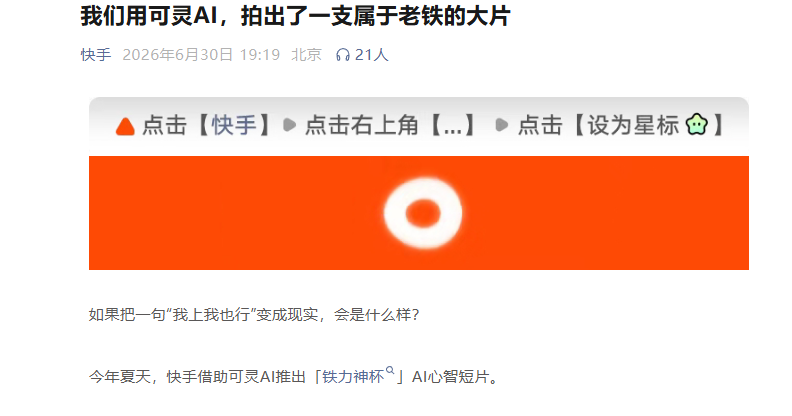
Fortunately, Kuaishou is not lenient in governing short dramas, continuously taking down low-quality short drama works since last year. Kuaishou is also guiding creators to use Keling to generate healthy works that align with the 'Laotie' culture.
Keling's technological strength is undeniable, with $3 billion in financing and an $18 billion valuation being the best proof. However, technological and commercial success cannot exempt it from the responsibility of content ecosystem governance.
Doubao and Qianwen withdrawing their intelligent agent services is the first 'sword strike' of regulation on AI applications. The second phase of 'Clear and Bright' targets 'digital swill' and violent vulgarity, with video AI likely being the next target.
The script remains the same. After technological progress, rules always come to hit the brakes.
Only this time, the person hitting the brakes may already be standing at the door. And Keling and Kuaishou, sitting in the car, are they prepared for emergency braking or drifting around the bend?
Disclaimer: This article is based on legally disclosed company information and publicly available data, providing commentary, but the author does not guarantee the completeness or timeliness of this information.
Additionally: The stock market involves risks, and caution is advised when entering. This article does not constitute investment advice, and investment decisions must be made independently.
-
![]()
After the Demise of the Big Factory Bot, I Leveraged AI to Craft an Interactive 'Haaland'
-
Wu Jianjun Steps In: Konka’s Fight for Efficiency and Revival
-
![]()
Hainan Sets 2030 Deadline for Phasing Out Fuel Vehicle Sales: Which Regions Will Be Next to Follow Suit?
-
Huabei Outage: System Failure Challenges User Trust
-
![]()
Keling Valued at $18 Billion Amid Tencent's Stake Reduction in Kuaishou: Why Are Investors Voting with Their Feet?
-
![]()
Xiaomi Reportedly Laying Off Employees: Is Lei Jun’s Success Limited to Ventures He Oversees Personally?
-
![]()
Seres' Semi-Annual Report Predicts Loss of 1.5-1.8 Billion Yuan, Potentially Affected by Rising Raw Material Costs, Price Wars, and Asset Write-Downs. AITO Cars Move from Profitability to Losses.
-
![]()
Seed Eats Meat, Flow Drinks Soup: When ByteDance No Longer Goes 'All in' on a Single AI