Why Does Yin Qi, Who 'Doesn't Listen to Advice,' Insist on Making AI Agent Smartphones? | Interview with Jieyue Xingchen
 07/14 2026
 367
367
In developing AI agents, Jieyue Xingchen has chosen the most challenging path.
'Many people advised us not to make hardware, but in the end, we went ahead and did it,' said Yin Qi.
Previously, our impression of Jieyue Xingchen was that of a 'large model vendor' providing AI capabilities for mobile phones and automobiles. However, on July 13, the company shed its original label and officially released the large model-native AI terminal brand STEPX for the age of AI agents, while unveiling its first AI terminal—the large model-native AI agent smartphone STEPX Neo—marking its formal entry into the hardware sector.
Why the 'disregard for advice?'
Yin Qi stated that without directly creating an innovative terminal, it would be difficult for the agent OS to unleash its capabilities on old operating systems and devices, forming a value closed loop, or allowing consumers to truly perceive its value.
'Few people know that Anthropic formulated its Coding strategy as early as 2021. For a large model startup, it cannot catch up from behind; it must make choices and have convictions from the very beginning,' Yin Qi said. 'Jieyue Xingchen has believed from the very beginning that large models need to reach consumers through good smart terminal products, rather than just focusing on B2B. This strategy has been in place from the start, and my joining has accelerated its implementation.'
In the AI agent terminal space, smartphones are an increasingly competitive category.
The first-generation 'Doubao Phone' integrated AI assistant capabilities into the phone, using a GUI Agent (Graphical User Interface Agent) to enable various permission activations, allowing the phone to truly assist users. Although it was quickly 'suppressed' by apps, the second-generation 'Doubao Phone' is now deeply collaborating with Nubia and will debut at this year's WAIC. Then there's OpenAI, which was reported in April this year to be developing an AI agent smartphone, collaborating with MediaTek and Qualcomm to develop mobile processors, aiming for mass production as early as the first half of 2027.
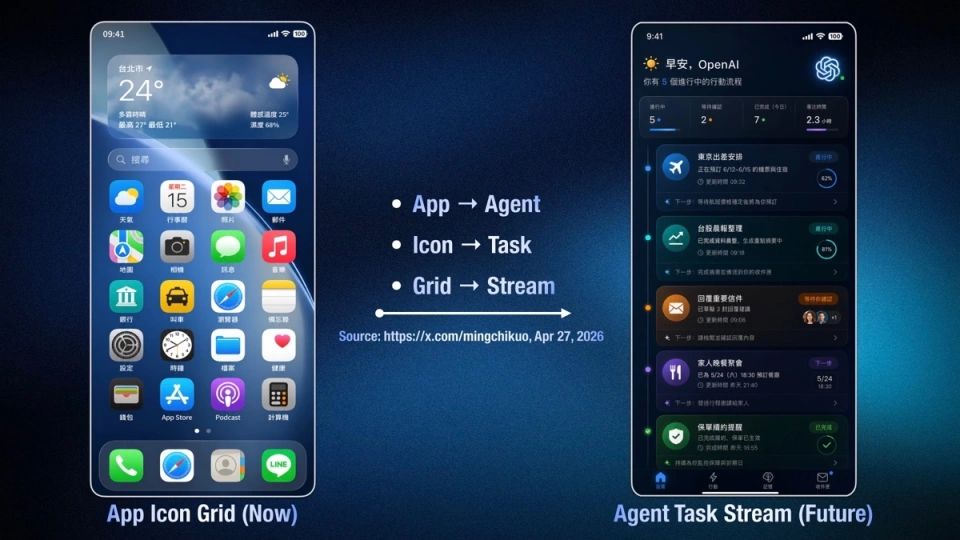
Ming-Chi Kuo's conceptual rendering of OpenAI's smartphone
All these products point to one fact: the core of this generation of AI agent smartphones lies in breaking through the operating system to gain internal permissions, thereby truly assisting users through human-like interactions:
In contrast to previous agents that used MCP to invoke software capabilities, GUI Agents now directly bypass app barriers. They can 'read' information by capturing screen interfaces and then simulate screen taps based on each step of the agent's plan. By accessing internal permissions, their capabilities are further enhanced—such as opening your email app to organize information or automatically replying to friends' messages.
However, they quickly encounter the insurmountable 'Wall of Sighs' of apps.
When agents attempt to operate directly beyond apps, they inevitably infringe on the app traffic ecosystem and commercialization models—they take over information retrieval and operations, cutting off the ad views and clicks that apps rely on for survival, directly threatening the core business models of app developers.
'All these scenarios are nearly impossible to achieve under the current Android system when crossing app boundaries,' Yin Qi pointedly highlighted the pain point. 'For ordinary users, the most relevant are many local life applications, but they require data and permission connections beyond the app level—this is why our users definitely need a new OS.'
At the launch event, Jieyue Xingchen released the personal AI agent Jieyue Amoo and the self-developed agent-native operating system Step AOS (Step Agentic-native OS). The first large model-native smartphone under the STEPX brand, STPEX Neo, also made its debut, with Yin Qi stating that it is still being refined.
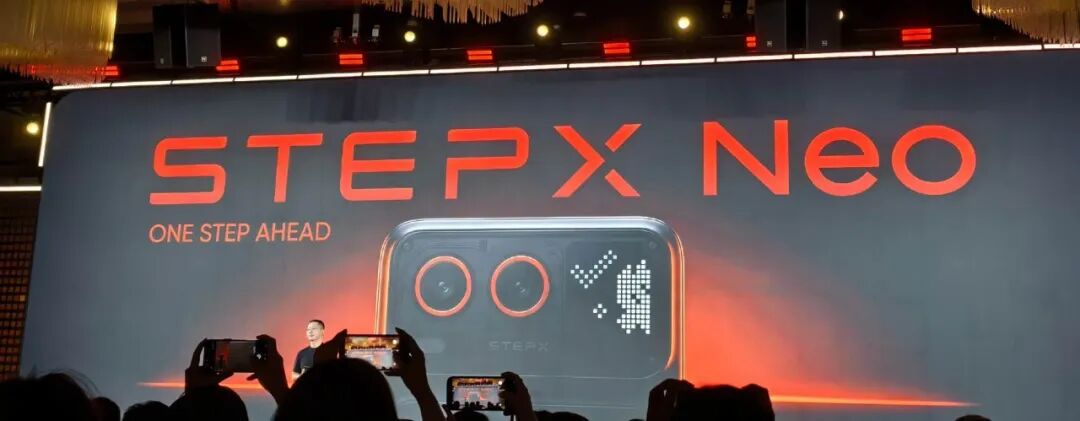
Built on the AOS system, Jieyue has redesigned three foundational capabilities:
The first is memory capability. AOS constructs a 'dual-domain, three-step memory structure'—the 'user domain' allows the agent to understand user profiles, while the 'agent domain' is responsible for its own continuous growth in knowledge and experience. To enable precise recording and recall by the agent, Jieyue Xingchen has established a 'record-process-recall' three-step chain: recording at any time during daily interactions, automatic backend organization and precipitate [translation note: ' precipitate ' is translated as 'organization' here to convey the idea of accumulating and structuring information], and precise recall when needed.
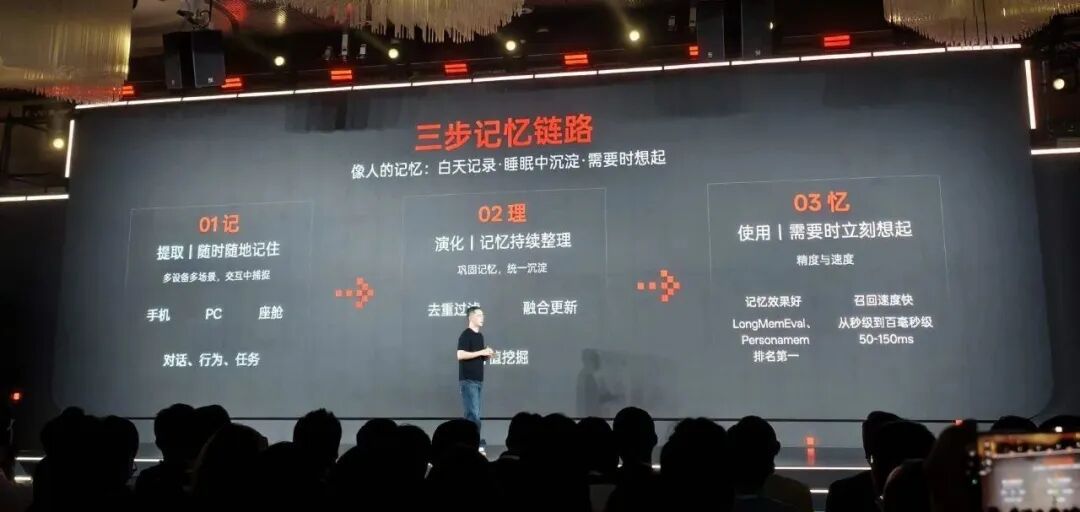
The second is decision-making and execution capability. Yin Qi did not shy away from discussing the realities of edge-side computing in interviews: 'Current edge-side chips struggle to run models with tens of billions of parameters. If we want the agent to perform hundreds of operations for you in the future, users expect it to be done in seconds, not waiting for ten minutes.'
To address which scenarios use the cloud and which use the edge, Jieyue Xingchen employs an 'edge-cloud multi-brain' approach, assigning immediate tasks to edge-side models while handing over complex reasoning and multi-step planning to the cloud, with the two working in tandem when necessary. Privacy data never leaves the device.
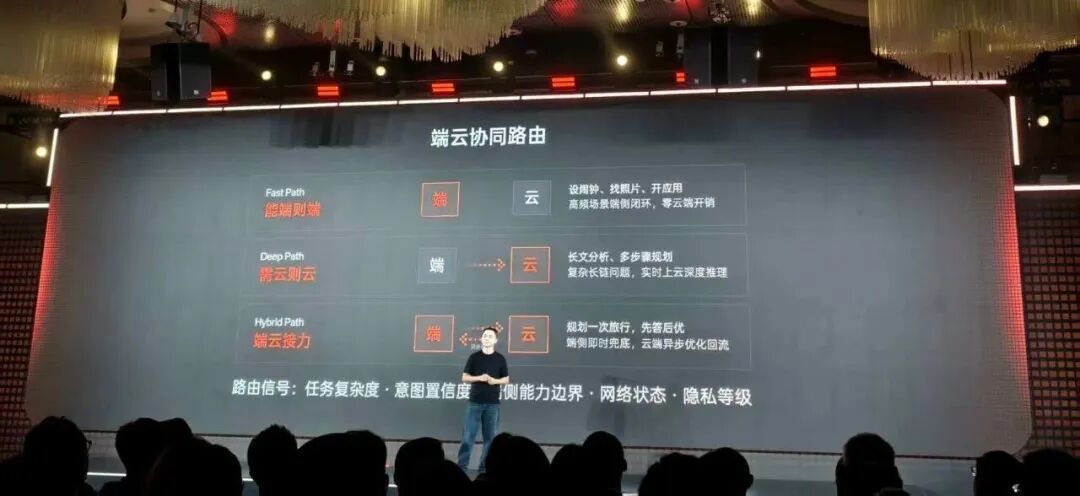
The third is security capability. Yin Qi stated that AOS has rebuilt Android, Linux, and RTOS while establishing a security framework on top.
'Security mechanisms are dynamic and data-based. For example, when deleting a photo, it needs to understand the context, know what constitutes sensitive information, and whether to delete it. There are many complex mechanisms involved. AOS has a dedicated team responsible for security and privacy, with extensive software-level architectural design,' Yin Qi revealed.
The capabilities of the agent Amoo, which 'grows' on AOS, have been expanded. It possesses operating system-level identity—capable of cross-app scheduling, edge-cloud collaboration, and seamless task continuation across multiple devices.
Overall, Jieyue's design for agent smartphones does not exceed the foundational frameworks of previous AI phones, such as edge-cloud collaboration, agent memory, and privacy management. However, compared to the industry's approach of 'gradually elevating AI permissions' from smart assistants to system-level AI and then to AI-native operating systems, Jieyue's vision is relatively more complete and less burdened.
Currently, the smartphone supply chain is highly mature; making a phone is not difficult, but achieving scale is.
Regarding sales expectations for the first generation, Yin Qi stated that the first phase will not solely pursue shipment volume but must 'achieve scale,' as only by reaching a certain scale can the model flywheel truly start spinning.
According to IDC data, the top five smartphone vendors in the Chinese market currently sell at least 9 million units annually. This means Jieyue must achieve annual sales of at least ten million units to 'enter the game.'
In developing smart terminals, Jieyue Xingchen has chosen the most challenging path. Next, it remains to be seen whether Amoo can truly 'settle in' on StepX Neo and prove its value.
After the AI terminal brand launch event, Yin Qi, Chairman of Jieyue Xingchen, and Ni Jiayue, President of Jieyue Xingchen's AI Terminal Division, accepted a media group interview. Below is a compilation of the interview content:
Q: What is the essential difference between launching an AI terminal brand and the previous B2B strategy?
Yin Qi: Previously, we focused on B2B, providing full AI capabilities to mobile phone and automotive OEMs. That business will continue.
However, in the age of AI agents, the existing mobile ecosystem struggles to fully present the integration of models + OS + agents. We hope to lead by example, first building a complete ecosystem while maintaining an open attitude—future agents and the OS are very willing to be opened up to other OEMs.
Q: How do you determine if AI hardware can achieve a positive commercial cycle? What is the biggest challenge in making hardware?
Yin Qi: The team has over a decade of experience in hardware supply chains, approaching hardware with both reverence and caution. We chose a closed loop because we chose to do the difficult but correct thing.
Today's focus is Step AOS; the first step is to deliver the OS. If we cannot be the first to create an innovative terminal, Step AOS will struggle to form a value closed loop or reach consumers.
Building large models is hard, and so is making hardware—doing both is even harder. The greater challenge is if we don't believe in other commercialization paths ourselves. Chinese large model companies need to find their own paths to commercialization and industrialization.
Q: You've been with Jieyue for nearly 200 days. What major strategic adjustments have you driven?
Yin Qi: Anthropic set its Coding strategy in 2021; today's results are the culmination of five years. Large model startups cannot catch up from behind; they must make choices, trade-offs, and have convictions from the very beginning.
Jieyue believed from Day 1 in the integration of software and hardware—that large models need good hardware carriers to reach consumers, focusing on B2C rather than B2B, ultimately forming a commercial closed loop. This strategy has existed from the start. My role has essentially been to accelerate its implementation. This is also why we haven't been very vocal over the past three years.
We're speaking up now because we're ready to showcase the full strategic landscape. It will still be difficult going forward, but this is what makes AI entrepreneurship truly interesting.
Q: Where do this AI terminal and agent system fit in the roadmap toward AGI?
Yin Qi: We believe the path to AGI involves three stages: language models, multimodal models, and world models. I have always been an entrepreneur who combines AI and hardware.
Taking the automotive sector as an example, only by forming suitable physical carriers in vertical scenarios can innovations like autonomous driving and smart cabins emerge. The same applies to smartphones: only with hardware can a value closed loop and data flywheel form. Currently, agents excel at writing code and articles but struggle to execute instructions on mobile PCs. Without an OS and ecosystem, they will never excel because they lack data.
Q: How do you position AI phones? Is it about fostering an ecosystem or aiming for high sales volumes?
Ni Jiayue: Our biggest focus this year is bringing agents into the physical world. The true user base is how many users in the physical world accept AI, so we haven't set a specific sales target.
Unlike traditional terminal manufacturers, we don't start by setting shipment targets and then pushing products. In the AI era, we care more about the symbiosis between agents and users. As human-agent symbiosis progresses, more AI-savvy users will accept agents in the physical world, so sales volumes shouldn't be the deciding factor.
Q: OpenAI is also releasing a phone next year. Did their plans inspire Jieyue's release this year?
Yin Qi: When we started in 2011, everyone talked about 'copy to China.' Now, in the AI era, China should have original capabilities.
We pay attention to OpenAI, but in the terminal space, we should focus more on Gemini and Apple. This is a mutual learning process. In combining software and hardware, China has a strong supply chain advantage. Combined with our AI strengths, we should be able to create products that amaze global users.
Q: Making hardware involves supply chains, quality control, after-sales, and other dimensions. How do you address areas outside your core expertise? Why didn't you heed the advice to 'avoid hardware'?
Yin Qi: For over a decade, my background has been in software-hardware integration, while Ni Jiayue is a veteran in hardware terminals. We have a complete team—daring but not reckless, with a deep understanding of supply chains, quality control, and R&D systems. Precisely because of this, we see it as a good opportunity to push the industry forward.
The DNA must be right from the start. If a company isn't built on software-hardware integration, it's hard to succeed in hardware. The parent company is purely large model-driven, software-centric, while the terminal division is strongly software-hardware integrated.
Q: What will you do—and not do—in terminals and agents? What are the boundaries?
Yin Qi: On the model side, we won't pursue video generation models—that track [translation note: ' track ' is translated as 'field' here to convey the idea of a competitive area] is naturally suited for large companies. We focus more on foundational models, multimodal perception, and interaction capabilities.
On the agent side, we concentrate on personal agents as the primary phone interface. Vertical agents must be co-built, co-lived, and co-created—we won't build them ourselves.
For future devices, the AI Native standard is very strict. We aim to build AI-native agent terminals, not just phones + AI. By this standard, we'll make very few device types in the future, only those truly strongly related to AI.
Q: How does your phone differ technically from Doubao Phone? Will you completely abandon Android in the future?
Yin Qi: Previous Agentic OS versions were more like iterative upgrades to Android; we see a different path. Essentially, this OS should sit above all future edge-side OS layers, building a runtime environment for agents from scratch based on human-agent symbiosis principles while maintaining backward compatibility with Android/Linux/RTOS.
We believe future OS should be cross-device, not confined to a single phone or PC. By this definition, our approach to agent systems differs significantly from existing terminal manufacturers (including Doubao). Ideally, everyone should rapidly experiment, and we'll see which path proves correct.
Q: Will Amoo only be on STEPX Neo, or do you want to empower other phone manufacturers?
Ni Jiayue: As long as manufacturers are willing, we're open to it. The large model is open-source, and Step AOS is open-source too. As long as partners are willing to collaborate, we hope to embrace more allies, jointly bringing agents into the physical world and giving Amoo more scenarios. We don't insist on keeping Amoo exclusive to our phones.
Q: How does AOS address permission and security issues?
Yin Qi: The most critical aspect lies at the OS level. Step AOS has rebuilt Android, Linux, and RTOS, adding an agent framework on top. Security is based on data security, requiring more context for judgment.
We've released a 'trustworthy, visible, controllable, reversible' agent security framework with hard mechanisms like sandboxes and rollbacks. The most important aspect is dynamic, data-based mechanisms—for example, when deleting a photo, it needs to understand the context and whether the information is sensitive. We have one of the largest security teams dedicated to OS security and privacy.
Q: What are your thoughts on new architectures and technological routes for models? What proportion of investment goes into foundational models?
Yin Qi: Investment in foundational models holds an absolute position within Jieyue. We're serious about foundational models, focusing on agents, so we invest more in multimodal capabilities than other model vendors. There's relatively broad consensus on large model architectures. You can expect Step4 later this year, and possibly Step4 Pro, which will show strong performance in foundational intelligence ceilings, long context, and RSI.
If we're talking about foundational models, top-tier companies will be relatively close. Aside from the three U.S. companies with a head start, Chinese vendors are relatively close. The true differentiation in large models will come from application data-driven advancements. Over the next two to three years, Jieyue will be among the most technologically solid and strategically determined in China's foundational large model landscape. We don't aim to be the Phase 1 [translation note: ' Phase 1 ' is translated as 'temporary leader' to convey the idea of short-term leadership], but we must remain globally top-tier while integrating with agent terminals—that's our long-term strategy.
Q: Edge-side implementations have become homogeneous. Can OS and hardware nativity break this cycle?
Yin Qi: From the perspective of model dimensions, a pure on-device model system does not exist; the cloud needs to share computing architecture and data. Without developing large models, small models cannot be done well; without the capabilities of large models, it is also difficult to deploy models on the edge side.
For future on-device deployment, we may not necessarily be the best, but we are one of the most serious companies working on intelligent agent terminals. Current on-device chips cannot fully support the future needs of intelligent agents. Whether a good on-device chip architecture can emerge in the next two to three years, working in tandem with the cloud, is something we hope to promote.
Intelligent agent terminals are still in a very early stage. This involves a complete reconstruction from the most fundamental layers to the top, a massive undertaking. We have taken the initiative to start this.
Q: What is the most important milestone for the next step, or the sign of success for the first phase?
Yin Qi: We hope that the earliest mass-market intelligent agent phones will be truly used by AI Native efficiency-focused users, fostering genuine co-creation. Many Skills and Agents are still rapidly evolving.
In the first phase, we will not solely pursue shipment volumes, but we must achieve scale. Just as Vibe Coding needed users to get the flywheel spinning in its early days. We have clear internal goals and hope to get users on board as soon as possible.
Why is hardware development difficult? There's a saying that it takes three generations of hardware to produce a 'noble.' The iPhone 1 wasn't that impressive either; it wasn't until around the iPhone 4 that it truly became a mass-market product. We have sufficient patience and hope to iterate quickly, working alongside our earliest users, because this involves the complete iteration of models, systems, and terminals.
Q: What will the terminal business model be? One-time hardware sales, or hardware plus subscription?
Yin Qi: It will definitely not rely on simply selling hardware for profit, nor will it depend on long-tail application pre-installs and advertising for profit. These are the main models for current terminals, but they should not be the reasons for the intelligent agent era in the future.
A business model built on user needs will be effective. In the past, terminal development involved identifying selling points, incorporating them into phones, and then setting prices—that was the traditional era. In the AI era, we need to co-create, working more with intelligent agents and with users.
Q: Do you already have prototypes?
Yin Qi: Yes, we do. Whether we can sell them depends on many factors, but we will push forward as soon as possible. The important thing is that when people get this phone, users won't need to ask, 'What's different from existing phones?' For our first batch of early users, we are not pursuing a 'perfect product,' but rather something that truly feels like a new species, and we want to gather genuine feedback.
-
![]()
Hunan’s Wealthiest Entrepreneur Eyes Comeback with Apple’s Foldable iPhone
-
![]()
Planning to Secure 1.055 Billion Yuan to Propel AR Optics Forward! Lante Optics Receives Green Light for Private Placement on the Science and Technology Innovation Board
-
![]()
MiniMax: At the Heart of the AI Maelstrom
-
![]()
Securing 600 Million Yuan in Funding: This AR Optics Company Steps into the Limelight!
-
![]()
From a 706% Surge to a $340 Billion Market Cap Plummet: Has MiniMax's Moment Passed?
-
![]()
High Demand, Low Stock Price: Can the Emotional Companion Robot Ease UBTECH’s Worries?
-
![]()
Why Does Yin Qi, Who 'Doesn't Listen to Advice,' Insist on Making AI Agent Smartphones? | Interview with Jieyue Xingchen
-
![]()
AI-Generated Code Reveals Surprise That Thrills China