Model AB Price Reduction Controversy: Is Ninebot Losing Its Friendly Touch?
 08/02 2026
 342
342
Author/Qingfu
Editor/Jiajia
Recently, Ninebot electric bikes have become embroiled in a controversy surrounding their 'Model AB.' Specifically, the FZ3 110 model under the Ninebot brand is available in two versions—old and new—with notable differences in motor performance and firmware upgrade capabilities. However, Ninebot did not disclose this information during its promotional sales, leading many consumers to purchase products of varying quality at the same price.
Numerous consumers have already voiced their complaints on platforms such as Xiaohongshu and Heimao Tousu, demanding explanations and subsequent actions from Ninebot. Yet, as of now, Ninebot has not offered any follow-up compensation.
It's worth noting that in its previous brand promotions, Ninebot positioned itself not just as a product seller but also as a brand seeking to forge friendships with young consumers. Through user-centric marketing that emphasized understanding and listening to its users, Ninebot achieved remarkable success in the two-wheeled electric bike market, winning the favor of many young people and even showing signs of expanding to entire families.
However, in the current 'Model AB' controversy, Ninebot's silence has left users feeling betrayed. Without being informed about the existence of old and new versions of the FZ3 110 model, why haven't consumers who purchased the old version received an official apology and compensation from Ninebot? Is this how Ninebot builds friendships with its users?
【1】Not Just Selling Products, But Building Relationships
For the two-wheeled electric bike industry, Ninebot stands out as both an innovator and a formidable competitor:
In June 2026, affected by new national standards, the domestic two-wheeled electric bike market hit a growth bottleneck, with overall sales reaching 6.42 million units, a year-on-year decrease of 3.8%. Traditional brands like Yadea, Ai Ma, and Tailg experienced sales declines of 5.8%, 7.9%, and 1.1%, respectively, with market shares increasing by -0.8%, -0.8%, and 0.4%.
In contrast, Ninebot bucked the trend, achieving a June market share of 10.6%, a 3.3% month-on-month increase, and becoming the brand with the highest growth rate. How has Ninebot managed to penetrate the industry's downturn?
Unlike other sellers of two-wheeled electric bikes, Ninebot views electric bikes not as a one-time transaction but as a tool to forge relationships with users, especially young ones. By offering superior products, Ninebot builds trust with users, thereby unlocking ecological scenarios for the entire family. This is the complete closed-loop strategy that Ninebot has always advocated: 'tech enthusiasts → loyal users → family users.'
'Stand at attention, take the hit, and correct quickly,' stated Wang Cheng, Ninebot's market head. 'We don't want to be stubborn old men who don't listen to advice but young people who admit and correct mistakes.' This approach has brought Ninebot closer to young people. Facing user complaints on social media, Ninebot must bravely accept criticism to win users' favor.
A case in point is when users previously complained about Ninebot products, the company's boss would respond to user messages in groups late at night. When users raised concerns about the bike's shock absorption and lights, Ninebot's technical team would provide solutions within a week.
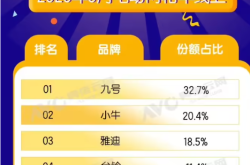
By taking young users' product issues seriously, Ninebot has gained a loyal following. In June 2026, Ninebot accounted for a staggering 32.7% of online retail sales of electric two-wheelers, surpassing Xiao Niu and Yadea to top the charts.
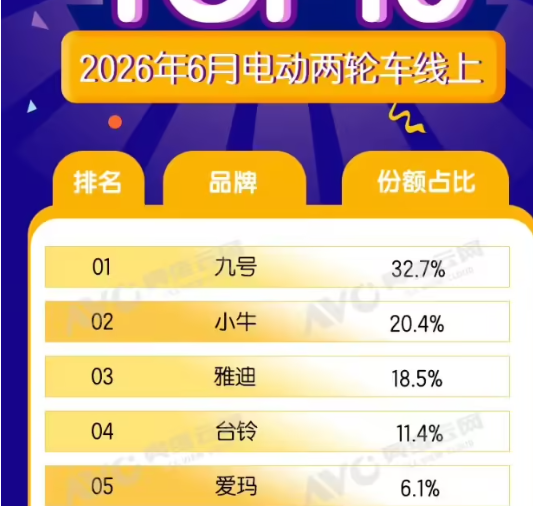 (Source: All View Cloud)
'It's not us educating the market; it's young users teaching us how to make products,' Wang Cheng said in a media interview. Within Ninebot, the philosophy of putting users first is repeatedly emphasized.
Ninebot's success largely stems from its business philosophy of respecting users and operating from their perspective.
【2】Model AB Exposed, Ninebot's Tardy Response
'We're at a critical climb. It's like running a marathon; we've just completed 10 kilometers, seeing some achievements but knowing the road ahead is long,' Wang Cheng said. In the competition among domestic electric two-wheelers, Ninebot has won the first half.
However, amidst its victories, consumers have noticed a shift in Ninebot's approach. It seems to be abandoning its philosophy of respecting, listening to, and befriending users.
For instance, in the recent issue of Ninebot's two-wheeled electric bike Model AB, it is understood that the FZ3 110 model exists in two distinct product versions. The old model's certification date is November 2025, with certification number TDT167Z, while the new model's issuance date is February 2026, numbered TDT238Z.
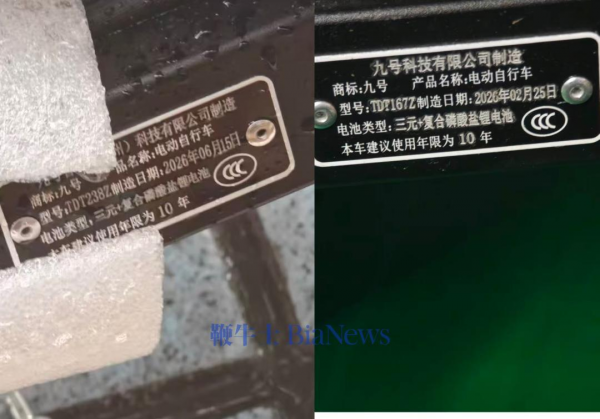 (Source: Internet)
Compared to the new model TDT238Z, the old model TDT167Z has deficiencies in both software and hardware. At the software level, users have been explicitly informed that the firmware is permanently locked at version 6.5.2.5, with official OTA updates permanently discontinued. In terms of hardware, the old model is criticized for resonance and electromagnetic noise issues.
A blogger on Xiaohongshu complained: 'I bought an electric bike for 4699 yuan at the end of June, and by July, the motor batch was better after a price reduction. Now, the total mileage is less than 200 kilometers. The old motor stutters and lacks power on slopes. I spent more money to buy a worse motor. What did I pay over 4000 yuan for?'
It's clear that the old and new models differ significantly. However, the issue lies not in the differences but in Ninebot mixing the sale of the two models without informing consumers about the existence of AB old and new versions, whether in promotional posters, product introductions, or offline purchase services.
This has led to some consumers unknowingly purchasing an old model at the same price, leading many users to claim it's for clearing inventory.
More importantly, consumers' rights have been compromised. However, in the half-month since mid-July, Ninebot has only stated to some media:
The two different models of FZ3 110 are produced by two different factories, hence the differences in model numbers. However, both models have complete product qualification filings and meet national standard requirements.
But regarding subsequent compensation and handling measures, Ninebot has not officially responded.
This inevitably raises questions. Without any notification from Ninebot, consumers have purchased two-wheelers with different performances at the same price. Why has Ninebot been slow to respond to those who bought the old model? Regardless of whether they were produced by different factories, differences in software and hardware performance do exist.
【3】Sudden Price Reduction, Betraying Old Users' Trust
In fact, the lack of response to the Model AB issue is just a microcosm of Ninebot starting to distance itself from and stop listening to its users.
Taking the FZ3 110 as an example, the bike was first released on December 22, 2025, at a price of 4899 yuan. Subsequently, the price dropped to 4499 yuan and further fell to 3799 yuan, a decrease of over 1100 yuan in eight months.
While rapid product iteration and price declines are normal, what angers many consumers is Ninebot's betrayal.
'Betraying loyal customers! There will be fewer and fewer loyal customers,' a blogger shared on Xiaohongshu, stating that during store promotions, they were promised the lowest price of the year, but the bike's price dropped by 250 yuan within ten days of purchase, eventually being exchanged for an umbrella and helmet.
Such experiences are not isolated. A consumer in Guangdong said they purchased the Ninebot FZ3 110 for 4999 yuan during the 618 promotion, aiming for the lowest discount. However, by July, the official price was only 3799 yuan, greatly sparking the consumer's dissatisfaction: 'The price plummeted in less than two months! Now it's only 3799 yuan. What does my 4999 yuan purchase count for? Am I just rich? It's dropped more than cars! Is this fair to previous Ninebot owners? Are we being treated as suckers?'
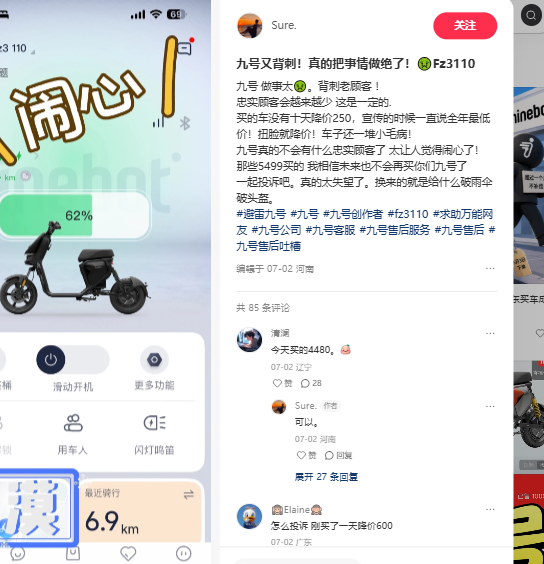 (Source: Xiaohongshu)
Searching for the keywords 'Ninebot betrayal' on Xiaohongshu reveals numerous user complaints, with some saying, 'Ninebot betrays again! They really went all out!' Others suggest, 'Ninebot is truly an excellent company; if you can't afford to play, don't hold promotions.' Some users even refer to Ninebot as a 'sucker car, betrayal king'...
Without prior notification before price reductions and only offering lower-priced products as compensation afterward, this is a clear betrayal of old customers for consumers.
It's worth mentioning that Wang Cheng once said, 'Don't be fooled by short-term growth figures. The goal is for young people to think of Ninebot first when it comes to travel.'
However, judging by the Model AB and price reduction betrayal issues with the Ninebot FZ3 110, Ninebot seems to have forgotten its original intention of 'sales being the result, not the goal' in embracing young users.
From 'the boss responding to messages late at night' to 'waiting half a month for a response,' Ninebot's silence in the Model AB controversy is eroding its most precious asset—user trust.
According to Ninebot's earlier plan, it targeted tech enthusiasts as its core user group, aiming to win their trust through products and services and convert them into its base. Then, it relied on these core users to drive the entire family user base.
It was this path planning that led us to see Ninebot's early care and respect for users. However, with the establishment of its core base, Ninebot seems to have become lax in communicating with users. For instance, in the Model AB controversy and price reduction betrayal brought by the FZ3 110 model, Ninebot has either been slow to respond or rather perfunctory.
This state of communication with young users is a dangerous signal for Ninebot. After all, no matter how big a company grows, winning user trust will always be at the core of a business.
END
-
![]()
More Car Models, Quicker Demise? Global Automakers Are Abandoning the 'Car Sea' Tactics", "Automakers, Model Streamlining, Profit Pressure, Universal Platform, Brand Management", "Global automakers ar
-
![]()
Model AB Price Reduction Controversy: Is Ninebot Losing Its Friendly Touch?
-
![]()
Computing Power Supplier Bags Orders Worth Over 600 Million Yuan, Yet Receives Only 4.5 Million Yuan in Actual Payments!
-
Alibaba Is Just Five Months Away from Securing Two Consecutive AI Coding Titles
-
![]()
Less Investment Isn't Apple's Get-Out-of-Jail-Free Card
-
![]()
The 'King of Africa' Tecno Mobile: What Is the Market Hesitating About After Its 'V-shaped' Rebound?
-
![]()
ByteDance Restructures Feishu, What Signals Does It Send?
-
![]()
ByteDance Overhauls Feishu: What Strategic Signals Are Being Sent?