More Car Models, Quicker Demise? Global Automakers Are Abandoning the 'Car Sea' Tactics", "Automakers, Model Streamlining, Profit Pressure, Universal Platform, Brand Management", "Global automakers ar
 08/02 2026
 488
488
Streamlining, divesting, and bidding farewell to extensive operations. This seems to be the common goal of global automakers currently.
It is reported that Volkswagen Group's Touareg and Touran models have already exited the market, with the T-Roc Cabriolet set to be discontinued in 2027; the Audi A1 and Q2 have left the market, while the Audi TT, supercar R8, and Q8 e-tron have been successively discontinued; Porsche's 718 Boxster and 718 Cayman ceased production in October last year, and the first-generation Macan will end production by the end of July this year.
On Toyota's side, the mass production plan for the next-generation Lexus all-electric sedan LF-ZC has been halted.
'Business Insider' has summarized a series of moves by Volkswagen, Toyota, and Ford, suggesting that the global automotive industry has entered an era of 'decluttering.'
Perhaps this is an inevitable fate for the entire industry. Even some companies that do not plan to reduce their models have opted to streamline model variants. For example, Dongfeng Honda's S7 is offered in only two configurations—Pioneer Edition and Navigator Edition; Li Auto's i8 has been adjusted from three model variants to one; NIO's all-new ES6 focuses on 'standard features as full features.'
Various signs indicate that, led by leading automakers, there may be fewer and fewer new cars globally in the future.
Actively Eliminating 'Competitors' for Yourself?
Why are automakers voluntarily choosing to 'declutter'?
Profit, cost, sales volume, profitability, and homogenization are all important factors in consideration.
Over the past year, the profitability of global automakers has generally declined. Data shows that in the 2025 fiscal year, the profit per vehicle of the world's seven major automakers declined, with Tesla's profit per vehicle plummeting by 40%; Toyota's profit per vehicle decreased by 20% year-on-year; Stellantis and Ford Motor even fell into losses.
Volkswagen and General Motors are also facing significant profit pressures. By the first half of 2026, Volkswagen Group's operating profit was €5.931 billion, down 11.6% year-on-year; the operating profit margin decreased from 4.2% to 3.8%; after-tax profit was €3.1 billion, down 30.7% year-on-year.
Despite declining profit figures, cost expenditures are on the rise.
As early as August 2025, China Securities Journal reported that when explaining the reasons for their performance declines, global mainstream automakers generally cited rising costs. In July 2026, Cui Dongshu from the China Passenger Car Association released data showing that with high commodity prices, the cost per vehicle in the automotive industry chain from January to June was ¥305,000, a 6% increase year-on-year.
In comparison, the gross profit per vehicle during the same period was only ¥13,000, a 17.7% decrease year-on-year.
Groups of concerning figures may be the fundamental reason why automakers are continuously reducing their lineups. Of course, another important factor is worth mentioning: homogenization. It is important to note that the 'homogenization' here refers not to external market homogenization but to long-standing internal self-'replacement.'
During the golden age of incremental growth in the automotive industry, a multi-brand matrix was a standard approach for automakers, achieving full coverage of market segments through different positioning. A typical example is Volkswagen: Volkswagen, Skoda, SEAT, and Cupra form the mainstream brand lineup, with luxury brand Audi, supercar brands Porsche and Lamborghini, plus the commercial vehicle segment, more than ten independent brands lined up.
Similarly, Stellantis, as one of the automakers with the most global brands, has assembled over ten brands including Peugeot, Citroën, Opel, Fiat, Dodge, Jeep, and Alfa Romeo, once dubbed the 'brand department store' of the automotive industry.
During the years of upward momentum in the auto market, this vast brand system was a huge profit engine. With similar technology platforms and powertrains, different logos and exteriors could attract users from different circles, maximizing market share and revenue.
However, as the automotive industry enters an era of inventory (stock) competition, this approach not only adds burdens but also causes internal 'cannibalization.' Especially as the differences and positioning between brands under the same automaker are rapidly narrowing, some brands are beginning to fall victim to their own siblings.
Take 'Volkswagen alternative' Skoda as an example. From 2018 to 2025, the core competitors of this 'Volkswagen alternative's' main selling models almost all came from the Volkswagen brand. Among them, the top five models most frequently compared to Skoda's flagship product, Octavia, were all under the Volkswagen or Skoda brands themselves.
The reason is simple: the Volkswagen brand, which is being 'alternated,' cannot withstand the impact of market changes and has been continuously lowering prices.
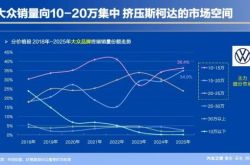
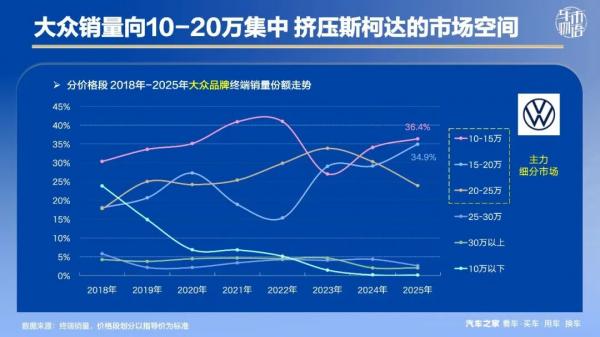
Terminal sales data shows that Volkswagen's market share in the ¥100,000–¥200,000 price segment has been expanding. As of 2025, this segment has contributed over 70% of its sales, with the ¥150,000–¥200,000 segment showing the most prominent growth, increasing from 18% in 2018 to 35% in 2025.
This change in brand positioning directly affects other brands.
Terminal sales data shows that from 2016 to 2025, over ten years, Skoda's sales in China plummeted from over 300,000 units to less than 15,000 units. This is the total brand sales, and how many units must a new model sell at least to break even over its entire lifecycle?
'China Automotive News' estimates that it is 100,000 units. In 2025, excluding Skoda's global total sales, except for the Octavia, Kodiaq, Kamiq, Fabia, and Karoq, all other models sold less than 100,000 units. In March 2026, Skoda confirmed its withdrawal from the Chinese market.
In the future, tragedies like 'Skoda's' will continue to unfold. After all, besides internal competition, external pressures are also increasing. According to incomplete statistics, in the first half of this year, over 500 new models were launched in China alone. Automakers cannot stop others from progressing; to survive better, they can only learn to control themselves, sacrificing one inferior model to protect a better one.
Has the Era of 'Universal' Platforms Arrived?
Interestingly, automakers are seeking more stable means of survival beyond just streamlining models and cutting configurations. Beneath the surface of 'subtracting' from the product side, a deeper transformation is underway in the industry: moving away from the past multi-platform model and betting on highly versatile 'universal platforms.'
In the old era of automotive logic, each market segment, powertrain type, and even different brands under a group had their own dedicated development platforms. Today, a highly compatible modular architecture can horizontally cover sedans, SUVs, MPVs, pickups...
For example, in 2026, Great Wall Motors launched its new vehicle platform, 'Guiyuan,' covering seven major categories: sedans, urban SUVs, off-road-capable SUVs, hardcore off-road SUVs, pickups, MPVs, and sports cars, compatible with five powertrain types: plug-in hybrid, hybrid, all-electric, fuel, and hydrogen.
It is reported that in the future, Great Wall will be able to produce over 50 models based on this 'universal' platform.
In addition, 'Economic Observer' reported that Volkswagen also plans to launch the SSP platform, integrating three fuel vehicle platforms (MQB, MSB, MLB) and two all-electric vehicle platforms (MEB, PPE), capable of producing all brands and model levels under Volkswagen in the future; BMW's Neue Klasse platform emphasizes compatibility with multiple powertrain types, with its first mass-produced model being the iX3.
Previously, platform reductions and integrations by GM, Mercedes-Benz, and Ford have also been proceeding at a high profile.
Is the era of automotive 'universal platforms' approaching?
It cannot be denied that the global automotive industry is facing a critical juncture of pressure-induced restructuring and breakthroughs. The '2026 Global Automotive Industry Mid-Year Panoramic Scan Report' shows that from January to May 2026, global auto sales were approximately 39.15 million units, a 2% year-on-year increase, presenting a pattern of 'slight total growth, weak momentum, and regional differentiation.'
Even new energy vehicles, which have been expanding rapidly for years, are bidding farewell to the era of high growth. BMI data shows that in the same period in 2026, global new energy passenger vehicle sales reached 7.5 million units, a 0.9% year-on-year increase; compared to the compound annual growth rate of 40% from 2017 to 2025, the industry's growth dividends have significantly diminished.
This means that market competition is becoming increasingly fierce, and automakers need more 'cost-saving and revenue-generating' measures.
'Universal platforms' have a significant cost-saving effect. Analysts from Victory Bird Strategy Consulting stated that the hidden costs for automakers to develop and maintain a brand-new platform can reach billions or even tens of billions of yuan. A compatible platform can increase the commonality of parts to over 70% by sharing chassis, electrical architectures, and thermal management systems.
Great Wall Motors has also calculated that the Guiyuan platform can reduce R&D costs by at least 30%.
To 'save money,' many automakers are currently going to great lengths, including scaling back once-ambitious electrification plans. In the first half of 2026, traditional giants such as Volkswagen, Stellantis, Mercedes-Benz, BMW, and Honda simultaneously rolled back their 'electrification strategies,' instead investing limited resources into more efficient projects.
It is reported that behind Volkswagen's series of operations lies a 'grand' plan:
By 2030, achieve an 8%–10% return on sales, with the automotive business division generating higher net cash flow, accounting for over 60% of the group's operating profit. Similarly, Nissan Motor plans to streamline its model lineup from 56 to 45 models, hoping to concentrate resources so that these models contribute over 80% of global sales, increasing per-model sales by 30%.
Against this backdrop, 'universal platforms,' directly linked to system efficiency and cost control, have emerged.
However, this architecture also has lingering hidden risks. In recent years, 'mass recalls' of automobiles have become increasingly frequent. In the first half of 2026, the State Administration for Market Regulation issued 50 recall announcements related to automobiles, involving 26 automotive brands, with a total recall volume of approximately 1.65 million units, averaging over 9,000 vehicles recalled per day.
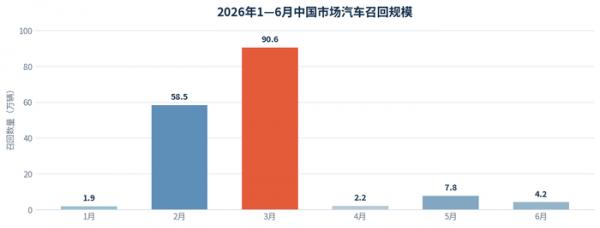
'Zizhu Auto Network' analyzed this set of figures, stating that the more platform-based and intelligent automobiles become, the more likely a local design, programming, or manufacturing deviation can quickly spread to tens or even hundreds of thousands of vehicles along shared platforms, software versions, and supply chains. Additionally, questions about whether homogenization will worsen and whether brand positioning will become blurred also need to be considered...
In short, a series of self-help measures after the automotive industry enters an era of inventory (stock) competition may not necessarily solve the real problems.
After the 'Car Sea' Ebbs, Automotive Competition Returns to the Brand Origin
Currently, the vast automotive lineups are not only exhausting companies but also overwhelming consumers. The 'Global Electric Vehicle Outlook 2026' released by the International Energy Agency shows that in 2025, there will be over 1,100 car models available in the Chinese market alone. Among them, models, technologies, configurations, and suppliers are increasingly similar.
As automakers continuously simplify their model lineups and cut unprofitable projects, brands become increasingly important in the next step.
The '2026 McKinsey China Automotive Consumer Insights' also mentions the importance of 'brands.' It is reported that as the gaps in basic vehicle technologies (range, intelligent driving, smart cockpits, etc.) have largely been eliminated, consumers in a highly complex market are beginning to rely on 'brands' to facilitate their car-buying decisions.
Data shows that among the key factors influencing car purchases, 'brand' has jumped from fifth place to second place. Especially in the electric vehicle supply chain, with CATL's global market share steadily increasing and Qualcomm's cockpit chips holding about 75% of the market, technological convergence and supply chain concentration have made 'brand' second only to 'range and charging time' in importance.
Over the past decade, multi-model coverage and multi-brand positioning have been the growth bibles for almost all automakers. Volkswagen and Stellantis have reaped incremental dividends through their complex brand matrices, while Chinese automakers have also used 'car sea tactics' to expand their market presence. But now, this approach has become a burden; as products become increasingly similar, brands become more important for automakers.
Clearly, some automakers have already realized this and are simultaneously streamlining their lineups and refocusing on brand management.
A typical example is Nissan Motor. It is reported that Nissan has established three strategic pillars, with 'brand strategy' being particularly prominent. Nissan plans to revitalize its brand at the brand level, shaping a young, innovative, and passionate brand image.
Stellantis is doing the same. After integrating the PSA and FCA automotive systems, it retained influential brands such as Peugeot, Citroën, Jeep, Maserati, and Dodge, conducting differentiated brand operations through concentrated resource allocation; Volkswagen also stated on its official website that Volkswagen, Skoda, SEAT/CUPRA, and Volkswagen Commercial Vehicles will introduce a new cross-brand management model.
For luxury cars, reshaping the brand is even more urgent.
In recent years, price wars among luxury cars have repeatedly (repeatedly) occurred, severely impacting the positioning and image of some luxury brands. In March 2026, Jaguar Land Rover announced the discontinuation of all domestically produced fuel models. Due to the long-term erosion of brand premium by labels like '70% off Jaguar, 80% off Land Rover,' the brand ultimately decided to cut itself off and retreat to the imported luxury market.
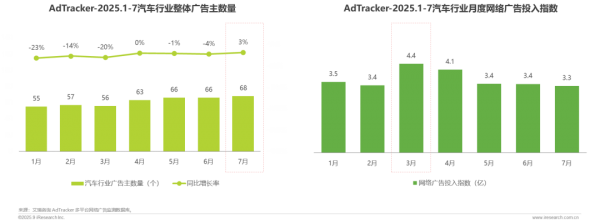
Changes in the marketing landscape of the entire automotive industry also reflect this shift. From competing for market share through model expansion to retaining users through brand building, the competitive atmosphere in the automotive industry has undergone significant changes. The '2025 Automotive Industry Online Marketing Monitoring Report' released by iResearch shows that in July 2025, the number of advertisers in the domestic automotive industry officially began to grow, with March being the peak investment period and advertising efforts significantly increasing.
Marketing costs for major automakers are also skyrocketing, especially for some traditional automakers.
Take SAIC Motor as an example. In 2025, SAIC's selling expenses were ¥20.898 billion, a 4.07% year-on-year increase compared to ¥20.08 billion the previous year; advertising and promotion expenses accounted for the majority of selling expenses, at ¥9.179 billion, a 27.04% year-on-year increase compared to ¥7.225 billion in 2024.
Great Wall has also been focusing on brand building in recent years.",
From the expansion philosophy of 'having more children for better competition' to everyone embracing 'decluttering,' the global automotive industry has completed a full business cycle over several decades. When automakers take the initiative to cut the models they once competed to launch, scale back their heavily invested brand lines, and redirect the money saved from R&D and production lines into the battlefield of brand perception.
After all the twists and turns, everything seems to have come full circle.
-
![]()
More Car Models, Quicker Demise? Global Automakers Are Abandoning the 'Car Sea' Tactics", "Automakers, Model Streamlining, Profit Pressure, Universal Platform, Brand Management", "Global automakers ar
-
![]()
Model AB Price Reduction Controversy: Is Ninebot Losing Its Friendly Touch?
-
![]()
Computing Power Supplier Bags Orders Worth Over 600 Million Yuan, Yet Receives Only 4.5 Million Yuan in Actual Payments!
-
Alibaba Is Just Five Months Away from Securing Two Consecutive AI Coding Titles
-
![]()
Less Investment Isn't Apple's Get-Out-of-Jail-Free Card
-
![]()
The 'King of Africa' Tecno Mobile: What Is the Market Hesitating About After Its 'V-shaped' Rebound?
-
![]()
ByteDance Restructures Feishu, What Signals Does It Send?
-
![]()
ByteDance Overhauls Feishu: What Strategic Signals Are Being Sent?