Dingdong Fresh Bids Farewell, Fresh Produce E-commerce Steps into the Giant Era
 02/09 2026
 540
540

Author|Di Tianyu
Editor|Hu Zhanjia
Operations|Chen Jiahui
Produced by|LingTai LT (ID: LingTai_LT)
Header Image|Publicly sourced image from the internet
Dingdong Fresh Joins the Ranks of Industry Leaders
On February 5, 2026, Meituan announced on the Hong Kong Stock Exchange its acquisition of 100% equity in Dingdong Fresh's China operations for an initial consideration of approximately USD 717 million. Post-acquisition, Dingdong Fresh will become an indirectly wholly-owned subsidiary of Meituan, with its financial results consolidated into Meituan's financial statements.
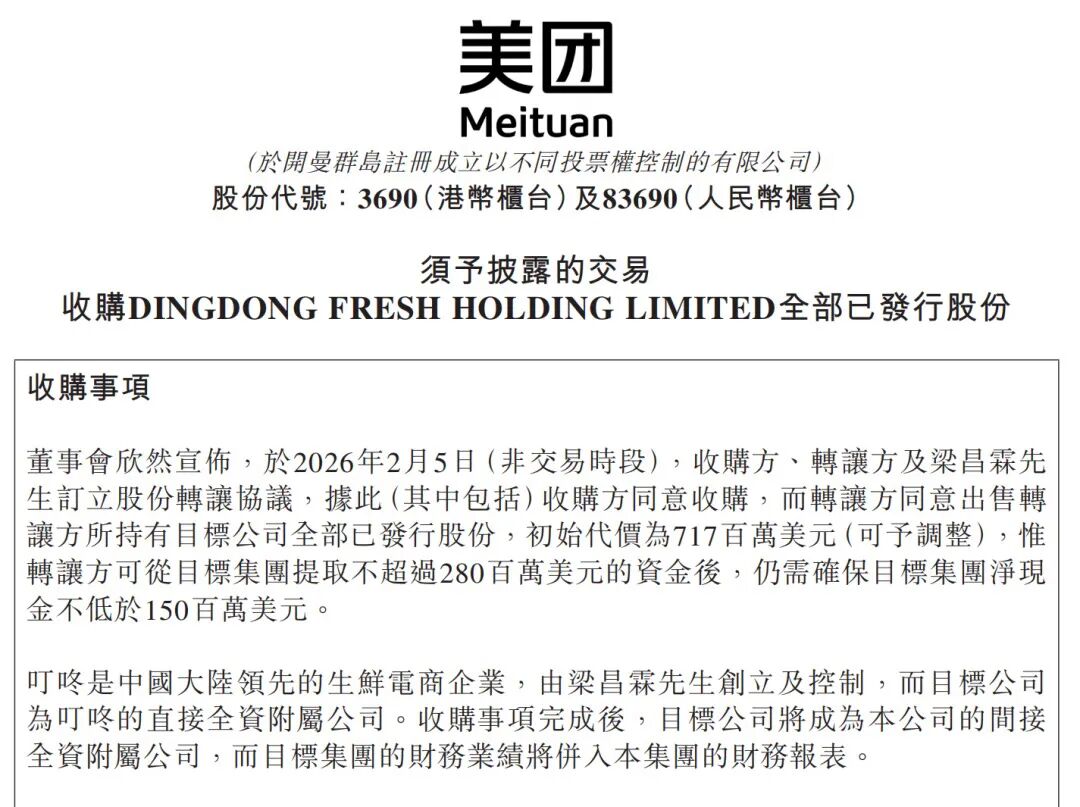
As Dingdong Fresh's founder, Liang Changling, stated in an internal memo, "Looking ahead, we've made a visionary decision: to set aside rivalries and embark on a collaborative journey." As one of the former "Big Three" in fresh produce e-commerce, Dingdong Fresh's acquisition by Meituan signals the industry's entry into an era of consolidation by industry giants.
While Dingdong Fresh's "story" will no longer unfold in China's fresh produce e-commerce sector, its acquisition by an industry leader is a dignified outcome compared to the sudden collapse of MissFresh.
The Story Behind Dingdong Fresh's Acquisition
The dawn of the mobile internet era spawned numerous innovative business models, including fresh produce e-commerce. Around 2016, companies like MissFresh, Hema Fresh, and Dingdong Fresh emerged, all focusing on the "front-end warehouse" model.
These companies unanimously chose the front-end warehouse model due to its effectiveness in addressing key pain points in the fresh produce sector, such as timeliness, spoilage, and fulfillment. For instance, financial reports reveal that in Q1 2024, Dingdong Fresh's turnover cycle for fresh produce was a mere 5 days, with an end-to-end spoilage rate of just 1.5%.
However, the front-end warehouse model also led fresh produce e-commerce companies into a quagmire of losses due to exorbitant fulfillment costs and a fragile profit model.
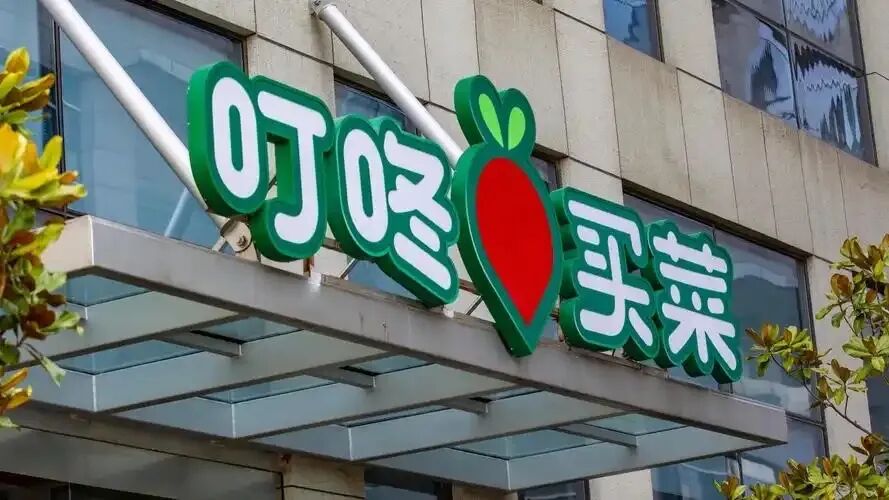
In response, Hema's founder, Hou Yi, declared in 2019, "The front-end warehouse model is a false proposition for VC investment; profitability is unattainable." By year-end, Hema adjusted its model to community supermarkets known as Hema MINI.
To quickly achieve a closed business loop, Dingdong Fresh proposed a development strategy in 2021 prioritizing "efficiency while considering scale." It subsequently closed stations in cities like Zhuhai, Tangshan, and Xuancheng, focusing on the East China region. Simultaneously, Dingdong Fresh significantly reduced expenses to save on capital costs.
Driven by these cost-reduction and efficiency-enhancement measures, Dingdong Fresh finally achieved stable profitability. According to comprehensive media reports and financial data, in Q3 2025, Dingdong Fresh's revenue reached RMB 6.66 billion, with a net profit of RMB 101 million under Non-GAAP standards, marking twelve consecutive quarters of profitability.
If Dingdong Fresh could maintain stable profitability, it could be considered a "small but beautiful" company. However, with industry giants increasingly investing in the fresh produce e-commerce sector, uncertainties grew.
LatePost cited sources close to Dingdong Fresh as saying that after Liang Changling's return to manage the company, he frequently inquired about responses to moves by companies like Meituan. Few within the company could provide satisfactory answers.
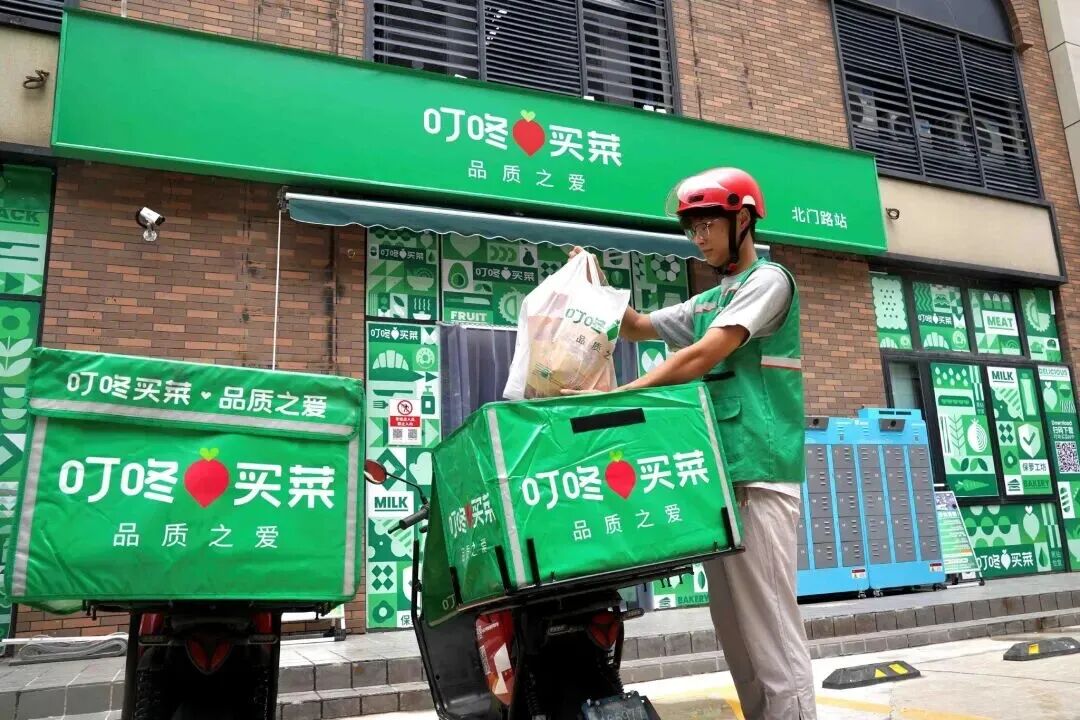
Evidently, as an instant retail company, Dingdong Fresh's core dilemma lay not in choosing to remain "small but beautiful," but in operating in a sector embroiled in "infinite war."
Once targeted by industry giants, Dingdong Fresh's survival space would rapidly shrink. In this context, timely "acquisition" emerged as the most rational, lowest-risk, and highest-reward path for Dingdong Fresh.
Dingdong Fresh, Acquired by Meituan, Fuels XiaoXiang Supermarket's Growth
Meituan's decision to acquire Dingdong Fresh was largely driven by its quest for new business opportunities.
During the Q3 2025 earnings call, Meituan CEO Wang Xing stated, "XiaoXiang is growing rapidly. We believe we are one of the largest online grocery businesses by scale, ranking in the top two and growing the fastest. We have a particular advantage in fresh food. Therefore, we plan to increase our investment in XiaoXiang Supermarket."
XiaoXiang Supermarket, Meituan's self-operated front-end warehouse instant retail business, was launched as Meituan Grocery in January 2019 and rebranded as XiaoXiang Supermarket in December 2023.
By addressing a critical user need, XiaoXiang Supermarket has experienced rapid growth. In June 2025, Leiphone reported that XiaoXiang Supermarket's GMV reached nearly RMB 30 billion in 2024, surpassing Dingdong Fresh's RMB 25.5 billion. Financial reports show that in Q3 2025, Meituan's new business segment, including XiaoXiang Supermarket, generated revenue of RMB 28 billion, a year-on-year increase of 15.9%.
To further expand its market influence, XiaoXiang Supermarket plans to significantly increase its number of front-end warehouses. By the end of 2025, it had approximately 1,000 front-end warehouses, primarily in North China. 36Kr reported that in 2026, XiaoXiang Supermarket plans to open 700 new front-end warehouses, nearly doubling its current number.
Against this backdrop of expansion, Dingdong Fresh presents a unique "engine." On one hand, Dingdong Fresh has already achieved a closed business loop, and its integration into XiaoXiang Supermarket is expected to help reduce losses in Meituan's new business segment.
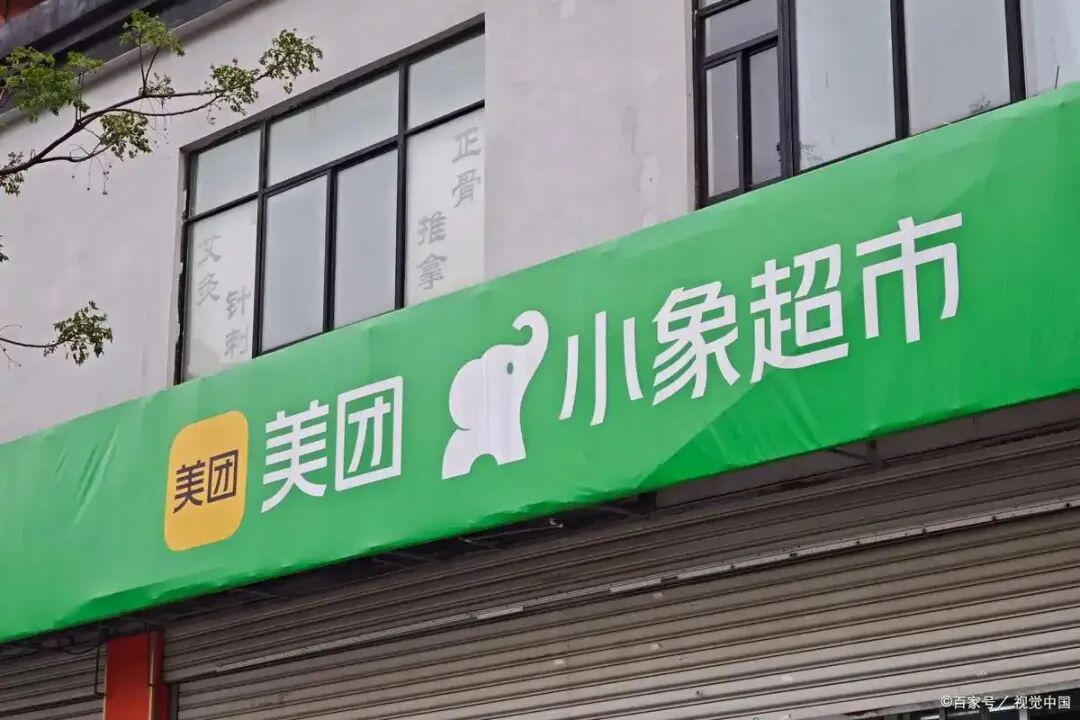
On the other hand, Dingdong Fresh's strong presence in East China complements XiaoXiang Supermarket's front-end warehouse resources, enabling rapid expansion in high-consumption regions like the "Jiangsu-Zhejiang-Shanghai" area. According to comprehensive media reports and financial data, in Q3 2025, Dingdong Fresh's GMV in Shanghai and the Jiangsu-Zhejiang region increased by 24.5% and 40% year-on-year, respectively, with Shanghai's average daily orders per warehouse reaching approximately 1,700.
Beyond direct business benefits, Meituan's acquisition of Dingdong Fresh also effectively suppresses competitors. JD.com had previously planned to acquire Dingdong Fresh to strengthen its front-end warehouse capabilities but failed to sign the agreement within the lock-up period, allowing Meituan to complete the transaction.
A source close to the matter told LatePost, "Meituan doesn't want to leave infrastructure to JD.com or other competitors; otherwise, the cost of defense in instant retail would be higher in the future."
LingTai LT believes that from a purely commercial perspective, Dingdong Fresh, with its limited profit margins, is not a high-quality investment target. However, its deep roots in the instant retail sector and the rich resources it has accumulated give it significant strategic value.
Now, as competition in the instant retail industry intensifies, Meituan has finally recognized the value of Dingdong Fresh. This acquisition not only rapidly strengthens and amplifies XiaoXiang Supermarket's growth momentum and effectively restrains competitors but also sends a clear signal of expansion at the strategic level, boosting confidence in the capital markets.
Fresh Produce E-commerce Enters the 'Giant' Era
Over the past few years, many companies have demonstrated through their experiences and performance that the front-end warehouse fresh produce e-commerce business model has inherent flaws and struggles to achieve impressive results.
However, paradoxically, since 2024, internet giants like Meituan, JD.com, and Alibaba have increased their investments in the front-end warehouse fresh produce e-commerce sector. For example, in August 2024, Hema restarted its front-end warehouse model; in September, JD.com's fresh produce business, "Qixian," opened its first front-end warehouse in Beijing.
LingTai LT believes that the giants' increased investment in the low-margin fresh produce e-commerce sector is not solely focused on this single business but rather sees it as a strategic fulcrum to leverage a larger retail footprint, compete for core users, and gain control over infrastructure.
During the Q2 2025 earnings call, Wang Xing stated, "Apart from food delivery, XiaoXiang Supermarket is the most frequently used business," because "fresh produce is a high-frequency consumption category." Therefore, Meituan realizes that "XiaoXiang Supermarket can reach more cities than imagined."
A year after the "food delivery wars," consumers' needs for main meals and milk tea have been largely met. Fresh produce e-commerce, previously less explored, has become a new growth point that instant retail platforms cannot ignore.
On the other hand, unlike independent fresh produce e-commerce platforms that face high costs, instant retail platforms, with their millions of riders, achieve economies of scale and lower delivery costs. Therefore, even with the limited profit margins of the front-end warehouse fresh produce e-commerce model, industry giants can more easily control costs and avoid losses.
In summary, Meituan's acquisition of Dingdong Fresh marks a critical turning point for China's fresh produce e-commerce industry. Although the industry has returned to the front-end warehouse model after more than a decade, this is not a step backward but a "change of players and a new game."
The core of competition in China's fresh produce e-commerce industry has shifted from model innovation and capital-driven growth to a systematic competition in supply chain integration capabilities, fulfillment efficiency, and cross-business synergy. Fresh produce e-commerce is no longer a standalone sector but a key component deeply integrated into the instant retail and local life ecosystems.
In this context, only industry giants with a massive user base, a mature delivery network, and sufficient capital endurance are qualified to participate in long-term competition. It can be said that China's fresh produce e-commerce has officially entered the "era of giants."
-
![]()
Registered Capital Slashed to 372 Million Yuan! Yutong Optical Finalizes Industrial and Commercial Change Registration
-
![]()
Zhuque-3 Successfully Lands, and 'Time Traveler' Secures Another ¥100 Million in Funding: China's Commercial Space Industry Experiences a 'Dynamic August'
-
![]()
Autohome Faces a Shrinking Window of Opportunity
-
![]()
Even a Titan Like Musk Has Faced Setbacks in Fulfilling Promises
-
![]()
AI Office: The End of the Racing Era, Context Becomes the Key to Success
-
![]()
Domestic Vehicle Chassis Revolution ②: The Steering Wheel Remains, But Mechanical Connections in the Steering System Are Decreasing
-
![]()
Exploring MiniMax Design: Can Video Editing Be as Simple as Speaking?
-
![]()
Why Can SenseTime Achieve Profitability While CloudWalk Still Faces Challenges, Despite Both Adopting Large Models?