The Successful Recovery of the First Stage of the Long March 10B: What Does It Mean for China's Commercial Space Industry?
 07/13 2026
 545
545
China's commercial space industry is on the verge of explosive growth.
At noon on July 10th, the new-generation large liquid rocket Long March 10B soared into the sky from the Hainan Commercial Space Launch Site.
Six minutes later, over the sea 430 kilometers away from the launch site, the core first stage, having completed its mission, flew back, descended vertically, and landed steadily in a 36-meter-wide net on a massive ship with a full displacement of 25,000 tons.
In 1963, Qian Xuesen was the first to propose the concept of a winged, reusable transport rocket. After over two decades of research and development starting in the 2000s, China has finally entered the era of rocket recovery.
A month ago, Elon Musk's SpaceX went public, closing with a total market capitalization of $2.1 trillion on its first day, becoming the seventh-largest company globally by market value. This reflects the commercial space value represented by its reusable Falcon rockets.
Unlike SpaceX's dominance in the U.S., China's commercial space sector is thriving with diversity. There are routes similar to Falcon 9's landing leg recovery, such as the Zhuque-3 and Long March 12A, as well as the unique net-based recovery route of the Long March 10.
Why is Rocket Recovery Crucial?
The key lies in significantly increasing launch frequency and drastically reducing launch costs, marking a new phase for China's space industry.
What is the status of other Chinese space enterprises behind the Long March 10B?
01
Reusable Rockets: The Propeller of Commercial Space
To understand the value of the Long March 10B's successful recovery, it's helpful to place it in the global context of reusable rocket development.
Before SpaceX's founding in 2002, space launches were costly and disposable. Musk chose to challenge the reusable route, significantly reducing launch costs and ushering in the era of commercial space.
From the failure of the parachute recovery plan during the Falcon 9's maiden flight in 2010 to switching recovery methods, over five years of technical breakthroughs and 22 tests led to the first successful vertical landing on December 21, 2015.
From the first recovery to the first reuse, SpaceX took another 1 year and 3 months.
Today, SpaceX's Falcon series rockets have completed over 600 booster recoveries, with a single booster reused up to 36 times.

Image Source: AI
China's exploration of reusable technology for the Long March series rockets dates back to July 2019.
At the Xichang Satellite Launch Center, a Long March 2C rocket equipped with grid fins successfully landed its first stage within the Pre designated landing area (predetermined landing zone).
This marked China's first successful test of "grid fin-based separation body landing zone safety control technology," making China the second country in the world after the U.S. to master this technology.
Over the following years, state-owned and private space enterprises achieved breakthroughs in low-altitude vertical takeoff and landing, multiple engine ignitions, thermal protection, navigation control, and other individual technologies and recovery plans.
From the Long March 10B's project approval in August 2025 to its successful maiden flight and recovery in July this year, the process took less than a year. Calculating from the grid fin technology verification, the entire process took about seven years, an astonishing achievement globally.
SpaceX's Falcon series uses a vertical landing recovery plan with landing legs, demanding extreme precision in landing and hover control, with high trial-and-error costs.
In contrast, the Long March 10B's sea-based net recovery plan, inspired by aircraft carrier-based arrestor landings, captures the rocket body with a flexible net, significantly reducing the requirements for terminal control precision and impact load, offering an equally effective alternative.
Traditional disposable rockets cost about $20,000 per kilogram to launch, while the reusable Falcon 9 reduces this to $2,000 per kilogram, a 90% reduction.
If China's reusable rocket technologies, such as the Long March 10B, mature, they could compete with SpaceX for global commercial orders, accelerating China's commercial space industry.
02
Dual Fulfillment: Technology and Capital
With the national team taking the lead, China's private commercial space enterprises are also in the intensive sprint phase for recovery technology.
After years of development, a pattern has emerged with liquid oxygen-methane as the mainstream and multiple parallel verification routes.
Currently, LandSpace is the closest to successful recovery among private enterprises and may face another major test this month.
In December 2025, LandSpace's Zhuque-3 Y1 rocket successfully reached orbit, but its first stage experienced an engine anomaly during return.
Half a year later, the Zhuque-3 Y2 underwent comprehensive upgrades, particularly in thermal protection, landing leg structure, and the Tianque-12B engine. On June 29th, it completed static firing, passing all ground verifications.
As planned, the Zhuque-3 Y2 will launch from the Jiuquan Satellite Launch Center in mid-to-late July, attempting its second vertical landing recovery.
If successful, LandSpace plans to achieve a secondary reuse launch of the first stage in the fourth quarter, aiming for the first domestic recovery-reuse closed loop (closed loop).
Meanwhile, LandSpace's Sci-Tech Innovation Board IPO review resumed at the end of June, seeking to raise 7.5 billion yuan.
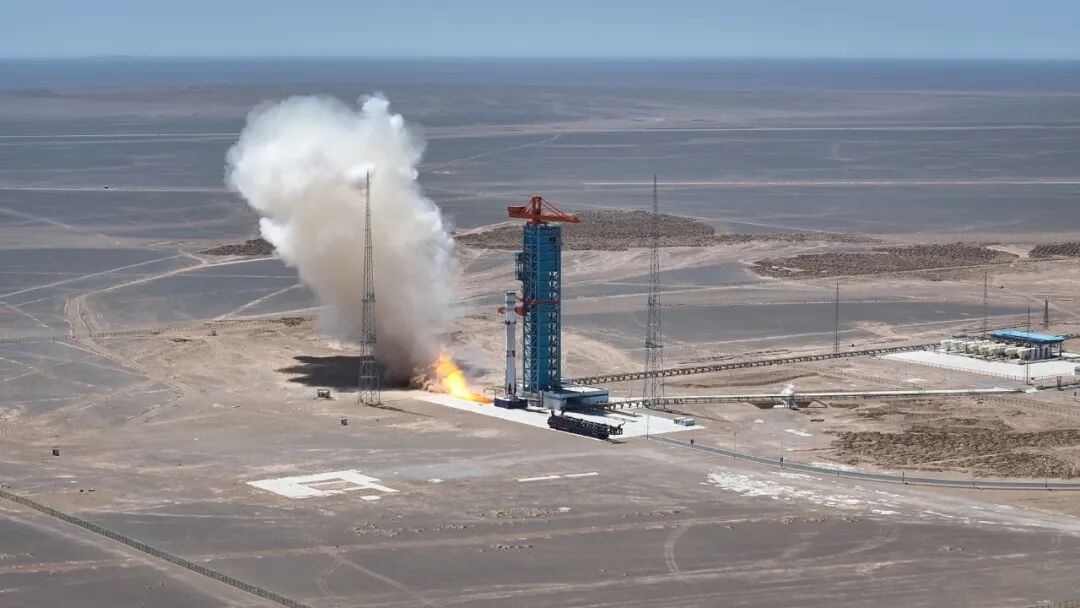
Image Source: LandSpace Launch Screenshot
i-Space has chosen a sea-based vertical recovery route. Its Hyperbola-2 test vehicle completed China's first full-scale liquid rocket first-stage 100-meter vertical takeoff and landing test in 2023, with a landing error of less than 2 meters.
The Hyperbola-3 is paired with China's first dedicated recovery vessel, the Xingji Guihang. In June 2026, the vessel completed a full-process sea recovery simulation drill in the Yangjiang sea area.
According to the plan, the Hyperbola-3 aims for its maiden flight by the end of 2026, targeting simultaneous orbit insertion and sea recovery, using a traditional landing leg scheme.
As early as December 2020, i-Space initiated IPO counseling but has yet to complete validation.
Jiuyuan Space's Yuanxingzhe-1 is a medium-sized liquid oxygen-methane reusable rocket. In May 2025, its verification model completed its first sea flight recovery test at the Eastern Spaceport, covering eight key stages from ignition to soft sea landing.
It also plans for a maiden flight and sea recovery verification by the end of 2026, adopting a sea capture "chopstick clamp" recovery plan similar to SpaceX's Starship.
Space Pioneer adheres to the liquid oxygen-kerosene route, with a near-Earth orbit capacity of 22 tons, surpassing the Long March 10B. It uses a vertical landing recovery plan with landing legs. Its engine and rocket body designs have been validated. In April, its Tianlong-3 Y1 failed its maiden flight but will resume recovery tests after repairs.
In October 2025, Space Pioneer entered IPO counseling.
CAS Space has pioneered a clustered integral recovery plan where the core stage and boosters do not separate. Its Lijian-2 liquid rocket successfully launched on March 30th, with recovery test flights scheduled after 2027. Its Sci-Tech Innovation Board IPO has entered the inquiry phase.
Galactic Energy simultaneously advances the Ceres solid rocket and Pallas liquid rocket routes. The Ceres series has achieved scaled revenue, but the Ceres-1 Y19 failed in November 2025, and the Ceres-2 Y1 failed in January 2026.
Its liquid oxygen-kerosene rocket, Pallas-1, has completed all ground tests and will soon have its maiden flight. However, it will not attempt first-stage recovery during the maiden flight, adopting a "first orbit, then recover" strategy.
In October 2025, Galactic Energy also initiated IPO counseling.
Overall, many private commercial space enterprises are on the verge of their first recovery tests.
Meanwhile, many are already in IPO counseling, indicating that the commercial space industry is entering a period of dual fulfillment in technology and capital.
In December 2025, China submitted 14 sets of low-Earth orbit (LEO) constellation frequency and orbit filings to the International Telecommunication Union (ITU), registering 203,000 LEO satellites. By the end of 2030, the "Qianfan Constellation" alone plans to deploy over 10,000 LEO broadband multimedia satellites.
In 2025, China conducted 92 space launches, deploying about 500 LEO commercial satellites. The vast Chinese commercial space market is on the brink of explosive growth.
-
![]()
Weekly Stock Review | Who Dominates the Market: Hedge Funds, Quant Traders, Institutions, or Hot Money?
-
![]()
Sales Slump Again: Why Are Affluent Buyers No Longer Exclusively Opting for Porsche?
-
![]()
Xiaomi’s New Auto Brand Launch Sparks Stock Rebound: Is a Trend Reversal on the Horizon?
-
![]()
Seres Mid-Year Report Catastrophe: Projected Losses Surpass 1.5 Billion Yuan!
-
![]()
"Fruit Chain Brother No.1" Plummets Below Issue Price on Debut Trading Day! Chaoshan's Wealthiest Woman Stakes HK$24 Billion on AI
-
![]()
Auto Market Undergoes Major Shake-Up: Winners and Losers Revealed
-
![]()
The Successful Recovery of the First Stage of the Long March 10B: What Does It Mean for China's Commercial Space Industry?
-
![]()
Xiaomi Pengcheng: Crafting the Future of Mobility