Doubao Starts Charging: Does ByteDance Face Commercialization Pressure?
 07/14 2026
 452
452
 This article is the 1055th original work by DeepAtom.
"
Strategic Monetization or Forced Damage Control?
Yang Xiaoxian | Author
DeepAtom Studio | Editor
On June 24, 2026, Doubao officially launched its professional subscription service with three pricing tiers: 68 yuan, 200 yuan, and 500 yuan. Public opinion quickly split into two camps.
On one side, angry users declared: "The era of free services is over." "This is more expensive than ChatGPT." On the other side, industry observers noted with nuance: "ByteDance is finally doing the math."
Both reactions point to the same core question: Does ByteDance face commercialization pressure? Is Doubao's charging model a strategic monetization play or a desperate move to stop the bleeding?
A False News Story That Needs Correction
In May, a rumor spread wildly on social media: "ByteDance quietly canceled 30% of its AI projects. AI inference costs exceeded 8 billion yuan in 2025, 2.3 times the revenue growth, and the company's cash flow won't last until 2027."
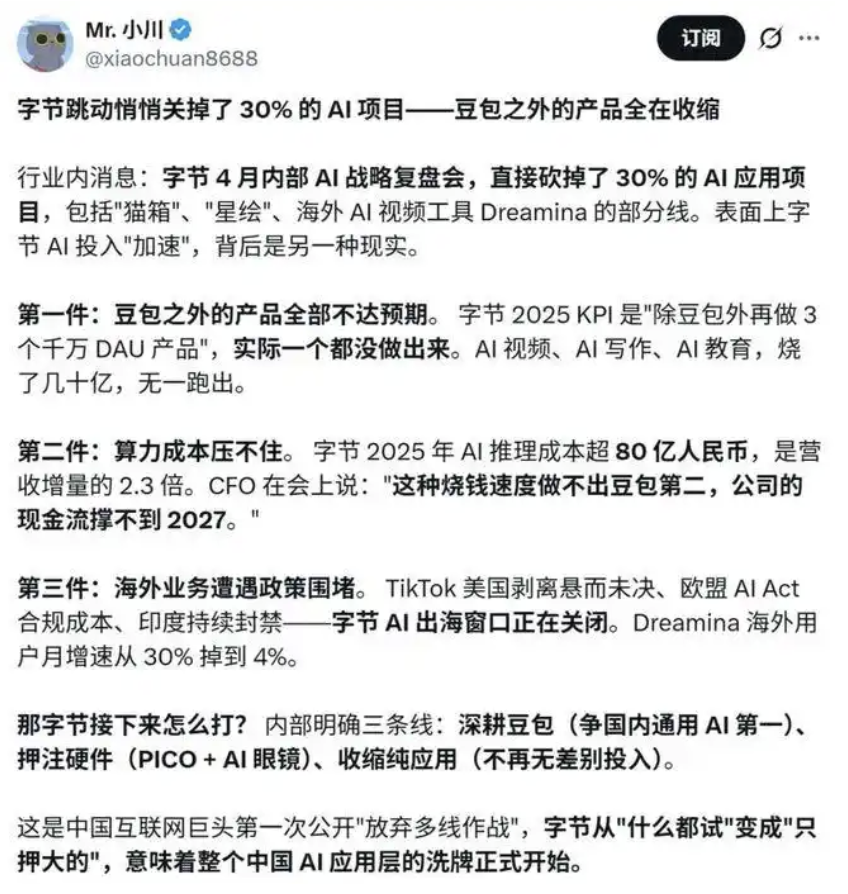
ByteDance employees dismissed it as "obviously fake" and "ridiculous." Zheshang Securities data shows ByteDance's AI investment exceeded 80 billion yuan in 2024; the South China Morning Post reported its 2026 AI infrastructure budget surpassed 200 billion yuan. An industry analogy clarifies the situation: A billionaire planning a 20 million yuan renovation wouldn't panic over an 80 yuan utility bill and declare bankruptcy. The rumor's claim about canceling 30% of projects was also factually incorrect—products like "Meng" and "Dreamina" weren't cut but are now key focus areas.
The debunking holds water. ByteDance's revenue scale, cash reserves, and core business fundamentals are transparent, making a "cash flow crisis" conclusion untenable. However, dismissing the rumor misses the real issue.
While the rumor had many flaws, its resonance in the industry was genuine. YouMind founder Yubo's judgment during this controversy carries more weight than the rumor itself: "Using an internet mindset for AI products is a dead end—AI products lack network effects." Yubo's background lends credibility to this view. He joined Alibaba in 2008, led Ant Design and Yuque development for 15 years, became Feishu's VP at ByteDance in 2023, then left to found an AI company a year later. In a June 2026 Huxiu interview, he summarized his two-year journey as "breaking free from internet illusions." For someone who reached P10 at Alibaba and Feishu VP at ByteDance before starting his own AI venture, this statement carries more weight than any analyst report. It highlights the root of Doubao's dilemma: from "free users driving losses" to "paid willingness being locked by free habits" to "advertising models failing in AI"—all stem from applying an internet mindset to AI.
False News Debunked, Real Pressures Remain
China Entrepreneur magazine published a deep dive on June 26 titled "ByteDance AI Faces Sweet Challenges" (Huxiu followed with analysis on June 29). The title itself provides the answer—both "sweet" and "challenging" elements exist.
The report revealed two key metrics: Doubao has over 200 million daily active users but generates less than 1 million yuan in daily revenue; its large model's daily token calls exceed 180 trillion, growing over 10x in a year. An AI infrastructure founder told China Entrepreneur: "If Doubao maintains this user growth, its computational demands could deplete ByteDance's resources."
Volcano Engine president Tan Dai tried to downplay these anxieties, stating, "From Volcano Engine's perspective, we don't track computational costs—we focus on B2B business." However, he admitted in the same interview: "The reported Seedance revenue figures are wrong and inflated. I'm under pressure—finance keeps asking if I'm hiding numbers."

Even revenue from core flagship products faces financial scrutiny. This may not qualify as a "cash flow crisis," but it certainly indicates commercialization anxiety.
More concerning is ByteDance's overall financial trend. Bloomberg reported its 2025 profit at around 50 billion USD, which ByteDance sources denied. The Financial Times reported 2025 capital expenditures at about 150 billion yuan; the South China Morning Post put its 2026 AI infrastructure budget over 200 billion yuan—equivalent to 60% of 2025 profits. While Douyin generates about 400 billion yuan in annual ad revenue, AI burns nearly 200 billion yuan yearly. After accounting for TikTok's overseas investments and operational costs across business lines, profits face severe pressure.
Meanwhile, multiple growth engines are slowing: Douyin's monthly active users reached 1.009 billion, growing only 14.43% YoY—near its ceiling. Douyin E-commerce's GMV growth slowed from 320% in 2022 to around 30% in 2025, expected to decline further in 2026. Revenue growth is flattening while cost curves remain steep—the question isn't if problems will arise, but how long they can be managed.
Why Charge Now?
These numbers tell the same story: ByteDance's investments are accelerating while revenue growth decelerates. But this reflects the group's financials, not directly explaining Doubao's charging. To understand that, we must focus on Doubao itself.
First, revenue. As of H1 2026, Doubao generated less than 1 million yuan daily, primarily from e-commerce commissions—revenue sharing when users make purchases through the app. Before the June 24 paid subscription launch, Doubao's C-end commercialization was nearly zero. With 345 million monthly active users generating under 1 million yuan daily, each user contributed less than 0.003 yuan per day.
Now, costs. Volcano Engine FORCE Conference data shows Doubao's large model exceeds 180 trillion daily token calls. Huxiu's "ByteDance Starts Doing the Math" cited CSDN cost breakdowns: general dialogue costs about 4 yuan per million tokens, implying 720 million yuan in daily costs for 180 trillion tokens. Guolian and Minsheng Securities provide more conservative estimates—even using the cheapest models, daily costs range from 130 to 240 million yuan. Taking the midpoint, annual costs reach tens of billions yuan.
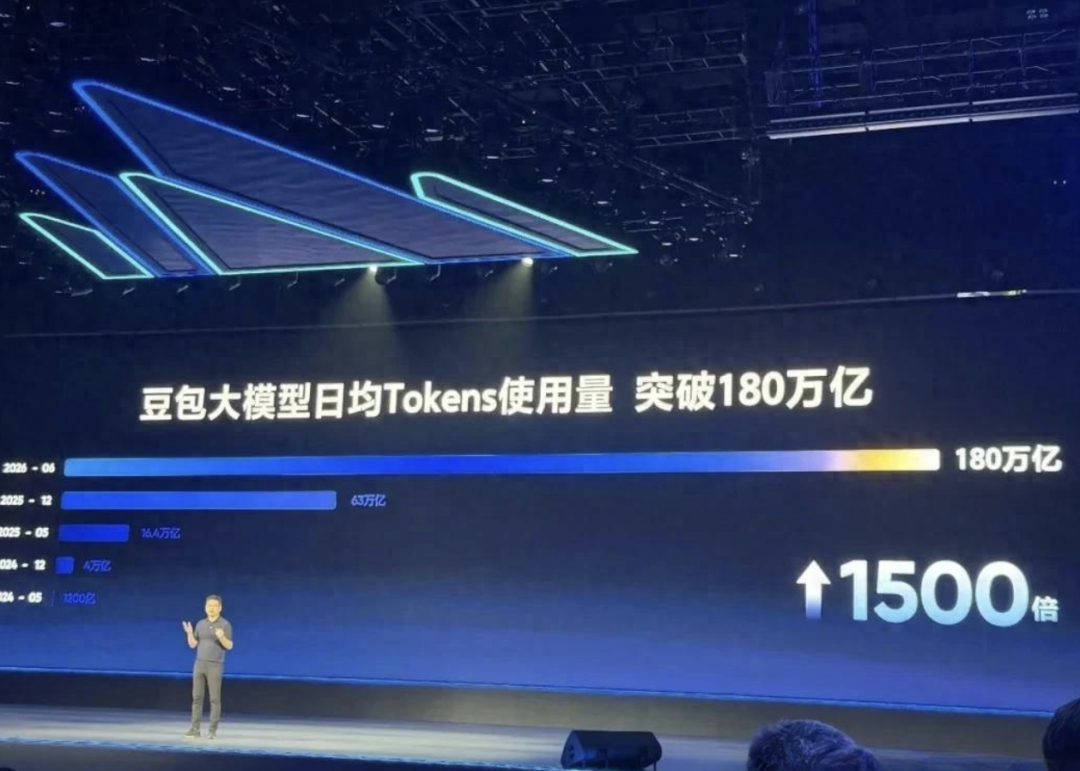
The massive gap between revenue and costs provides the most direct rationale for charging. But there's more.
A bigger issue lies in user structure. QuestMobile data shows AI app user growth in Q1 2026 skewed toward "lower-tier cities + senior users." Huxiu's analysis, citing Citigroup research, notes Doubao's 345 million monthly active users are mostly students and seniors using it for casual chats, information searches, and life advice, averaging under one hour daily. Meanwhile, professionals, developers, and creators with high productivity needs find Doubao's capabilities insufficient, preferring ChatGPT, Claude, or domestic alternatives like Kimi.
Citigroup's survey of 1,800 respondents revealed a specific dilemma: 45% would pay for advanced AI features but only accept an average of 48.3 yuan monthly. Doubao's standard package starts at 68 yuan—about 20 yuan higher than this threshold.
This creates a lose-lose situation: Users most willing to pay find Doubao inadequate, while loyal users don't need paid features. In essence, "low-end users don't need it, high-end users don't want it."
This mismatch between user structure and business model isn't new to ByteDance. In 2020, online education was a major ByteDance advertiser. Seeing the sector's scale through ad data, ByteDance launched Dali Education, hiring 10,000 people in four months and operating two dozen projects internally. After China's 2021 "double reduction" policy, Dali Education laid off staff with "N+2 compensation and yellow gift boxes." ByteDance saw the market's scale through ad data but underestimated entry barriers.
AI is repeating this logic but with opposite issues. Education's barriers were policy and operations—ByteDance had traffic and capital but couldn't adapt quickly enough. AI's barriers are technical and product-related—ByteDance's large models aren't weak, but its traditional playbook—free acquisition and ad monetization—fails in AI. Beijing University of Posts and Telecommunications professor Wang Xiaojie told Huxiu bluntly: "AI advertising lacks viable entry points—even slight missteps risk being perceived as malicious." Users want AI for reports and PPTs, not pop-up ads.

Industrywide, companies succeeding in AI commercialization take different paths. Titan Media's deep dive reveals Anthropic's enterprise adoption rate reached 34.4% in April 2026, surpassing OpenAI, with annual recurring revenue (ARR) soaring to 45 billion USD—over 80% from enterprise services. OpenAI has 900 million weekly active users but a paid conversion rate below 6%, spending 1.6–2.25 USD to generate 1 USD in revenue. Sam Altman admits the 200 USD/month Pro subscription still loses money.
Domestic differentiation is sharper. The Paper reports Alibaba's QianWen integrates with Alibaba Cloud and e-commerce ecosystems, while Tencent's Yuanbao leverages WeChat's social and payment systems—neither relies on direct C-end charging. Only Kimi has succeeded in C-end subscriptions by "simplifying features and screening users," reaching 200 million USD ARR in April.
Baidu's ERNIE Bot follows a noteworthy path. Caijing reports Baidu launched a 59.9 yuan/month professional version in November 2023—just eight months after ERNIE Bot's debut—becoming China's first C-end charged large model. This timing was crucial. During the 2023 "free tier arms race," Baidu bucked the trend by erecting paywalls early. Haibao News summarized this as "first-mover premium": Baidu distinguished between genuine AI users and curiosity seekers. If users truly needed AI tools, they'd pay. This approach filtered out casual users, reduced wasteful computational costs, and locked in high-value customers early. In February 2025, facing pressure from DeepSeek's free strategy, Baidu announced ERNIE Bot would go fully free starting April 1 and refund existing subscribers. This wasn't a repudiation of charging but a strategic pivot after fulfilling its initial purpose.
This contrast is key to understanding Doubao's charging. Baidu's approach was proactive—setting boundaries early to identify core users during industry hype. Doubao's charging is reactive—a response to saturated user growth and soaring costs. While both involve C-end charging, their logics differ fundamentally: Baidu screened users before serving them; Doubao offered free services before attempting harvesting. This explains why Baidu's 59.9 yuan pricing seemed expensive then but appears restrained now, while Doubao's 68 yuan feels costly to users accustomed to three years of free access.
DeepSeek's API pricing adds final context. The Paper reported in June that DeepSeek V4-Pro permanently offers 75% discounts—6 yuan per million tokens for outputs, 0.025 yuan for cache hits. In comparison, Volcano Engine prices Doubao 2.1 Pro at 30 yuan per million tokens for outputs, 1.2 yuan for cache hits—costing 5–60x more for equivalent tasks. DeepSeek's previously disclosed V3/R1 Inference cost profit margin (inference cost profit margin) reached 545%—though for older models, this efficiency carries over to V4-Pro, proving its pricing reflects genuine cost advantages, not subsidies. For Doubao users, the choice is stark: pay 68 yuan monthly for Doubao or spend less to access DeepSeek APIs for other applications. With near-zero migration costs, price gaps are hard to bridge with "ecosystem" or "brand."
Against this backdrop, Doubao's position becomes clear. Unlike Anthropic, which has a distinct enterprise service DNA, or Qianwen and Yuanbao, which can rely on super ecosystems, nor does it have the precise product-market fit that Kimi has already achieved. With 345 million monthly active users, the average daily usage time per user is less than one hour, with a willingness to pay concentrated below RMB 50, while power users complain it's not powerful enough. In this context, Doubao's decision to charge fees doesn't seem like a fully validated business model but rather a necessity to begin testing one.
Burning Money Without Making It Count
Returning to the core question: Does ByteDance face pressure to commercialize?
My assessment is: While it hasn't reached a 'cash flow crisis,' growth anxiety is real.
ByteDance remains one of China's most profitable internet companies. Its cash reserves are sufficient to support AI investments for many years to come, eliminating concerns about 'not surviving until 2027.'
However, 'having money' and 'having a validated business model' are two different things. Doubao generates less than RMB 1 million in daily revenue, while its daily computing costs run into the tens or even hundreds of millions. Volcano Engine's ToB business is indeed growing—MaaS Token's market share has reached 49.5%, and market rumors suggest Seedance's monthly revenue exceeds RMB 1 billion. However, Tan Dai himself has stated that this figure is inflated, and B-side business growth is far from keeping pace with the soaring C-side inference costs.
The real issue is: Every increment of growth comes at a cost, and the cost is growing faster than the growth itself.
ByteDance's commercial DNA has long been built on the 'traffic tax'—concentrating massive user attention and charging advertisers who need it. This model was unstoppable in the mobile internet era. But in the AI era, core costs have shifted to electricity and depreciation of GPU clusters, causing product marginal costs to rise instead of fall. The internet maxim of 'more users → lower costs' has been replaced by 'more users → more losses.' ByteDance's entire business model needs restructuring.
Doubao's charging fees is the first step in this restructuring.
The Paywall Is Up—What Next?
The article began by asking: Is Doubao's charging fees a strategic monetization move or a desperate attempt to stop the bleeding?
The correct answer likely lies somewhere in between. Strategically, ByteDance is indeed taking proactive steps—the professional office task mode now integrates Doubao 2.1 Pro, Seedance 2.5 is set to launch, and Volcano Engine's MaaS business is surging on the B-side. As for being desperate, with Doubao's daily revenue under RMB 1 million and daily costs in the tens or hundreds of millions, this gap won't close on its own.
But the truly critical judgment lies at another level. Multiple media outlets, citing insiders, report that Doubao will not make paid user penetration a core KPI in 2026. This detail speaks louder than the pricing scheme itself: ByteDance doesn't expect subscriptions to wipe out losses overnight. What it's doing is a cautious commercialization trial—testing whether Chinese users will pay for an AI assistant, how much they're willing to pay, and whether they'll renew.
The outcome of this trial matters beyond just Doubao. It tests whether ByteDance can find a new path beyond the old model of 'trading traffic for ads.' With user growth capped, ad revenue growth slowing, and AI costs following the opposite logic of mobile internet—Doubao's charging fees represent ByteDance's first answer to this question. The score will depend on renewal rates.
-
![]()
Jieyue Paves the Way for Agents with a New Phone and AgentOS
-
![]()
Research on the Industrial Logic Behind the Surge of Chinese Action Camera Brands in Japan and GoPro's Decline: How the UGC+AIGC Creative Wave is Reshaping the Market
-
![]()
Has Doubao Started Charging? Does ByteDance Face Commercialization Pressure?
-
![]()
Doubao Starts Charging: Does ByteDance Face Commercialization Pressure?
-
![]()
HK$340 Billion Wiped Out in 4 Months, Founder Takes 'No Salary' Pledge: What’s Ailing MiniMax?
-
It's Time to Tally the ROI for Tokens
-
![]()
WPS, with 678 Million Users, Seeks Equilibrium Between Revenue Growth and User Experience
-
![]()
Seres, Once a Profit Leader, Shifts from Gains to Losses in H1: It’s Not Entirely Huawei’s Fault | MIRROR Pro